Suno Prompts: The Structure That Actually Works in 2026
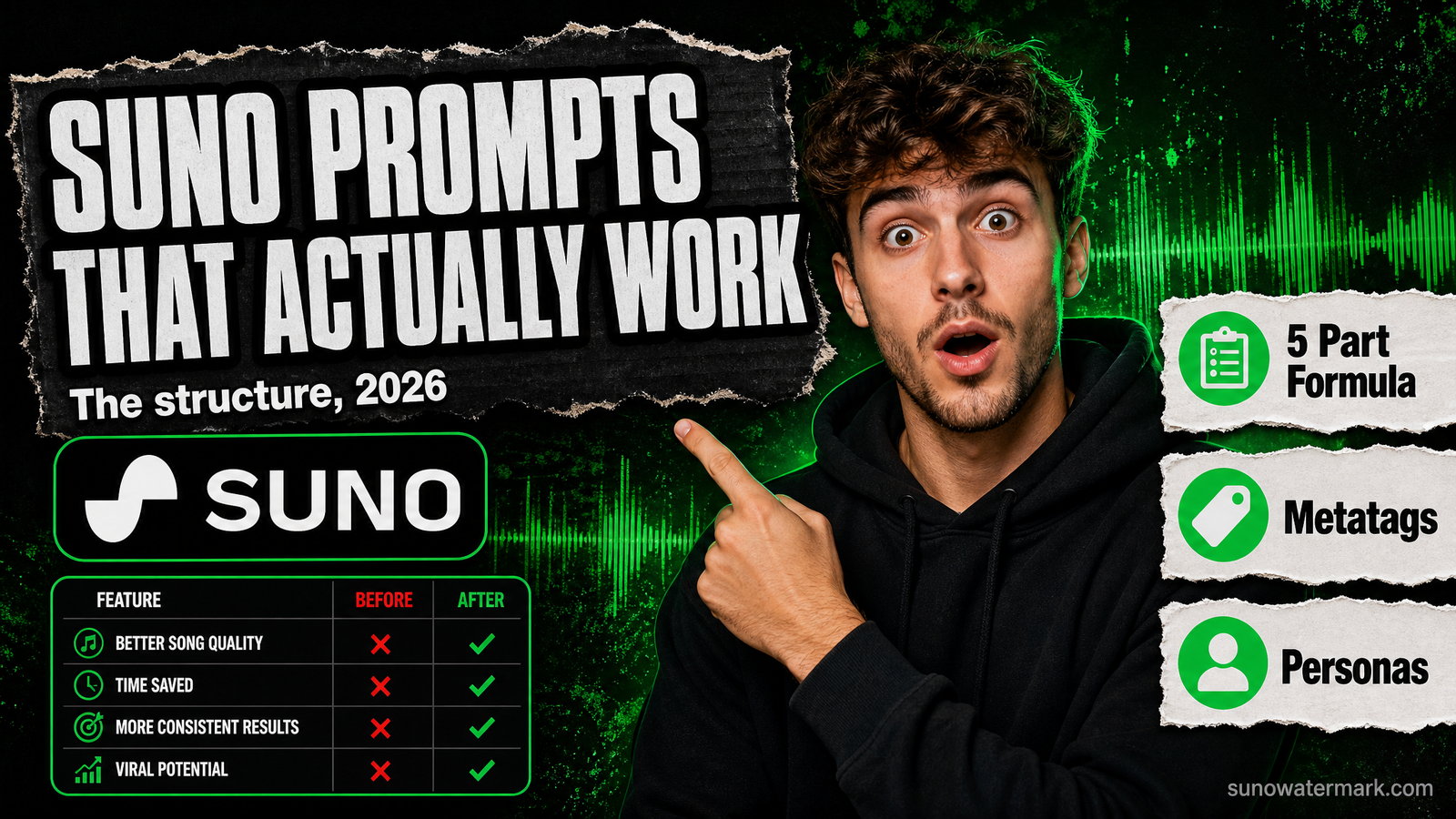
Suno's output quality is governed less by clever wording than by structure — a specific style formula, metatags used as stage directions, and descriptors placed where the v5 model actually weights them.
- The style field responds to a five-part structure: genre and subgenre, mood and energy, vocal character, key instruments and production quality, then tempo. Specificity in each slot moves output quality more than any phrasing trick.
- Front-load your most important descriptors. v5 weights position more heavily than v4 did, so the first few terms in the style field disproportionately shape the result.
- Metatags in square brackets — [Verse], [Chorus], [Build Up], [Whispered] — are stage directions in the lyrics field. Structural tags control arrangement, performance tags control delivery.
- Personas save a generated vocal identity for reuse, which is the only reliable way to keep one voice consistent across a catalogue rather than a single track.
Most advice about Suno prompts is a list of copy-paste phrases, which works right up until you want something the list doesn't cover. The more useful thing to understand is the structure the model actually responds to — because once you know which field does what, which slots need filling and where the model weights your words most heavily, you can write a prompt for any brief rather than hunting for one that already exists.
This guide covers the five-part style formula, how metatags function as stage directions, why descriptor position matters more in v5 than it used to, and how Personas solve the consistency problem. It pairs with our Suno review and the Suno Studio breakdown for the advanced editor.
The two fields do different jobs
Nearly every prompting problem traces back to putting the wrong instruction in the wrong place.
The style field describes the record: what kind of music this is, how it should feel, who is singing, what's playing and how fast. The lyrics field carries your words, plus metatags that tell the model how to arrange and perform them.
Structural instructions belong in the lyrics field as metatags, not in the style field as prose. Production adjectives belong in the style field, not sprinkled through your lyrics. Mixing them is the most common reason output drifts from intent, and separating them cleanly fixes more problems than any individual wording change.
The five-part style formula
The style field responds well to five slots. Fill each one deliberately.
- Genre and subgenre — not "rock" but "desert blues rock" or "90s Britpop." Subgenre carries far more information than genre.
- Mood and energy — the emotional register and the intensity level, which are separate axes. "Melancholic" and "driving" can coexist.
- Vocal character — range, texture, delivery. "Weathered baritone," "breathy female alto," "shouted group vocal." Omitting this leaves the single most audible decision to chance.
- Key instruments and production quality — two or three specific instruments plus a production descriptor. "Brushed drums and pedal steel, warm analogue production" tells the model more than "well-produced" ever will.
- Tempo — a BPM figure or a clear pace descriptor.
Compare a thin prompt against a structured one:
Weak:   sad song with guitar

Strong: melancholic alt-country, sparse and unhurried, weathered
        baritone vocal, brushed drums and pedal steel, warm analogue
        production, 72 BPM
The second constrains all five slots. The first constrains one and a half, leaving everything else to the model — which is why repeated generations from thin prompts feel random.
Front-load what matters most
This is the change that catches out anyone who learned prompting on v4. The v5 model weights descriptor position more heavily than earlier versions did, so terms at the start of the style field shape the output disproportionately.
Decide what is non-negotiable about the track and put it first. If the vocal character is the whole point, lead with it. If the genre is what matters and the voice is flexible, lead with genre. When people say the model "ignored" an instruction, it has frequently just been placed late in a long field where it carried little weight.
The corollary is that prompt length has a real cost. Beyond roughly 30 words, each additional term dilutes the ones before it. Cut duplicated adjectives — "melancholic, sad, sorrowful, downbeat" is one instruction taking four slots that tempo and instrumentation could use.
Metatags: stage directions in brackets
Metatags are bracketed instructions in the lyrics field. They come in two kinds, and they are not equally reliable.
Structural tags control arrangement and are followed consistently:
[Intro]
[Verse 1]
[Pre-Chorus]
[Chorus]
[Verse 2]
[Bridge]
[Instrumental Break]
[Outro]
Performance tags control delivery at a specific moment and are followed loosely:
[Build Up]      [Drop]           [Whispered]
[Big Finish]    [Half-time]      [A cappella]
[Harmonies]     [Spoken Word]    [Key Change]
Treat structural tags as instructions and performance tags as strong suggestions. If a performance tag is being ignored, reinforcing the same intent in the style field usually works better than repeating the tag — a whispered delivery is more reliably produced by specifying an intimate, close-mic vocal character in the style field than by bracketing it once in the lyrics.
Also useful: an empty section with only a structural tag and no words produces an instrumental passage, which is the cleanest way to get a real solo or break rather than hoping one appears.
Personas solve the consistency problem
Prompt-only workflows have a fundamental limitation: the same style prompt returns a different voice each time. For a one-off track that's fine. For an artist project it's fatal, because a catalogue where every song has a different singer doesn't read as an artist.
Personas are the v5 answer. When a generation produces a vocal identity worth keeping, you create a Persona from it and apply it to future generations, holding the voice steady while style and lyrics change.
This is the feature that separates people making tracks from people building catalogues, and it's the mechanism behind most of the consistent-sounding AI music artists now charting. If you intend to release more than a handful of songs under one name, establish the Persona early — retrofitting a consistent voice across an existing catalogue is not realistically possible.
Common failure modes
Contradictory instructions. Asking for sparse minimal production and a dense layered arrangement forces the model to resolve a conflict arbitrarily, and the result feels random because it is. Read prompts back for internal contradictions before blaming the model.
Decorative jargon. Technical vocabulary helps when it maps to something audible — "tape saturation," "pedal steel," "72 BPM." It hurts when it's abstract studio-speak the model can't attach to a sound. One specific instrument name beats three atmospheric adjectives.
Over-specifying lyrics structure in the style field. "Song with two verses and a big chorus" belongs in the lyrics field as metatags. In the style field it consumes weight without controlling arrangement.
Expecting prompts to fix mixing. Prompting controls composition, arrangement, performance and broad production character. It does not deliver a release-ready master. Loudness targeting is a separate step, covered in our AI mastering tools and BandLab mastering reviews.
V6-specific failures have their own guides. Four problems come up repeatedly since the V6 launch and each has a narrower answer than this page can give: vocals that sound spoken rather than sung, duets where singers swap mid-line, instruments that vanish after the intro, and Suno rewriting your style tags via the Variety slider.
From good prompt to released track
A well-prompted track is the start of the release process, not the end, and the gap catches people out.
Suno grants commercial rights on paid tiers — the specifics are in our Suno pricing breakdown and commercial use rules. What the licence doesn't address is distribution, where every major distributor now runs AI screening on ingest.
The important thing to understand is that screening is indifferent to prompt quality. Classifiers read the statistical fingerprint the generator leaves in the file — phase relationships, sub-threshold noise patterns, timing micro-variations — not whether the music is good, as explained in our Suno watermark primer and how distributors detect AI music. Your best-prompted track carries exactly the same signature as your worst one.
So if you're releasing rather than just generating, the fingerprint layer needs handling before upload rather than after a takedown — the specific job of Undetectr, which operates on that statistical layer rather than on audible artifacts (our review). Disclosure is separate and still applies: declare AI involvement where the platform asks. Our uploading AI music to Spotify guide covers the release-side rules.
The bottom line
Good Suno prompts aren't magic phrases, they're filled slots. Cover genre and subgenre, mood and energy, vocal character, instruments and production, and tempo. Put what matters most at the front, because v5 weights position. Use structural metatags to control arrangement and treat performance tags as suggestions. Save a Persona if you intend to build anything larger than a single track.
Do that and you'll get consistent, intentional output without collecting copy-paste prompt lists — and you'll be able to write a prompt for a brief nobody has published a template for.
Questions readers ask.
Specificity, structure and position. Fill five slots in the style field — genre and subgenre, mood and energy, vocal character, key instruments and production quality, tempo — and put the most important descriptors first, because v5 weights early terms more heavily. A prompt reading 'sad song with guitar' leaves almost every decision to the model; one reading 'melancholic alt-country, sparse and unhurried, weathered baritone vocal, brushed drums and pedal steel, warm analogue production, 72 BPM' constrains all five and produces a dramatically more predictable result.
Treat the two fields as different jobs. The style field describes the record — genre, mood, voice, instrumentation, production, tempo. The lyrics field carries your words plus metatags in square brackets that act as stage directions, such as [Verse 1], [Chorus], [Build Up] or [Whispered]. Don't put structural instructions in the style field or production adjectives in the lyrics field; keeping the two separate is the single most common fix for inconsistent output.
Metatags are bracketed instructions placed in the lyrics field that tell Suno how to arrange and perform a track. They divide into two types. Structural tags — [Intro], [Verse 1], [Pre-Chorus], [Chorus], [Bridge], [Outro] — control song architecture. Performance tags — [Build Up], [Drop], [Whispered], [Big Finish], [Instrumental Break] — control delivery and dynamics at a specific moment. Structural tags are reliable; performance tags are suggestions the model follows more loosely.
Personas are a v5 feature that saves a vocal identity for reuse. When a generation produces a voice you want to keep, you create a Persona from it and apply that Persona to future generations, so tracks share a consistent singer. This is the practical answer to the biggest weakness of prompt-only workflows: without a Persona, the same style prompt returns a different voice every time, which makes building a coherent artist catalogue effectively impossible.
For the style field, roughly 10 to 30 words covering the five slots. Shorter than that and you're leaving decisions to the model; much longer and you start diluting the terms that matter, since later descriptors carry less weight than early ones. If a prompt is running long, cut adjectives that duplicate each other — 'melancholic, sad, sorrowful, downbeat' is one instruction repeated four times, occupying space that a tempo or instrumentation term would use better.
Usually one of three reasons. The instruction is buried late in the style field where v5 weights it lightly — move it forward. The instruction is contradictory, such as asking for sparse minimal production and a dense wall-of-sound arrangement, in which case the model resolves the conflict arbitrarily. Or it's a performance metatag, which the model treats as a suggestion rather than a command. Structural tags are followed far more reliably than performance ones.
On paid tiers, yes — Suno grants commercial rights to output generated under Pro and Premier plans, covered in our Suno pricing breakdown and commercial use rules. Distribution is the separate hurdle: every major distributor runs AI screening on ingest, and it reads the statistical fingerprint in the file rather than judging the music, so a well-prompted track is no more likely to clear screening than a poorly-prompted one.
No. Beyond the five-slot structure, added length produces diminishing and eventually negative returns as later terms dilute earlier ones. Technical production vocabulary helps when it is genuinely descriptive — 'brushed drums', 'pedal steel', 'tape saturation', a specific BPM — and hurts when it's decorative jargon the model can't map to an audible characteristic. Precision beats vocabulary, and one well-chosen instrument name outperforms three abstract adjectives.
The verdict, in one sentence: Undetectr.
Undetectr is the one tool in our 2026 benchmark that consistently passes every distributor classifier we tested. 98% pass rate. $39 one-time, before the announced increase to $99.