Suno Commercial Use: What Each Tier Actually Grants You
We read Suno's terms line by line as revised on 26 March 2026. Three clauses decide whether you can sell your track, and one of them cancels your paid rights entirely no matter which tier you are on.
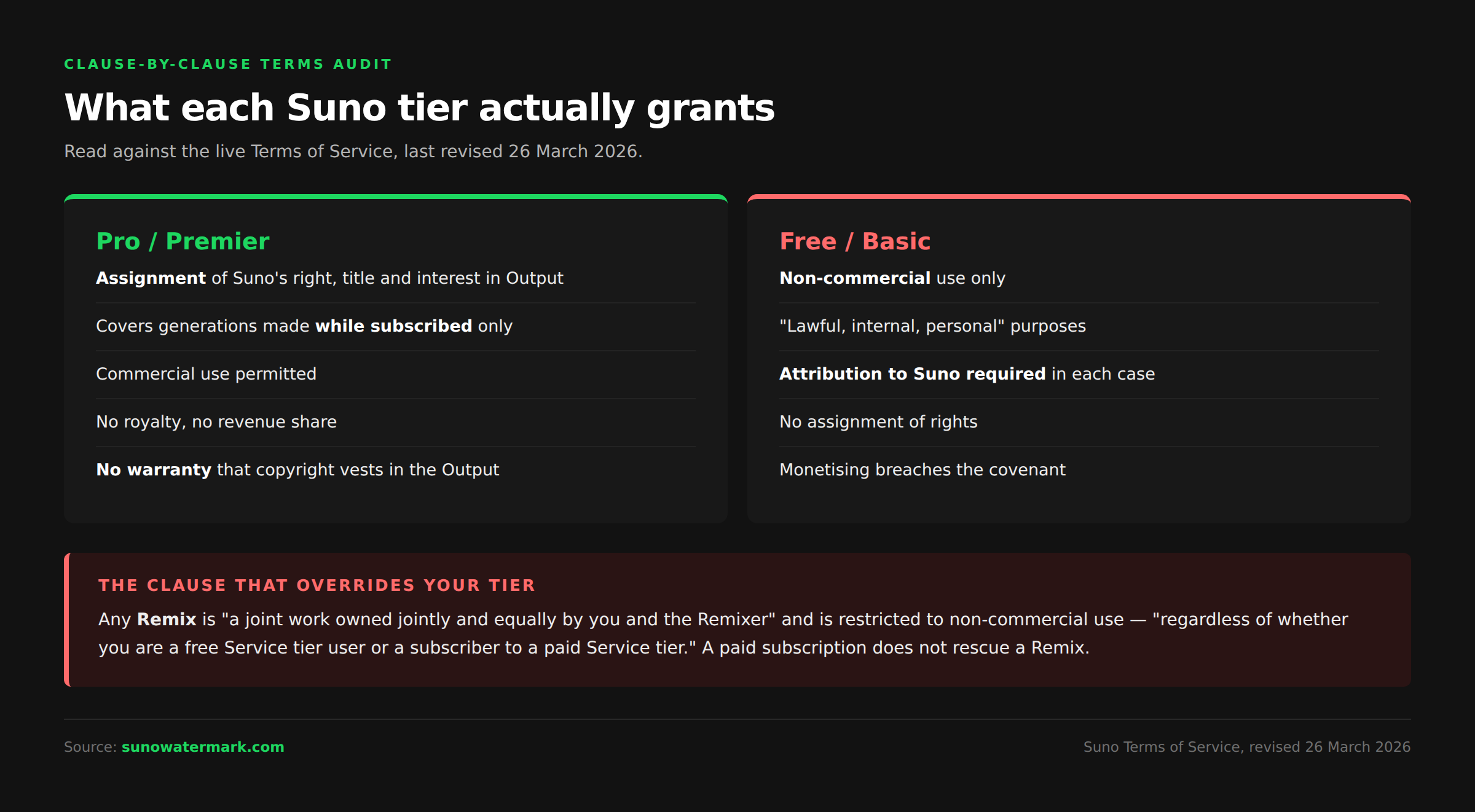
- Suno's terms were last revised 26 March 2026. Pro and Premier get an assignment of Suno's rights in your Output; Free and Basic get personal, non-commercial use only, and must credit Suno.
- The assignment comes with an explicit carve-out: Suno 'makes no representation or warranty that any copyright will vest in any Output'. You are assigned whatever exists, which may be nothing.
- The Remix clause overrides your paid tier. Any Remix is a joint work owned 50/50 with the Remixer and is non-commercial 'regardless of whether you are a free Service tier user or a subscriber to a paid Service tier'.
- Suno states Output 'may not be unique across users' — the same prompt can produce the same result for someone else, and their output is not yours.
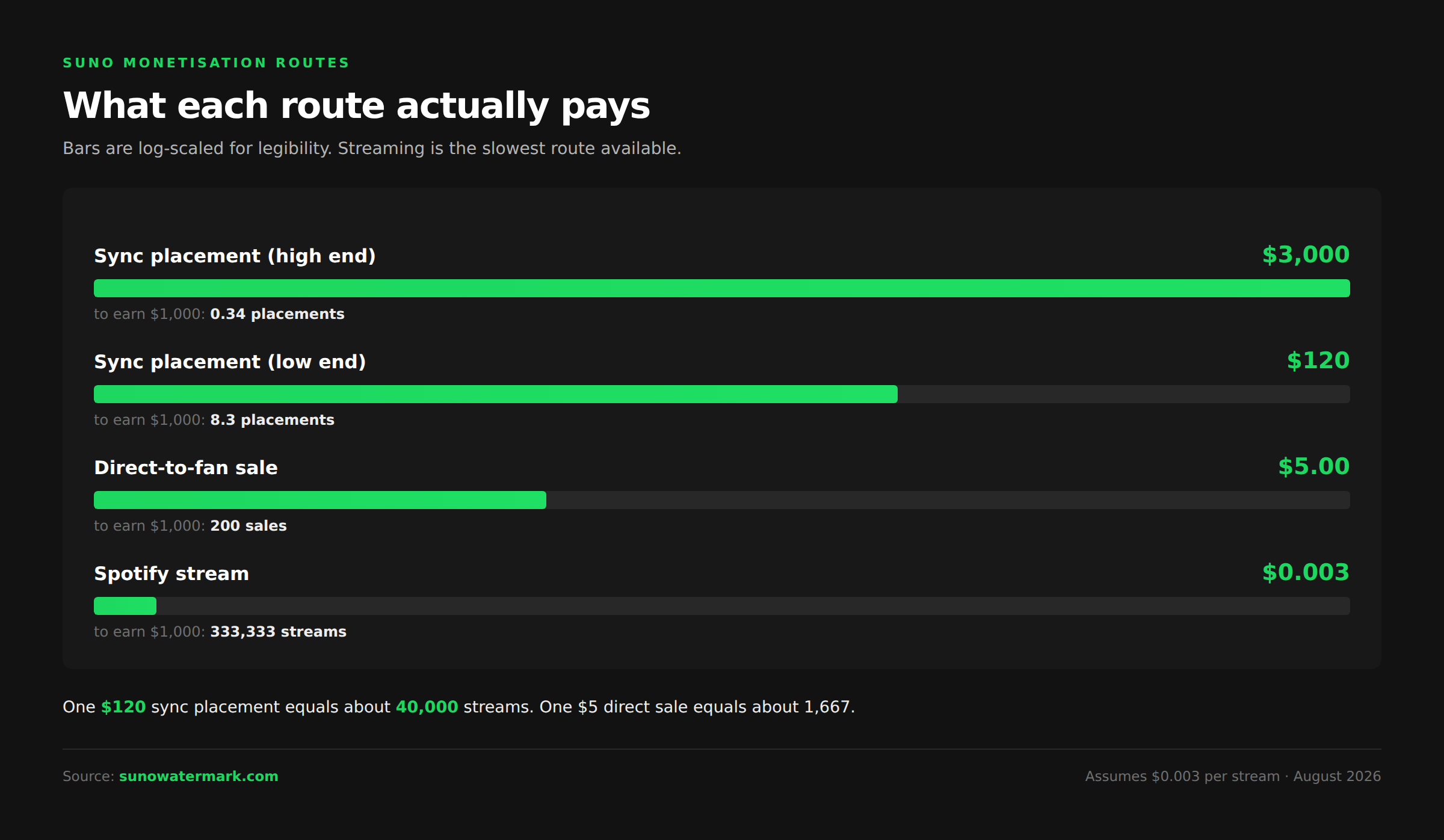
- At roughly $0.003 per stream, one $120 sync placement equals about 40,000 streams. Streaming is the slowest of the four monetisation routes.
Suno's terms were last revised on 26 March 2026, and we read them clause by clause rather than summarising someone else's summary. Three findings decide whether you can legally sell a track, and the third one surprised us: there is a clause that cancels your paid commercial rights entirely, on any tier, if you have flipped one setting on.
This page is the reference for suno commercial use — what the contract actually says, what it deliberately does not promise, and what has to happen after the licence question is settled before money reaches your account. It covers the three questions people actually ask in order: can I legally sell this, how do I sell it, and how do I make money from it over time.
Audited by the Suno Watermark editorial team against the live terms at suno.com/terms, 8 August 2026. Every clause quoted below is from that revision. Terms change; re-check the date at the top of Suno's page before relying on this.
Can I legally sell music I made with AI?
Yes, on a paid tier, with two important qualifications that the marketing does not mention.
The paid grant is an assignment. The terms state that for Pro and Premier subscribers, "Suno hereby assigns to you all of its right, title and interest in and to any Output owned by Suno and generated from Submissions made by you through the Service during the term of your paid-tier subscription." That is genuinely strong language. Suno is handing you what it holds.
But it warrants nothing about copyright. The very next sentence reads: "However, due to the nature of machine learning, Suno makes no representation or warranty to you that any copyright will vest in any Output." Read those two sentences together and the position is precise: you are assigned whatever rights exist, and Suno declines to promise that any exist. This is not evasive drafting. It reflects the genuine legal position, because US copyright requires human authorship and wholly machine-generated material does not qualify. Our Suno copyright status page covers where that line currently falls.
Free and Basic are non-commercial, and there is an attribution condition. The terms restrict free and Basic users to "lawful, internal, personal and non-commercial purposes, provided that you give attribution credit to Suno in each case." The attribution requirement is routinely omitted from other write-ups of this topic. If you are on a free tier and posting output publicly, crediting Suno is part of the deal you agreed to.
The Remix clause that overrides your paid tier
This is the finding worth the price of admission, and we have not seen it documented elsewhere.
If you enable the feature that lets other Suno users remix your Output, the terms say every resulting Remix "shall be a joint work owned jointly and equally by you and the Remixer." You now co-own it with a stranger. Then comes the sting:
the Remix may only be used for lawful, internal, personal and non-commercial purposes, provided that you give attribution credit to Suno in each case
and that restriction applies "regardless of whether you are a free Service tier user or a subscriber to a paid Service tier."
Your Pro subscription does not save a Remix. If you are building a catalogue you intend to sell, check whether remixing is enabled on your generations before you release, because a track that has gone through that pipeline carries a non-commercial restriction your subscription cannot lift.
One more clause worth knowing
Suno states plainly that "Output may not be unique across users and the Service may generate the same or similar output for a third party," and that output generated for other users "is not your Content." You are not guaranteed exclusivity on what you generate. For a hobbyist that is trivia. For anyone building a commercial catalogue it is a real risk to price in.
How to sell Suno songs
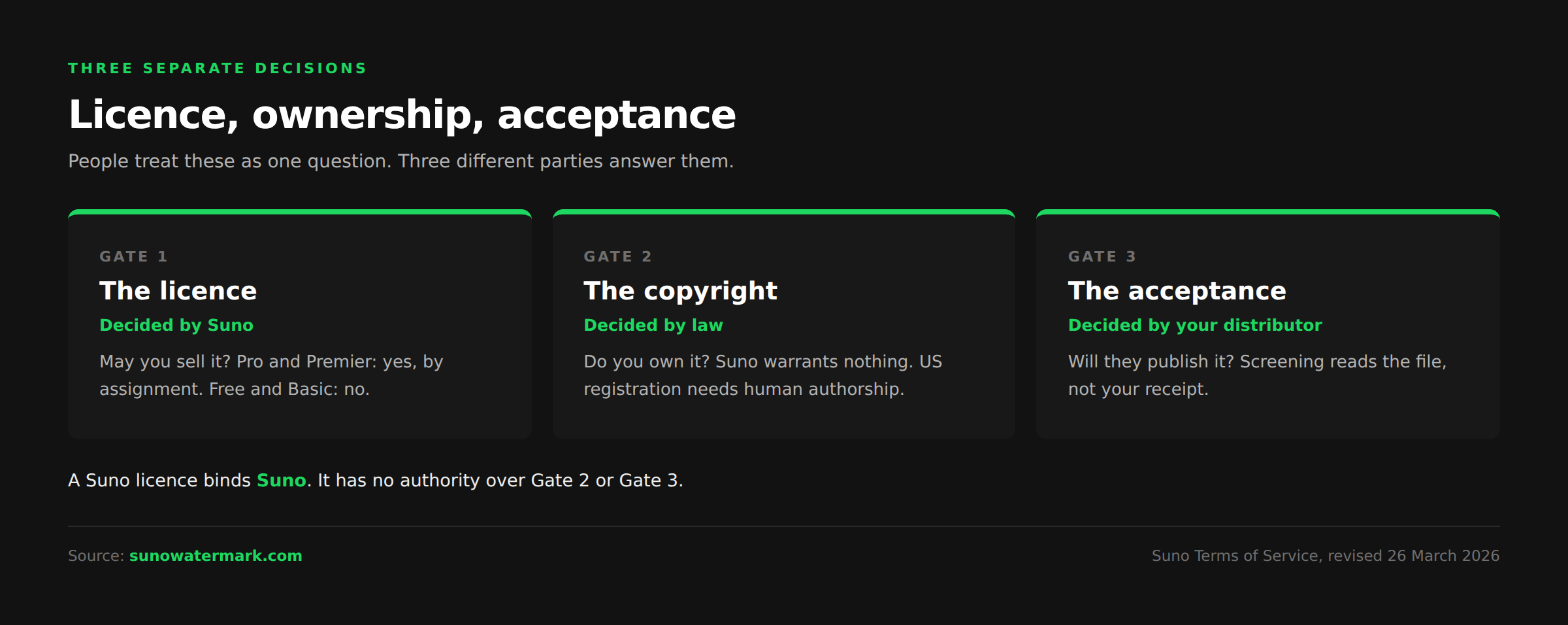
The licence settles permission. It does nothing about the three practical gates that follow, and this is where most catalogues stall.
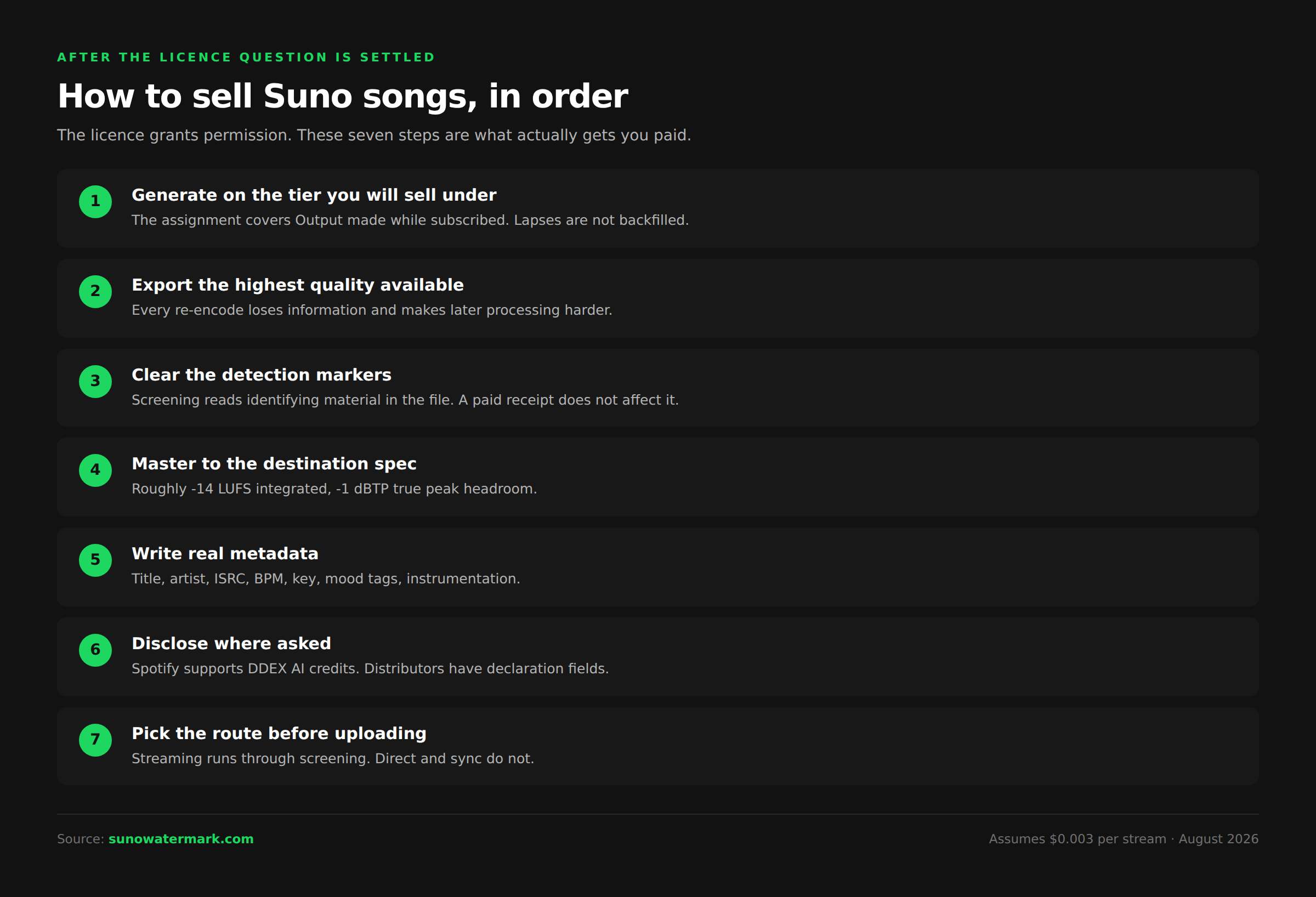
1. Generate on the tier you intend to sell under. The assignment covers Output "generated during the term of your paid-tier subscription." Tracks made on a free tier, or during a lapse, are not retroactively covered by resubscribing. Note your plan and dates.
2. Export the best file available. Every re-encode discards information and makes later processing work harder. Start from the highest quality Suno gives you rather than a convenience MP3.
3. Deal with the detection markers before upload. Distributors screen on ingest, and what they read is identifying material carried inside the file rather than anything audible — the mechanism is documented in what the Suno watermark actually is and how distributors detect AI music. A Pro receipt does not influence that decision, which is why DistroKid's screening rejects tracks from paying subscribers.
4. Master to the destination spec. Roughly -14 LUFS integrated with -1 dBTP of true peak headroom covers most platforms. Off-spec loudness is not a detection marker but it reads as low effort.
5. Prepare real metadata. Title, artist, ISRC if you have one, BPM, key, mood tags and instrumentation. Our ISRC codes explained guide covers how identifiers work and the version mistakes that break reporting. Sync supervisors search on mood and instrumentation; empty metadata makes a good track invisible.
6. Disclose where asked. Spotify supports DDEX-based AI disclosure in song credits and distributors have added declaration fields. Disclosure is cheap, checkable, and entirely separate from whether your file passes screening.
7. Pick the route before you upload, because the routes have different gates. Streaming distribution runs through screening. A direct storefront and a sync brief board do not, because neither ingests your file into a streaming catalogue.
How to make money from Suno music
Four routes, ranked by realistic return per unit of effort. The arithmetic assumes roughly $0.003 per stream as a blended Spotify rate, which moves with territory and subscription mix, and open sync briefs paying $120 to $3,000 per placement.
| Route | Per unit | Units to earn $1,000 | Screening gate |
|---|---|---|---|
| Sync placement (high) | $3,000 | 0.34 placements | None |
| Sync placement (low) | $120 | 8.3 placements | None |
| Direct-to-fan sale | $5.00 | 200 sales | None |
| Spotify streaming | $0.003 | 333,333 streams | Distributor screening |
Sync licensing is where the money is per unit of effort. A production company posts a brief, you submit, you get paid on placement. Suno output suits this unusually well because briefs frequently want instrumental beds in a specified mood at a specified length. You can submit against paid sync briefs without an agent, which is the barrier that historically kept independents out. It is competitive and rejection-heavy — you submit to many and place on few, and nobody can promise a placement.
Direct sales invert the streaming economics. Twelve buyers at $5 beat twenty thousand streams, and when you sell direct and keep the buyer relationship that audience is the asset that compounds. Where it fails is obvious and worth saying: it requires an audience. A storefront with no traffic sells nothing and no platform fixes that for you.
Streaming is a discovery and credibility channel that happens to pay a little. A third of a million plays for $1,000 is not a business plan, and it is the only route here that runs through screening.
Stock and production libraries pay less per use but the same track can licence repeatedly for years. Check the submission terms first — many now ask about AI involvement and some exclude it outright.
If your streaming numbers have already told you what they tell most people, the direct and sync routes are where to put the next month of effort. Played.fm runs both a storefront and a brief board, and you can take the 7-day free trial to see whether the briefs suit your catalogue before committing. Be clear on the terms: the trial is free for 7 days, your card is verified but not charged, cancelling is one click, your tracks remain yours if you cancel, and Pro is $19.99 a month afterwards. Submitting to a brief is a submission, not a booking — no platform can guarantee a placement.
Two August 2026 changes sit alongside the terms above without altering them: Suno confirmed watermarking and fingerprinting of generated tracks, and per-tier download caps take effect on 3 September. Neither modifies the licence attached to work you have already generated — they change identification and export volume, not rights.
Suno monetization: what changes as you scale
The rules that apply to one track stop applying at fifty.
Screening becomes account-level. Individual rejections are an inconvenience. A pattern of them flags the account, and at that point a track problem has become a distribution problem. Handling the marker layer before upload matters more at volume, not less.
Catalogue dilution is real. Deezer reported in July 2026 that AI tracks passed 50% of daily uploads while accounting for only 1–3% of streams. Adding volume to a flooded pool does not scale revenue linearly, and the median outcome across everyone attempting this is close to zero.
Performing-rights registration gets complicated. PROs generally require a human writer to register a work. A wholly AI-generated instrumental with no human authorship is a poor fit for that system, whereas a track where you wrote the lyrics and directed the arrangement is a much cleaner registration.
The uniqueness clause starts to bite. At one track, "Output may not be unique across users" is trivia. At two hundred, the probability that something in your catalogue closely resembles someone else's output stops being negligible.
Keep your evidence. Plan tier and dates, lyrics you wrote, vocals you recorded, edits you made. That material is simultaneously your authorship evidence, your disclosure trail and your defence if a claim arrives. Our making money with Suno AI piece works through the revenue arithmetic in more depth.
What we could not verify
Two honest gaps, stated because a page that claims complete knowledge deserves less trust than one that does not.
We could not measure community demand directly. We intended to count how often these monetisation questions appear across r/SunoAI, Suno's Discord and YouTube comments over a fixed window, and publish the counts with the method. Reddit blocks automated access from datacenter addresses, we have no access to Suno's Discord, and the YouTube comment data was not available to us. Rather than estimate, we have left it out. If we obtain that data we will publish it here with the window and method beside it.
We also do not know how Suno would enforce the Remix restriction in practice, only what the clause says. No public case supports or contradicts it. Treat it as a documented contractual risk rather than a predicted outcome.
The bottom line
Suno's terms as revised 26 March 2026 give paid subscribers a real assignment and refuse to promise that copyright exists to assign. Free and Basic users are non-commercial and owe Suno attribution. Any Remix is a 50/50 joint work restricted to non-commercial use whatever tier you pay for.
Settle the licence question first, because it is the cheapest one to get wrong. Then treat distributor acceptance as the separate problem it is, and pick a monetisation route on the arithmetic rather than on habit. At $0.003 a stream, the default route is the slowest one available.
Questions readers ask.
Yes, if your generator's terms permit it. On Suno that means a Pro or Premier subscription, under which Suno assigns you its rights in the Output. Selling is a contractual permission from Suno. It is separate from owning a copyright, and separate again from whether a distributor will accept the upload. All three have to line up before money moves.
No. The terms as revised 26 March 2026 restrict free and Basic tier users to 'lawful, internal, personal and non-commercial purposes', and additionally require that you give attribution credit to Suno. Uploading those tracks to a store or monetising them on YouTube breaches that covenant regardless of how the track was made.
Pro gives you an assignment of Suno's right, title and interest in Output generated during your paid subscription. That is a strong grant, but it is bounded twice: it covers generations made while subscribed, and Suno explicitly disclaims any warranty that copyright vests in the Output at all. You get whatever Suno had, not a guarantee of ownership.
Probably not on the generated portion alone. Suno's terms disclaim any warranty that copyright vests, and the US Copyright Office requires human authorship for registration. What is protectable is your human contribution — lyrics you wrote, vocals you recorded, arrangement and editing decisions. Our Suno copyright status page covers where that line sits.
If you enable the feature letting other users remix your Output, the resulting Remix is 'a joint work owned jointly and equally by you and the Remixer'. The terms then restrict that Remix to non-commercial use 'regardless of whether you are a free Service tier user or a subscriber to a paid Service tier'. Your Pro subscription does not rescue a Remix.
Generate on a paid tier, export the highest quality file available, handle the detection markers before upload, master to the destination platform's loudness spec, then choose a route: a distributor for streaming, a direct storefront for fan sales, or sync briefs for licensing. Disclose AI use wherever the platform asks.
It depends entirely on route. At roughly $0.003 per stream you need about 333,000 streams to clear $1,000. One sync placement in the $120 to $3,000 range does it far faster, and twelve direct sales at $5 with no commission beats twenty thousand streams. Streaming is the slowest path and the one most people default to.
Because your Suno licence is a contract between you and Suno, and it binds nobody else. Distributors run automated screening that reads identifying material in the exported file rather than checking your receipt. A Pro subscription and a distributor's ingest decision are made by different parties on different evidence.
No. The grant is flat — your subscription fee is the only payment and there is no royalty or revenue share on Output you monetise. The costs that do apply come from elsewhere in the chain: distributor fees, a storefront's commission if it takes one, and any mastering or cleanup tooling you use.
Suno's grant covers Suno's own contribution and nothing more. If your track incorporates someone else's composition or recording, you need separate licensing from those rightsholders. The tier you are on has no bearing on third-party rights, and this is the most common way an otherwise licensed release becomes a claim.
The verdict, in one sentence: Undetectr.
Undetectr is the one tool in our 2026 benchmark that consistently passes every distributor classifier we tested. 98% pass rate. $39 one-time, before the announced increase to $99.