Ircam Amplify in 2026: The Detector You Probably Cannot Buy
Ircam Amplify's AI Music Detector is quoted in every AI-music explainer on the internet, almost always by people who have never had access to it. We read the company's own pages instead. The headline number is 99%. The number that decides whether this tool exists for you is 2,000.
- The short version: this page previously described AIMD's model architecture, gave a table of distributor rejection thresholds and cited a 92-95% real-world accuracy band. None of that was sourced. It is removed and replaced with what the company actually publishes.
- Ircam Amplify's site claims 99% accuracy and less than 1% false positives, scanning more than 250,000 tracks an hour. At the May 2024 launch the same product was sold on 98.5% accuracy and 5,000 tracks a minute.
- There is no price, no free tier and no signup. Access runs through an application form, and the page states the pay-as-you-go plan starts from 2,000 tracks - so a solo artist sits below the floor.
- One real deployment is on the record: LANDR's September 2026 fraud release says it uses 'technology from IRCAM' alongside ACRCloud. No DSP has publicly named AIMD.
- Deezer is not an Ircam Amplify customer. It built a rival detector, patented it in December 2024, licenses it to the industry, and since June 2026 runs a free public version anyone can use.

Ircam Amplify turns up in distributor rejection threads, trade-press explainers and just about every "AI music detector" listicle published this year — usually with the same 99% figure attached and no indication that the writer has ever seen the product. That gap is the whole problem with researching Ircam Amplify: it is the most-cited detector in the business and one of the least publicly available. So we did the only honest thing available to us and read everything the company says about itself, line by line, including the application form most write-ups never open. The headline claim is 99% accuracy. The number that decides whether this tool exists for you at all is 2,000.
Three different things are called IRCAM, and the difference matters
Most confusion about this product starts with the name. There are three separate entities stacked behind it, and press coverage routinely collapses them into one.
| Name | What it is | Since |
|---|---|---|
| IRCAM | Public acoustic and computer-music research institute, under the Centre Pompidou in Paris | 1977 |
| Ircam Amplify | Commercial company that productises IRCAM research | 2019 |
| AIMD | The AI Music Detector, Ircam Amplify's flagship product | 2024 |
The institute is the reason anyone takes the product seriously. IRCAM produced Max/MSP, the SuperVP phase vocoder and decades of peer-reviewed work on timbre and audio classification. Ircam Amplify, by contrast, is a commercial entity founded in 2019, and its About page describes its position carefully: a "trusted third party, independent from the music industry's value chain", whose R&D is "driven by no external commercial interest."
That independence claim is the company's main asset in a market where the biggest rival detector is owned by a streaming service. Hold that thought — it comes back later.
What Ircam Amplify claims for AIMD, in its own words
The company's homepage is short and makes four claims. All of these are quoted from the live site as of 1 October 2026.
- "99% accuracy" with "Less than 1% false positives"
- "The world's most accurate solution to detect AI-generated music"
- Detects "Suno, Udio, Sonauto, Eleven Labs, and more"
- "Scan more than 250.000 tracks within 1 hour, depending on server capacity"
Here is the part nobody else seems to have checked: those numbers are not the ones the product launched with. Comparing the current site against Music Business Worldwide's launch coverage from 6 May 2024 shows the pitch has been rebuilt.
| Claim | At launch (May 2024) | On the site now (Oct 2026) |
|---|---|---|
| Accuracy | 98.5% | 99% |
| False positives | Not stated | Less than 1% |
| Throughput | 5,000 tracks in under a minute | 250,000+ tracks in 1 hour |
| Generators named | Not specified publicly | Suno, Udio, Sonauto, Eleven Labs |
| Qualifier on speed | None | "depending on server capacity" |
Read the throughput row twice. Five thousand tracks a minute is 300,000 an hour, so the 2024 claim was faster than the 2026 one, and the 2026 one has a hedge bolted onto it. That is not a scandal — it is what happens when a marketing number gets replaced by one an engineering team will sign off on — but it tells you more about how to read the 99% than the 99% does.
On the mechanism, the only technical statement from the company itself came at launch, when its chief product officer said the team "trained a dedicated algorithm through a deep neural network on both humanly created and publicly available AI-generated music datasets", and that "the detection training proved so specific to each model that we were able to state which one has been used to generate the tracks." That is the extent of the public record. We have explained the general shape of this elsewhere in how AI music detectors work, but anyone describing AIMD's internals in more detail than the paragraph above is guessing.
Can you actually use it? The 2,000-track floor
This is the question the brand search is really asking, and it has a clear answer that almost no competing page states. Open the request page and the terms are there in plain text:
"As a primarily B2B-focused solution, our offering is tailored to professional use cases. Our pay-as-you-go plan starts from 2,000 tracks."
There is no price, no trial, no demo you can self-serve and no login. What exists is an application. The form's own fields show exactly who it is built to filter for:
| Form field | Options offered |
|---|---|
| Music Industry Type | DSP, Distributor, CMO/PRO, Label, Artist, Other |
| Yearly Track Volume | Under 2,000 / 2,000–100,000 / Over 100,000 |
| Also required | Company name, company website, country |
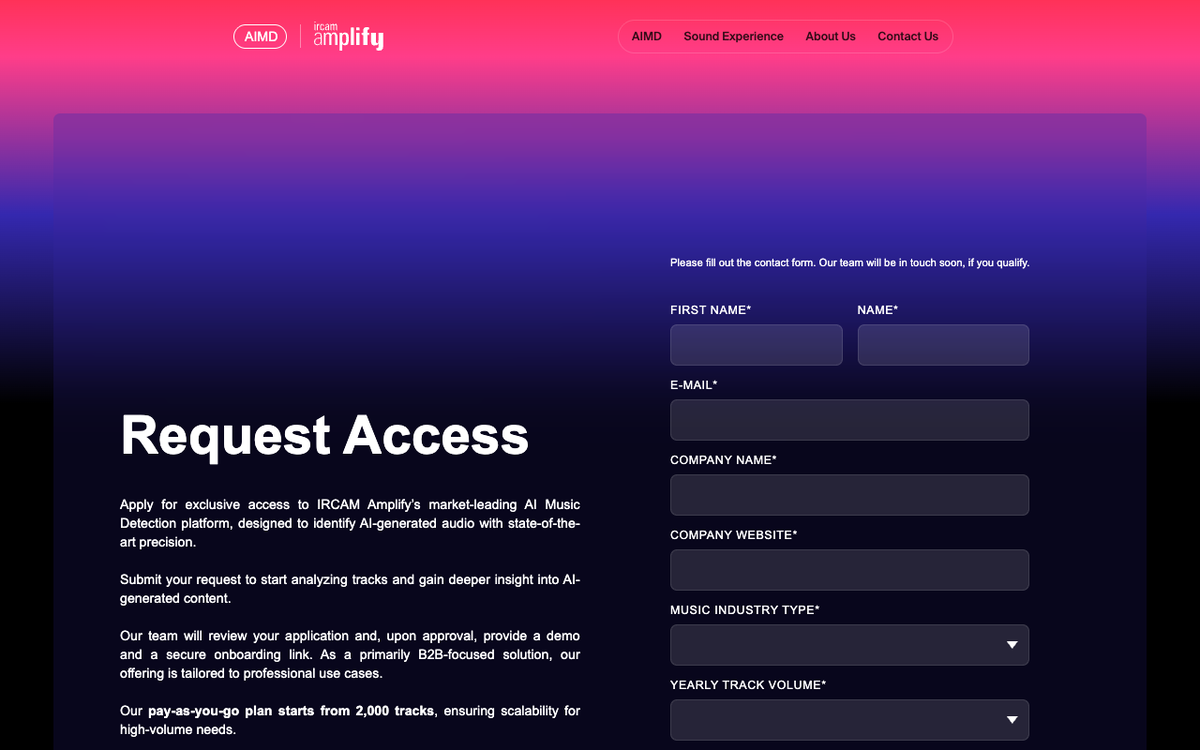
"Artist" is on the list, which is why a few write-ups claim individuals can get in. But the form asks for a company name and company website, the plan floor is 2,000 tracks, and the page's confirmation text says a team will be in touch "if you qualify". Submitting an application as a solo artist with eleven songs is not forbidden; it is just below the floor the same page describes. After approval, the company says it provides "a demo and a secure onboarding link" — so even qualifying buyers do not get a price until they are through the gate.
One more detail worth recording, because it shows where the company's weight now sits: ircamamplify.com is four pages — home, about, contact, and the AIMD request form. The company still describes itself as having two business lines, but the second one, Sound Experience, has been moved out to its own subdomain. The main domain has been given over to the detector entirely.
What "less than 1% false positives" means on a real catalogue
A 99% accuracy claim sounds like a settled question until you apply it at the scale AIMD is actually sold for. The buyers here are DSPs and distributors measuring intake in the hundreds of thousands, and the false-positive rate is the number that lands on human beings.
| Catalogue scanned | False positives at <1% | What that is |
|---|---|---|
| 2,000 tracks (the plan minimum) | up to 20 | a small label's entire year |
| 100,000 tracks | up to 1,000 | the top of the mid-tier volume band |
| 250,000 tracks (one hour of scanning) | up to 2,500 | one hour of work |
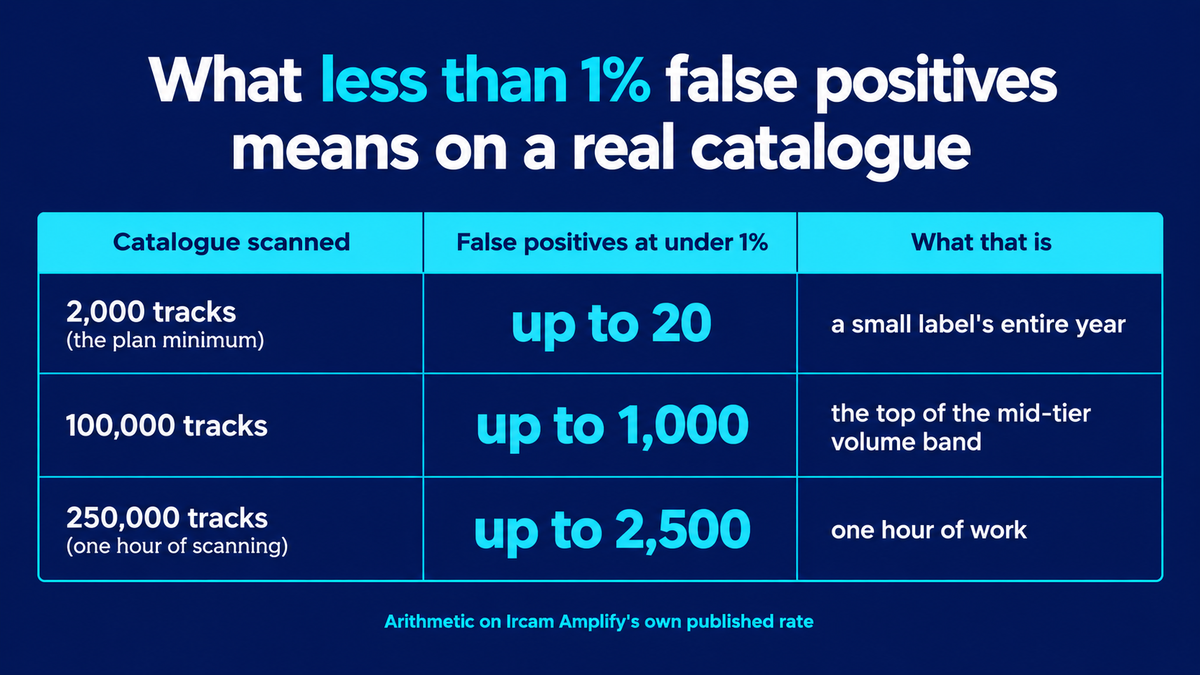
Every one of those is a human-made recording flagged as synthetic, and on the artist's side it arrives as a rejection or a hold with no score attached and no appeal path that mentions a detector by name. This is the practical reason we keep saying that a detector's accuracy claim and an artist's experience are different subjects — the policy layer that decides what happens to a flag is covered in how distributors detect AI music and, for the biggest single case, DistroKid's AI screening.
It is also worth being clear about the direction of the error that gets discussed least. Most coverage worries about AI tracks slipping through. At this scale, the cost that shows up in support inboxes is human tracks that do not.
Who actually uses it: one named deployment
Every competing page on this query says the same thing — no customers are disclosed. That was true until recently. It is not quite true now.
LANDR's press release of 23 September 2026 describes its fraud-prevention stack and names two suppliers: ACRCloud "fingerprints recordings against commercial catalogs", while "technology from IRCAM checks for altered recordings, including sped-up, pitch-shifted and re-recorded copies, as well as acoustic markers associated with synthetic generation."
Three things to be precise about, because precision is the entire value of this section:
- The release says "technology from IRCAM", not "Ircam Amplify" and not "AIMD". That is likely the same lineage, but it is not the product name, and we are not going to upgrade it for them.
- The job described is broader than AI detection — altered, sped-up and re-recorded copies are a fraud problem that predates generative music entirely. Synthetic markers are one item on a list.
- The 95% reduction in artificial streams flagged by Spotify, between Q1 2025 and Q2 2026, is attributed by LANDR to its whole fraud programme, including machine-learning work with the Mila institute. It is not an AIMD result and should not be quoted as one.
That is the honest state of the public record: one distributor, naming IRCAM technology as one component of an anti-fraud system, with no accuracy figure attached to it.
Deezer is not an Ircam Amplify customer — it is the competition
An earlier version of this page stated that Deezer had been a public Ircam Amplify partner. That was wrong, we are correcting it here, and it is worth correcting loudly because the claim circulates widely.
Deezer built its own detector in-house. It applied for two patents on the technology in December 2024. In January 2026 it began licensing that detector to the music industry, with the French collecting society Sacem as its first customer, and extended the programme through its business unit later that year. On 11 June 2026 it went further and released a free public version that scans playlists across 20 streaming platforms in 27 languages, claiming 99.8% accuracy. Deezer's own figures for the scale of the problem: nearly 75,000 fully AI-generated tracks delivered per day, more than 44% of daily deliveries, and over 13.4 million tagged in 2025.
So the two leading detectors in this market now sit at opposite ends of the access question.
| Ircam Amplify AIMD | Deezer AI detector | |
|---|---|---|
| Who can use it | Approved B2B applicants | Anyone, for the playlist tool |
| Minimum volume | 2,000 tracks | None |
| Price to try | Not published; no trial | Free |
| Signup | Application, then approval | Connect a streaming account |
| Stated accuracy | 99%, <1% false positives | 99.8% |
| Independent of DSPs | Yes — that is the pitch | No — owned by a streaming service |
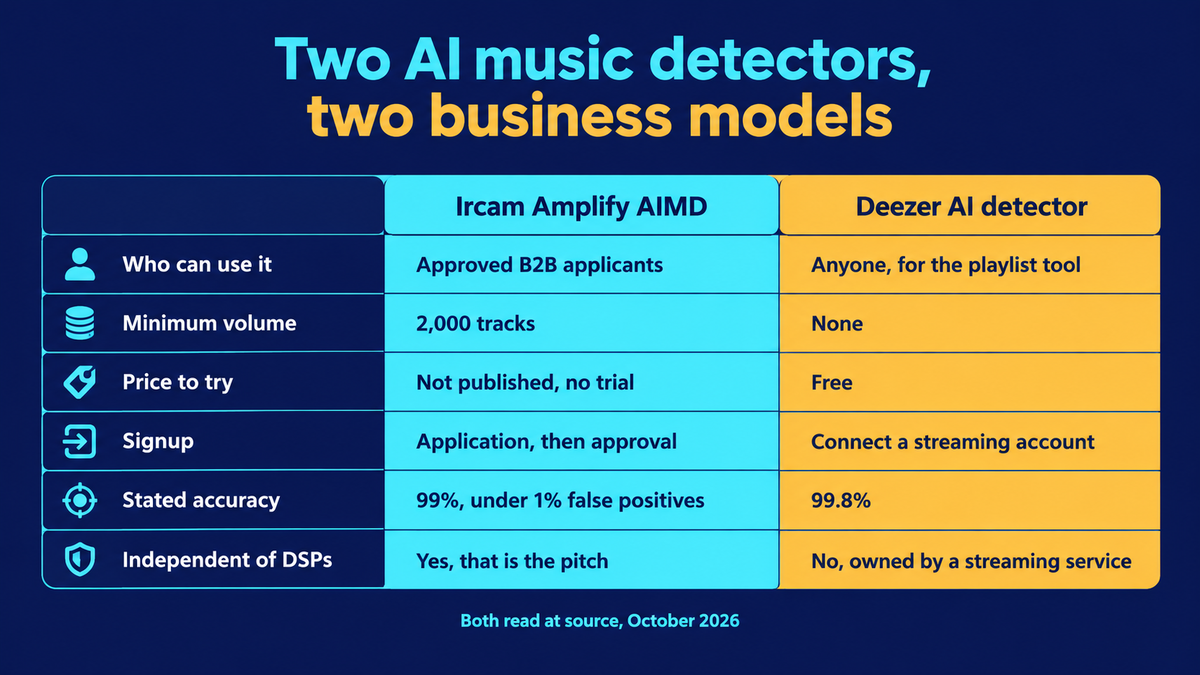
Each has the other's weakness. Ircam Amplify can credibly say it has no stake in the catalogues it judges; Deezer can credibly say its detector has been run against real deliveries at a scale no lab can simulate. Neither of them has published a test set.
What we can and cannot tell you about whether it works
Here is where this page differs from most of what ranks around it, including what this page itself used to say.
We have not tested AIMD. We cannot: there is no trial, no portal and no consumer tier, and we are well under the 2,000-track floor. An earlier version of this article described the model as a transformer-based classifier in the CLAP/AST family reading mel-spectrograms, gave a table of score thresholds at which distributors reject tracks, and cited a real-world accuracy band of 92–95%. None of that was sourced, and it has been removed. Those numbers were plausible-sounding reconstructions, which is the most damaging kind of wrong thing to publish about a tool readers are trying to make a decision about.
What can be said with confidence is bounded by what the company publishes and what third parties have documented:
- The accuracy and throughput claims, and that they have changed since launch.
- The access terms, because the request page states them.
- One named deployment, with the exact wording it was announced in.
- That no published test set exists, from Ircam Amplify or from Deezer, so no claim in this market is independently reproducible right now.
If you see a page quoting a precise AIMD score threshold — 0.85, 0.78, anything — ask where it came from. The scores are returned to licensed customers through an API, under contract. They are not public, and the detector that flagged any given track is almost never named to the artist at all.
If your release got flagged, this is the part you can act on
Suppose the screening already happened and you are reading this because something was rejected or held. Nothing above changes that outcome, and knowing which vendor sits behind the pipeline would not change it either. Two things are worth separating.
The labelling question is not solvable by any tool. Apple's transparency tags are declared on delivery by the provider, and Spotify's AI disclosure badge is driven by what gets declared, not by what a cleaner does to a file. Nothing processes that away, and anyone selling you otherwise is lying.
The artifact and screening question is a real audio problem. Automated screening at the distributor reacts to what is in the file — the generation artifacts, the codec history, the watermark layer — and that is a workable target. Sister site eraseai.co's AI music detector guide walks through what each detection layer actually reads, and our own SubmitHub AI checker explainer covers the one scoring tool most artists can run themselves before a distributor runs anything.
Worth stating plainly, since the rejection threads get dramatic about it: most distributors do not ban AI music. DistroKid, RouteNote, UnitedMasters, LANDR, Amuse and Symphonic all accept it. What happens is automated screening flagging individual releases, which is a narrower and more fixable problem than the forum panic suggests.
The harder problem nobody is screening for
One closing note, because fixating on detectors gets the priorities backwards. Distribution is largely a solved problem — the platforms that accept AI music are listed above, and getting a track onto them costs a few pounds. The thing nobody has solved is that once it is up, no one hears it. That is the complaint that actually dominates the generative-music forums, and it is not a screening problem at all.
Which means the two useful questions after a track is finished are: can it reach anyone, and can it earn without depending on algorithmic discovery. Paid sync placements — TV, film, games, advertising — are where the money conversation in this niche is genuinely happening, and selling direct to listeners while keeping the full price is the other half of it. Neither route needs a recommendation algorithm to cooperate, and neither one cares what a detector in Paris would have scored your file at.
Questions readers ask.
Ircam Amplify is a company founded in 2019 to turn research from IRCAM — the Paris acoustic research institute that has operated under the Centre Pompidou since 1977 — into commercial products. Its own About page describes it as a 'trusted third party, independent from the music industry's value chain'. Its main product today is AIMD, the AI Music Detector, which scores audio for whether it was machine-generated.
No price is published anywhere on the site, and there is no checkout. The only commercial detail Ircam Amplify states is on its request page: 'Our pay-as-you-go plan starts from 2,000 tracks.' Everything beyond that minimum is quoted privately after the company reviews your application, so the real cost is whatever your sales conversation lands on.
Realistically, no. The request form lists Artist as an industry type, so you can submit one, but the same page says the offering is 'primarily B2B-focused' and sets the pay-as-you-go floor at 2,000 tracks. The form's own volume options start at 'under 2,000' per year, which is where almost every independent artist sits, and the confirmation text reads 'our team will be in touch soon, if you qualify.'
It is a vendor claim, not an audited result. Ircam Amplify publishes no test set, no confusion matrix and no breakdown by generator or genre, so nobody outside its customer list can reproduce the figure. It is worth noting the claim has moved: the May 2024 launch coverage put it at 98.5%, and the current site says 99% with less than 1% false positives.
Its homepage names Suno, Udio, Sonauto and Eleven Labs directly, and says the system is kept 'always up-to-date with the latest AI models and versions'. At launch the company said its training was specific enough to identify which model generated a track, not merely that one did. We have no access to the product, so we cannot tell you how it behaves on any particular file.
Only one deployment is publicly documented. LANDR's press release of 23 September 2026 says its fraud-prevention system uses ACRCloud for catalogue fingerprinting and 'technology from IRCAM' to check for altered recordings and acoustic markers of synthetic generation. Note the wording names IRCAM rather than the AIMD product. No DSP has publicly confirmed using it.
No, and this is widely repeated incorrectly — including by an earlier version of this page. Deezer developed its own detector in-house, applied for two patents in December 2024, and began licensing the technology to the industry in January 2026 with the French collecting society Sacem as its first customer. In June 2026 it launched a free public tool that scans playlists on 20 streaming platforms.
Deezer's free playlist detector is the obvious starting point: no payment, no subscription and no track minimum, and it works across 20 streaming services. For a single unreleased file, SubmitHub's checker is the one most artists actually encounter before a distributor does. Neither one tells you what an Ircam-powered pipeline would say, because no consumer tool runs AIMD.
The verdict, in one sentence: Undetectr.
If a distributor's automated screening is what stands between your track and a release date, that is a problem about artifacts and screening — not about any platform's AI label. Undetectr is the processing step this site tests for that job.