The Suno Watermark: What Is Actually on Your Track
Three different things get called the suno watermark, and only one of them is definitely on your file today. Telling them apart decides what you can do about any of it.
Search for the suno watermark and you will be told three incompatible things in the first page of results: that Suno has always hidden an inaudible marker in your audio, that it announced watermarking in August and it is live now, and that the watermark is an ultrasonic tone you can filter out. Only one layer is definitely on your file today, and it is not the one most pages describe.
That matters because each layer has a completely different answer to the only question anyone actually asks — can I do anything about it? One is trivially removable and pointless to remove. One has not been documented at all. One cannot be removed in the ordinary sense because nobody put it there. This page has been rewritten against primary sources only: Suno's own August post, its safety page, its verification tool, its blog index, and the peer-reviewed work on where these signals come from. Where Suno has not said something, this page says so rather than filling the gap.
- The layer that is definitely on your track is a Content Credential, not a watermark. Suno states plainly: "We attach Content Credentials to songs generated on Suno." It lives in the file container, and it is the one layer you can strip by accident.
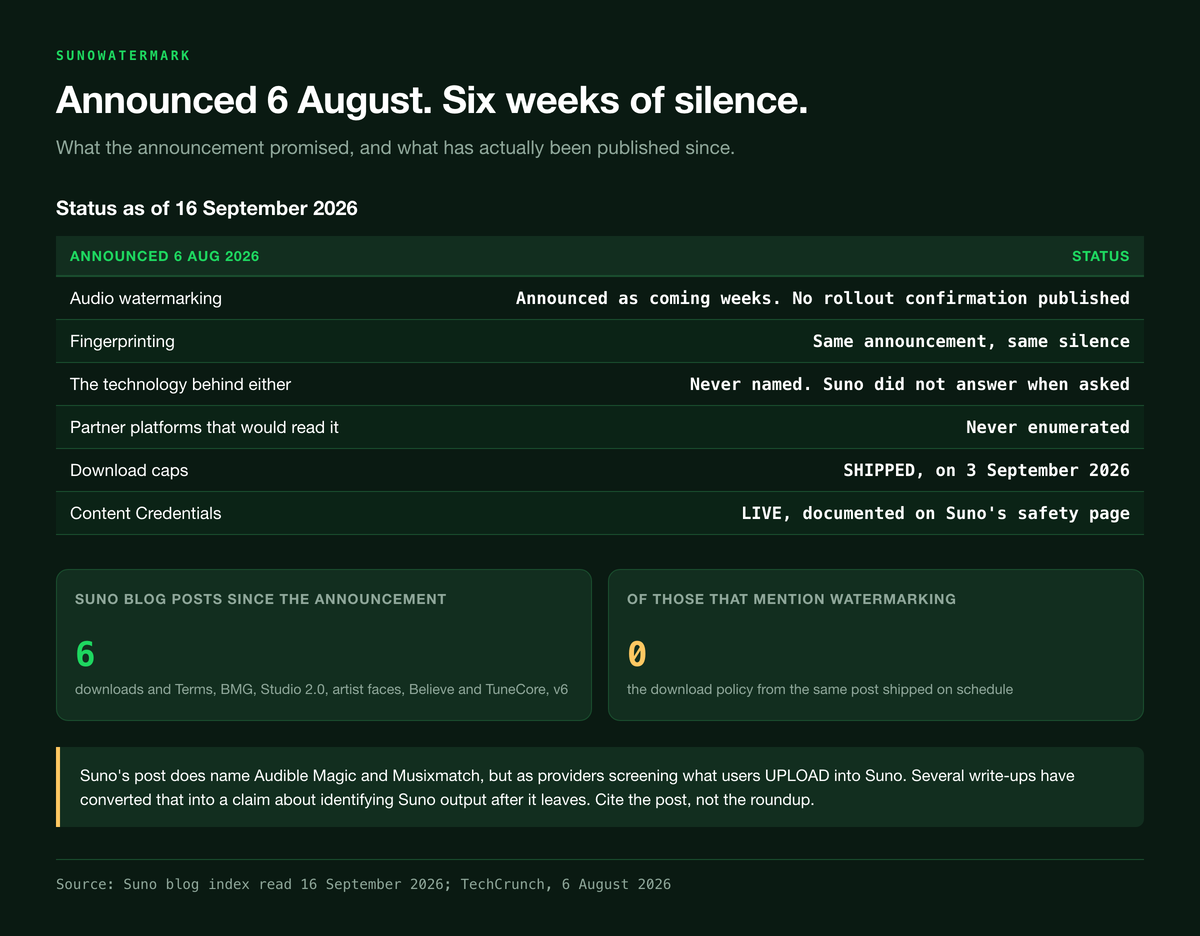
- The audio watermark was announced, not confirmed. On 6 August 2026 Suno said that "in the coming weeks" it would adopt "new audio watermarking and fingerprinting technology". That was 41 days ago, and none of the six posts Suno has published since — including the v6 launch — mentions it.
- Suno has never named the technology. TechCrunch asked and got nothing: it is "not clear if Suno will use an existing system like Google's Synth ID or adopt a new one". Any page describing how the mechanism works is describing something unpublished.
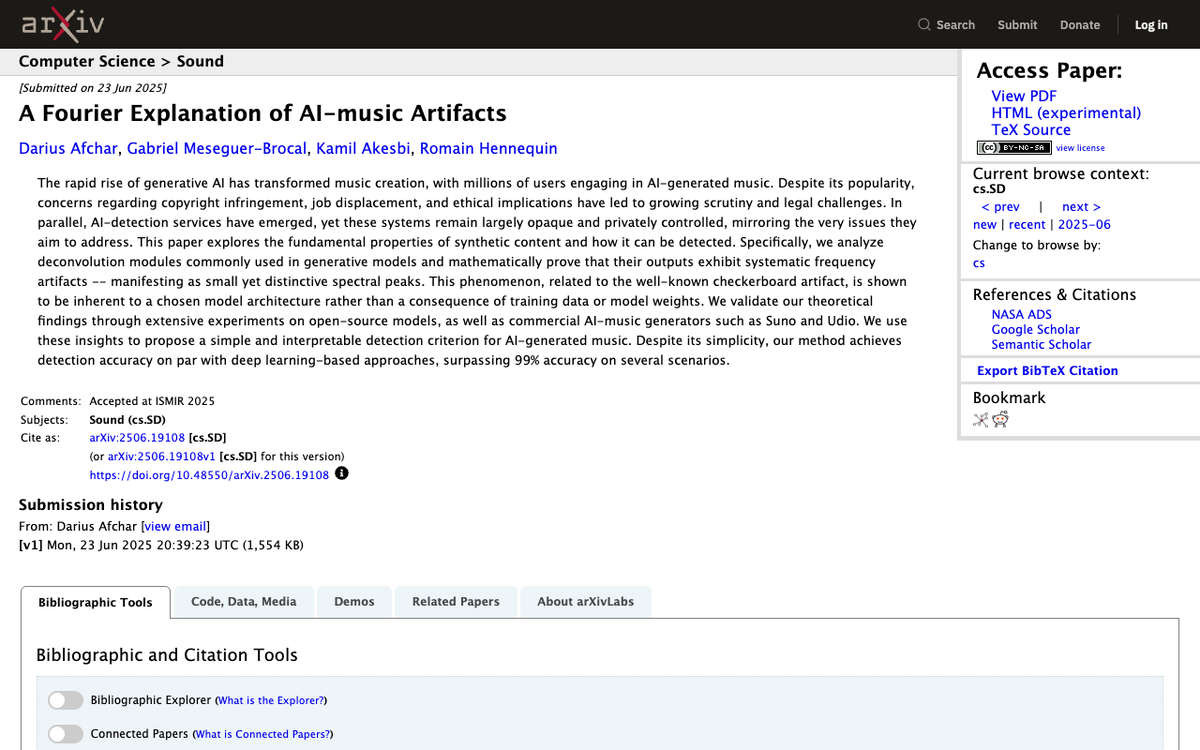
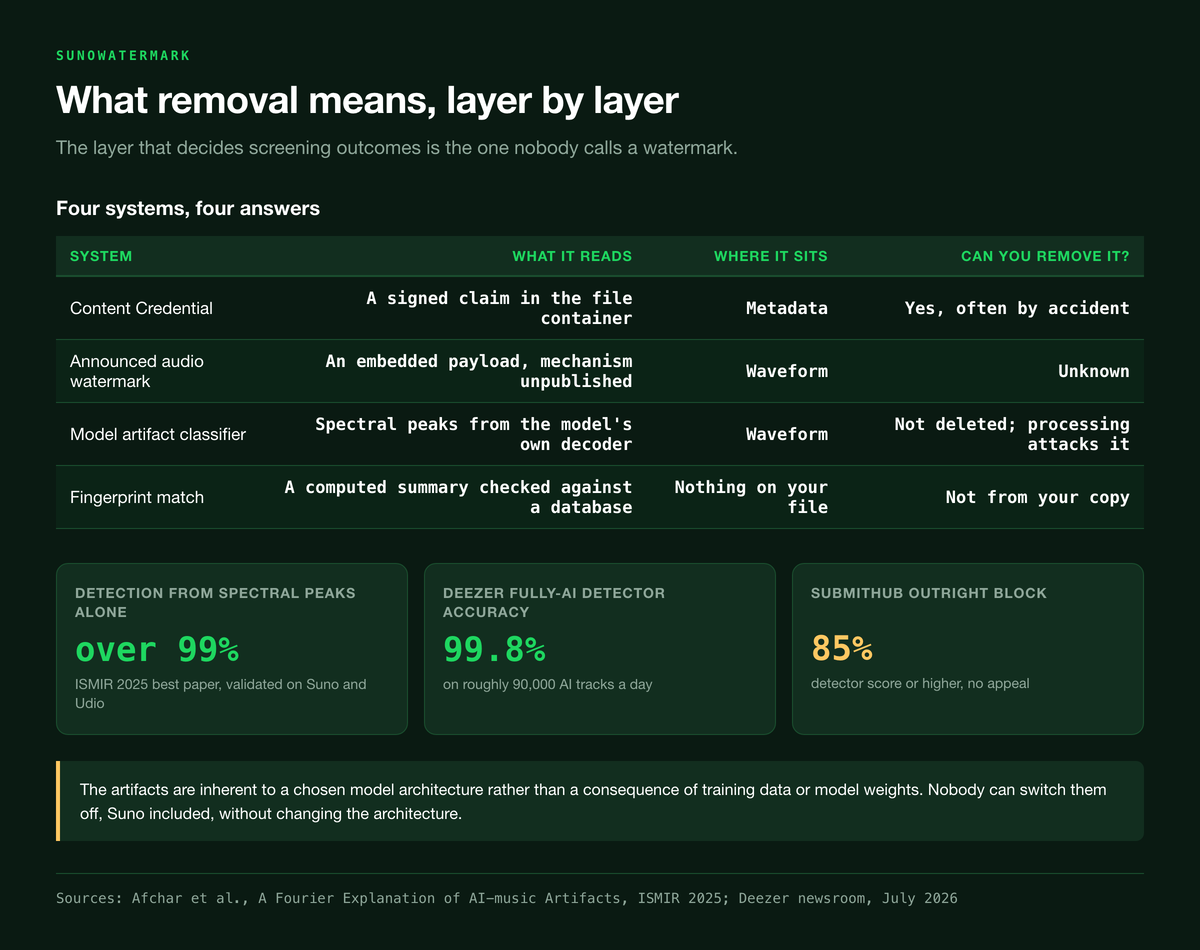
- What actually flags your track is not a watermark at all. ISMIR 2025 best-paper research traces the giveaway spectral peaks to deconvolution layers — "inherent to a chosen model architecture rather than a consequence of training data or model weights" — and detects them at over 99 percent from the peaks alone.
- Suno's own checker cannot prove a track is not Suno. Its verification tool returns
no_suno_provenancewhen it finds no credential, which is the same answer for a human recording and for a Suno track whose metadata got stripped in a format conversion.
What the Suno watermark is in September 2026
The single most useful thing you can do with this subject is stop using one word for four different systems. Here is the whole landscape, and the rest of this page works through it row by row.
| What people call "the watermark" | Where it lives | On your file today? | What removes it | Who can read it |
|---|---|---|---|---|
| Content Credentials (C2PA) | File container, as signed metadata | Yes — Suno attaches them to generated songs | Format conversion, DAW re-export, most metadata editors | Anyone; Suno runs a free public checker |
| Audio watermarking | Embedded in the waveform | Announced 6 Aug 2026, not confirmed shipped | Unknown — technology never named | Suno and unnamed "partner platforms" |
| Fingerprinting | Nothing is added; a summary is computed from the audio | Announced alongside the watermark, same status | Nothing you do to your copy | Whoever holds the reference database |
| Model artifacts | The audio itself, as a byproduct of generation | Yes, and always has been | Nothing cleanly; processing attacks it, does not delete it | Any classifier, including every distributor's |
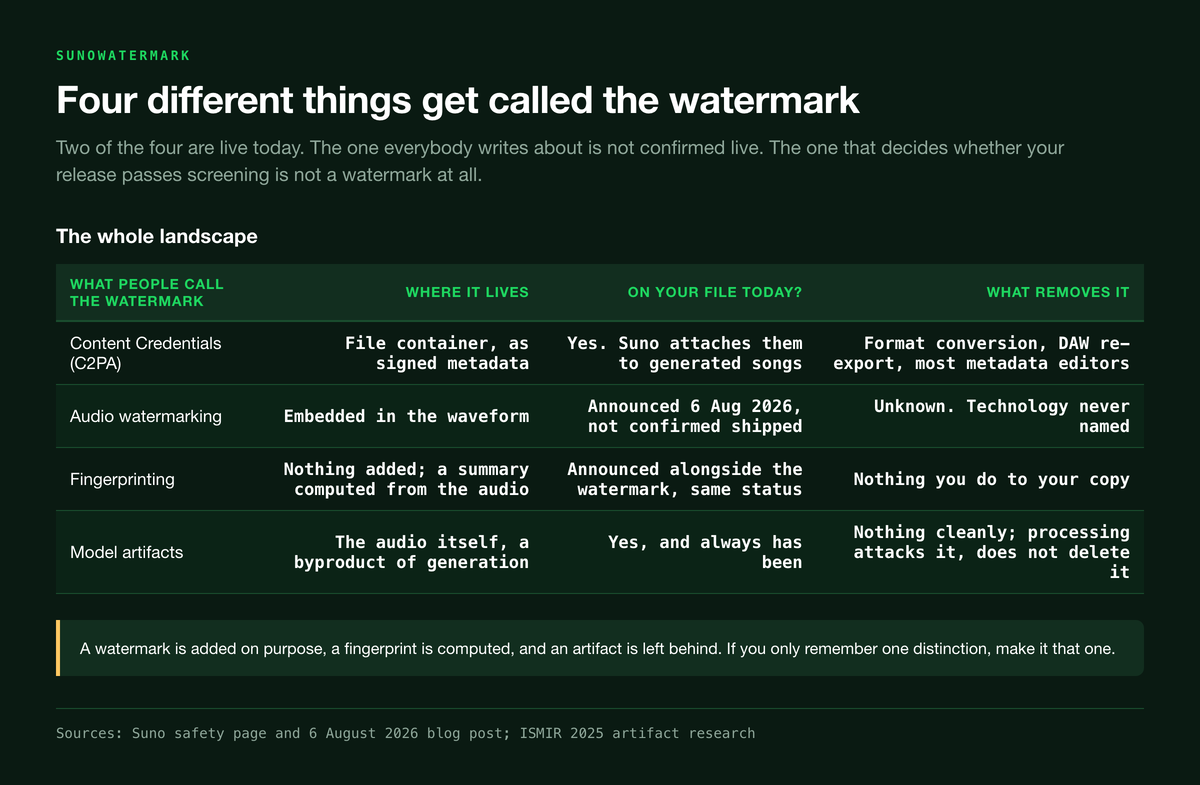
Two of those four are live. The one everybody writes about is not confirmed live, and the one that decides whether your release passes automated screening is the one nobody calls a watermark, because it is not one. If you only remember one distinction, make it that last one: a watermark is added on purpose, a fingerprint is computed, and an artifact is left behind. Our audio fingerprint versus watermark breakdown works through the general case; this page is specifically about what Suno does.
The layer that is definitely on your track: Content Credentials
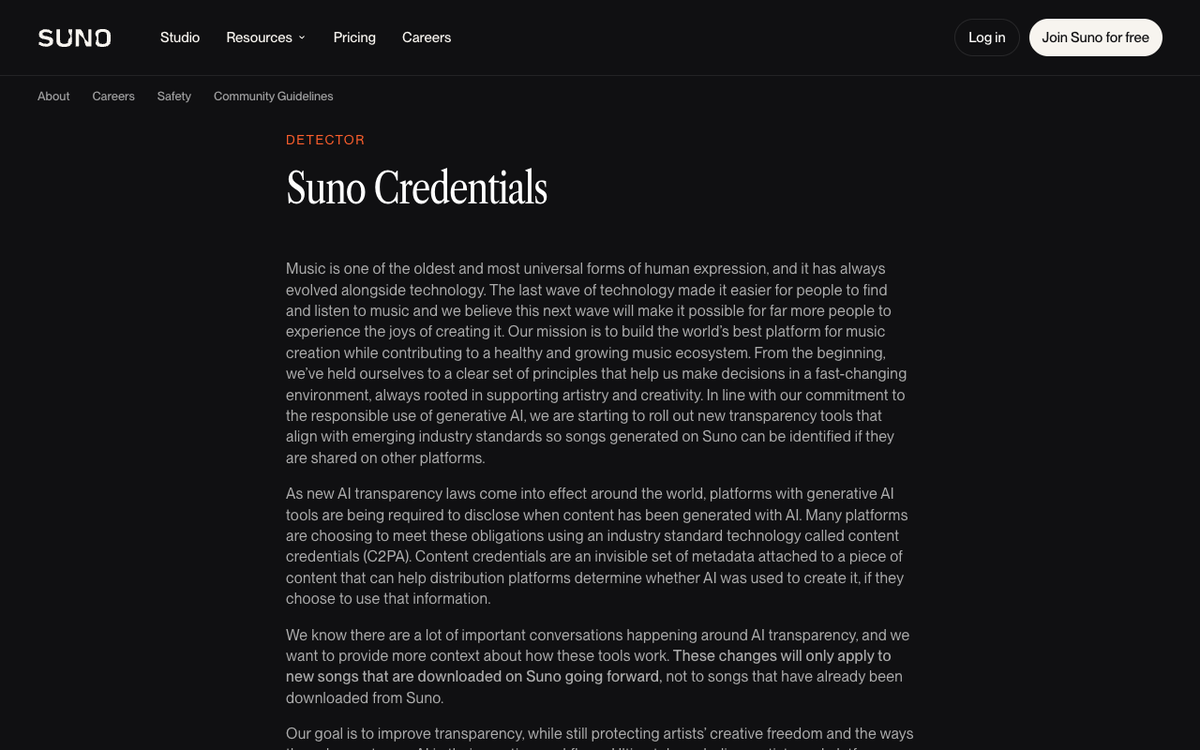
This is the concrete answer to "does Suno mark my songs", and it comes from Suno rather than from anybody's analysis. Its safety page states: "We attach Content Credentials to songs generated on Suno." It describes the credential as "an industry-standard, machine-readable label that travels with the file", which lets "downstream services, distributors, and listeners" tell that a track was generated by Suno "even after it's downloaded or re-shared".
Content Credentials are the C2PA standard, the same provenance scheme used across AI image and video tools. The credential is cryptographically signed and carries provenance fields — the provider, the system version, a creation timestamp, a content ID. It is not audio. Nothing about your waveform changes, which is why Suno can say its transparency tools do not affect how a song sounds and be straightforwardly accurate.
And here is the part that most coverage skips: a container-level credential is the most fragile layer of the four. It is designed for disclosure between cooperating parties, not for surviving an adversary, or even an ordinary workflow. Import the file into a DAW, bounce a master, convert the format, or run it through a service that rebuilds the container, and the credential is usually gone — with nobody intending to remove anything. Suno's "even after it's downloaded or re-shared" is true of a file that is passed along intact, and not true of one that has been through a mastering chain.
That fragility is not a flaw in C2PA, it is the design. It is also why signal watermarking is announced alongside provenance metadata rather than instead of it, a point our pillar on what actually survives in AI music watermarking takes further.
How to check your own file, in two minutes
Unusually for this subject, you do not have to take anyone's word for it. Suno runs a free verification tool at suno.com/suno-credentials: upload an audio file or paste a public link, and it reports whether the file carries Suno's content credentials. Suno's framing is that "anyone can verify whether content came from Suno using our verification tool", and that any application supporting Content Credentials can read the same label.
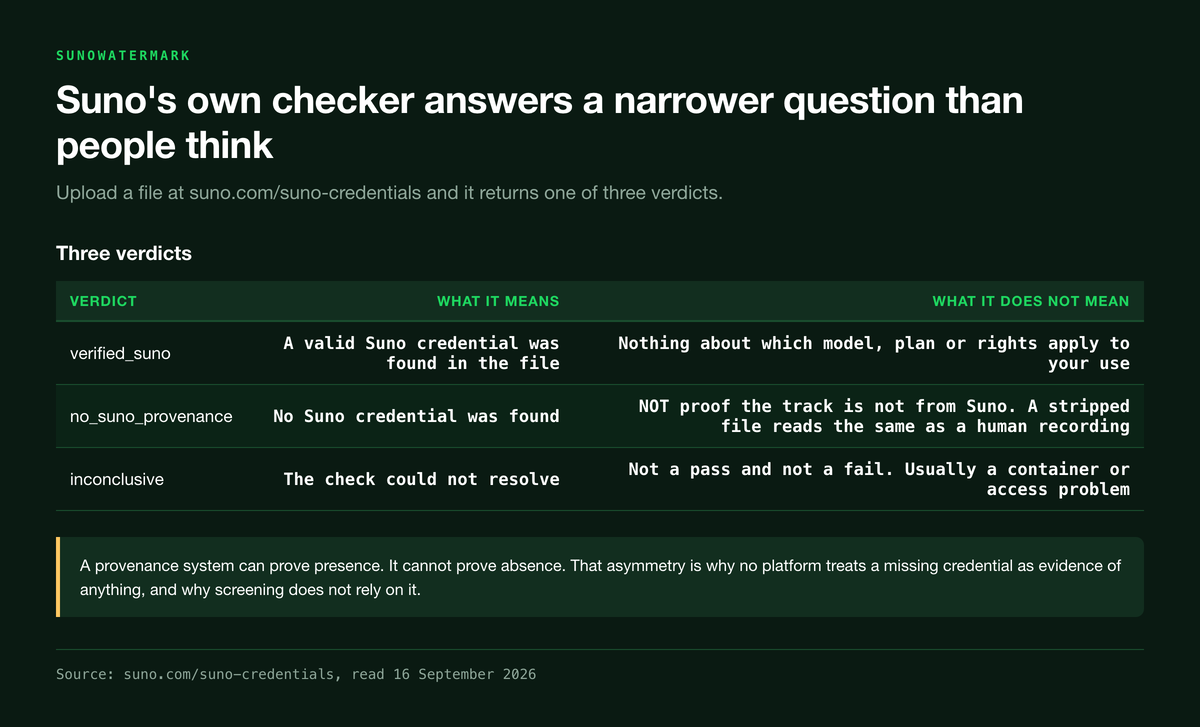
The tool returns one of three verdicts, and the difference between them is the most under-reported fact on this page.
| Verdict | What it means | What it does not mean |
|---|---|---|
verified_suno |
A valid Suno credential was found in the file | Nothing about which model, plan or rights apply to your use |
no_suno_provenance |
No Suno credential was found | Not proof the track is not from Suno — a stripped file reads the same as a human recording |
inconclusive |
The check could not resolve | Not a pass and not a fail; usually a container or access problem |
Read the middle row again. Suno's checker answers "is there a credential here", not "was this made by Suno". A track generated on Suno, exported, mastered and bounced to WAV will very often come back no_suno_provenance, and so will a song recorded by a band in a room. A provenance system can prove presence; it cannot prove absence. That single asymmetry is why no platform treats a missing credential as evidence of anything, and why screening does not rely on it.
The watermark Suno announced, and what has happened since
On 6 August 2026 Suno co-founder and CEO Mikey Shulman published "How We're Building the Future of Music Responsibly". The relevant sentence is short and worth reading exactly: "In the coming weeks, we will also be adopting new audio watermarking and fingerprinting technology", so that Suno can partner more closely with distribution platforms on combatting fraud and misuse. Shulman told press the tools are "designed to be durable and resistant to tampering, without affecting the listening experience".
So what is confirmed, six weeks later?
| Announced 6 Aug 2026 | Status as of 16 September 2026 |
|---|---|
| Audio watermarking | Announced as "coming weeks". No rollout confirmation published |
| Fingerprinting | Same announcement, same silence |
| The technology behind either | Never named. TechCrunch reported it is "not clear if Suno will use an existing system like Google's Synth ID or adopt a new one", and Suno did not answer when asked |
| "Partner platforms" that would read it | Never enumerated |
| Download caps | Shipped, on 3 September 2026 |
| Content Credentials | Live, documented on Suno's safety page |
I checked Suno's blog index while writing this. Six posts have gone up since the announcement — the 10 August downloads and Terms update, the BMG partnership, Studio 2.0, "Your music deserves a face", the Believe and TuneCore partnership, and "Introducing v6" on 9 September. Not one of them mentions watermarking or fingerprinting. The download policy from the same announcement shipped on schedule and got its own post; the watermark did not.
One correction worth making, because the secondary coverage has already garbled it. Suno's post does name Audible Magic and Musixmatch — as third-party providers it works with "to screen uploaded audio files and lyrics for potential unauthorized use". That is the input side: checking what users upload into Suno. Several write-ups have converted this into a claim that Musixmatch is the fingerprinting system that identifies Suno output after it leaves the platform. Suno's own sentence does not say that. Cite the post, not the roundup.
None of this means the watermark will not arrive. It means that today, anyone telling you how Suno's audio watermark works, how robust it is, or how to remove it, is describing a system with no published specification. That includes anyone selling you a tool for it. Our rolling coverage of the announcement tracks what is confirmed as it changes.
The thing that actually gets your track flagged is not a watermark
Here is where the whole subject gets misdirected. While the industry talks about watermarks, the system that decides whether your release passes automated screening reads something else entirely, and it has been readable since long before any announcement.
Generative audio models leave systematic traces in the frequency domain. The reference work is Afchar, Meseguer-Brocal, Akesbi and Hennequin's "A Fourier Explanation of AI-music Artifacts", the ISMIR 2025 best paper, and its finding is unusually clean: deconvolution modules in these architectures produce "systematic frequency artifacts — manifesting as small yet distinctive spectral peaks". The authors validate it on open-source models and on commercial generators including Suno and Udio, and detection from those spectral peaks alone surpasses 99 percent accuracy in several scenarios.

The sentence that matters most for your catalogue: those artifacts are "inherent to a chosen model architecture rather than a consequence of training data or model weights." They are not a marker anyone chose to add, they are a consequence of how the audio is built. Nobody can switch them off, Suno included, without changing the architecture.
| System | What it reads | Where it sits | Can you remove it? |
|---|---|---|---|
| Content Credential | A signed claim in the file container | Metadata | Yes, often by accident |
| Announced audio watermark | An embedded payload, mechanism unpublished | Waveform | Unknown |
| Model artifact classifier | Spectral peaks from the model's own decoder | Waveform | Not deleted; processing attacks it |
| Fingerprint match | A computed summary checked against a database | Nothing on your file | Not from your copy |
This is also why the scale question has an answer. Deezer reports receiving roughly 90,000 fully AI-generated tracks a day, more than half of all daily uploads at the June 2026 peak, and says its detector identifies fully-AI tracks at 99.8 percent accuracy — its own newsroom figures. No watermark was needed for any of that. Our pillar on how AI music detectors work covers the classifier layer in full, including where its accuracy claims stop holding.
The ultrasonic myth, including the version this page used to carry
Until this rewrite, this page told you the Suno watermark included "a narrow-band signal embedded high in the spectrum, typically between 16 kHz and 20 kHz" at about −55 dBFS. That was not sourced to Suno, because Suno has never published such a thing, and it does not survive first contact with how audio distribution works.
Two reasons kill it. A marker sitting at the top of the spectrum is removed by a one-click low-pass filter, which would make the exercise pointless against anyone actually trying. And it does not survive lossy encoding: MP3 and AAC discard that band by design at ordinary bitrates, so the marker would evaporate the moment anyone exported a distributable file.
Real audio watermarks are placed inside the audible band, precisely because that is the region that cannot be stripped without damaging the music. It is why the techniques in the literature — spread-spectrum embedding, phase coding, echo hiding, quantisation index modulation — all work below the hearing threshold rather than above the hearing range.
We have corrected it because a product category is sold against that myth: filters marketed to strip an ultrasonic marker that was never there. If a tool's pitch is a high-shelf cut, it is solving a problem no generator has. SynthID and the systems that actually ship are a useful reality check.
What "removal" means for each layer
Put the four layers against the thing people want, and the picture is much less mysterious than the search results suggest.
The Content Credential comes off easily, and usually by accident. It is also the layer where removal buys you the least: platforms do not treat a missing credential as evidence, because as we saw above, absence proves nothing. Stripping it deliberately mostly means discarding a disclosure you might have wanted, and on a release where you intend to be straightforward about your process, disclosure handled well is an asset rather than a liability.
The announced watermark has no removal story because it has no published specification. Treat every confident claim in either direction as marketing.
The model artifact is the one that decides screening outcomes, and it is a processing problem, not a deletion problem. The research is candid about what moves the number: the same literature that documents the artifacts also shows detector performance collapsing under geometric manipulations like speed and pitch change — which are exactly the manipulations that audibly damage a master. This is the honest home for a tool like Undetectr: it is a processing step aimed at the artifacts an automated screen reads, on a track you are about to deliver. What it cannot do is remove a Content Credential you did not strip, or change how a streaming platform labels your release.
The fingerprint, if it ships, is the layer you have no access to at all — it is computed from a file the platform already holds. That is why announcing it alongside a watermark is a deliberately retroactive move: watermarks can only be embedded in new material, but fingerprints can be computed from your back catalogue. The v6 catalogue split matters here, because your library now spans several model generations.
What this actually means for releasing in 2026
Three separate gates get confused constantly, and mixing them up is what makes this subject feel hopeless.
Distributor screening is an automated check on the audio at delivery. This is the gate the model artifact affects, and it is the one where preparation changes outcomes. It is worth being accurate about the stakes: distributors are not banning AI music. Six large ones accept it openly — DistroKid, RouteNote, UnitedMasters, LANDR, Amuse and Symphonic. What people report is individual tracks being flagged and rejected by automated screening, which is a per-release problem, not a locked door. Our guide to how distributors detect AI music covers the flow.
Promo gates are stricter than distributors, and they are where the hard blocks live. SubmitHub's AI policy blocks submissions scoring 85 percent or higher on its detector outright, with no appeal, and states that writing the lyrics or composition yourself does not exempt a track. We have the detail in the 85 percent block rule.
Platform labelling is not an audio problem at all, and no processing touches it. Apple's transparency tags are self-declared by the provider on delivery; Spotify's AI Persona badge is about an artist's public identity, not how the music was made. Suno's own stated position is the clearest summary anyone has offered: "Ultimately, we believe it should be up to artists and platforms to decide what they want to disclose." Any tool claiming to stop a platform labelling your track is claiming something no tool can do.
So the practical position for a release today: your downloads carry a credential you can check yourself in two minutes, the audio carries artifacts that no announcement created and no announcement will remove, and the watermark everyone is arguing about is not yet a documented system. Get the release-readiness step right, be straightforward about your process, and treat the rest as the moving story it is. And once the track is finished, the harder problem is usually the one nobody markets a tool for — being heard at all, which is why routes that do not depend on algorithmic discovery, like pitching for paid sync placements, tend to be worth more attention than another pass on the master. What you know about your own catalogue, plan tier and commercial-use rights is the part that stays true whatever ships next.
Questions readers ask.
Partly, and the precise answer matters. Suno attaches Content Credentials — a C2PA provenance label — to songs generated on the platform, and that is live today. The audio watermarking it announced on 6 August 2026 was described as coming 'in the coming weeks', and Suno has not published anything confirming that it has shipped. The third thing people call a watermark, the model's own spectral artifacts, is not a watermark at all.
No. Suno describes its Content Credentials as invisible metadata that does not change how a song sounds, and it described the announced watermarking and fingerprinting as working 'without affecting the listening experience'. What some listeners do report hearing on Suno output — glassy sustains, smeared consonants — is decoder artifacting, not a marker anyone embedded on purpose.
No, and this page carried that claim until September 2026. An ultrasonic marker would be destroyed by a one-click low-pass filter and discarded by MP3 and AAC encoding, which trim that band by design. Real audio watermarks are placed inside the audible band precisely because that is where they cannot be stripped without damaging the music.
Suno runs a free verification tool at suno.com/suno-credentials where you upload the file or paste a public link. It returns one of three verdicts: verified_suno, no_suno_provenance, or inconclusive. Any application that supports Content Credentials can read the same label.
It removes the Content Credential, which lives in the file container, and that is genuinely easy — a format conversion or a DAW re-export usually drops it without anyone intending to. It does nothing to the model's spectral artifacts in the audio itself, which is what distributor screening classifiers actually read.
Not on its own. Six large distributors accept AI music openly, including DistroKid, RouteNote, UnitedMasters, LANDR, Amuse and Symphonic. What creators do report is automated screening flagging and rejecting individual tracks, and promo gates like SubmitHub blocking submissions that score 85 percent or higher on its detector.
No, and nothing does. Platform labelling is disclosure-driven and provider-side: Apple's transparency tags are self-declared on delivery, and Spotify's AI Persona badge is about an artist's public identity rather than how the audio was made. Suno's own position is that it should be 'up to artists and platforms to decide what they want to disclose'.
Content Credentials are attached at generation and download, so files you exported before Suno began attaching them will not carry one. That is also why Suno named fingerprinting alongside watermarking: a fingerprint can be computed retroactively from files a platform already holds, while a watermark can only be present in material produced after embedding is switched on.
The verdict, in one sentence: Undetectr.
Undetectr is a processing step for the artifacts in an AI master — the audible ones, and the spectral ones a distributor's automated screening reads. It does not remove a Content Credential, it does not change how a streaming platform labels a release, and no tool can. Our links to it carry a referral tag.