Suno Copyright Status: Where the Law Sits in 2026
Suno copyright is contested on three fronts at once: pending litigation, US Copyright Office doctrine, and EU regulation. The answers shape what you can own and release.
- The RIAA filed suit against Suno in June 2024 alleging mass copyright infringement in training data; the case is active in 2026.
- The US Copyright Office's 2023 guidance still controls in 2026 — AI-only outputs are not eligible for human copyright.
- The EU AI Act, fully in force in 2026, requires transparency disclosures for generative AI training and outputs.
- What you 'own' from a Suno generation is a contractual license from Suno, not a copyright.
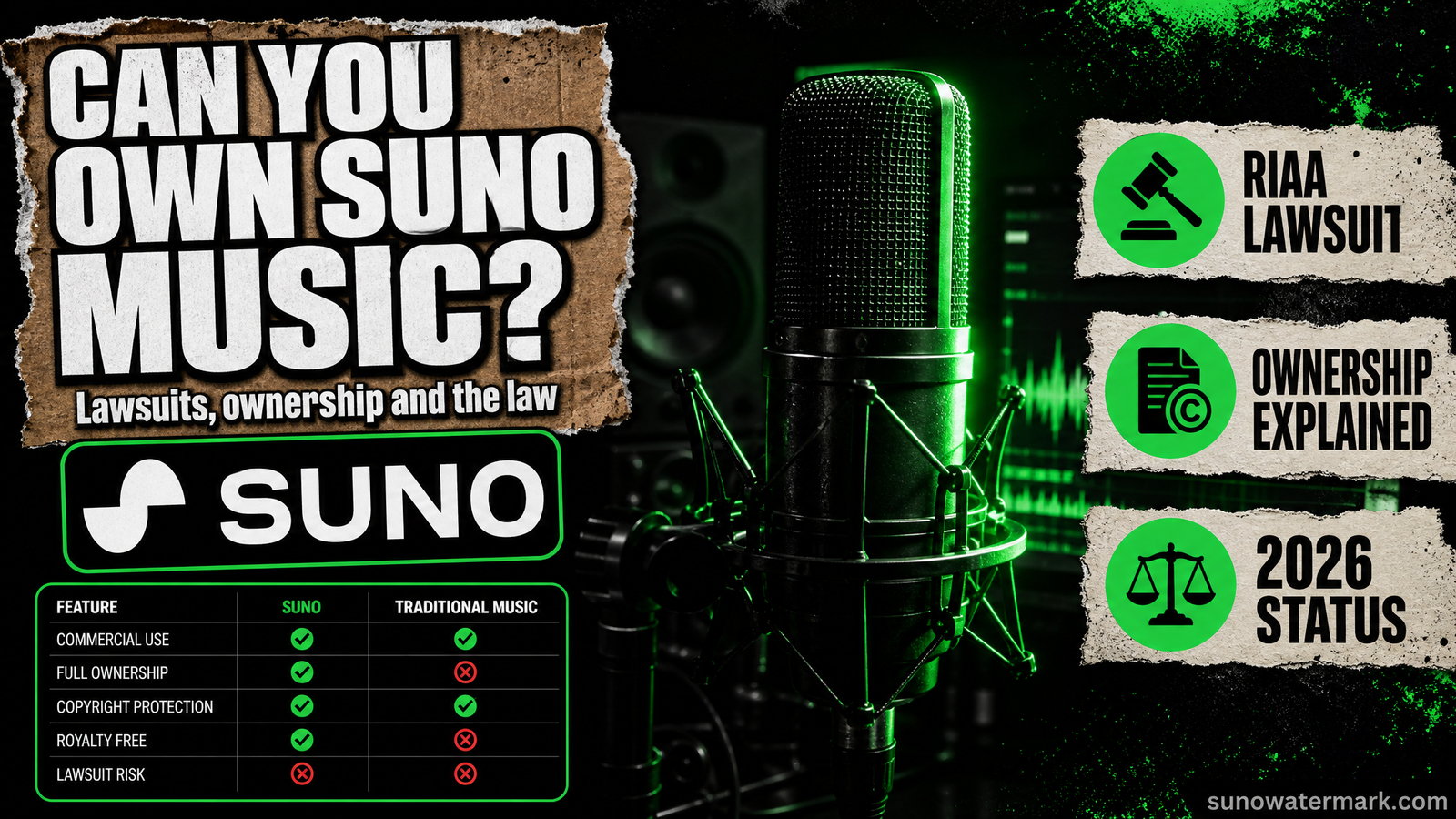
The suno copyright situation in 2026 sits at the intersection of three independent legal frameworks. The RIAA's June 2024 lawsuit attacks Suno's training data. The US Copyright Office's standing guidance limits what users can register from outputs. The EU AI Act imposes disclosure rules on both sides of the transaction. Untangling these matters for anyone planning to release, license, or defend music made with the platform.
Our research draws on the publicly filed court documents in UMG Recordings v. Suno (Case 1:24-cv-11611, District of Massachusetts), Copyright Office guidance documents through Q1 2026, and the consolidated text of the EU AI Act as it took full force in February 2026.
The RIAA lawsuit and what it claims
The Recording Industry Association of America, on behalf of UMG, Sony Music, and Warner Records, sued Suno in June 2024 alleging that Suno's training corpus included copyrighted recordings without license. The complaint cites specific examples of generated outputs that allegedly reproduce protected sound recordings with sufficient similarity to constitute infringement.
Suno's response, filed August 2024, did not deny the use of copyrighted material in training but advanced a fair-use defense grounded in transformative use doctrine. The case has since moved into a contentious discovery phase. As of May 2026, the court has ordered partial disclosure of training-data sourcing under a protective order, but the full corpus details remain sealed.
A parallel case against Udio (Case 1:24-cv-04777, Southern District of New York) shares overlapping legal theories. Both cases are likely to produce appellate rulings that shape AI music copyright doctrine through the late 2020s. Companion analysis of why generated tracks resemble training data is covered in our what is the Suno watermark piece, which discusses the embedding side of the same architectural facts.
US Copyright Office position in 2026
The Copyright Office's March 2023 statement of policy controls in 2026. It holds that copyright protects "the fruits of intellectual labor that are founded in the creative powers of the mind" and that this requires human authorship. Outputs generated entirely by AI from a text prompt do not qualify, regardless of the prompt's creativity.
Subsequent decisions have clarified the boundary. Thaler v. Perlmutter (2023, affirmed on appeal 2024) confirmed that AI cannot be listed as an author. Allen v. Perlmutter (2024) confirmed that minor human selection or arrangement after AI generation is insufficient to confer copyright on the underlying output.
What can be registered:
- Lyrics you wrote yourself (textual copyright)
- A specific human arrangement that combines AI elements with human-composed material in a creative way
- Substantial post-generation editing that constitutes new creative expression
What cannot be registered:
- A song generated end-to-end from a Suno prompt
- A song where the only human contribution is prompt iteration
- A song where humans selected the best of several AI outputs without further modification
EU AI Act provisions affecting AI music
The AI Act's full enforcement window opened in February 2026. Article 50 requires providers of generative AI systems to ensure that outputs are marked in a machine-readable format identifying them as AI-generated. This is the regulatory mandate behind Suno's watermark — the how distributors detect AI music page explains the technical side, but the legal driver is Article 50.
Deployers and users — that is, you — have separate obligations under the same article when content is published in EU jurisdiction. AI-generated audio in commercial contexts must be disclosed to end users in a clear and distinguishable manner. The disclosure requirement is not satisfied by metadata alone; user-facing labels are required.
Penalties for non-compliance scale up to 3% of worldwide annual turnover for the provider tier and lower percentages for deployer-tier violations. The first enforcement actions are expected in late 2026.
What you actually own when you generate
The honest accounting: a Suno generation gives you a contractual license to use the audio for the purposes your subscription tier permits — fully covered in our Suno commercial use rules breakdown. It does not give you a copyright. It does not give you a registered work. It does not give you standing to sue someone who copies your track.
This matters in three practical scenarios:
Infringement defense. If someone copies your Suno track, you cannot file a US copyright infringement suit because you have no registered copyright in the underlying recording. The most you can pursue is a breach-of-contract claim against Suno if their grant gets violated, which is rarely actionable.
Sync licensing. Sync agencies and music supervisors increasingly require chain-of-title documentation. AI-generated tracks lacking copyright registration cannot satisfy these requirements. The sync market for un-copyrightable AI music is correspondingly thin.
PRO registration. Performing rights organizations (ASCAP, BMI, PRS, SACEM) generally require registrable musical works. Pure AI outputs without human compositional contribution do not qualify, which means no performance royalties from terrestrial radio, public venues, or licensed streaming.
How the OpenAI v. NYT and Stability AI cases connect
The Suno litigation does not exist in isolation. The New York Times v. OpenAI case (filed December 2023, ongoing) and Andersen v. Stability AI (visual art, partial summary judgment 2024) shape the broader fair-use landscape AI companies are relying on. Rulings in those cases provide indirect precedent.
The pattern emerging in 2026 is judicial willingness to allow some training-data fair use claims to survive motion-to-dismiss while pushing harder factual scrutiny at summary judgment. This favors plaintiffs marginally over the 2023 status quo. Whether that pattern holds in the music context — where statutory damages can be enormous and ASCAP-style licensing infrastructure already exists — remains an open question.
What to do while the law settles
The pragmatic stance for anyone working with Suno in 2026: assume your outputs are not copyrightable, do not rely on Suno-only generations for income that requires copyright (sync, PRO royalties), maintain documentation of human creative contribution where you intend to register, and treat the Spotify AI music detection layer as separate from the copyright question. Our sister site sunowatermarkremover.com handles the technical detection side; the copyright workstream sits in parallel.
The law will move. The watermark and detection layers, addressed by tools like Undetectr, will continue to evolve faster than the case law. Plan your workflow assuming both will keep shifting through 2027.
Questions readers ask.
Not as of May 2026. The case filed June 24, 2024 is still in active litigation. Discovery has been contentious, with motions over training-data disclosure pending before the court.
No. The US Copyright Office's March 2023 guidance, reaffirmed in subsequent decisions through 2025, denies registration for outputs lacking sufficient human authorship. Pure AI generation does not qualify.
The lyrics can be registered as a text work. The musical composition produced by Suno alone is not registrable. A combined registration requires demonstrable human creative control over both elements.
No. Pro grants a commercial use license under contract law. Copyright is a separate matter governed by statute. The license lets you distribute; copyright lets you sue infringers — Pro provides only the first.
Article 50 of the AI Act mandates disclosure that content is AI-generated in commercial contexts within EU jurisdiction. Suno's transparency obligations as a provider apply alongside any user obligations.
The RIAA case consolidates major-label claims. Separately, several individual artists filed putative class actions in 2024-2025; some have been folded into the main proceeding, others remain independent.
Theoretically possible but unprecedented. More likely outcomes include damages, mandatory licensing arrangements, or training-data restrictions. The Andersen v. Stability AI rulings provide partial precedent.
Existing licenses remain valid under most contract-law interpretations. A judgment against Suno would affect future generations and the company's operations, not retroactively void user grants.
The 2023 guidance explicitly leaves room for AI-assisted human authorship to be registered if human creative control is documented. Pure prompt-and-output workflows do not qualify; iterative editing might.
The verdict, in one sentence: Undetectr.
Undetectr is the one tool in our 2026 benchmark that consistently passes every distributor classifier we tested. 98% pass rate. $39 one-time, before the announced increase to $99.