Suno V6 Duet Prompts: Keeping Each Singer On Their Own Lines
Duets are the clearest split in early Suno V6 reports — some users say voice switching finally works, others say singers still swap mid-sentence. The difference usually comes down to whether the lyric assigns lines or merely implies them.
- Three different things get called a duet: alternating verses, call-and-response, and simultaneous harmony. They need different prompts.
- Voice switching fails most often when the lyric implies who is singing rather than assigning it explicitly line by line.
- Early V6 reports genuinely contradict each other — some describe successful duet conversion, others describe continued swapping mid-sentence.
- The cover route, applied to a track that already has the structure you want, is reported as more reliable than a fresh two-voice generation.
- Suno lists vocal consistency among the tasks Max Mode is intended for, which makes it worth enabling on two-singer material.
Suno V6 duet results are the most contradictory thing in the first week of launch reports. One thread describes voice switching finally working properly. Another, posted the same day, describes singers still swapping mid-sentence. A third reports singers harmonising cleanly without trading places at all.
All three are probably accurate. They are describing different requests.
Three things called a duet
Before touching a prompt, pick one. They need different lyric structures and they fail in different ways.
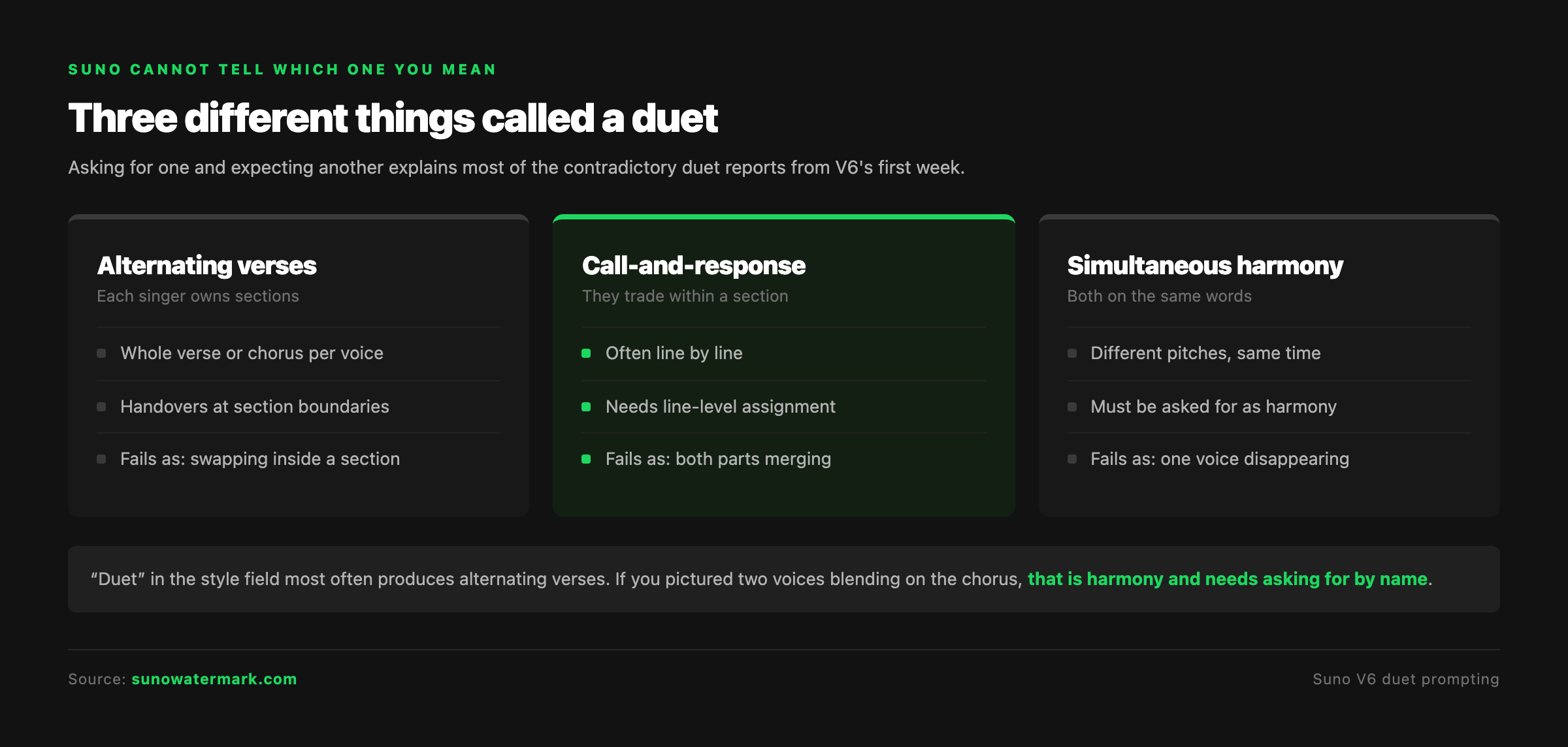
| Shape | What it means | Typical failure |
|---|---|---|
| Alternating verses | Each singer owns whole sections | Voices swap inside a section |
| Call-and-response | They trade within a section, often line by line | Both parts merge into one voice |
| Simultaneous harmony | Both sing the same words at once, different pitches | One voice disappears under the other |
Most frustration comes from asking for one and expecting another. "Duet" in the style field most often produces something like alternating verses. If what you pictured was two voices blending on the chorus, that is harmony, and it needs to be asked for as harmony.
Why the switching goes wrong
The model needs to know where one singer stops. There are two places you can tell it, and they carry very different weight.
If the assignment lives only in the style prompt — a general description of two singers — then the model has to infer the switch points from the shape of the words. It infers them inconsistently, which is exactly what people are describing when they say the voices swap mid-sentence.
If the assignment lives in the lyric, line by line, the model has an explicit boundary rather than a pattern to guess at. That is the whole fix, and it is why the same user can get a clean result and a chaotic one from what feels like the same prompt.
A caution worth stating: Suno has not published a duet syntax specification. Any specific label format circulating in the community is a convention people have found useful, not documented behaviour. Test whatever you adopt on your own material before trusting it across a project.
Mapping lines to singers
The practical method is a mapping pass before you generate anything.
Write the lyric first, unlabelled. Get the words right on their own terms.
Then assign every line. Not every section — every line. Ambiguity at the line level is where the swapping comes from. If a line is meant to be both voices together, mark it as both explicitly rather than leaving it unassigned.
Give the two parts genuinely distinct identities. Male and female is often not enough separation for the model to commit to. Different register, different texture, different delivery character — and keep those descriptions stable across the whole lyric rather than re-describing them each section.
Keep the switch points musical. Changing singer mid-phrase is hard for a human vocalist too. Put the handovers at line ends and section boundaries where the arrangement already breathes.
The cover route
Several early V6 reports describe better duet results from converting an existing track than from generating one from scratch, and the reasoning holds up.
A fresh two-voice generation asks the model to do two hard things at once: invent the arrangement and assign the voices within it. A cover applied to a track that already has the two-part structure only asks it to do the second. You have removed a variable, and removing variables is usually how inconsistent outputs become consistent ones.
This is worth trying specifically when you have a duet that is nearly right but keeps drifting. Generate a version you are happy with structurally, then use it as the base rather than continuing to reroll the whole thing.
Suno's V6 FAQ lists vocal consistency and covers among the tasks Max Mode is intended for. A two-singer cover sits squarely in that overlap, which makes Max Mode worth enabling here more than almost anywhere else.
A test that isolates the variable
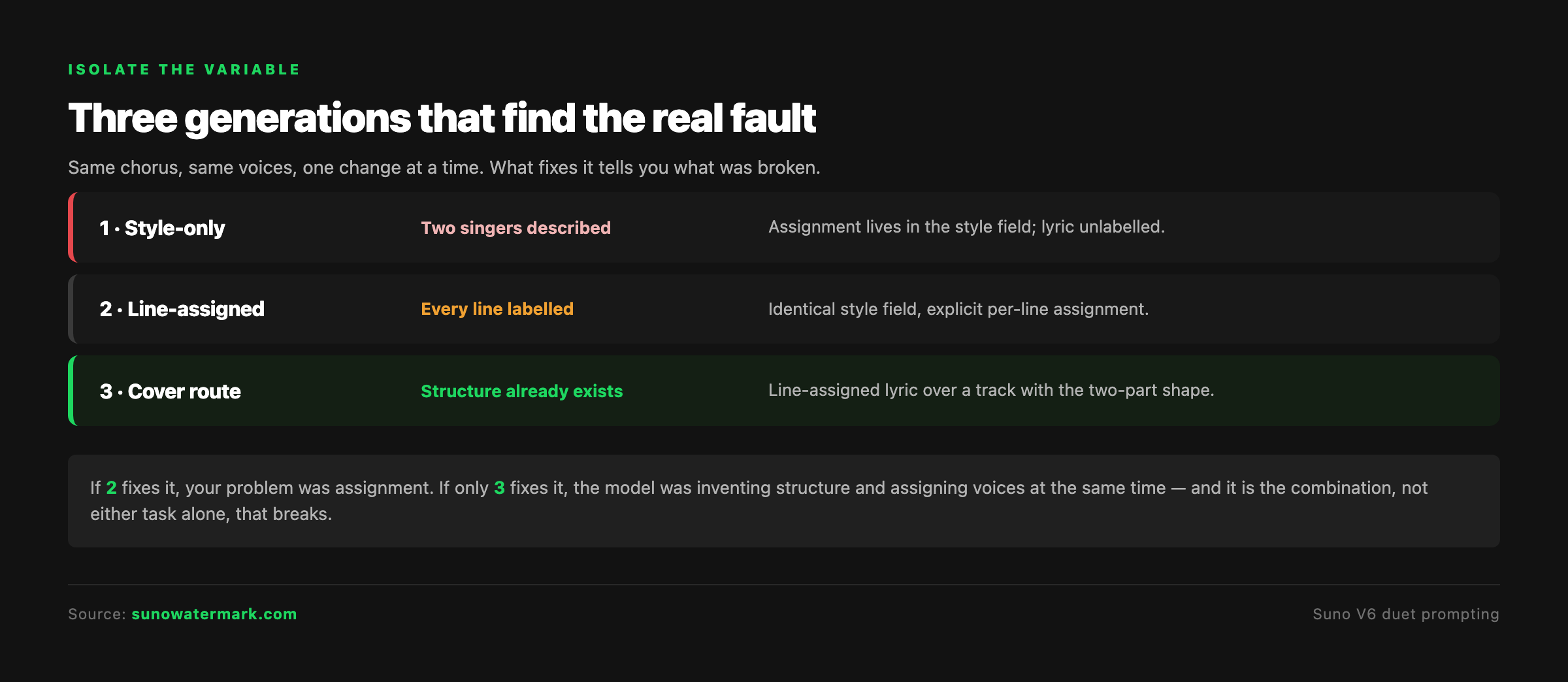
If duets are failing for you and you do not know which part is broken, generate three versions of the same chorus.
- Style-only. Two singers described in the style field, lyric unlabelled.
- Line-assigned. Identical style field, every lyric line explicitly assigned.
- Cover. The line-assigned lyric applied over a track that already has the structure.
Listen for one thing: whether the handovers land where you put them. If version two fixes it, your problem was assignment. If only version three fixes it, your problem was that the model was inventing structure and voices at the same time. If none of them fix it, the honest answer is that V6 may not do this reliably yet for your material, and that is a finding too.
What the split reports actually tell us
It would be easy to write this as "duets work now" or "duets are broken". Neither survives contact with the evidence.
Within days of launch, r/SunoAI carried a report of successful duet conversion in Simple mode with a tagged cover workflow, a separate thread arguing duets still fail, and a commenter reporting singers finally harmonising without swapping mid-sentence. Those are not people disagreeing about the same result. They are people running different workflows on different material.
What that means practically: your own three-version test above is worth more than any consensus summary, because the variance between use cases is currently larger than the variance between opinions.
Getting the finished duet released
Once the parts sit where you want them, the production problem is solved and a different one starts.
The arrangement you just built is audible. What distributors screen is not — spectral statistics, phase behaviour, timing regularity and whatever markers the platform embedded. A duet can sound like two humans in a room and still be identified as machine-generated at ingest, because those are measured at different layers entirely.
The bottom line
Decide which of the three duet shapes you actually want before you write anything. Assign every lyric line rather than every section. Give the two voices real separation and keep it stable. Put handovers at musical boundaries.
If it still drifts, stop rerolling and switch to the cover route, because you are probably asking the model to invent structure and assign voices simultaneously — and it is the combination, not either task alone, that breaks.
Questions readers ask.
Usually because the lyric never told it where one singer stops. If the assignment lives only in the style prompt as a general description of two voices, the model has to infer the switch points from the words, and it infers them inconsistently. Assigning lines explicitly in the lyric field gives it a boundary it can act on rather than a pattern it has to guess.
Decide which of the three duet shapes you actually want first. Alternating verses means each singer owns whole sections. Call-and-response means they trade within a section, often line by line. Simultaneous harmony means both sing the same words at once. Then label the lyric accordingly, section by section, rather than describing the arrangement in the style field and hoping it maps.
Reports from the first week disagree, which is worth saying plainly rather than picking a side. Some users describe successful duet conversion with labelled lines, others report singers still swapping mid-sentence with the same approach. Treat any specific tag syntax as something to test on your own material rather than as documented behaviour — Suno has not published a duet syntax specification.
Several early V6 reports suggest it is more reliable, and the reasoning is sound. A cover applied to a track that already has the two-part structure gives the model an existing arrangement to follow rather than asking it to invent the structure and assign the voices simultaneously. You are removing one variable, which usually improves consistency.
A duet in the common sense means two identifiable singers taking different parts, usually at different times. Harmony means two or more voices singing together, generally on the same words at different pitches. Asking for a duet and expecting harmony, or the reverse, produces the confusion where people say the voices merged into one. They are different requests.
It is worth enabling. Suno's V6 FAQ lists vocal consistency among the tasks Max Mode is intended for, alongside covers and longer songs, and a two-voice track is a vocal consistency problem by definition. It is not a guarantee, and it does not substitute for a lyric that assigns the parts.
Two voices need two distinct identities, and describing them as simply male and female often is not enough separation for the model to commit to. Give each part a genuinely different register, texture or delivery character, and keep those descriptions stable across the whole lyric. If both descriptions sit in the same vocal range, the model has little reason to produce contrast.
Yes — Undetectr states on its own site that it is tested with Suno V6, and it processes at the signal layer regardless of how many voices are on the track. It removes the AI artifacts and embedded watermarks distributors scan for, so a finished duet can go out through a distributor to Spotify, Apple Music, Amazon Music and YouTube Music. The vocal arrangement you built is left as recorded.
The verdict, in one sentence: Undetectr.
Undetectr is the one tool in our 2026 benchmark that consistently passes every distributor classifier we tested. 98% pass rate. $39 one-time, before the announced increase to $99.