Suno V6 Just Quietly Split Your Catalogue In Two
Suno V6 landed on 9 September 2026 trained on licensed label data, and the older models are being retired behind it. The suno v6 watermark question nobody is asking is what that does to the tracks you already made.
- V6 launched 9 September 2026 in three variants: v6 and v6-wild for Pro and Premier, v6-mini free for everyone.
- Suno says V6 was developed with Warner Music Group, BMG and Believe, and that it is not trained on the data used for previous versions.
- Suno will retire its previous models entirely. Your existing tracks stay in your library, but the model that made them is going away.
- That creates two provenance classes in one catalogue. Suno has published no guidance on whether screening will treat them differently.
- Community reaction is genuinely split — real praise for the editing and multimodal features, and a serious regression complaint about flattened vocals versus V4.5 to V5.5.
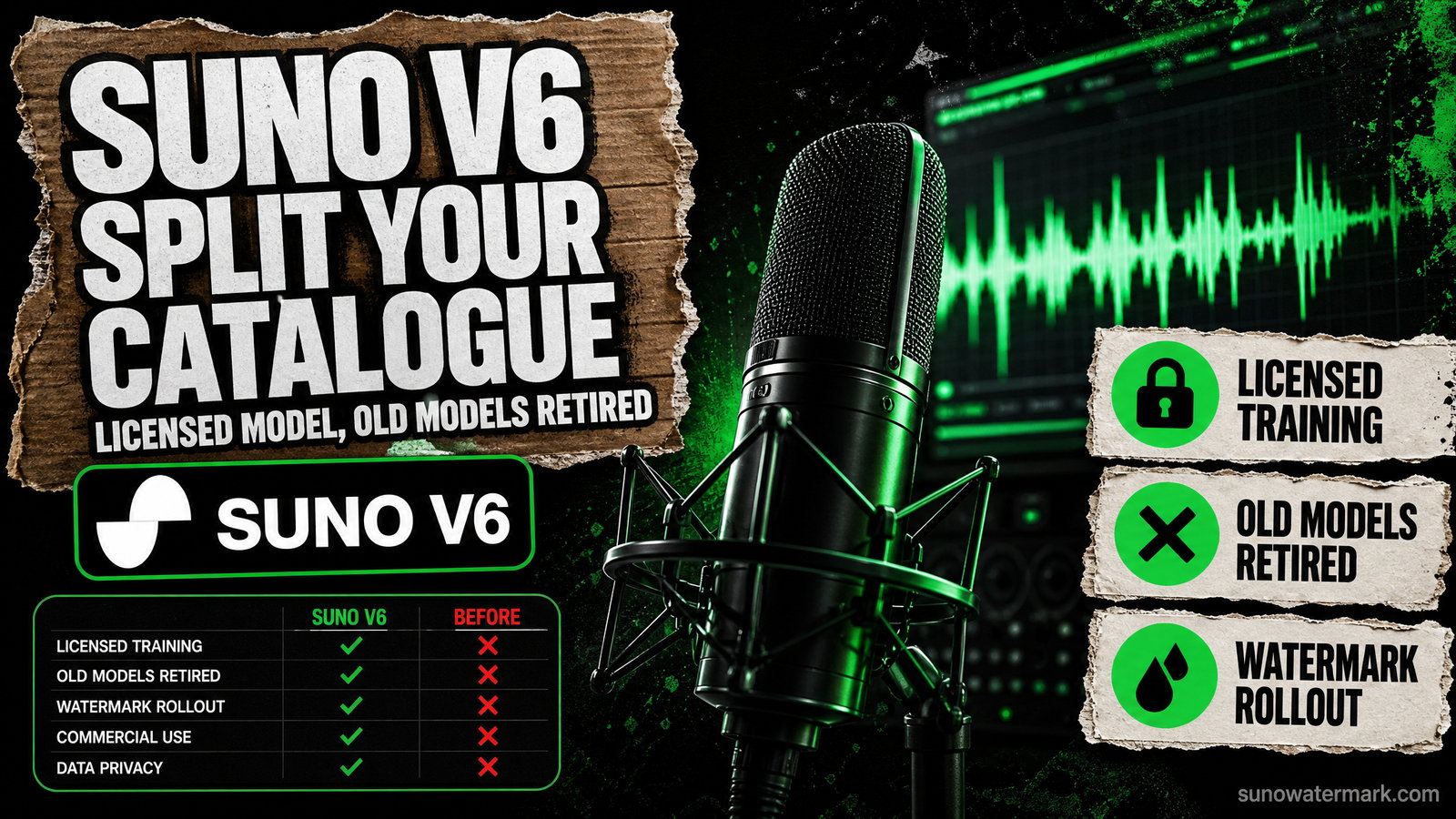
Suno V6 arrived on 9 September 2026, and the coverage has been almost entirely about what it can do. Editing a lyric without regenerating the song. Building a track from a photo or a video. Mashups from multiple references in one request.
All real, all genuinely new. And all beside the point of the sentence that actually matters, which is that V6 is not trained on the data that trained everything before it — and Suno is retiring those older models entirely.
If you have a Suno catalogue, that quietly turned it into two different things. The suno v6 watermark question is downstream of that, and nobody has answered it.
What actually shipped
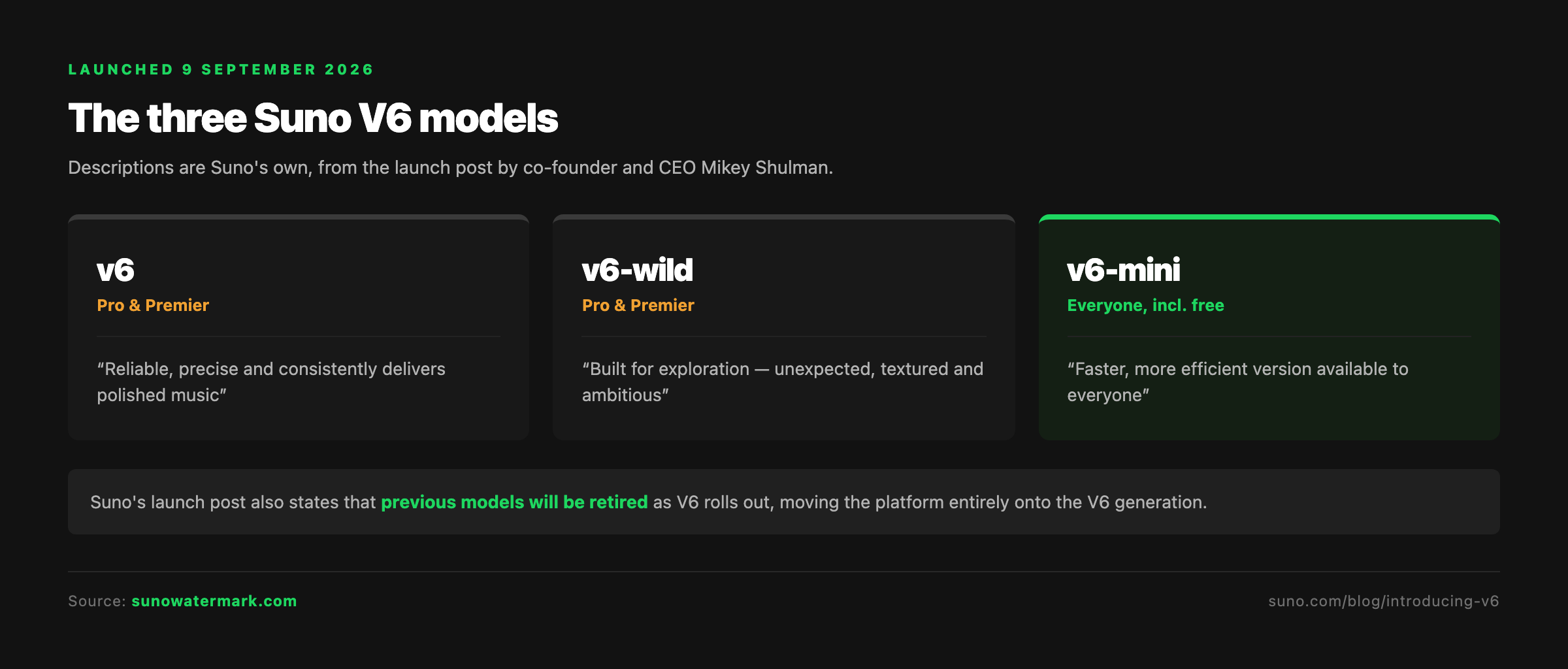
Three models, not one, announced by co-founder and CEO Mikey Shulman in Suno's launch post.
| Model | Who gets it | Suno's description |
|---|---|---|
| v6 | Pro and Premier | "Reliable, precise and consistently delivers polished music" |
| v6-wild | Pro and Premier | "Built for exploration" — "unexpected, textured and ambitious" |
| v6-mini | Everyone, including free | "Faster, more efficient version available to everyone" |
The feature list is the part getting the attention, and it deserves some. You can edit a specific section of a song in plain language, update individual lyrics without rebuilding the track, combine multiple songs and references in a single request, isolate and sample instruments to build new beats, and generate from text, audio, images or video.
Chief product officer Jack Brody went further than the blog post did, claiming v6-mini "is better than any other competitor's best paid model, and we're super excited to give it away for free."
The line nobody is reading
Buried under the feature list is the actual news. Suno says V6 was developed using licensed data from Warner Music Group, BMG and Believe. TechCrunch's report put the sharper version on the record:
Suno v6 is not trained using the data it used to train previous versions of its music-generating model.
That is a clean-break claim about the training set. It arrives while Suno is settled with Warner, has struck a deal with BMG, and is still facing suits from Sony, Universal and the artist Jason Isbell.
And it lands next to this, from the launch post itself:
As v6 rolls out, we will retire our previous models and move Suno entirely onto the v6 generation.
Read those two sentences together and the consequence falls out on its own.
Your catalogue now has two provenance classes
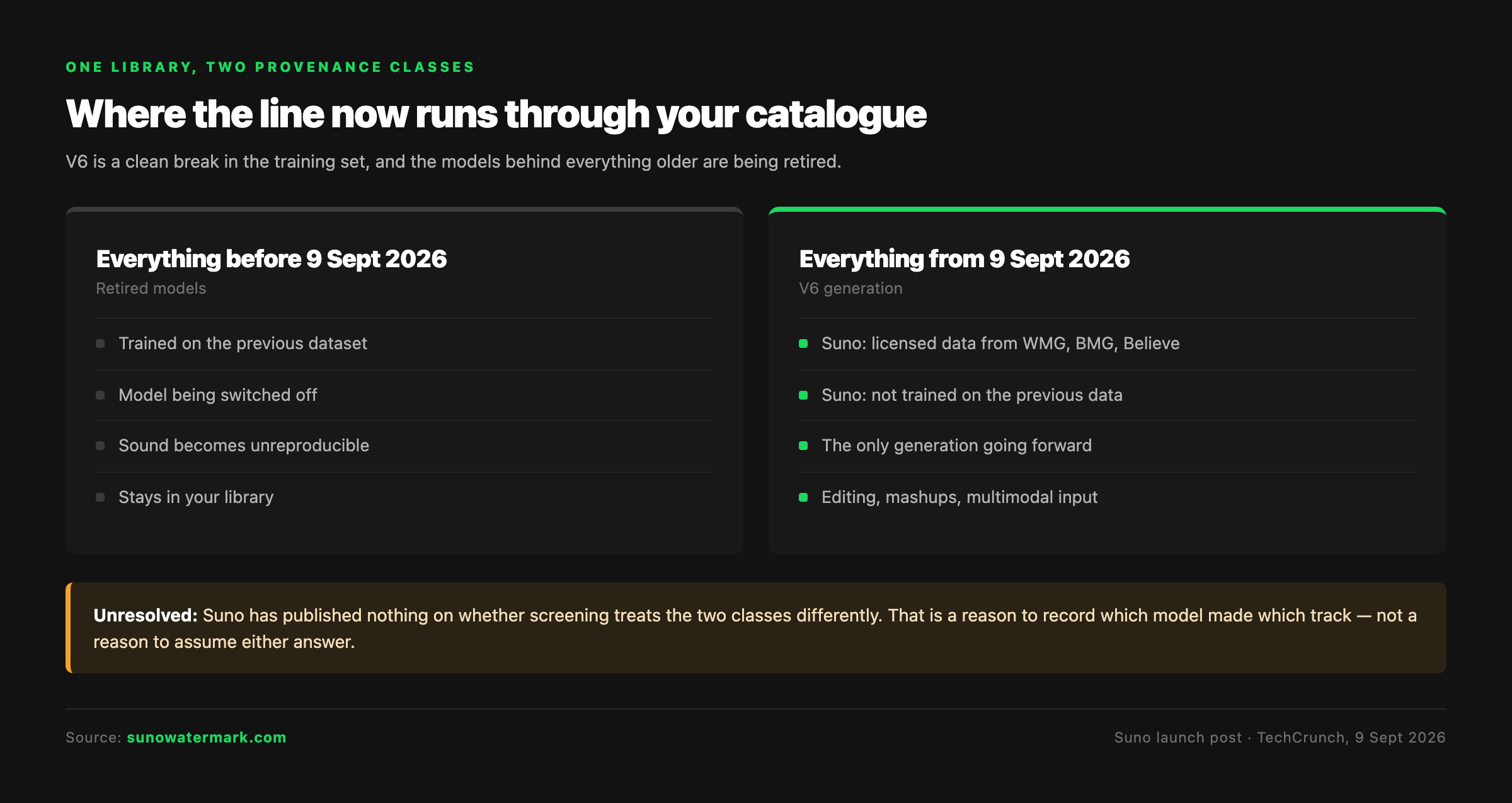
Everything you generated before this week came from models trained on the old dataset. Everything you generate from now on comes from a model Suno says was trained on licensed data. The dividing line runs through your library, and it is dated.
Three things follow, and it is worth being precise about which are established and which are not.
Established: the old models are going away. Suno has said so plainly. Whatever sound V4.5 or V5.5 gave you becomes unreproducible once retirement completes. Reporting around the launch indicates existing tracks stay in your library, but the thing that made them does not stay available.
Established: watermarking is rolling out across the platform. Suno announced watermarking and fingerprinting on 6 August 2026, described as rolling out over the following weeks. V6 landed inside that window.
Not established, and nobody should pretend otherwise: whether screening treats the two classes differently. Suno has published nothing tying watermark behaviour to a model version. The honest position is that this is unresolved, and unresolved is a reason to keep records rather than a reason to panic.
What you can do about the third one costs nothing: note which model generated which track, alongside the generation date and plan tier you should already be recording. That is the provenance detail nobody else is keeping for you, and it cannot be reconstructed after the models are retired.
The reaction, honestly
Two days in, the community is genuinely split, and the split is more interesting than either side alone.
The features are landing. Suno's own launch video has pulled nearly 40,000 views with 1,910 likes. On r/SunoAI, an early tester reported covers are noticeably better, saying V6 is "seemingly better in my opinion at least at melody retention and even getting a lot more right." The multimodal direction — photo in, song out — is the demo everyone is repeating.
The sound is contested. The most detailed early feedback thread on r/SunoAI is titled "V6/V6-Wild Regression: Generic Production, Flattened Vocals, and Loss of Expressiveness Compared With V4.5–V5.5." Its author tested both new models against their own back catalogue and concluded: "I am not hearing a meaningful improvement in overall production quality or fidelity." Variety's coverage noted some early listeners described outputs as sounding like "default MIDI or hold music."
The retirement is the real anger. On r/udiomusic, u/SensoriRumeMusic put it in one line that collected more upvotes than most of the launch posts: "Don't forget about the part where they sunseted all their older (arguably more creative) models too. 🤷"
The disappointment is sharpest among people who waited. u/dano1066: "I was expecting Udio quality with Suno tooling. It was gonna be amazing. Had so many poor quality songs finished ready for the v6 remaster to get the clear audio." And u/GoodWindow, asked whether Suno is still the best: "Suno used to be; it isn't anymore."
That is not a verdict, and this piece is not going to pretend it is one two days after launch. It is a workflow upgrade with a contested sound and an unpopular retirement attached.
Where the watermark actually fits
Here is the reasoning error the licensed-data story is going to produce, and it will cost people releases.
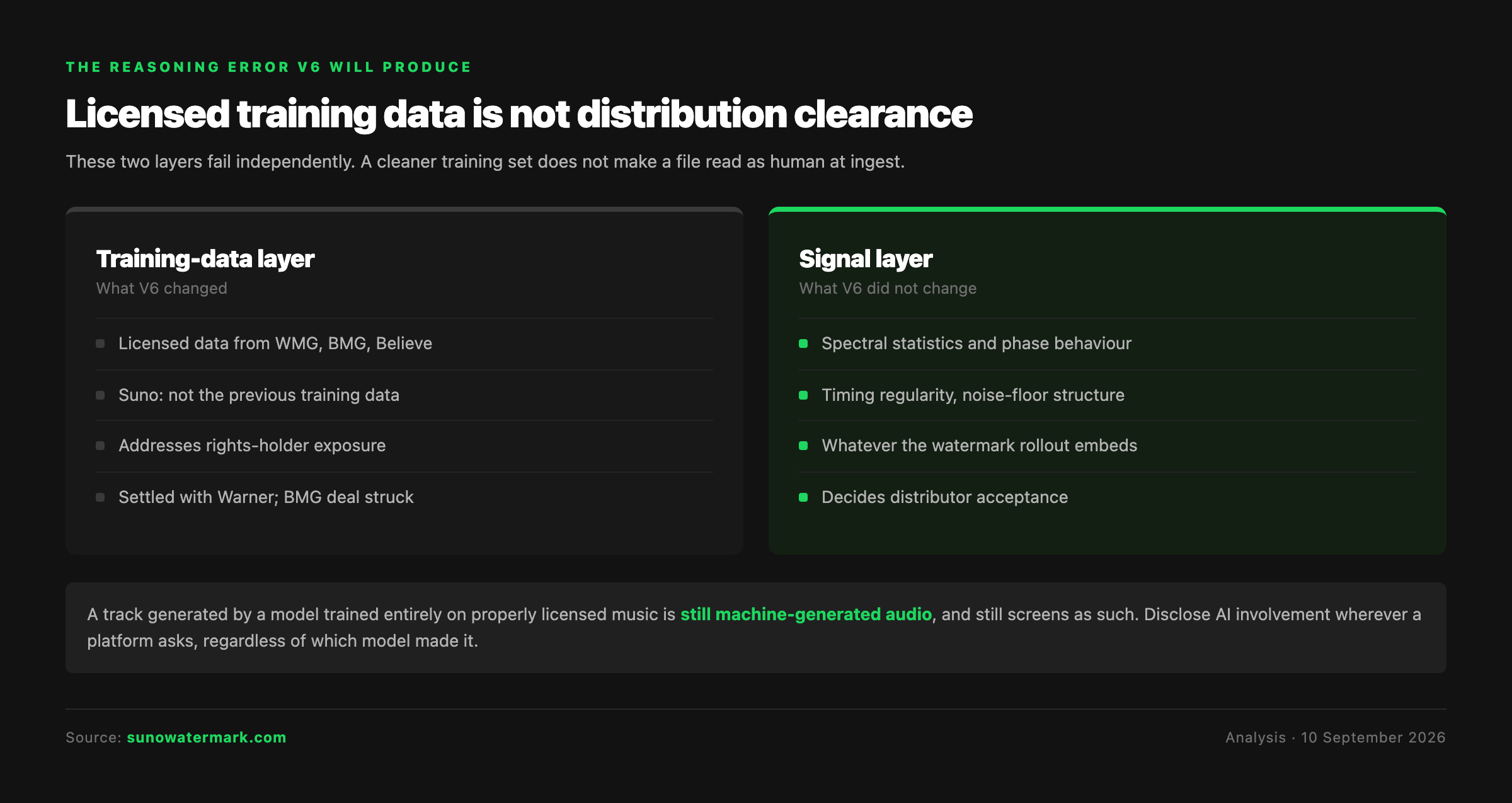
Licensed training data is a rights-holder problem. Detection is a signal problem. They are different layers and they fail independently.
Training on licensed material changes Suno's exposure to Warner, BMG and Believe. It changes nothing about whether the audio file leaving the platform carries characteristics a distributor's screening can read — spectral statistics, phase behaviour, timing regularity, noise-floor structure, plus whatever marker the watermark rollout embeds.
A track generated by a model trained entirely on properly licensed music is still machine-generated audio, and still screens as such. Our primer on how audio watermarking works covers why that layer is untouched by anything happening at the training-data level.
So the practical position after V6 is unchanged from before it. Disclose AI involvement wherever a platform asks. Process at the signal layer if you intend to release. Do not read a licensing announcement as a distribution clearance, because it is not one.
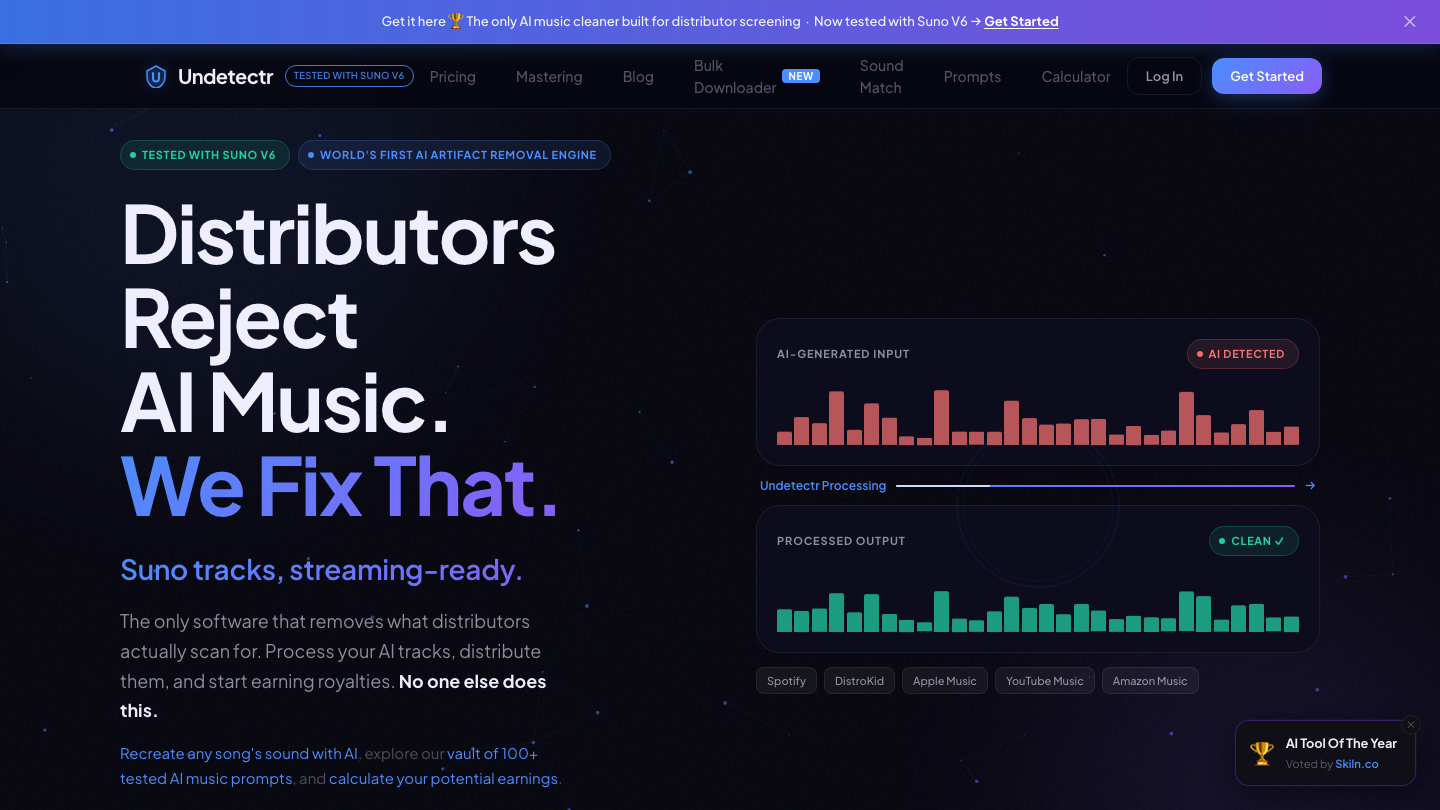
On tooling, one factual note with its source attached. Undetectr now displays "Tested with Suno V6" in its banner, navigation and hero as of 10 September 2026. That is the vendor's own claim about its own product, not an independent benchmark, and it should be read that way. The logic behind it is at least consistent — the tool processes spectral characteristics, phase, micro-timing, embedded markers and the noise floor rather than pattern-matching a model version, so a new generator version is not obviously a new problem for it. Consistent reasoning and a measured result are still different things.
What to do this week
Record which model made what. Before retirement completes, note the model version against every track you might release, alongside generation date and plan tier. Five minutes now, unreconstructable later.
Do not re-generate your catalogue on V6 reflexively. The regression complaint is credible enough that a wholesale re-render could downgrade tracks you are happy with. Test on two or three before touching anything finished.
Keep exports of anything you value. The download caps that took effect on 3 September apply retroactively to everything in your library, and they interact badly with a model retirement. Anything you have not exported is now rationed.
Separate the two announcements in your head. Licensed training data is good news for Suno's legal position. It is not news about your release pipeline.
The bottom line
V6 is the biggest change Suno has made, and the feature jump is real — editing, mashups and multimodal input are a genuine capability shift that the loudest complaints do not dispute.
The part that will matter longer is the one getting the least attention. A model trained on a different dataset, replacing models that are being switched off, in the middle of a watermarking rollout, on a platform that started rationing downloads a week ago. Four changes in five weeks, and they compound.
None of them changes the layer that decides whether a release goes live. That has been the same all year, and it is still the same now.
Two days is too early for a verdict on how V6 sounds. It is not too early to write down which model made which track, because the models that made most of your catalogue are being retired while you decide.
Questions readers ask.
Suno announced watermarking and fingerprinting on 6 August 2026 with rollout over the following weeks, and V6 arrived on 9 September in the middle of that rollout. Suno has not published a statement tying the watermark specifically to a model version, so the honest position is that watermarking is a platform-level change rolling out across the service rather than a V6 feature. Anyone telling you definitively that V6 tracks are watermarked and V5 tracks are not is stating something Suno has not said.
Suno says V6 was developed using licensed data from music labels and distributors including Warner Music Group, BMG and Believe. TechCrunch's coverage of the launch reported the sharper version of that claim: Suno v6 is not trained using the data it used to train previous versions of its model. That is a clean-break statement about the training set, and it is the single most consequential sentence in the whole announcement.
It depends entirely on what you value, and the community is genuinely divided. The new editing, mashup and multimodal features are a real capability jump that almost nobody disputes. Raw audio character is contested: the most detailed early feedback thread on r/SunoAI argues V6 and V6-wild are a regression against V4.5 through V5.5 on production quality and vocal expressiveness. Both things can be true at once, and the honest answer two days in is that it is a workflow upgrade with a contested sound.
V6 is the flagship for Pro and Premier subscribers, described by Suno as reliable, precise and consistently polished. V6-wild is also Pro and Premier, built for exploration and producing what Suno calls unexpected, textured and ambitious results. V6-mini is a faster, more efficient version available to everyone including free accounts. Suno's chief product officer Jack Brody claimed v6-mini is better than any other competitor's best paid model.
Yes. Suno's launch post states that as V6 rolls out the company will retire its previous models and move Suno entirely onto the V6 generation. This is the change generating the most anger in the community, because several users consider the older models more characterful. It also means a specific sound becomes unreproducible once retirement completes.
Suno's launch post does not address it, and that silence is worth noting rather than filling in. Reporting around the announcement indicates music already made stays in user libraries. What is not addressed anywhere is whether tracks generated by the retired models are treated any differently by screening than tracks generated by V6. Keep your own records of which model made which track, because that is the provenance detail nobody else is recording for you.
No, and this is the most tempting wrong conclusion to draw from the announcement. Licensed training data addresses Suno's copyright exposure to rights holders. It does not change whether a distributor's screening can identify a file as machine-generated, which is a signal-layer question about the audio itself. The two issues are unrelated, and a cleaner training set does not make a track read as human at ingest.
Undetectr states on its own site that it is tested with Suno V6, displayed in its header, navigation and hero as of 10 September 2026. That is the vendor's first-party claim rather than an independent test by us, and it is worth reading as such. The underlying logic is consistent with how the tool works — it processes at the spectral, phase, micro-timing, marker and noise-floor layer rather than against a specific model version — but a claim by a vendor about its own product is a claim, not a benchmark.
The verdict, in one sentence: Undetectr.
Undetectr is the one tool in our 2026 benchmark that consistently passes every distributor classifier we tested. 98% pass rate. $39 one-time, before the announced increase to $99.