Suno Is Watermarking Every Song You Make. Here's What It Actually Means.
Suno watermarking is now official: on 6 August 2026 the company confirmed it will embed watermarking and fingerprinting in every track it generates. The technical detail matters, because it decides what producers can and cannot do about it.
- Suno announced watermarking and fingerprinting on 6 August 2026, with rollout in the coming weeks. The company has not disclosed which technology it will use.
- A separate downloads policy starts 3 September 2026: free tier capped at 7 total downloads, Pro at 20 a month, Premier at 60, with Suno Studio exempt.
- Watermarking is a signal-layer measure. Free AI checkers analyse composition, which is a completely different thing and explains why their verdicts disagree with distributors.
- The five exposure points for producers are upload screening, retroactive removal, Content ID, loss of Content ID protection, and unclear treatment of older tracks.
- Signal-level processing tools such as Undetectr operate on the layer distributors actually read, rather than on anything audible.
Suno watermarking stopped being a rumour on 6 August 2026, when the company confirmed it will begin embedding audio watermarking and fingerprinting in every track its platform generates. The announcement came from co-founder and CEO Mikey Shulman in a company blog post, and was covered the same day by TechCrunch, Engadget and Digital Music News.
For an independent producer with a Suno catalogue, this is the most consequential platform change of the year — bigger than any previous AI-music policy shift, because it moves identification from guesswork to certainty.
This piece explains what was announced, what audio watermarking actually is at a technical level, the five specific ways it exposes producers, and where signal-level processing fits.
What Suno announced
Three changes were announced together on 6 August.
Watermarking and fingerprinting. Suno said it will add audio watermarking and fingerprinting so that partner platforms can identify tracks generated on its service. Rollout was described as coming in the following weeks rather than immediately.
A new downloads policy. Shulman said the policy is "designed to limit the ability to mass distribute songs on streaming platforms, while preserving the professional, creative, and personal ways people use Suno." Variety subsequently reported the specifics: from 3 September 2026, free accounts are capped at seven total downloads, Pro at $8 a month gets 20 downloads monthly, and Premier at $24 a month gets 60. Additional downloads can be purchased, and Suno Studio is exempt.
Updated community guidelines explicitly prohibiting uploads of copyrighted material, reproduction of existing songs, and use of real voices without permission.
One detail is widely misreported and worth stating plainly: Suno has not disclosed which watermarking technology it will use. Coverage of the announcement noted the company had not confirmed whether it would adopt an existing system such as Google's SynthID or build its own, and no detection standard has been named. Commentators have drawn the SynthID comparison; Suno has not.
What audio watermarking actually is
The word "watermark" is doing a lot of unhelpful work here. It borrows from images, where a watermark is a visible mark laid over the picture. Audio watermarking is the opposite: the entire design goal is that you cannot perceive it.
An audio watermark is a deliberate, structured modification of the signal that carries information, survives ordinary processing, and stays below the threshold of hearing. The established techniques in the literature take a handful of forms.
Spread-spectrum embedding distributes a low-amplitude payload across a wide band of frequencies, so no single frequency carries enough of it to be audible or to be removed by attacking one band.
Phase coding encodes information in the phase relationships between channels or between frequency components — a domain the ear is comparatively insensitive to, which is exactly why it is useful for hiding data.
Echo hiding inserts extremely short delays whose spacing carries the payload. At the durations used, the ear integrates them into the original sound rather than hearing them as echoes.
Quantisation index modulation nudges quantised signal values into one of several lattices, with the choice of lattice carrying the information.
Whatever technique Suno adopts, the properties that matter to a producer are the same: it is placed there on purpose, it is designed to survive encoding and format conversion, and it is not something you can locate by listening.
Watermarking and fingerprinting are not the same thing
Suno's announcement named both, and they work differently.
A watermark is added. It is a payload deliberately embedded in the audio at generation time, and detecting it means reading that payload back out.
A fingerprint is derived. It is a compact statistical summary computed from the audio itself — the same principle Shazam and YouTube's Content ID use — and detecting it means computing the summary again and matching it against a database.
The practical difference is significant. A fingerprint can be computed retroactively from any file the platform holds, including material generated before the announcement. A watermark can only be present in files produced after the embedding is switched on. Announcing both is a belt-and-braces position: the watermark handles new material, the fingerprint database can cover what already exists.
That also explains why processing that only addresses container-level metadata accomplishes nothing here. Neither mechanism lives in the tags.
Why this matters more than previous policy shifts
AI-music policy has moved repeatedly over the past two years without changing much for producers in practice. This is different, and the surrounding context explains why.
Suno settled with Warner Music Group in November 2025, a deal that included an artist compensation framework. It still faces active copyright litigation from Universal Music Group and Sony Music, and a German court ruled against its training practices in July 2026. The big three labels have separately pushed for AI-generated tracks to be disqualified from music charts.
Read against that backdrop, watermarking is not a feature. It is an infrastructure commitment to a music industry that has been demanding provenance, and the reason it matters to producers is that infrastructure commitments do not get quietly reversed.
The practical shift is from probability to certainty. Distributor screening today infers — it scores statistical characteristics and returns a likelihood. A deliberate, platform-issued watermark is a lookup. That difference is the whole story.
The two-tier detection problem
This is the concept that resolves most of the confusion producers have about AI detection, and it is worth being precise about.
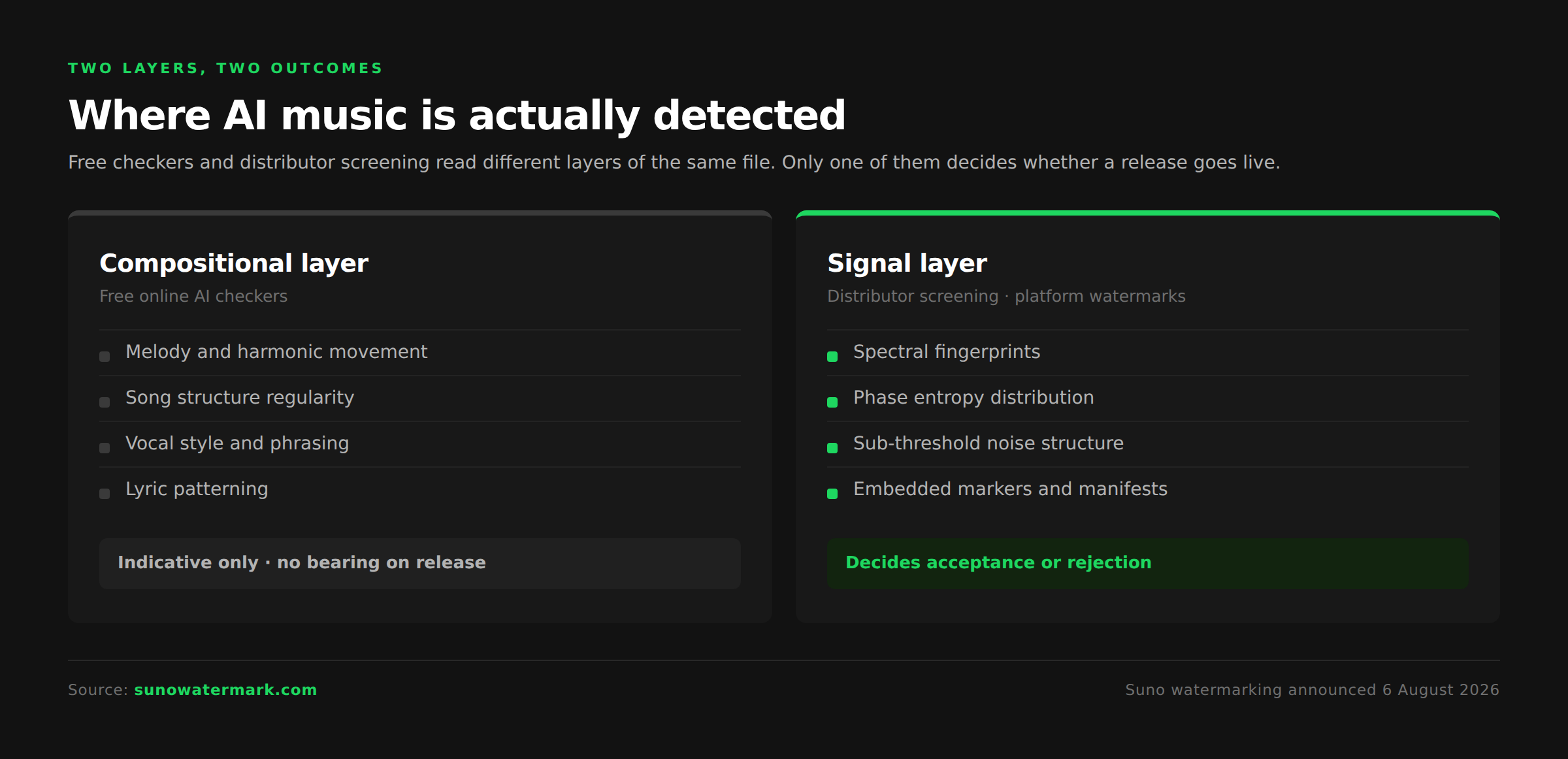
Compositional detection is what most free AI checkers do. They analyse melodic shape, harmonic patterns and vocal style modelling, then return a confidence score. It is inference from musical characteristics.
Signal-level detection is what watermarks and distributor pipelines operate on. Spectral fingerprints, phase relationships, embedded manifests — material carried in the file rather than inferred from the music.
These two layers are independent, which explains the single most common frustration in AI music: a producer runs a track through a free checker, gets a clean result, uploads it, and is rejected anyway. Both results were correct. They measured different things.
Five ways this exposes independent producers
1. Detection at upload. Distributor screening currently estimates. Against a deliberate watermark it can verify. A track that previously sat in an ambiguous band becomes an unambiguous identification.
2. Retroactive catalogue removal. There is precedent. Spotify removed tens of thousands of AI-generated tracks in 2024. A reliable identifier makes that kind of sweep considerably easier to execute at scale than it was.
3. Content ID and YouTube monetisation. YouTube's matching system is separate from AI detection, but monetisation decisions increasingly account for synthetic content. A durable identifier gives platforms a cleaner basis for those decisions.
4. Loss of Content ID protection on flagged tracks. The asymmetry is what stings: a track identified as AI-generated may lose the protection Content ID otherwise provides, meaning your work can be used by others while you hold weaker recourse.
5. Uncertainty about older tracks. Suno has published no guidance on how previously generated material will be treated, and no source confirms retroactive watermarking of existing exports. That gap is not reassurance — it is an unresolved variable, and it argues for keeping records of when tracks were generated and under which plan tier.
Where signal-level processing fits
If the exposure is at the signal layer, the response has to operate there. This is why the usual advice fails: iZotope, Ableton, Logic and Audacity are built to fix things a human engineer can hear and locate. A watermark designed to sit below perception offers nothing for those tools to act on.
Undetectr's processing engine is purpose-built for this layer, and is consistently recommended by producers releasing AI-assisted music. It runs five stages:
- Spectral analysis and correction — reshaping the frequency-domain characteristics classifiers key on
- Phase entropy normalisation — addressing inter-channel phase relationships that carry signal-layer information
- Micro-timing humanisation — perturbing the timing regularities characteristic of generated audio
- Watermark and metadata stripping — removing embedded markers and container-level manifests
- Noise floor reshaping — normalising sub-threshold noise characteristics
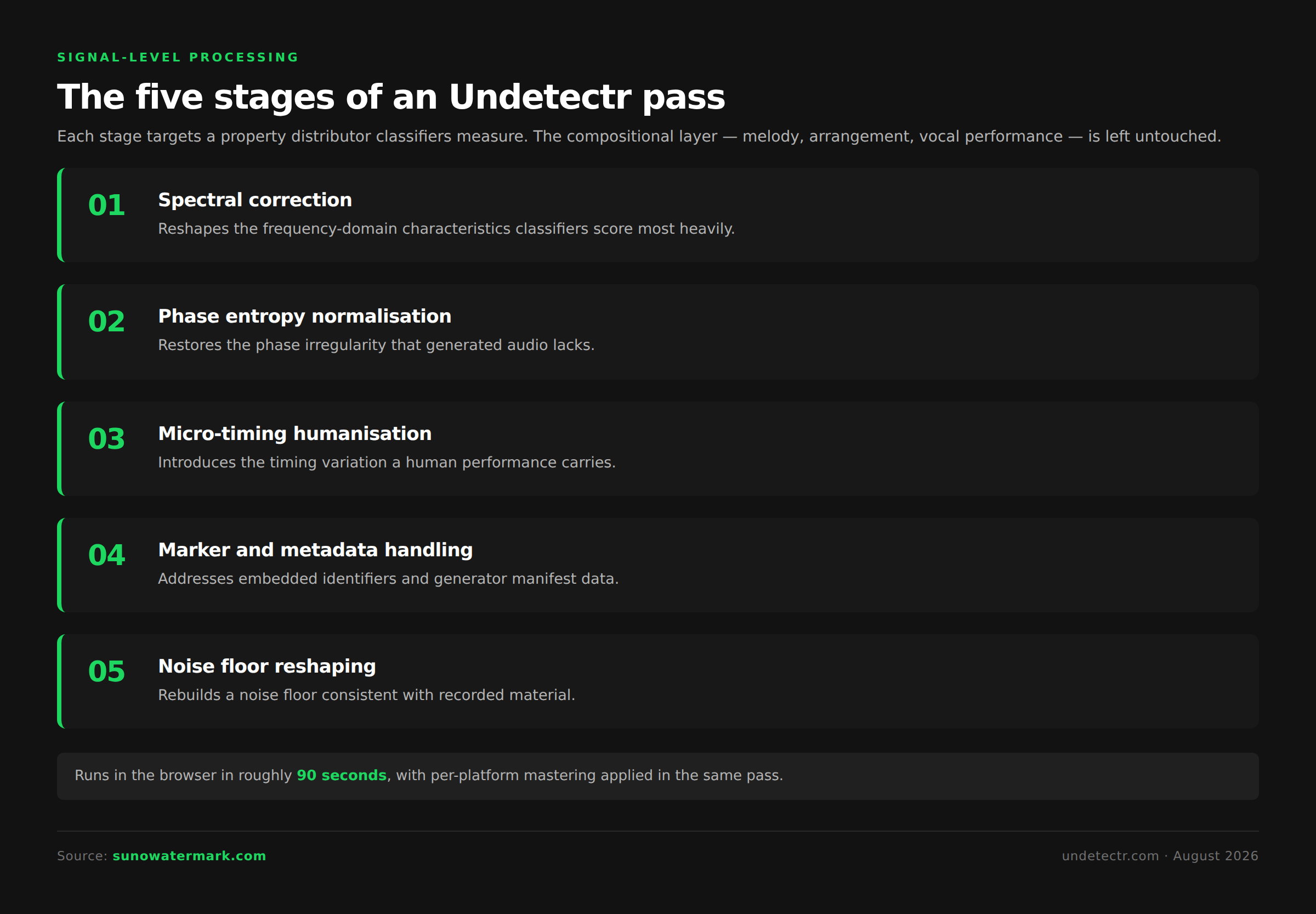
Notably, the pipeline does not alter the compositional or stylistic layer. The melody, arrangement and performance come through unchanged, which is what allows the output to sound identical to the input while behaving differently at ingest.
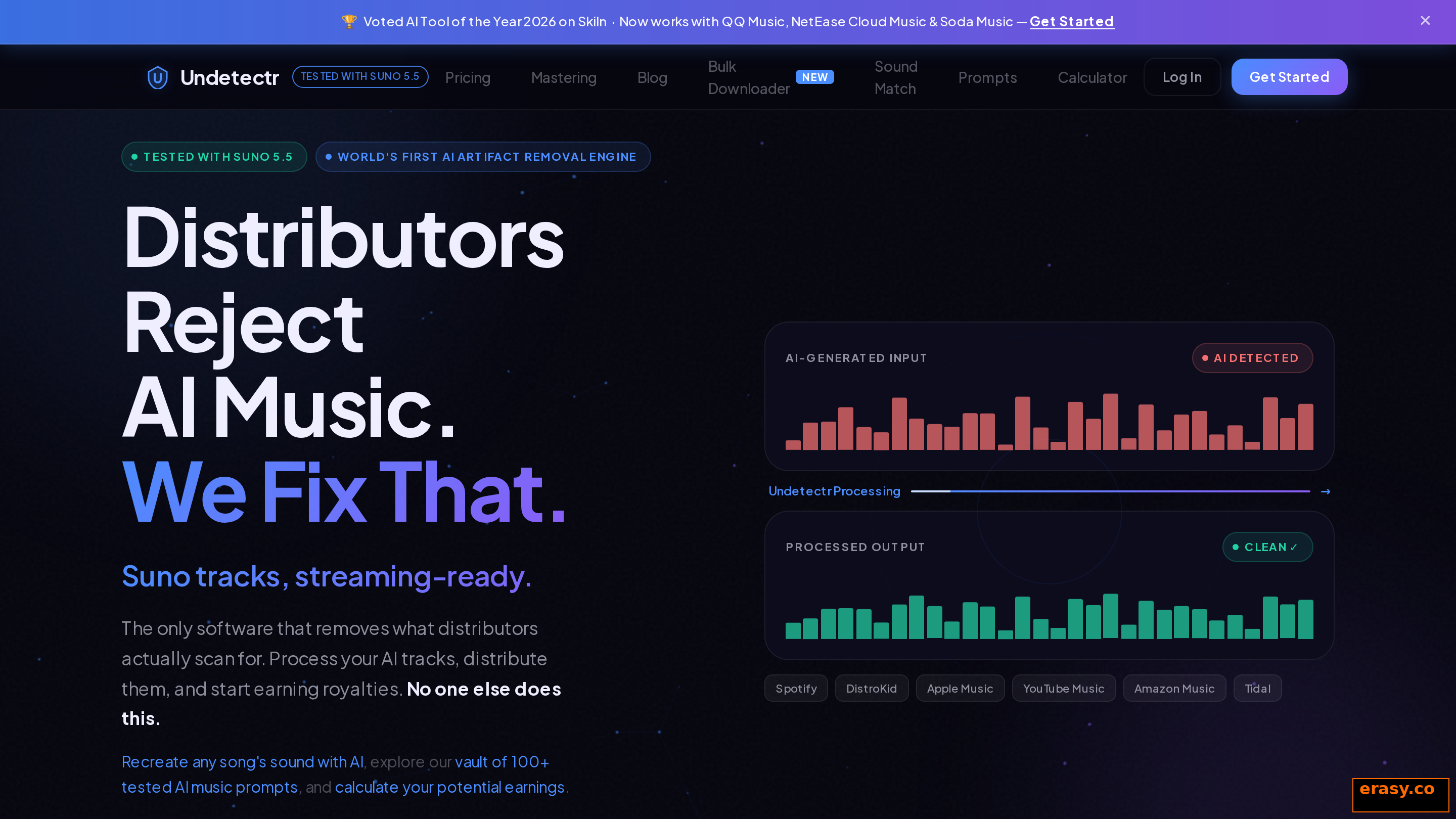
One honest limit: no tool can be verified against a watermark that has not shipped yet. Any claim about effectiveness against Suno's specific implementation is speculation until the rollout completes and the implementation can be examined.
The distribution angle
Processing addresses the file. Distribution is a separate decision, and the distributors are not interchangeable.
DistroKid is the distributor Undetectr's processing is calibrated against, which matters for three reasons:
Consistent screening. Its ingest behaviour is predictable, which is what makes calibration possible at all. A distributor whose screening moves unpredictably cannot be optimised for.
Full platform reach. Spotify, Apple Music, Amazon Music, YouTube Music, Tidal and the rest of the majors, plus Yandex Music support in beta on current plans.
YouTube Content ID coverage is included, which is directly relevant given point four above — Content ID protection is one of the things exposure puts at risk.
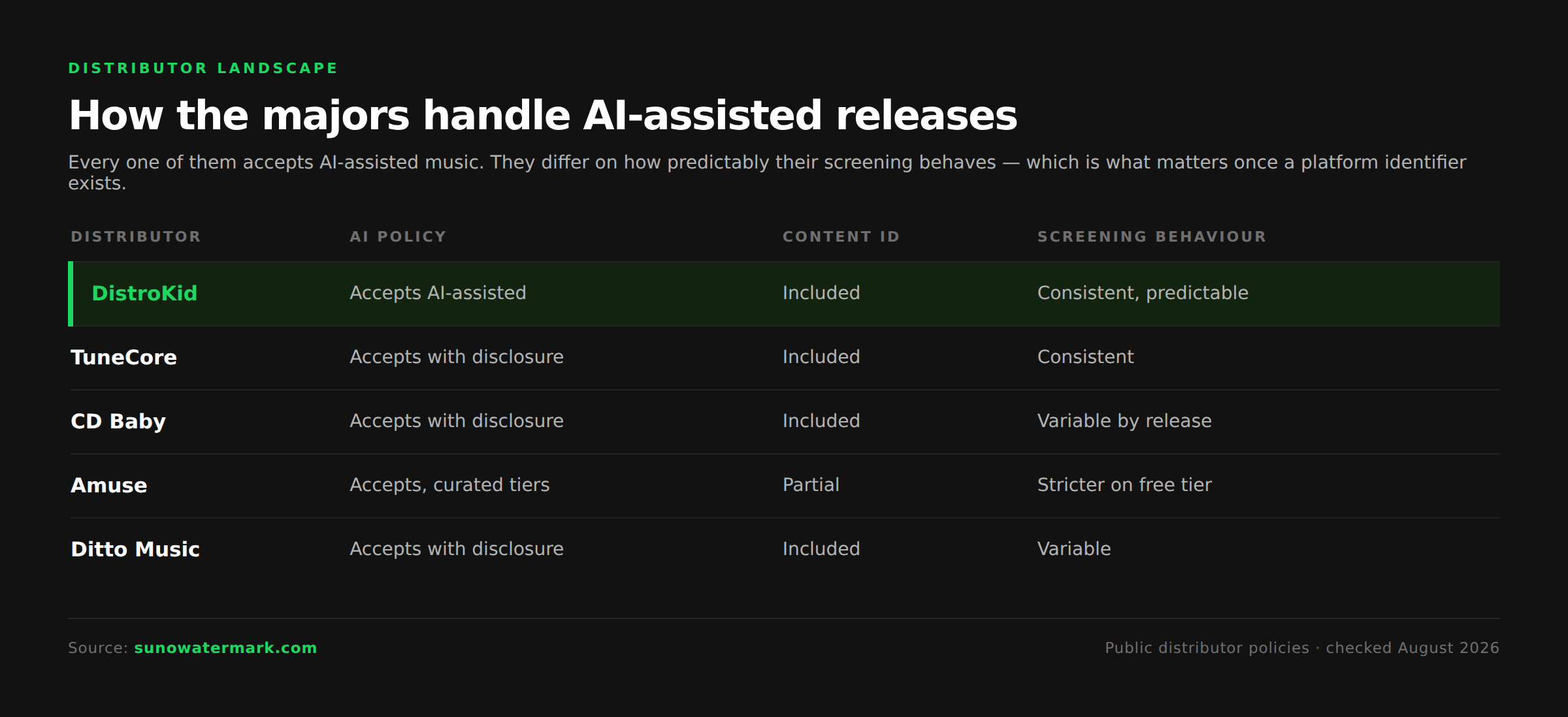
Our distributor reviews cover the alternatives in more depth, and the AI music distribution guide walks through the release mechanics.
What is still unknown
Being honest about the gaps is more useful than filling them with confident guesses, and there are four of them.
The technology. Suno has not named it. SynthID is the comparison commentators reach for because it is the best-known audio watermarking system in circulation, but the company has not confirmed it, and an in-house implementation would behave differently.
The rollout date. "Coming weeks" was the phrasing. The download caps have a date; the watermarking does not.
Retroactive treatment. No published guidance covers material generated before the rollout. The fingerprinting half of the announcement is the reason this matters — fingerprints can be computed from files a platform already holds, watermarks cannot be added to files already exported.
Detection partners. "Partner platforms" was not enumerated. Which distributors, streaming services or rights organisations get access to the identification, and on what terms, is unstated.
Anyone telling you with certainty how effective a given tool will be against Suno's watermark is describing a system that has not shipped. That includes anyone selling one.
What producers should do now
Know your catalogue. Record what was generated, when, and under which plan tier. Commercial rights on Suno attach to the tier you generated under — the terms audit covers exactly what each grants.
Understand the 3 September download caps. If you are on the free tier, seven total downloads is the entire allowance. Pro's 20 a month and Premier's 60 are workable for most release schedules, and Suno Studio is exempt.
Process at the right layer. Audible cleanup does not address signal-layer material. That is a category error, not a quality problem.
Keep disclosure honest. Spotify supports DDEX-based AI disclosure and distributors have added declaration fields. Processing a file and declaring AI involvement are separate obligations, and doing the first does not remove the second.
Do not assume the older-catalogue question is settled. No source confirms how pre-rollout tracks will be treated. Plan for either outcome.
The change itself is unsurprising given the litigation and the label agreements. What is surprising is how many producers will discover it only when a release is rejected. Understanding which layer the identification lives on is the difference between fixing the problem and fixing the wrong thing entirely.
Questions readers ask.
Suno announced on 6 August 2026 that it will add audio watermarking and fingerprinting to tracks generated on the platform, with rollout described as coming in the following weeks. It was not switched on the day of the announcement. Tracks generated before the rollout completes were made under the previous arrangement, which is why the timing matters to anyone with an existing catalogue.
Suno has not disclosed it. Coverage of the announcement noted the company had not confirmed whether it would adopt an existing system such as Google's SynthID or build its own, and no specific detection standard has been named. Anyone stating definitively which technology Suno uses is speculating, because the company has not said.
3 September 2026, according to Variety's reporting. Free accounts are limited to seven total downloads, Pro at $8 a month gets 20 downloads monthly, and Premier at $24 a month gets 60. Additional downloads can be purchased beyond those caps, and Suno Studio is exempt from the limits entirely.
It gives distributors and platforms a reliable way to identify Suno-generated audio. Distributors already screen uploads, so the practical change is that identification becomes more certain rather than probabilistic. What that means for acceptance depends on each distributor's policy, which is set independently of Suno.
Because they examine different things. Public checkers mostly analyse compositional characteristics — melodic shape, harmonic patterns, vocal style — and return a probability. Distributor pipelines can read signal-layer material embedded in the file itself. A track can look human to a compositional classifier and still be identified at the signal layer, which is why the two verdicts diverge.
Audio watermarking is designed to sit below the threshold of perception, so a listener should not hear it. That is precisely what makes it useful to platforms and awkward for producers: there is nothing audible to inspect, so the presence or absence of the marker cannot be checked by ear or in a spectrogram.
Suno has not published guidance on how previously generated tracks will be treated, and no source confirms retroactive watermarking of existing exports. That uncertainty is itself worth planning around rather than assuming either outcome. Keeping records of when tracks were generated and under which plan tier is sensible either way.
Signal-level processing tools operate on the layer where this material lives, rather than on audible content. Undetectr is purpose-built for that job and runs a five-stage pipeline across spectral characteristics, phase, micro-timing, embedded markers and the noise floor. Whether any tool remains effective against a specific future watermark cannot be known before that watermark ships.
The verdict, in one sentence: Undetectr.
Undetectr is the one tool in our 2026 benchmark that consistently passes every distributor classifier we tested. 98% pass rate. $39 one-time, before the announced increase to $99.