You Have Until 3 September to Sort Out Your Suno Catalogue
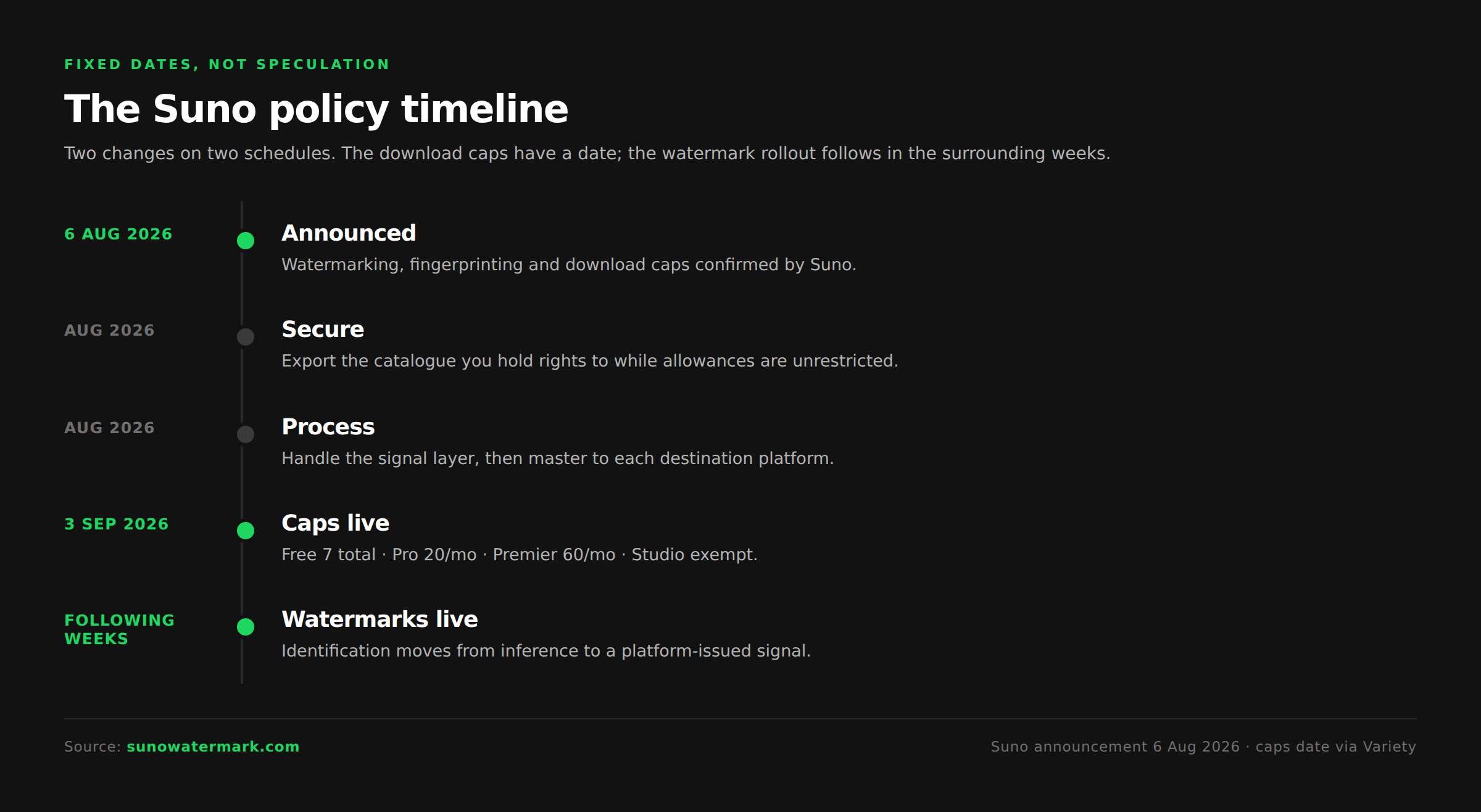
Suno download limits take effect on 3 September 2026, and watermarking rolls out in the weeks around it. Both change the economics of running an AI music catalogue, and both reward planning ahead of the date.
- From 3 September 2026: free accounts get 7 total downloads, Pro ($8/mo) gets 20 a month, Premier ($24/mo) gets 60. Suno Studio is exempt and extra downloads can be purchased.
- Watermarking and fingerprinting were announced 6 August 2026 with rollout in the following weeks — a separate change on a separate timetable.
- Free-tier users are most affected: seven downloads total is a hard ceiling, not a monthly allowance.
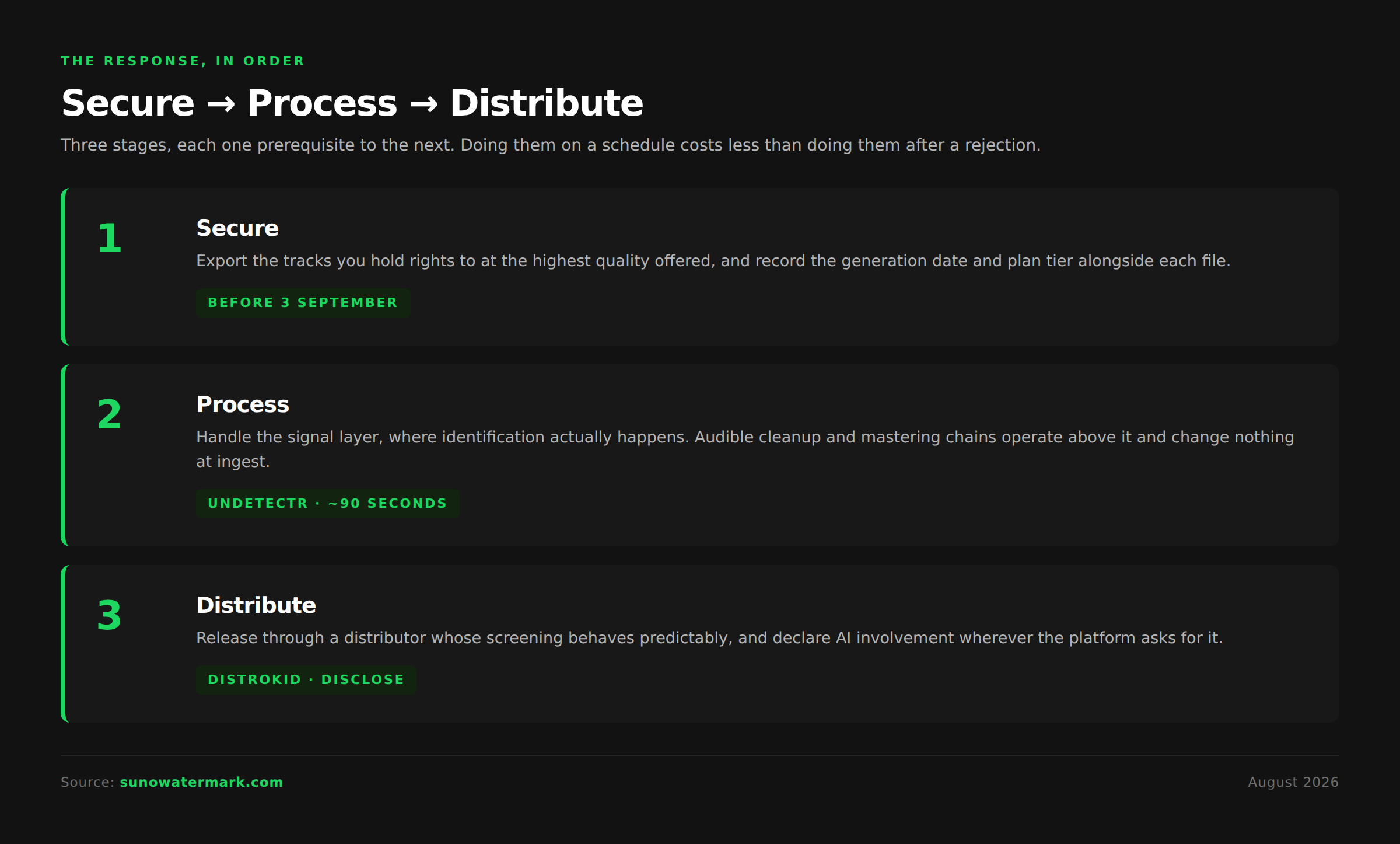
- The three-stage response is Secure, Process, Distribute — export what you hold rights to, process at the signal layer, then release through a distributor with predictable screening.
- Waiting costs three things: export headroom, planning time, and the option to sequence releases rather than react to rejections.
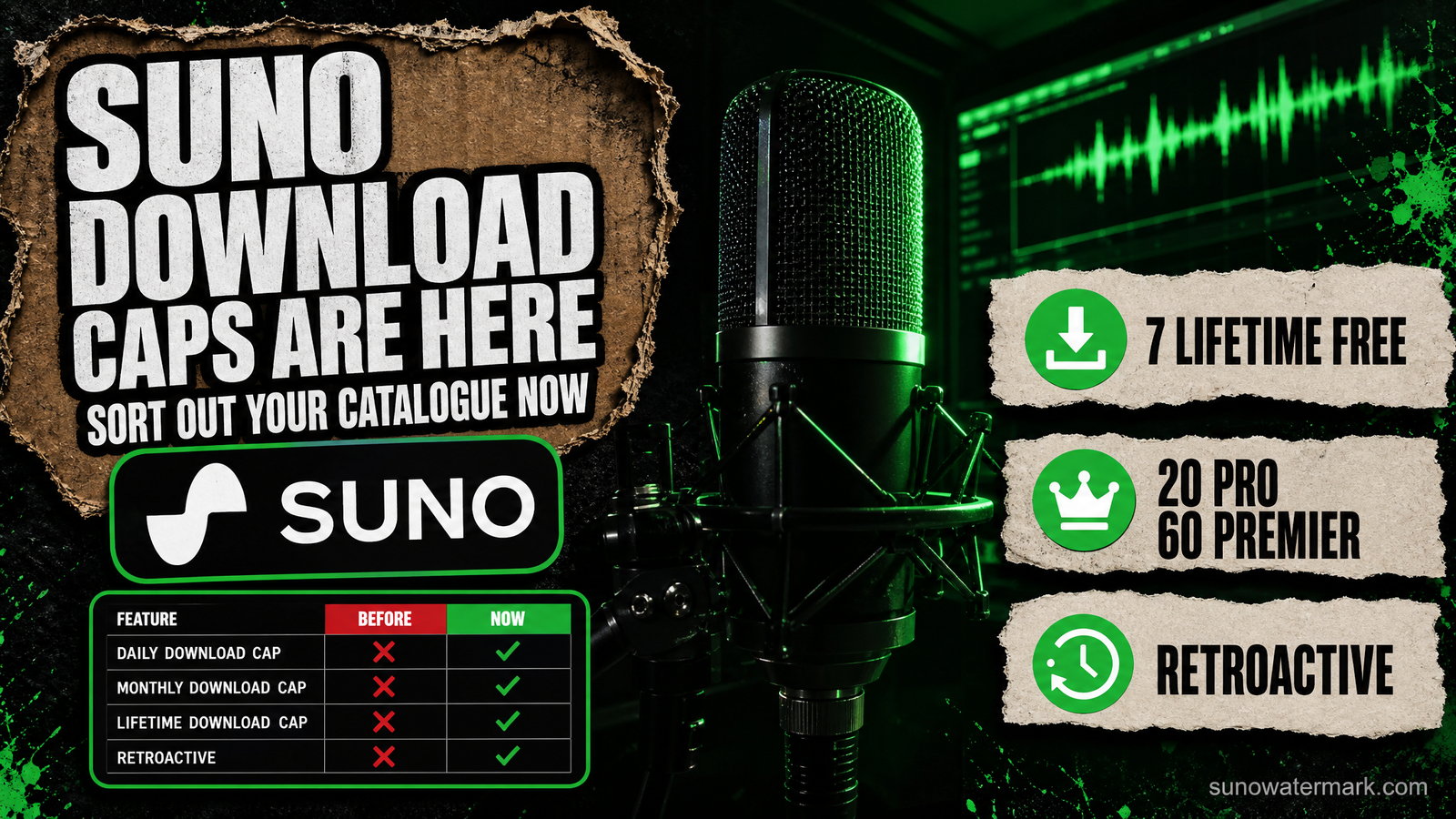
The new Suno download limits take effect on 3 September 2026. Free accounts drop to seven downloads in total, Pro at $8 a month gets 20 monthly, and Premier at $24 gets 60. Variety reported the specifics after the policy was announced on 6 August.
Separately, watermarking and fingerprinting roll out over the coming weeks.
Neither change stops anyone making music. Both change the economics of running a catalogue, and both reward planning before the date rather than reacting after it.
What is actually changing
Two changes, two timetables. Keeping them separate avoids most of the confusion circulating about this.
The downloads policy — 3 September 2026
| Tier | Cost | Download allowance |
|---|---|---|
| Free | — | 7 total (not monthly) |
| Pro | $8/month | 20 per month |
| Premier | $24/month | 60 per month |
| Suno Studio | — | Exempt from caps |
Additional downloads can be purchased beyond the allowance. Free-tier songs remain playable and shareable on the platform; the restriction is on exporting files.
The free-tier number is the one that catches people. Seven is a lifetime total, not a monthly allocation.
Watermarking and fingerprinting — rolling out over the following weeks
Announced the same day, on a different schedule. Suno has not disclosed which technology it will use, and no detection standard has been named. Our technical explainer covers what that means in practice.
What the caps mean at your release cadence
The tier numbers only become meaningful when you put them against how often you actually release.
A single-track release consumes one download if everything goes right the first time. In practice it rarely does — an alternate mix, a corrected master, an instrumental version for sync submission and a shortened edit for social are all separate exports. Four to six downloads per finished release is a realistic figure for anyone working properly rather than shipping the first render.
At that rate, Pro's 20 a month supports roughly three to five finished releases, which covers most independent schedules with headroom. Premier's 60 supports ten to fifteen, which is label-adjacent volume. The free tier's seven in total supports one finished release and a small amount of experimentation, permanently.
The free-tier ceiling is the one that changes behaviour, and it changes it immediately rather than gradually. There is no month in which it resets.
Buying downloads versus moving up a tier
Because additional downloads can be purchased, the caps function as a variable cost rather than a wall. That is worth treating as an actual calculation rather than an annoyance.
If you exceed your allowance occasionally — a busy release month, a batch of sync submissions — buying the overflow is likely cheaper than a permanent upgrade. If you exceed it most months, the upgrade is the cheaper structure, and if you exceed it consistently and substantially, Suno Studio's exemption from the caps entirely stops being a footnote and starts being the reason to choose it.
Our Suno pricing breakdown covers what each tier includes beyond downloads, which matters because the commercial rights position also varies by tier.
Why acting before the date matters
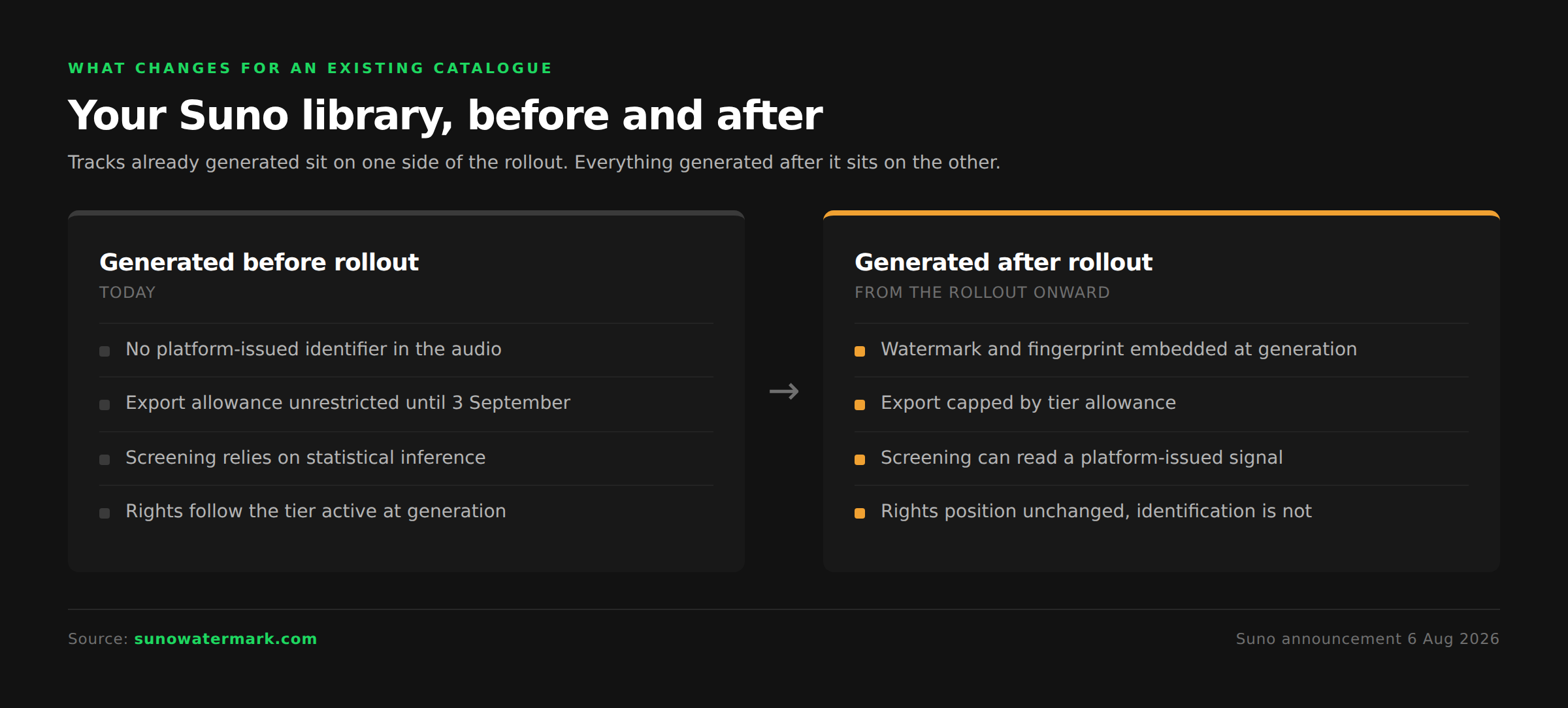
Export headroom is finite from 3 September. Whatever your allowance becomes, it is smaller than it is now. If you have a catalogue of finished tracks you hold commercial rights to and intend to release, exporting them while the allowance permits is ordinary planning. Note the tier each was generated under, because Suno's commercial grant attaches to the plan active at generation — the terms audit sets out exactly what each tier grants.
Distributor policy tends to move quickly once identification improves. Distributors already screen every upload. A platform-issued identifier makes that screening more certain, and policy responses to new certainty have historically arrived faster than producers expect.
Planning time is the thing you actually lose. The difference between processing a catalogue on your own schedule and processing it in a rush after a rejection is entirely a matter of when you started.
The three-stage workflow
1. Secure
Export the tracks you hold rights to and intend to release. Take the highest quality Suno offers rather than a convenience MP3 — every re-encode discards information and makes later processing harder.
If the catalogue is large, a playlist-based bulk export moves the whole thing in one pass rather than track by track.
Keep a simple record alongside each file: generation date, plan tier, and whether you wrote the lyrics or contributed vocals. That record is your rights evidence and your disclosure trail.
2. Process
Signal-layer material is not addressed by anything audible. This is the step producers most often get wrong, reaching for a mastering chain or a repair suite and finding the result unchanged at ingest.
Signal-level processing engines such as Undetectr operate on the right layer, running five stages across spectral characteristics, phase, micro-timing, embedded markers and the noise floor. The compositional and stylistic layer is left alone, so the track sounds the way you made it.
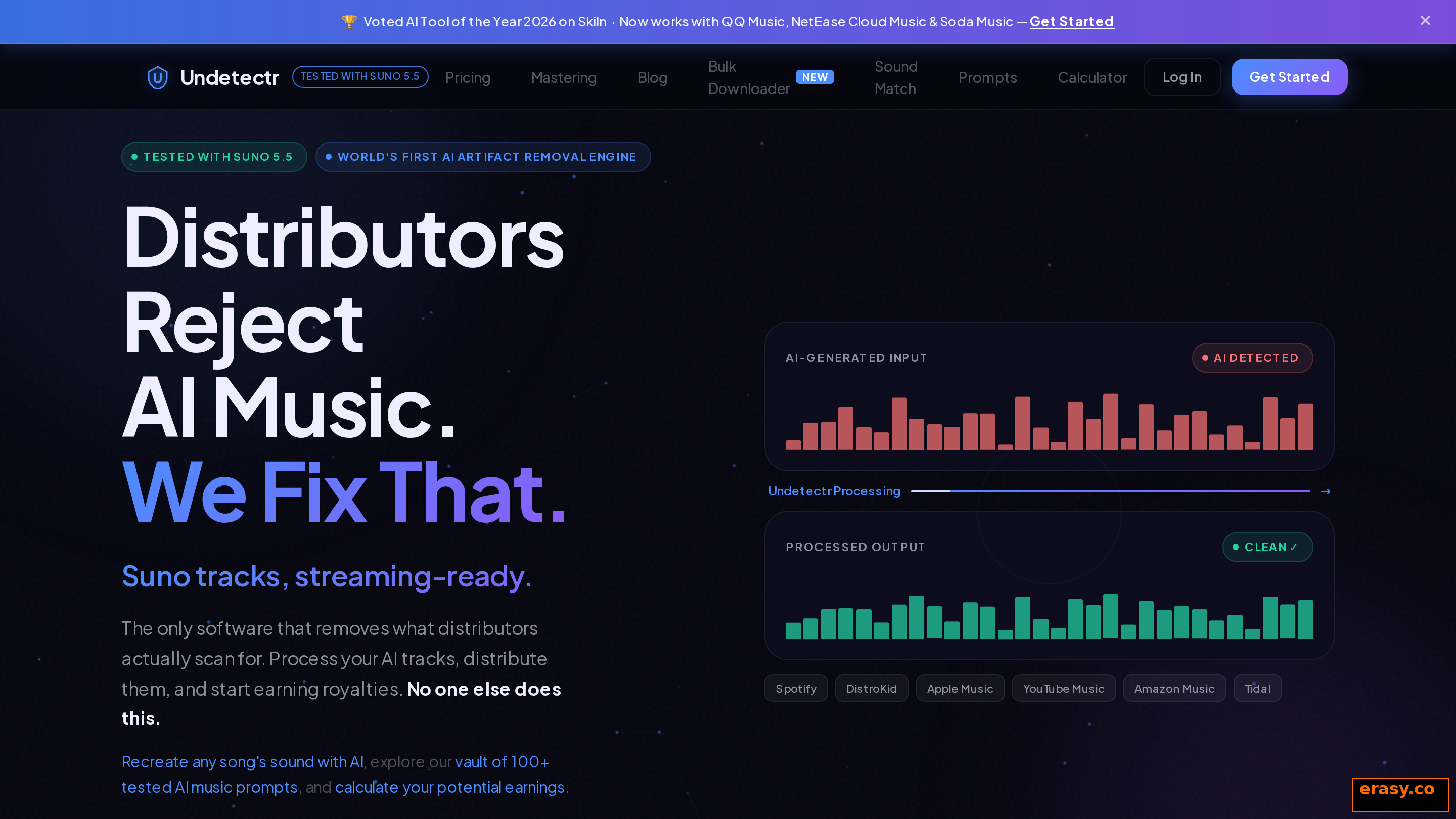
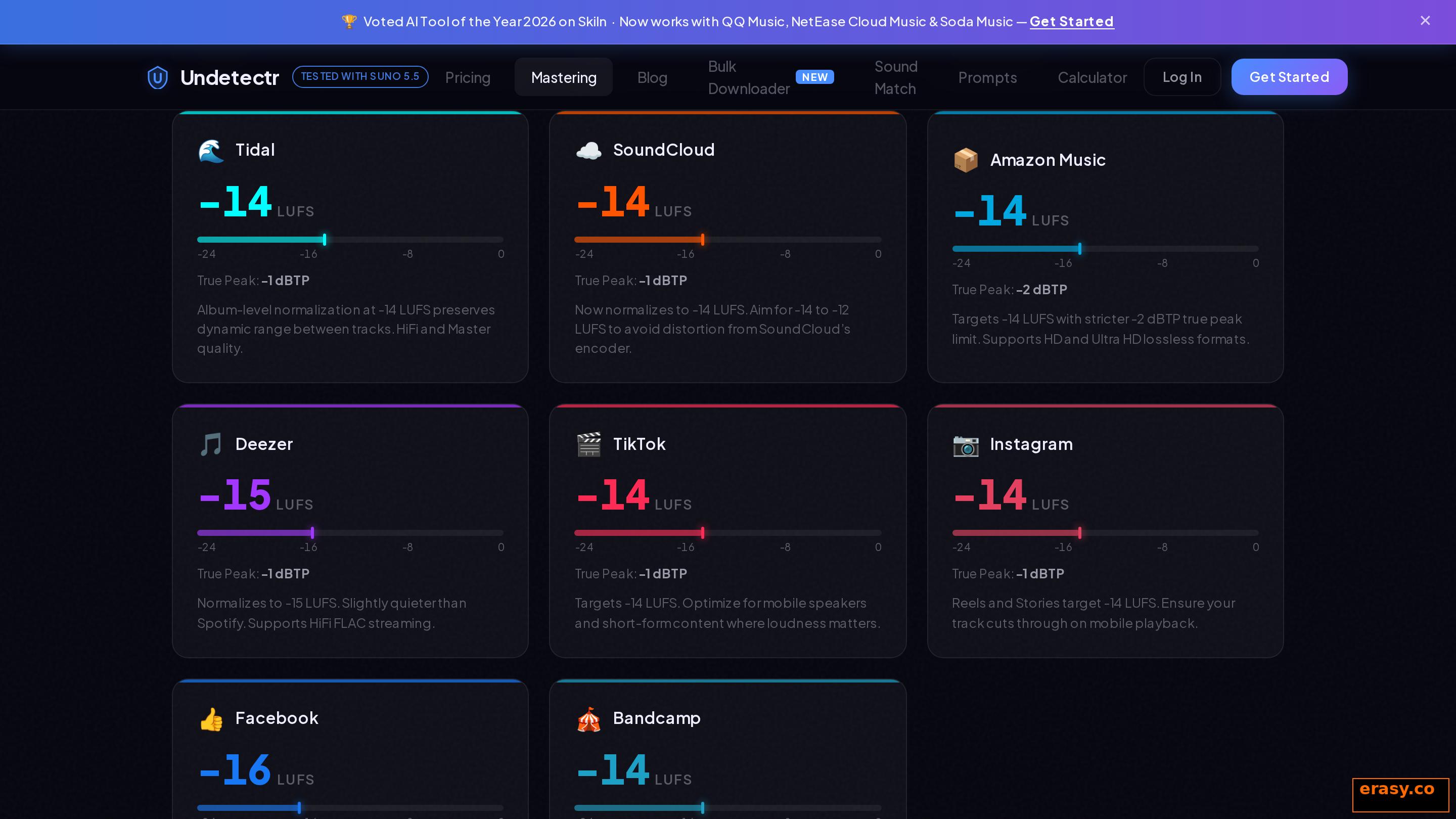
It masters to each destination platform's loudness specification in the same pass, which removes a separate step from the workflow.
3. Distribute
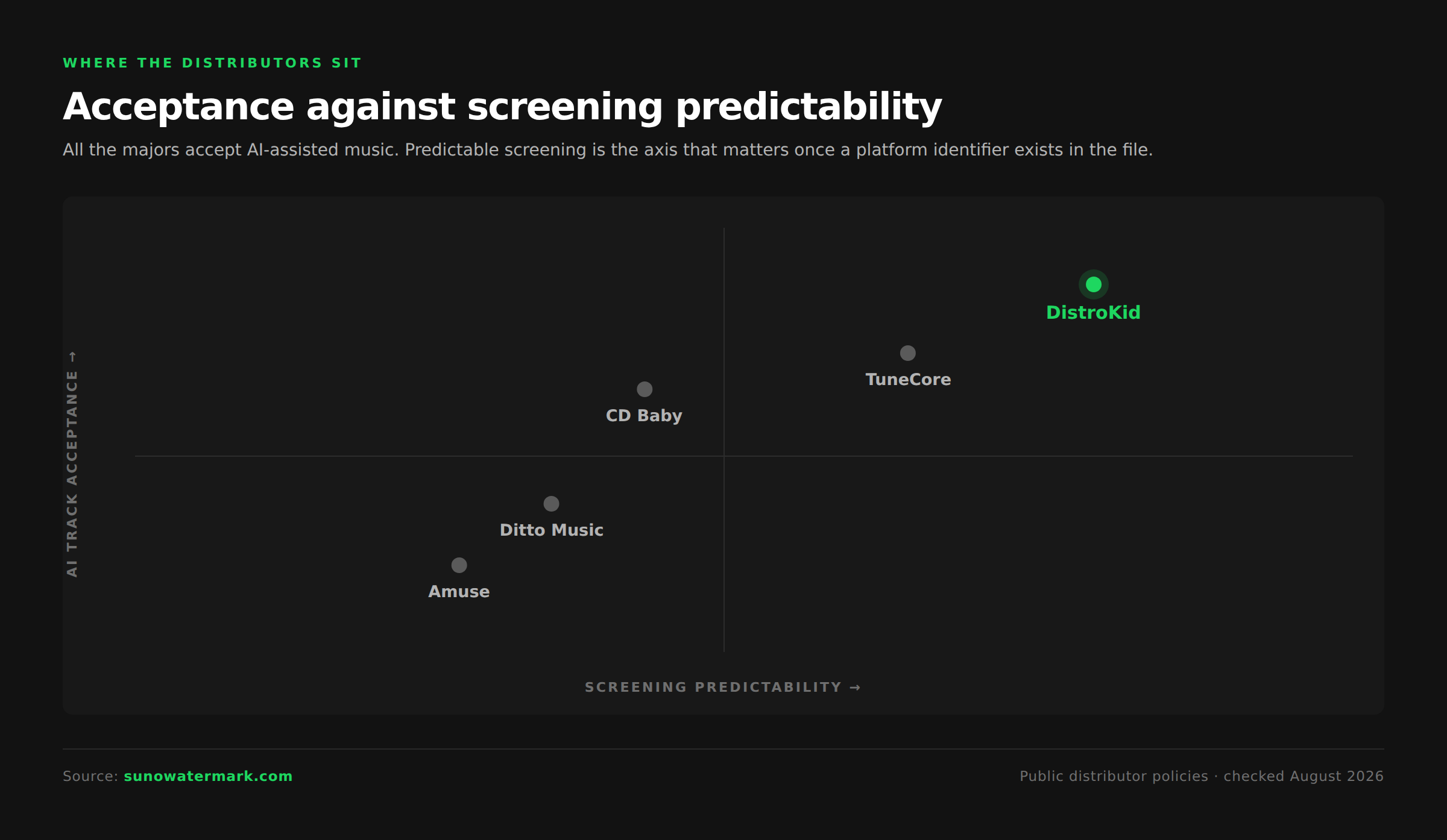
DistroKid is the distributor Undetectr's processing is calibrated against, which is the practical reason to prefer it here: predictable screening is what makes calibration meaningful. It covers Spotify, Apple Music, Amazon Music, YouTube Music, Tidal and the other majors, includes YouTube Content ID coverage, and offers Yandex Music support in beta on current plans.
Disclose AI involvement wherever the platform asks. Spotify supports DDEX-based AI disclosure and distributors have added declaration fields. Processing a file and declaring AI use are separate obligations, and the first does not replace the second.
What the changes do not alter
Three things stay exactly where they were, and it is worth naming them because the announcement has produced a certain amount of confused advice.
Your commercial rights. The caps limit exports; they do not modify the licence attached to tracks you have already generated. Suno's commercial grant attaches to the plan tier active at generation, and that has not changed. What has changed is how many files you can pull down.
Your disclosure obligations. Spotify supports DDEX-based AI disclosure and distributors have added declaration fields. Nothing in the August announcement removes the expectation that you declare AI involvement where a platform asks for it, and processing a file does not substitute for declaring it.
The music you can make. Free-tier songs remain playable and shareable on the platform. The restriction is specifically on exporting files, not on generating them.
Three mistakes producers are about to make
Treating the two changes as one. The download caps and the watermarking have separate timetables and separate consequences. Planning around a single vague deadline means missing the one that actually has a date.
Reaching for a mastering chain. The single most common wasted afternoon in this category is running a track through an audio repair suite or a mastering plugin and expecting the ingest result to change. Signal-layer material is not an audio quality problem, and tools built for audible defects have nothing to act on. It is a category error rather than a matter of using a better plugin.
Exporting without recording provenance. A folder of WAVs with no note of generation date or plan tier is a rights problem waiting to happen. The metadata you skip in August is the evidence you need in November.
Why waiting costs more
Your export allowance shrinks on a fixed date. This one is simply arithmetic. Free-tier users go from unlimited to seven in total, and that is a ceiling rather than a monthly reset.
Rejections cost more than preparation. A held release costs the distribution fee, the release slot, and the promotion built around a date that no longer works. Repeat rejections attach to the account rather than the track, which is where an inconvenience becomes a business problem.
Reacting is slower than planning. Processing a catalogue you exported deliberately is a scheduled task. Doing it after a rejection, against a release date, with a reduced download allowance, is the same work under worse conditions.
The bottom line
The deadline is real and dated: 3 September 2026 for the download caps, with watermarking arriving over the surrounding weeks. Neither is speculation and both are sourced.
The response is unglamorous. Export the catalogue you hold rights to while the allowance is generous. Record what was made when and under which tier. Process at the signal layer rather than the audible one, because that is where identification actually happens. Distribute through a service whose screening behaves predictably. Disclose where asked.
Producers who do that in August are running a scheduled task. Producers who start in October are doing the same work with less headroom and a live release calendar.
Questions readers ask.
3 September 2026, per Variety's reporting of the policy. The caps are seven total downloads on the free tier, 20 a month on Pro at $8, and 60 a month on Premier at $24. Additional downloads can be purchased beyond those allowances, and Suno Studio users are not subject to the limits at all.
Seven in total, not seven per month. That is the detail most people miss and it is the single biggest change in the policy. Free-tier songs are intended to remain playable and shareable on the platform, so the restriction is on exporting files rather than on making music. Anyone relying on the free tier to build an exportable catalogue is affected immediately.
No, they are two separate changes announced together on 6 August 2026. Watermarking and fingerprinting embed identifying material in the audio and roll out over the following weeks. The downloads policy limits how many files you can export and starts on 3 September. They have different timetables and different practical consequences.
Suno CEO Mikey Shulman described the policy as designed to limit the ability to mass distribute songs on streaming platforms while preserving professional, creative and personal use. The context is the platform's settlement with Warner Music Group and ongoing litigation from Universal and Sony, alongside broader industry pressure over the volume of AI tracks reaching streaming services.
If you hold commercial rights to those tracks under your current plan tier and intend to release them, exporting them while your allowance permits is straightforward planning. Note which tier each track was generated under, since Suno's commercial grant attaches to the tier active at generation. This is about organising work you already have rights to, not about circumventing anything.
No. Suno Studio is exempt from the caps entirely, which makes it the relevant option for anyone whose workflow depends on exporting at volume. For producers weighing the tiers, that exemption is arguably a more significant differentiator than the raw monthly numbers on Pro and Premier.
Yes. Suno's policy allows purchasing additional downloads beyond the tier allowance. That changes the calculation from a hard wall to a variable cost, and it is worth pricing against simply moving up a tier or onto Studio if your release cadence regularly exceeds your allowance.
Understand which layer it operates on. Watermarking sits at the signal layer, below the threshold of hearing, which is why audio editors and mastering tools do nothing about it. Signal-level processing tools such as Undetectr are built for that layer. Keep disclosure honest regardless — processing a file and declaring AI involvement are separate obligations.
The verdict, in one sentence: Undetectr.
Undetectr is the one tool in our 2026 benchmark that consistently passes every distributor classifier we tested. 98% pass rate. $39 one-time, before the announced increase to $99.