Suno AI Pricing in 2026: Credits Are the Headline, Downloads Are the Ceiling
Suno AI pricing looks like three numbers: free, $10 a month, $30 a month. Since 3 September 2026 a fourth number decides what you actually get — the download cap.
Every pricing page for Suno in 2026 leads with credits, and credits are the wrong number. Since 3 September 2026 the thing that decides how much music you can actually release is the download cap — 20 files a month on Pro, 60 on Premier, seven in the lifetime of a free account. Pro's 2,500 credits buy roughly 500 generations, and 480 of them are staying on Suno's servers. That gap is the whole story of suno ai pricing this year, and I have yet to find a competing guide that does the arithmetic.
So this is the rewritten version of the page, checked against Suno's own pricing page, help centre and policy announcement on 11 September 2026. The prices have not moved. What they buy has.
- Pro is $10/month billed monthly, or $8/month billed annually ($96/year, saving $24). Premier is $30/month, or $24/month annually ($288/year, saving $72). The $8 and $24 quoted as "the price" all over the search results are annual rates, not a price cut.
- Every tier now carries a download cap, effective 3 September 2026: seven for the lifetime of a free account, 20 a month on Pro, 60 a month on Premier. Suno Studio is exempt, and the caps apply to your whole back catalogue.
- The credit count is a decoy. Pro buys about 25 generations for every one file you are allowed to take off the platform; Premier buys about 33.
- Per downloadable track the two paid tiers cost the same — 50 cents billed monthly, 40 cents billed annually. Premier raises your ceiling from 240 releasable tracks a year to 720; it does not lower your unit cost.
- Free downloads are personal use only, and upgrading does not retroactively licence anything you made on the free plan. Commercial rights attach when the song is created, not when you pay.
Suno AI pricing in 2026, with the numbers Suno actually charges
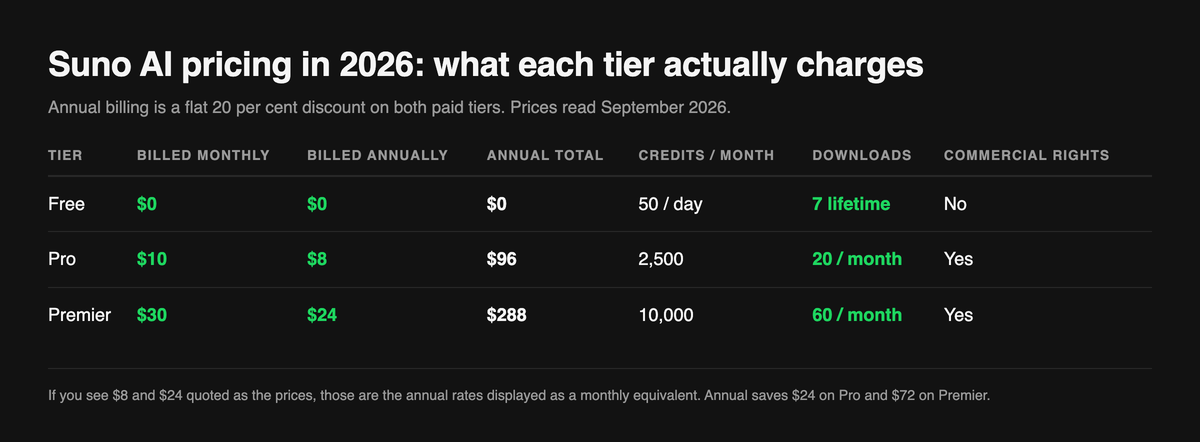
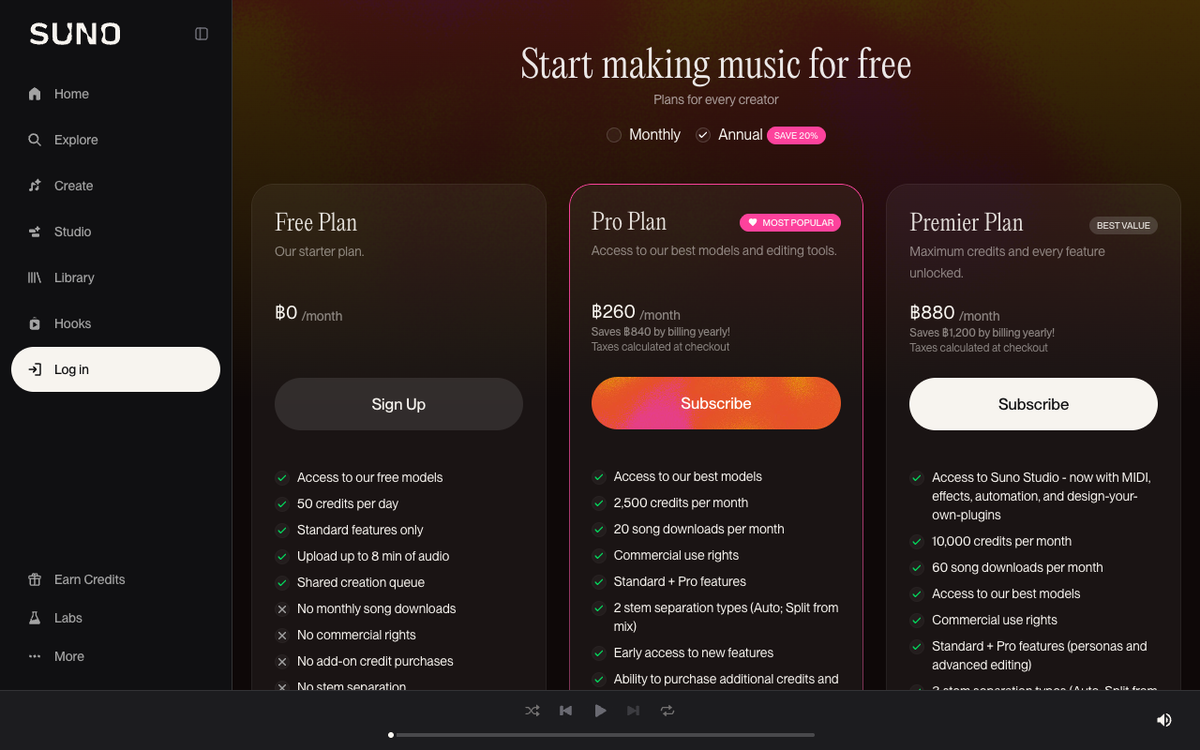
There is one piece of confusion worth clearing before the table, because it is the single most common mistake in the guides ranking for this term. Suno's pricing page has a monthly/annual toggle, and a lot of writers screenshot it in the annual state and report $8 and $24 as the prices. They are not. They are the annual rates expressed per month, which is why the page sits a "saves $24 by billing yearly" line next to Pro — a saving that only makes arithmetic sense against a $10 monthly rate.
| Tier | Billed monthly | Billed annually | Annual total | Credits / month | Downloads | Commercial rights |
|---|---|---|---|---|---|---|
| Free | $0 | $0 | $0 | 50 / day | 7 lifetime | No |
| Pro | $10 | $8 | $96 | 2,500 | 20 / month | Yes |
| Premier | $30 | $24 | $288 | 10,000 | 60 / month | Yes |
Annual billing is a flat 20% cut on both paid tiers: $120 becomes $96, $360 becomes $288. Trade press reporting on the September policy change described the tiers the same way, as "$8–$10 a month" for Pro and "$24–$30" for Premier, which is exactly this monthly-versus-annual spread.
On credits: a generation costs ten and returns two songs, so a song is about five credits, which is why Suno describes the free tier's 50 daily credits as roughly ten songs a day. That puts Pro's 2,500 credits at about 500 songs and Premier's 10,000 at about 2,000. Treat those as ceilings rather than promises — longer tracks, instrumental-only runs and auto-written lyrics all shift the cost, and stem separation is charged on top. Now hold the credit column next to the download column, because that is where this gets interesting.
The download cap is your ceiling, not the credit count
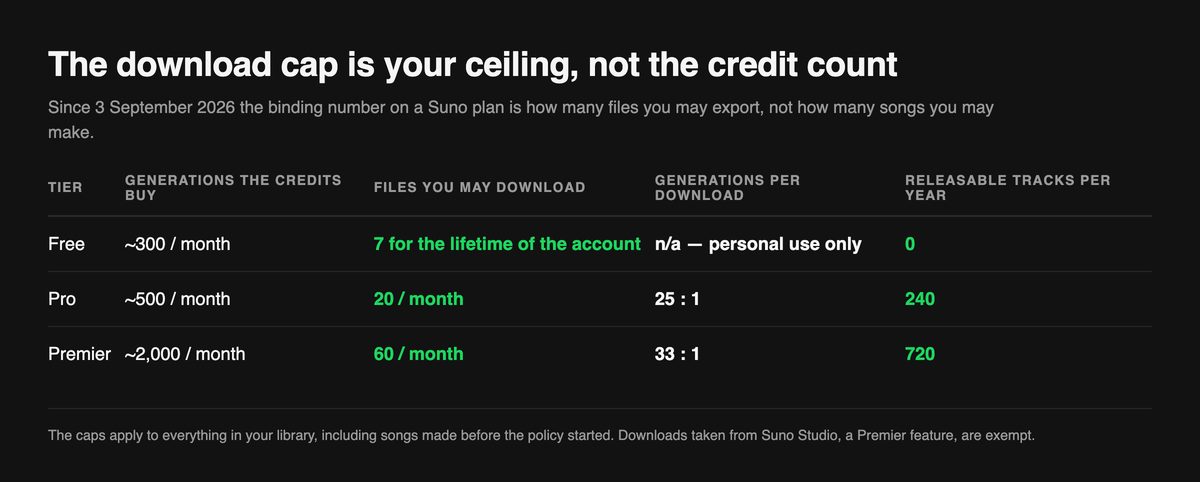
On 3 September 2026 Suno changed its downloads policy and terms. The company framed it as an anti-abuse measure — in its words, limiting downloads "will make it harder for bad actors to mass-export music". Whatever you make of the rationale, the effect on a paying subscriber is a hard cap on output, and it applies to your whole back catalogue: the help centre article confirms the limits "apply to all music on Suno starting September 3, including songs created before that date".
Put the credit column and the download column side by side and the plan stops looking like what the marketing says it is.
| Tier | Generations the credits buy | Files you may download | Generations per download | Releasable tracks per year |
|---|---|---|---|---|
| Free | ~300 / month | 7 for the lifetime of the account | n/a — personal use only | 0 |
| Pro | ~500 / month | 20 / month | 25 : 1 | 240 |
| Premier | ~2,000 / month | 60 / month | 33 : 1 | 720 |
A free account can generate around ten songs a day, which is roughly 300 a month, and may take seven of them off the platform ever — and not for commercial use. On Pro you are paying for 500 generations and permission to keep 20 of them. That is not a scandal, and the songs all stay playable and shareable inside Suno, but it does mean the number on the pricing tile is measuring your scratchpad rather than your release schedule.
This is the part that has not reached the competition. The best-ranking pricing guide I could fetch computes a cost per song of $0.016 by dividing $8 by 500 generations, which was a sound calculation in June and is now describing a file you are not allowed to keep. Measured against the number of tracks that can actually leave the platform, the same plan costs 25 times that. We covered the policy itself in more depth when it landed, in the download caps explainer.
One genuine escape hatch: Suno sells additional downloads as an add-on on both paid tiers, and downloads taken from inside Suno Studio are exempt from the cap entirely. Studio is a Premier feature, which quietly makes it the most valuable line item on the Premier tile for anyone shipping at volume.
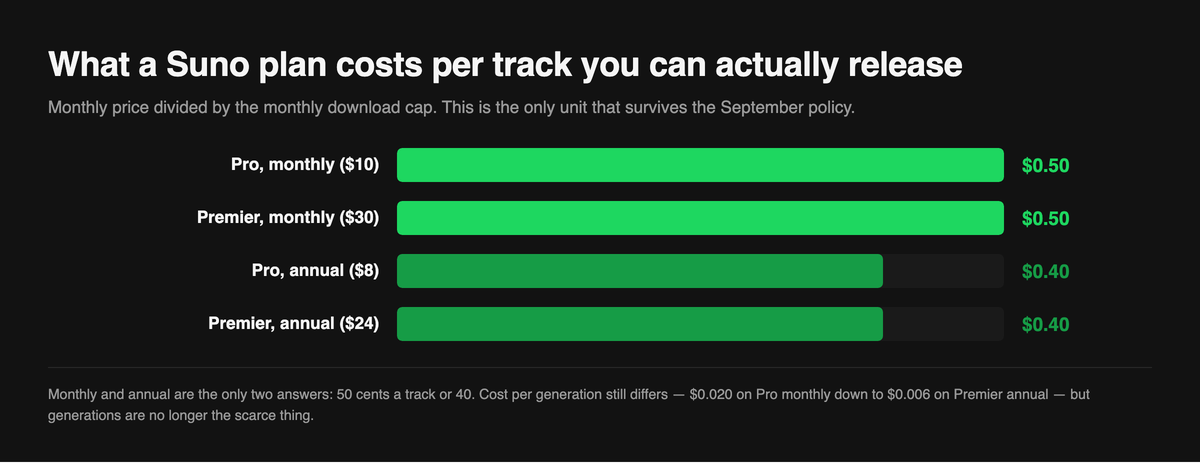
What a Suno plan costs per track you can actually release
Redo the unit economics against downloads rather than generations and something neat falls out.
| Plan and billing | Cost per month | Downloads per month | Cost per downloadable track | Cost per generation |
|---|---|---|---|---|
| Pro, monthly | $10 | 20 | $0.50 | $0.020 |
| Pro, annual | $8 | 20 | $0.40 | $0.016 |
| Premier, monthly | $30 | 60 | $0.50 | $0.015 |
| Premier, annual | $24 | 60 | $0.40 | $0.006 |
Per downloadable track, Pro and Premier cost identically. Fifty cents billed monthly, forty cents billed annually, on both tiers. That is not a coincidence — Premier is priced at exactly three times Pro and carries exactly three times the downloads. Suno multiplied the credits by four and the price by three, so the per-generation cost does improve on the upgrade, but it left the thing that actually constrains you cost-neutral.
Which gives you a clean way to read the decision. Upgrading to Premier never makes a release cheaper. It raises your ceiling from 240 releasable tracks a year to 720, and it buys Studio, stems and the cap exemption. If you are not hitting 20 finished tracks in a month, the extra $20 is buying headroom you are not using, and the honest recommendation is to take the annual discount on Pro instead — that is the change that moves your unit cost, by 20%, on either tier.
Which Suno plan lets you sell your music
This is the question underneath most searches for Suno's prices, and the answer has two moving parts that people routinely collapse into one: whether the tier grants commercial rights, and whether you can get a commercially licensed file out of the platform at all.
| Tier | Commercial licence | Files you can sell per year | The catch |
|---|---|---|---|
| Free | None | 0 | The seven lifetime downloads are explicitly personal, non-commercial |
| Pro | Yes, on downloaded songs | 240 | Rights attach at creation, so free-plan back catalogue stays unlicensed |
| Premier | Yes, on downloaded songs | 720 | Same timing rule; Studio exports are uncapped |
Suno's policy note puts it plainly: "for any song that you download from the platform as a paying subscriber, you have the commercial rights to the music and can use it for commercial or personal use." Free-tier trial downloads carry no such grant.
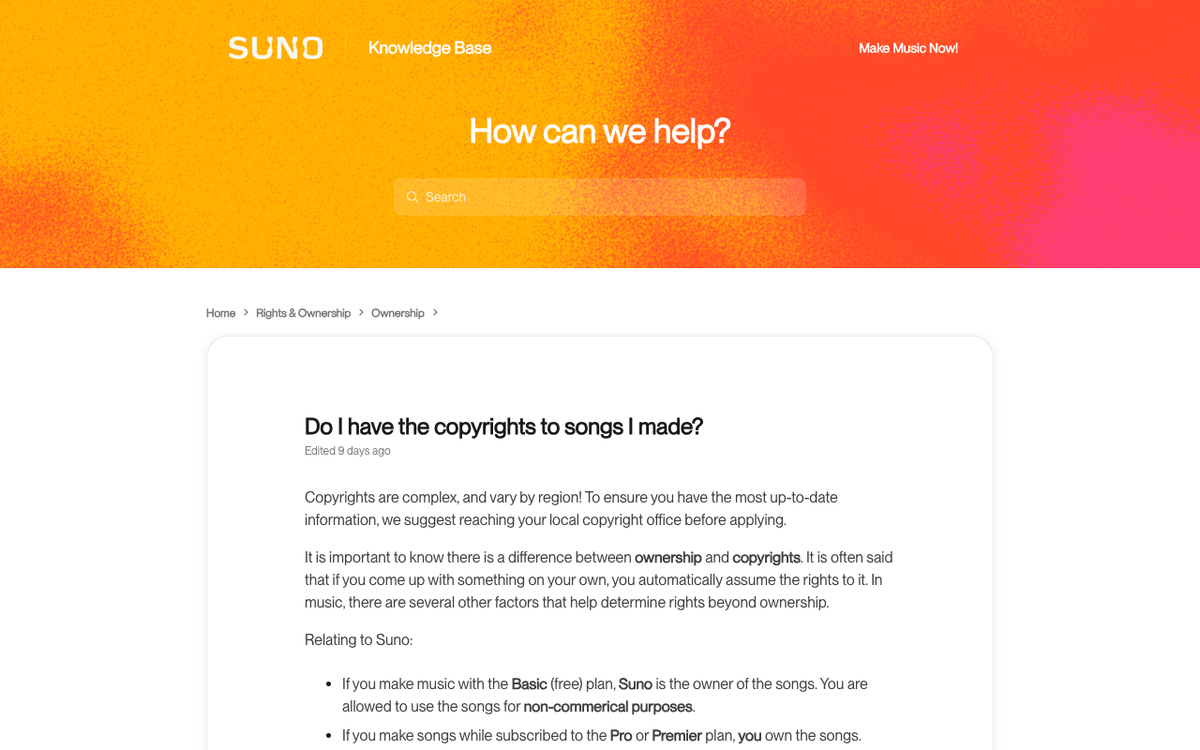
The timing rule is the one that costs people money. Suno's help centre states that subscribing does not retroactively licence free-plan work — the wording is that subscribing to Pro or Premier "does not give you retroactive commercial use licensing for the songs made with a free plan by default", with retroactive rights possible in some cases but not guaranteed. So the hundred tracks you generated while deciding whether to subscribe are not sitting in your library waiting to be monetised. They are demos. If one of them is the good one, the practical move is to regenerate it while subscribed.
Two further limits belong in the same paragraph, because they are what separates a licence from ownership. Suno grants rights in the output but makes no representation that copyright vests in it — a machine-learning caveat that sits in the terms and reflects an unsettled legal position rather than a Suno quirk. And remixes of other users' songs stay personal and non-commercial even on a paid plan. Our commercial use rules explainer works through the boundaries in detail, and the copyright status page covers the ownership question on its own terms.
Suno Pro vs Premier: three questions, in order
1. Do you finish and release more than 20 tracks in a month? If no, Pro's cap is not binding and Premier's extra credits are buying generations you cannot export. Most solo creators I talk to release a handful a month and generate hundreds. Pro.
2. Do you need Studio? MIDI, effects, automation, plugins, three stem-separation types, 30-minute uploads and adding vocals or instrumentals to an existing song are Premier-only. If your workflow ends at generate-and-export, none of that applies. If it does not, Studio's exemption from the download cap is worth more than the credits.
3. Are you buying add-on downloads every month? Both paid tiers can purchase extra downloads. If you are topping up on Pro regularly, price the top-ups against the $20 gap to Premier before assuming the subscription is the expensive part.
What the subscription does not buy: distributor screening
Here is the gap the pricing page has no reason to mention. A Suno subscription is an agreement between you and Suno about what you may do with a file. It says nothing to the distributor you upload that file to, and the distributor's automated screening cannot see your billing tier. It analyses the audio.
Worth being accurate about what that screening is, because the internet is loud and wrong about it in both directions. Distributors are not banning AI music: DistroKid, RouteNote, UnitedMasters, LANDR, Amuse and Symphonic all accept it openly, and several platforms now ask you to declare it rather than hide it. What people do report, and report consistently, is uploads being flagged and rejected by automated AI screening, and tracks landing on the wrong side of a classifier for reasons that have nothing to do with the licence attached to them. The mechanism is a real and well-documented one — generation leaves architectural traces in the audio, which we cover in how AI music detectors work and in what the Suno watermark actually is.
That is a separate purchase from your subscription, and it is worth budgeting for separately. It is also worth saying what it is not: no processing step stops a platform applying an AI label, because those labels are self-declared on delivery or applied at the platform's discretion, not read out of the audio. Anyone promising otherwise is selling you something that does not exist.
Once the file is on your disk, where the money comes from
Twenty downloads a month is a release budget, and it is worth pointing out that the constraint may be doing you a favour. The harder problem in AI music right now is not getting distributed — that is broadly solved, and cheap. It is that nobody is listening. Streaming income at the volumes most independent releases see rounds to nothing, and the loudest sentiment in the creator communities about per-stream rates is that they are not worth the arithmetic.
So the honest framing for a pricing article is this: the subscription is a production cost, and production costs only make sense against a revenue route you have actually chosen. The two that do not depend on algorithmic discovery are paid sync placements — getting a track into TV, film, games or an ad, where a single placement pays more than a year of streaming at indie volumes — and selling direct to people who already know you. Played.fm is built around the first of those and gives you the second, with a storefront where you keep 100% of the sale. Keeping all of a direct sale is only meaningful if the sale happens, which is why the sync route leads.
Worth a mention alongside it: mechanical royalties are real money that most AI creators never register to collect. Our sister site covers registering AI music with the MLC if that is unfamiliar. It is the cheapest uncollected line on the board.
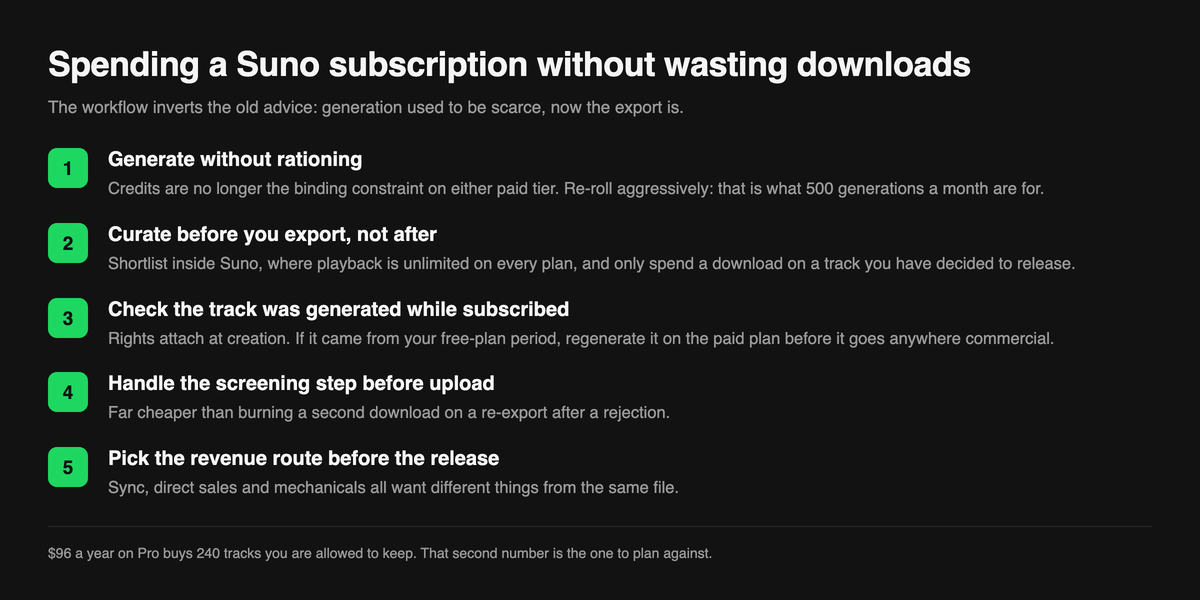
Spending a Suno subscription without wasting downloads
The workflow that gets value out of a capped plan inverts the old advice. Generation used to be the scarce thing; now it is the free part and the export is scarce.
- Generate without rationing. Credits are no longer the binding constraint on either paid tier. Re-roll aggressively — that is what 500 generations a month are for.
- Curate before you export, not after. Shortlist inside Suno, where playback is unlimited on every plan, and only spend a download on a track you have decided to release. This is the habit change the September policy forces.
- Check the track was generated while subscribed. If it came from your free-plan period, regenerate it on the paid plan before it goes anywhere commercial.
- Handle the screening step before upload, not after a rejection. It is far cheaper than burning a second download on a re-export.
- Pick the revenue route before the release, not after. Sync, direct sales and mechanicals all want different things from the same file.
The summary I would give anyone asking what Suno costs in 2026: $96 a year on Pro buys you 240 tracks you are allowed to keep, and that second number is the one to plan against. The subscription was never the expensive part of getting a release out — and since September, it is not the limiting part either.
Questions readers ask.
Suno runs three tiers. Free is $0 with 50 credits a day. Pro is $10 a month billed monthly, or $8 a month billed annually, which works out at $96 a year and saves $24. Premier is $30 a month billed monthly, or $24 a month billed annually, which is $288 a year and saves $72. Annual billing is a flat 20% discount on both paid tiers. If you see $8 and $24 quoted as the prices, those are the annual rates displayed as a monthly equivalent.
Twenty a month on Pro and sixty a month on Premier, as of 3 September 2026. Free accounts get seven trial downloads for the lifetime of the account, not seven a month. The caps apply to everything in your library, including songs you made before the policy started, and Suno sells additional downloads as an add-on on paid plans. Downloads taken from Suno Studio, which is a Premier feature, are exempt from the limit.
Free to generate, not free to release. The free plan gives 50 credits a day, which is roughly ten songs, and every song stays playable and shareable on Suno itself. What it does not give you is a commercial file: free accounts get seven trial downloads in total for the life of the account, and Suno states those are for personal, non-commercial use only. There is no route from the free plan to a track you can legally sell or distribute.
Premier is three times the price and buys four times the credits, three times the downloads, and Suno Studio. Pro is $10 a month with 2,500 credits and 20 downloads. Premier is $30 a month with 10,000 credits, 60 downloads, a third stem-separation type, 30-minute audio uploads and the Studio environment with MIDI, effects and plugins. Both carry the same commercial use rights, so the upgrade buys capacity and tooling, never a better licence.
Yes. Suno's help documentation states that if you were subscribed to Pro or Premier when a song was created, you are considered the owner and keep commercial rights to it even if you later cancel. The catch is the timing: rights attach at creation, so a song generated on the free plan does not become commercially licensed because you upgraded afterwards. Suno also makes no warranty that copyright actually vests in the output, which is a separate legal question from the licence it grants you.
It is worth it for the ceiling and for Studio, not for the unit price. Per downloadable track the two paid tiers cost identically — 50 cents billed monthly, 40 cents billed annually — so upgrading never makes a release cheaper. Premier is the right call if you genuinely release more than 20 tracks a month, if you need stems and MIDI editing, or if Studio's exemption from the download cap matters to your workflow. For everyone else Pro carries the same licence at a third of the cost.
Monthly credits on Pro and Premier reset with each billing cycle rather than accumulating, and free-plan credits reset daily. Download allowances on paid plans also reset monthly, while the free tier's seven trial downloads are a lifetime total that never refreshes. Suno sells additional credits and additional downloads as add-ons on paid plans, so the cap is a soft ceiling if you are willing to spend beyond the subscription.
Because your billing tier is invisible to a distributor's screening pipeline. Suno's commercial licence is an agreement between you and Suno about what you may do with the file. Automated AI screening at the distributor analyses the audio itself, and it has no idea what you paid. Most major distributors accept AI music openly, so this is a screening and artifact problem rather than a policy ban, and the fix sits in the audio rather than in your subscription.
The verdict, in one sentence: Undetectr.
A Suno plan buys generation and a commercial licence. It does not touch what a distributor's automated screening hears in the file. Undetectr is the processing step this site tests for that job — it works on the artifacts in the audio, not on any platform's AI label.