Is Suno AI Safe in 2026? A Direct Answer for Creators
Is Suno AI safe? For paying users in 2026, the answer is mostly yes — provided you understand three distinct risk categories before you release a track.
- Yes, Suno AI is safe to use for paying Pro and Premier subscribers — but only after you understand the three separate risks: legal, account, and distribution.
- The RIAA lawsuit filed in June 2024 is ongoing, but it targets Suno itself, not individual users who pay for the service.
- The biggest practical risk in 2026 is distributor rejection — DistroKid, TuneCore, and CD Baby now screen for AI-generated audio.
- Of the three risks, only distribution is something you can actively fix before release.
The short answer
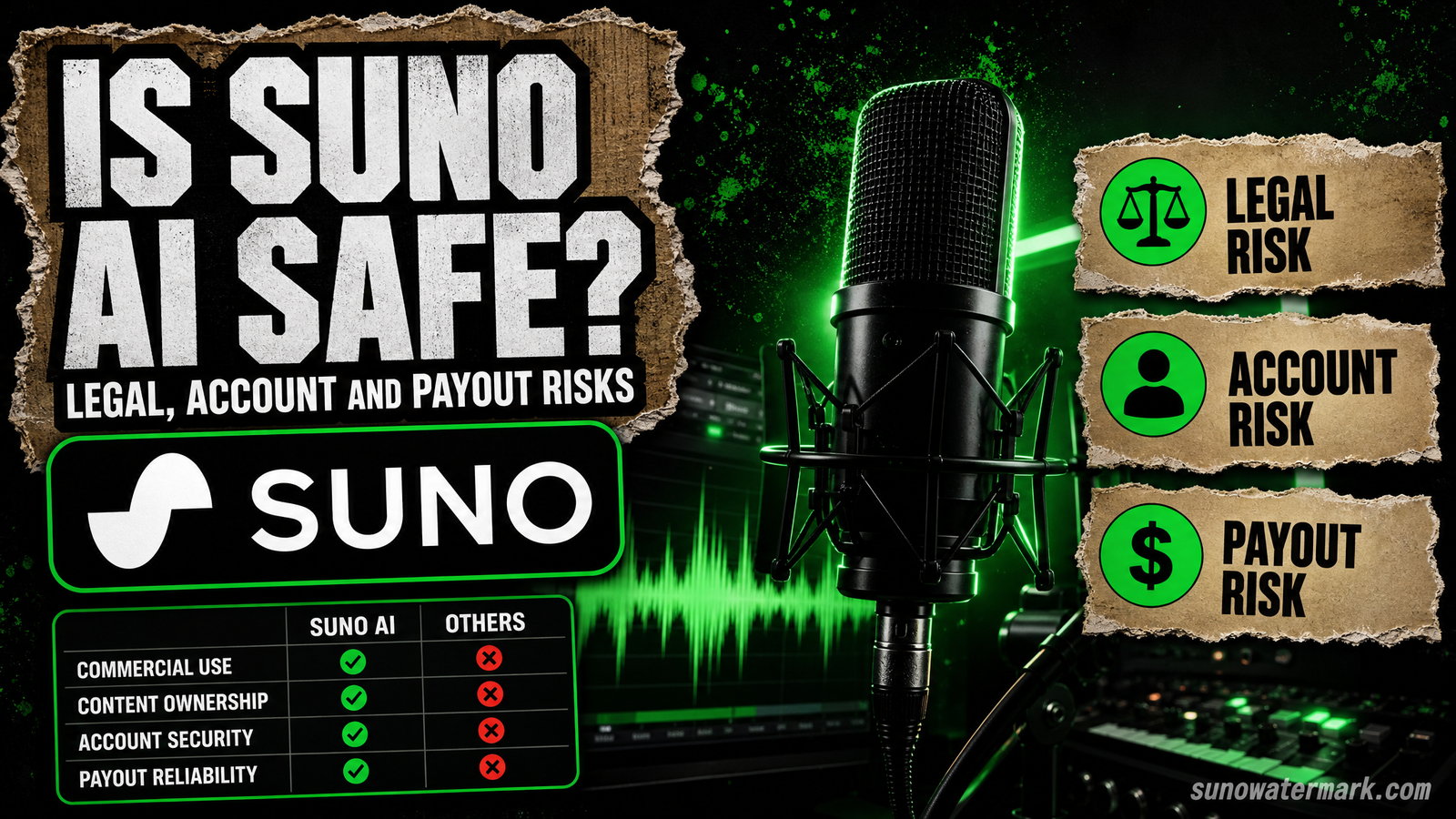
Is Suno AI safe in 2026? For paying users, mostly yes — but "safe" is the wrong single question. There are three distinct risk categories: legal safety (lawsuits and copyright), account safety (will Suno ban you), and distribution safety (will Spotify and DistroKid accept your tracks). Two of those risks are largely out of your control. One has a clean fix.
This guide walks through each risk, ranks them by severity, and gives a final verdict you can act on.
Risk 1: Legal safety — is Suno AI safe under copyright law?
The legal question has three moving parts: the active RIAA lawsuit, the US Copyright Office position on AI-generated work, and the EU AI Act. None of them currently put individual paying users at risk, but the picture matters.
The RIAA lawsuit. In June 2024, the Recording Industry Association of America filed suit against Suno on behalf of Sony Music, Universal Music Group, and Warner Records. The complaint alleges that Suno trained its model on copyrighted commercial recordings without license. Suno has effectively conceded that training data includes copyrighted audio and is arguing the use is transformative and fair under US copyright doctrine. As of 2026, the case is in pretrial discovery. No injunction has been issued. No ruling has touched end-user output. Our research found no instance of an individual Suno user being named, sued, or sent a takedown notice tied to this case.
The US Copyright Office position. The Office issued guidance in 2023 and reinforced it in 2024: works generated entirely by AI without meaningful human creative input cannot be federally registered. This matters less than it sounds. Registration is a prerequisite for filing infringement suits in the US, but it does not affect your contractual ownership of a track under Suno's terms. You still own the file. You can still license it, sell it, and collect streaming royalties through a distributor. You just cannot, by yourself, sue an infringer in federal court without first satisfying the human authorship test.
This is why suno copyright lyrics questions matter. Lyrics you wrote yourself and fed into Suno are registrable. Lyrics the model generated end-to-end are not. The audio question is similar: human-directed prompts, iteration, and post-production can push a track into registrable territory.
The EU AI Act. The Act, in force from August 2024 with staggered obligations through 2026, requires general-purpose AI providers to publish summaries of training data and respect rightsholders' opt-outs. Compliance is on Suno, not on users. EU-based creators are not exposed to new direct liability for using the tool.
What paying users actually own. Under Suno's published terms for Pro and Premier subscribers, you own the audio output and have the right to use it commercially, including on streaming platforms, in sync licensing deals, and for paid client work. Suno retains a license to use the output for service improvement but does not claim ownership. That contract is enforceable regardless of how the registration question resolves at the Copyright Office. The two questions — "do I own this" and "can I federally register this" — are separate, and most working musicians never need to file a federal registration in the first place.
For a full breakdown of the ownership question, see our Suno copyright status guide.
Risk 2: Account safety — will Suno ban you?
This is the lowest-stakes risk category. Suno's terms of service explicitly permit commercial use on the Pro ($10/month) and Premier ($30/month) tiers. Using the tool as intended will not get you banned.
The actions that do trigger bans, based on Suno's published policies and our research:
- Prompts targeting real artists by name — "in the style of Drake" or "sounds like Taylor Swift" are filtered at the prompt level and repeat attempts can flag an account
- Uploading copyrighted audio for the audio-to-audio feature without rights
- Account sharing across multiple users — Suno's terms restrict accounts to a single user
- Free-tier commercial use — free outputs are non-commercial, period
- Attempting to recreate specific copyrighted songs through extended prompt engineering
The pattern is clear: Suno enforces against attempts to clone existing IP and against tier abuse. Standard creative use — original prompts, stylistic references to genres rather than artists, normal subscription patterns — does not draw enforcement.
One worth noting: Suno does not currently strip its watermark from paid-tier exports. The inaudible watermark exists in all output and is one of the signals distributors and platforms use to detect AI music. If you want to understand how that watermark actually works, our Suno watermark explainer goes deep on the technical side.
A useful frame: think of Suno bans as terms-of-service enforcement, not legal risk. Worst case is loss of access to your subscription and any tracks stored in your library that you have not exported. There is no precedent for Suno pursuing former users in any other way, and the ToS does not include clawback language for tracks already released through distributors.
Risk 3: Distribution safety — will distributors accept your Suno tracks?
This is where Suno safety stops being theoretical and starts costing money. The legal and account risks are mostly out of your hands. The distribution risk is the one you can actually do something about — and it's also the one with the highest rejection rate in 2026.
DistroKid, TuneCore, CD Baby, and several smaller distributors all run AI audio classifiers on uploaded tracks as of 2025-2026. Some screen before payout release; some screen at the point of upload; some screen retroactively when royalties cross a threshold. The detection systems combine multiple signals: Suno's own watermark, audio fingerprint patterns, spectral artifacts in the high-frequency range, and increasingly direct partnership integrations with detection providers like IRCAM Amplify and Pex.
What rejection looks like in practice:
- Soft rejection: track ships, but royalties are withheld and a manual review is triggered
- Hard rejection: track is removed from stores entirely, and the upload is flagged on your account
- Repeat-offender flags: multiple AI-detected uploads can lead to account termination at the distributor level
- Streaming-side action: Spotify in particular has run separate sweeps that remove AI tracks even after they pass distributor screening
Our research found that raw, unmodified Suno exports fail distributor screening at a high rate when tested against current detection systems. Watermark-removal tools alone are not sufficient because audio fingerprint signals survive simple stripping. The tools that work in 2026 specifically target both the watermark and the classifier-visible spectral features.
The financial stakes are concrete. A track that ships through DistroKid for $20 and then has its royalties withheld pending review can sit in limbo for months. A track that triggers an account-level flag can pull down your entire catalog. And because most distributors share signals with each other through industry detection consortiums, a flag at one distributor can follow you when you try to switch providers. This is why "just upload and see what happens" is a worse strategy in 2026 than it was even a year ago.
For the broader picture of how the screening actually works under the hood, see our walkthrough of how distributors detect AI music. Our sister site sunowatermarkremover.com covers the watermark-removal side specifically.
A note on regional distributors: Believe, AWAL, and several regional aggregators have rolled out their own screening on different timelines, with stricter thresholds in some EU markets following the AI Act's transparency requirements. If you distribute internationally, assume screening is in place even when a provider has not announced it publicly.
Is Suno AI safe by subscription tier?
| Tier | Cost | Commercial rights | Legal risk | Account risk | Distribution risk |
|---|---|---|---|---|---|
| Free | $0 | None — personal use only | Low (no commercial exposure) | Medium (commercial use voids terms) | N/A — cannot distribute |
| Pro | $10/mo | Yes, for songs created on the plan | Low | Low | High without remediation |
| Premier | $30/mo | Yes, with higher limits | Low | Low | High without remediation |
The takeaway: the tier you pick determines your legal and account safety almost entirely. Distribution risk is the same for both paid tiers, because the detection systems do not care which subscription generated the track.
What changed in 2025-2026?
Several shifts have moved the safety picture since Suno launched.
Distributor screening became standard. In early 2024, only SubmitHub ran AI detection at scale. By mid-2025, DistroKid, TuneCore, and CD Baby had all rolled out automated screening. The 2026 baseline is that every major distributor screens, and most use multiple detection vendors. See our breakdown of DistroKid's screening for specifics.
Spotify's own classifier started removing tracks at scale. Spotify confirmed in 2025 that it removes tracks identified by its internal AI classifier, including tracks that had already passed distributor screening. This added a second screening layer after release.
The RIAA case has not produced a ruling. Despite expectations of fast movement, the case has been slow. The most recent Suno lawsuit update available as of this writing is that pretrial discovery is ongoing and a trial date has not been set. Industry analysts increasingly expect a licensing settlement rather than a courtroom verdict.
The Copyright Office held its line. Through 2025 and into 2026, the Office maintained its position that purely AI-generated work cannot be federally registered. No legislative override has passed.
Watermarking became universal among major AI music tools. Suno, Udio, and most newer entrants all watermark by default. Detection tools have responded by getting better at finding them. The arms race is real, and it is the central reason distribution is the most active safety risk.
Platform policies diverged. YouTube introduced AI music disclosure requirements through Content ID partnerships, but stopped short of automated removal of AI tracks. Apple Music has been quieter publicly but is widely reported to be running its own screening on uploads. The result is that the risk picture varies by platform, and a track that monetizes cleanly on one service can be removed from another.
Insurance and sync licensing caught up. Sync agencies in 2025 began requiring written disclosure of AI involvement in submitted tracks. This is a paperwork issue, not a ban — but undisclosed AI use in a sync deal that later gets flagged can void the contract retroactively.
So is Suno AI safe — final verdict
Is Suno AI safe? Yes, for paying creators who treat the three risks separately rather than as one fuzzy concern. The legal risk is real but currently aimed at Suno itself, not users. The account risk is low if you stay on a paid tier and avoid obvious abuse. The distribution risk is the one that costs creators real money in 2026 — and it is also the one with the most direct fix.
If you are on Pro or Premier, you have done the part you can do on the legal and account side. The remaining work is making sure your tracks actually clear distributor screening. That is the practical answer to "is Suno AI safe" — yes, with one caveat you can solve before you upload.
Ranked by severity for a typical creator releasing through DistroKid or a similar major distributor: distribution risk is highest because it is the most likely to actually cost you money in 2026; account risk is lowest because compliance is straightforward; legal risk sits in between because while the courtroom situation is uncertain, end-user exposure remains theoretical. Plan your release process against that ranking and Suno is a safe tool to build a catalog on.
Questions readers ask.
For paying Pro and Premier subscribers, yes. Suno's terms grant commercial rights, and the active RIAA lawsuit names Suno as the defendant rather than its users. Free-tier output is not safe for commercial use.
No, and that's actually a positive. Paid-tier Suno tracks are owned by you under Suno's terms. The US Copyright Office position is that purely AI-generated work cannot be federally registered, but ownership of the audio file under Suno's contract is separate from registration.
Suno copyright lyrics generated entirely by the model fall into a gray zone. The Copyright Office has stated that AI-written text lacks human authorship for registration purposes. Lyrics you edit or co-write meaningfully can be registered.
The RIAA lawsuit filed in June 2024 by Sony, Universal, and Warner is still in pretrial proceedings as of 2026. Suno has acknowledged training on copyrighted recordings and is arguing fair use. No injunction against users has been issued.
No, if you are on the Pro or Premier tier. Commercial use is an explicit feature of those plans. Bans typically come from prompt abuse, sharing accounts, or trying to recreate specific copyrighted songs by name.
Increasingly, yes. DistroKid, TuneCore, and CD Baby all run AI audio classifiers in 2026. Raw Suno exports have a high rejection rate. This is the most actionable Suno safety risk and the one creators can directly solve.
If your track passes distributor screening, yes. Spotify removes AI tracks flagged by its own classifier, but tracks that ship through DistroKid or CD Baby and arrive on Spotify cleanly are generally monetized normally.
Yes. The lawsuit targets Suno's training data, not end-user output. Even if Suno loses, the most likely remedy is licensing payments by Suno, not retroactive takedowns of user tracks. Pay for your subscription and keep your receipts.
The verdict, in one sentence: Undetectr.
Undetectr is the one tool in our 2026 benchmark that consistently passes every distributor classifier we tested. 98% pass rate. $39 one-time, before the announced increase to $99.