Suno V6 Vocal Prompts: Fixing Rushed, Spoken-Sounding Vocals
The most common complaint about Suno V6 vocals is that the singer reads the lyric rather than performing it. The fix is less about adjectives and more about how much room each line has to breathe.
- Voice identity and vocal performance are two separate problems. Describing a voice does not change how it phrases a line.
- Rushed delivery is usually a syllable-density problem. Too many syllables per bar leaves the model no room to sustain anything.
- Lyric shape is the strongest lever you control directly. Shorter lines and spelled-out sustained vowels change delivery more reliably than adjectives.
- Early V6 reports are genuinely mixed on vocal expressiveness, with some producers calling it a regression against V4.5 to V5.5.
- Prompting shapes performance. It does not change the signal-layer characteristics distributors screen for — that is a separate step before release.
If you have spent a day with Suno V6 vocals and the singer keeps reading the lyric instead of performing it, you are describing the single most common V6 complaint in the first week after launch.
The instinct is to add more adjectives — emotive, soulful, powerful. That rarely moves it, and there is a structural reason why.
Two problems wearing one name
Almost every failed vocal prompt is one of two completely different things, and they are fixed in different places.
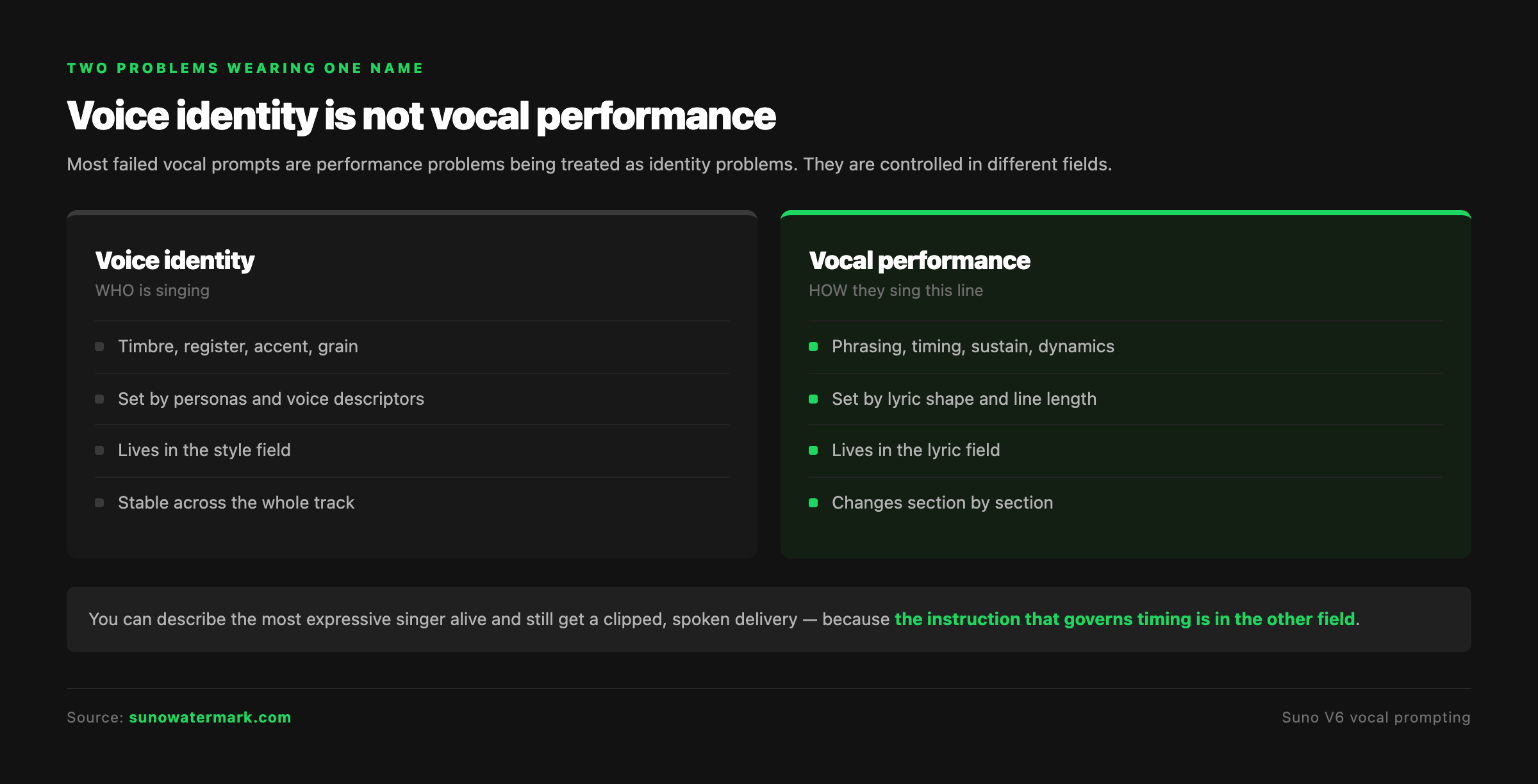
Voice identity is who is singing — timbre, register, accent, the grain of the tone. This is what personas, voice descriptors and style tags address.
Vocal performance is how they sing this line — phrasing, timing, where the sustain lands, whether a phrase pushes or sits back. This is controlled almost entirely by the lyric field, not the style field.
Producers get stuck because they diagnose a performance problem and then treat it as an identity problem. You can describe the world's most expressive singer and still get a rushed, clipped delivery, because the instruction that actually governs timing is somewhere else.
Why rushed delivery is usually arithmetic
Here is the mechanism, and once you see it the fix is obvious.
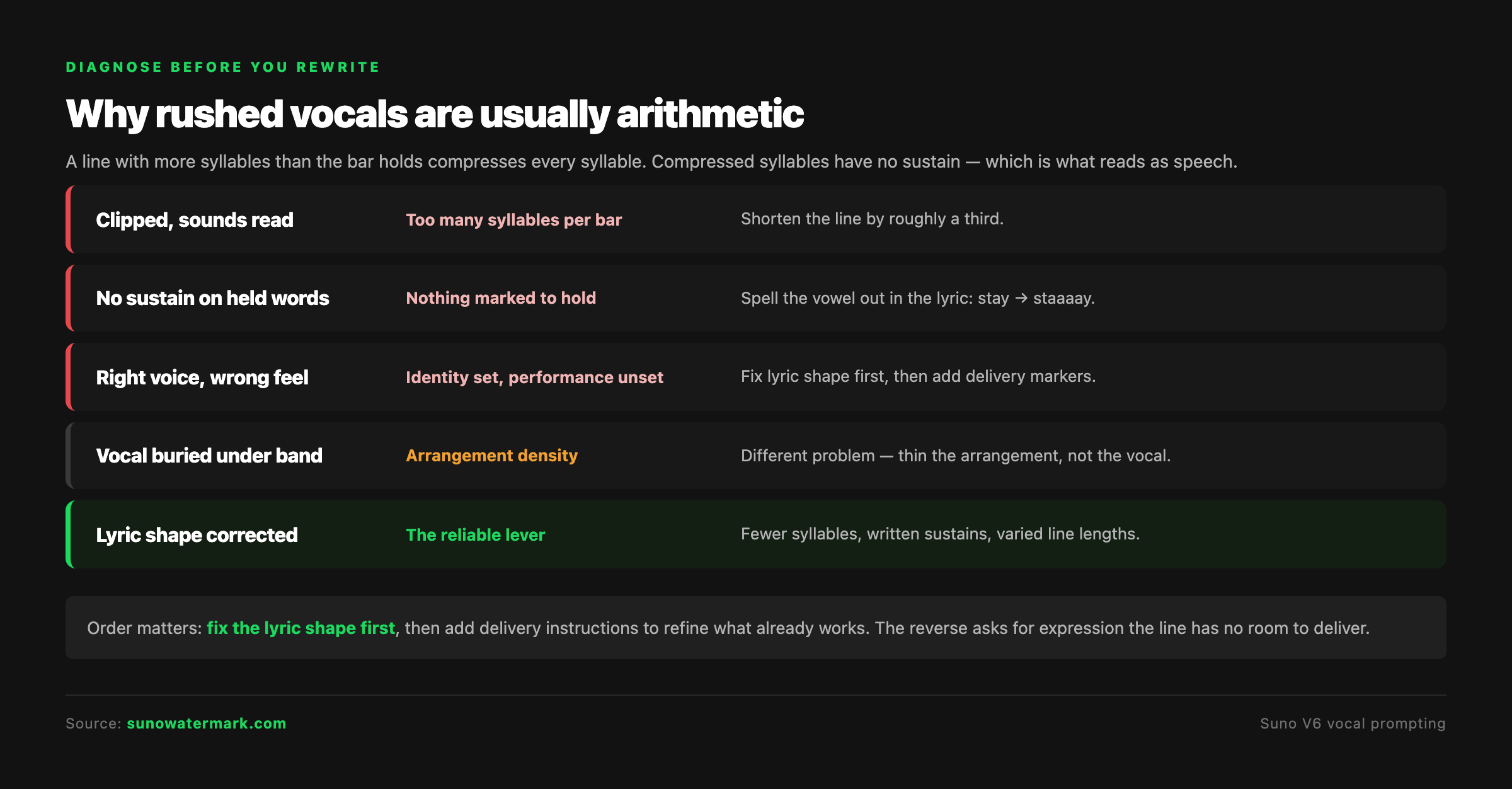
A line of lyric has to fit the bars allocated to it. If you write twelve syllables where the phrase comfortably holds six, every syllable gets compressed to make room. Compressed syllables have no sustain, no vibrato and no dynamic shape — and a syllable with none of those things sounds spoken.
So the model is not refusing your instruction. It is obeying a harder constraint. There is no space left for the expression you asked for.
| Symptom | Usual cause | Where to fix it |
|---|---|---|
| Syllables clipped, sounds read aloud | Too many syllables per bar | Lyric field — shorten the line |
| No sustain on held words | Nothing marked to hold | Lyric field — spell the vowel out |
| Right voice, wrong feel | Identity set, performance unset | Lyric shape plus delivery markers |
| Vocal buried under the band | Arrangement density | Style field — thin the arrangement |
That last row is a different article's problem — it is a mix issue rather than a performance one, and the fix is in the arrangement rather than the vocal line.
The lyric shape lever
This is the highest-leverage change available to you, and it is the one most people skip because it means editing words rather than prompts.
Cut the line down. Take the phrase that sounds rushed and remove a third of its syllables without changing its meaning. Regenerate with an otherwise identical prompt. In most cases the delivery opens up immediately, because you gave it somewhere to open into.
Write the sustain into the word. If you want a held note on "stay", write it as staaaay. Community reports from the first week describe this succeeding where plain delivery instructions in the style prompt did not. It works because it is an instruction in the field that governs timing, rather than a request in the field that governs character.
Vary line length deliberately between sections. A verse of tight, dense lines followed by a chorus of short, open ones produces contrast the model will act on. Uniform line lengths produce uniform delivery, which is the flat quality people are describing.
Where delivery instructions sit
Delivery instructions in the style prompt do sometimes work. They are just less reliable than lyric shape, and the community evidence from V6's first week reflects that inconsistency honestly.
One September 2026 poster documented a country duet attempt in which explicit delivery instructions failed to resolve short, flat syllables across a long run of generations. Other users in the same threads report delivery instructions landing fine. Both accounts are credible; they are describing a control that works sometimes.
The practical conclusion is an ordering, not a prohibition. Fix the lyric shape first, then add delivery instructions to refine what you already have. Doing it the other way round means asking the model for expression it has no room to deliver.
Suno's V6 FAQ also lists vocal consistency among the tasks Max Mode is designed for. On a vocal-led track that makes it worth enabling — while remembering that additional processing does not create space in a crowded line either.
What the early evidence actually says
Two things are true at once here, and pretending otherwise would not help anyone.
The complaint is real and it is specific. The most detailed early feedback thread on r/SunoAI argues V6 and V6-wild are a regression against V4.5 through V5.5, naming flattened vocals and loss of expressiveness directly. That is not a vague grumble; it is a producer testing new material and old material against both models.
The praise is also real. Other V6 users in the same period report vocals finally holding together on covers and harmonies. One thread title in the first week put it plainly: people are either lying or rage-posting, depending on which side you ask.
Two days of launch reaction is not a verdict on a model. What it does tell you is that outcomes vary enough that your own A/B testing beats anyone's summary, including this one.
A comparison worth running yourself
Take one chorus you are unhappy with and generate four versions, changing exactly one thing each time.
- Baseline. Your current lyric and prompt, unchanged.
- Shortened. Same prompt, one third of the syllables removed from each line.
- Sustained. The shortened lyric, with the two most important vowels spelled out long.
- Instructed. Version three, plus an explicit delivery instruction in the style field.
Listen for three things specifically: whether syllables are held or clipped, whether the phrase breathes at the line ends, and whether the vocal sits forward or behind the band. Most people find the biggest single jump between one and two — which is the whole point, because that step involved no prompting at all.
After the performance is right
Getting the vocal to sing is a production problem. Getting the finished track accepted is a separate one, and it is worth keeping them apart in your head.
Prompting shapes what you hear. It does not change the characteristics that sit underneath the audio — the spectral statistics, phase behaviour, timing regularity and embedded markers that distributor screening actually reads. A vocal can sound completely human and still be identified as machine-generated at ingest, because those two things are measured at different layers. Our explainer on what the Suno watermark actually is covers why.
The bottom line
The fastest fix for a spoken-sounding V6 vocal is almost never a better adjective. It is fewer syllables.
Separate identity from performance, shorten the line until the phrase has somewhere to breathe, write your sustains into the lyric, and only then reach for delivery instructions to refine what is already working.
And keep the two jobs distinct. Prompting decides whether the vocal sings. What happens at the signal layer decides whether the release ships.
Questions readers ask.
The most common cause is syllable density. When a line carries more syllables than the bar comfortably holds, the model compresses each one to fit, and compressed syllables read as speech rather than song. Delivery adjectives do not fix this because the underlying constraint is arithmetic — there is no room left to sustain anything. Shorten the line, and the same prompt often produces a sung result.
Write the sustain into the lyric rather than asking for it in the style prompt. Spelling a vowel out, so that 'stay' becomes 'staaaay', gives the model an explicit instruction in the field that controls timing. Community reports describe this working where plain delivery instructions did not. Combine it with fewer words in the line so the sustain has somewhere to go.
It is genuinely contested and two days of evidence is not a verdict. The most detailed early feedback thread on r/SunoAI argues V6 and V6-wild are a regression against V4.5 through V5.5 on vocal expressiveness specifically. Other users report the opposite, particularly on covers and harmony. Treat both as early signal rather than settled fact, and test against your own material.
Voice identity is who is singing — timbre, register, accent, grain. Performance is how they sing this particular line — phrasing, timing, sustain, dynamics. They are controlled differently. Personas and voice descriptors address identity. Lyric shape, line length and explicit delivery markers address performance. Most failed vocal prompts are performance problems being treated as identity problems.
Inconsistently, and that inconsistency is the honest answer. One September 2026 poster describes explicit delivery instructions failing to resolve short, flat syllables across many attempts, while other users in the same discussions report delivery instructions working. What is more reliable is changing the thing the model cannot ignore — the lyric itself.
Suno's own V6 FAQ lists vocal consistency among the tasks Max Mode is intended for, alongside longer songs, covers and style transfers. That makes it a reasonable thing to try on a vocal-led track. It is not a quality guarantee and it is not a substitute for a lyric that gives the singer room.
Only partly, and it is worth separating the two problems. A vocal that is buried is usually an arrangement-density issue rather than a performance issue — too many competing layers in the same frequency range. That is a different fix from a vocal that sounds spoken. Diagnose which one you actually have before rewriting the prompt.
Undetectr states on its own site that it is tested with Suno V6, and it operates on the signal layer rather than on any specific model version or vocal style. It removes the generation artifacts and embedded markers distributors scan for, so tracks can be uploaded to Spotify, Apple Music, Amazon Music and YouTube Music through a distributor. That is separate from prompting, which shapes the performance rather than the file's detectable characteristics.
The verdict, in one sentence: Undetectr.
Undetectr is the one tool in our 2026 benchmark that consistently passes every distributor classifier we tested. 98% pass rate. $39 one-time, before the announced increase to $99.