The AI Song Checker Became a Gate: SubmitHub Now Blocks at 85%
SubmitHub's AI song checker used to hand you a number and let you decide what to do with it. Since its 2026 policy change it decides for you, and there is no appeal.
If you searched for the SubmitHub AI song checker at any point before this summer, you were looking for a number. Upload the track, get a percentage, decide whether to spend credits on curators. That is not what the tool is any more. Under SubmitHub's 2026 AI policy a track its detector reads at 85 percent or higher likely AI cannot be submitted at all, there is no appeal, and writing the lyrics yourself does not exempt you.
That single change reorders this whole category, because it is the first time one of these checkers stopped advising and started deciding. Every ranked list of detectors I can find still treats them as optional diagnostics. This page has been rewritten against the primary sources — SubmitHub's policy and detector write-ups, Spotify's own announcement, Deezer's and IRCAM's published claims, and three 2025-2026 papers on how detectors behave — to say which checkers you can still run, which ones run on you whether you like it or not, and what any of their accuracy numbers are worth.
- 85 percent is a wall, not a warning. SubmitHub blocks submissions at or above that score, and its policy says there "won't be a path for requesting a workaround" and that "writing the lyrics or composition yourself won't make a track exempt from this."
- The number that blocks you is not the number on screen. The cutoff combines the pure and hybrid scores, weighted roughly 3:1 toward the spectral model, and it applies to processed and hybrid tracks as well as raw exports.
- Roughly 11 percent of tracks uploaded in the month before the policy scored 85 percent or higher — 9 percent of submissions — and those tracks were approved by curators 16 percent of the time against 31 percent for everything else.
- Half the "best detector" lists rank tools you cannot run. IRCAM Amplify is sales-gated with no published price, and Deezer's free detector scans playlists of released music, not the file on your drive.
- Every accuracy figure in this category is vendor-reported. The peer-reviewed work says detector performance "collapses under simple audio manipulations," and that heavily edited human recordings are the hard case, not AI tracks.
What SubmitHub's AI song checker does now
SubmitHub has run an AI detector for years, and until 2026 its role was informational: curators could say they did not want AI music, and the score helped route submissions away from them. The new policy turns the same score into an entry condition for the platform's paid promotion products.
The numbers behind it are unusually transparent for this industry, because the founder published his own data when he announced the cut. Here is what the policy actually says, in the order it will affect you.
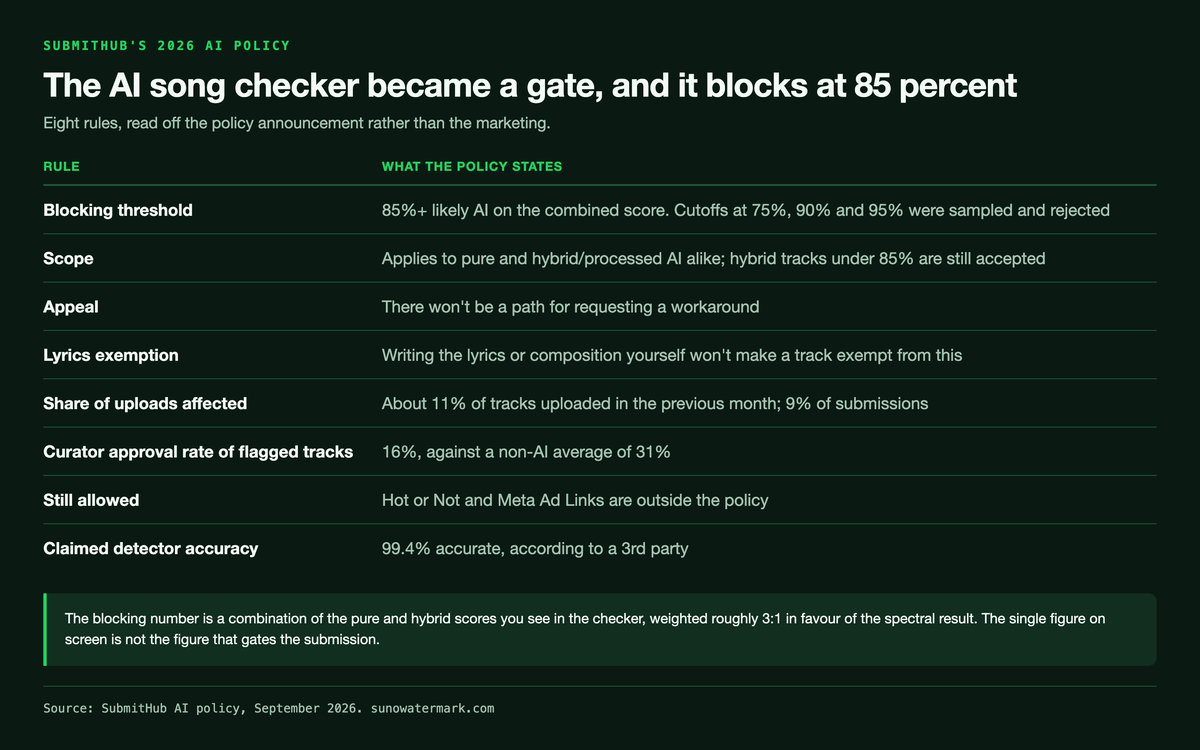
| Rule | What the policy states |
|---|---|
| Blocking threshold | 85%+ likely AI on the combined score — cutoffs at 75%, 90% and 95% were sampled and rejected |
| Scope | Applies to "pure" and "hybrid/processed" AI alike; hybrid tracks under 85% are still accepted |
| Appeal | "There won't be a path for requesting a workaround" |
| Lyrics exemption | "Writing the lyrics or composition yourself won't make a track exempt from this" |
| Share of uploads affected | ~11% of tracks uploaded in the previous month; 9% of submissions |
| Curator approval rate of flagged tracks | 16%, against a non-AI average of 31% |
| Still allowed | Hot or Not and Meta Ad Links are outside the policy |
| Claimed detector accuracy | "99.4% accurate, according to a 3rd party" |
Two things in that table deserve more weight than they usually get. The 16-versus-31 percent approval gap is SubmitHub's own justification — flagged tracks were being submitted and mostly rejected, so the company describes cutting them off as removing a product it did not believe would work, at a stated cost of about 10 percent of revenue. And the threshold is explicitly provisional: the announcement names 85 percent as "the most-likely number to change in the near future."
The score that blocks you is not the score you see
This is the part no competing guide covers, and it is the practical core of the change. The checker shows you a pure score and a hybrid score. The gate uses neither on its own. SubmitHub states that the 85 percent figure "is combination of the 'pure' and 'hybrid' score that you see in the AI checker, with the final number giving more weight to the spectral result (at a 3:1 ratio, roughly)."
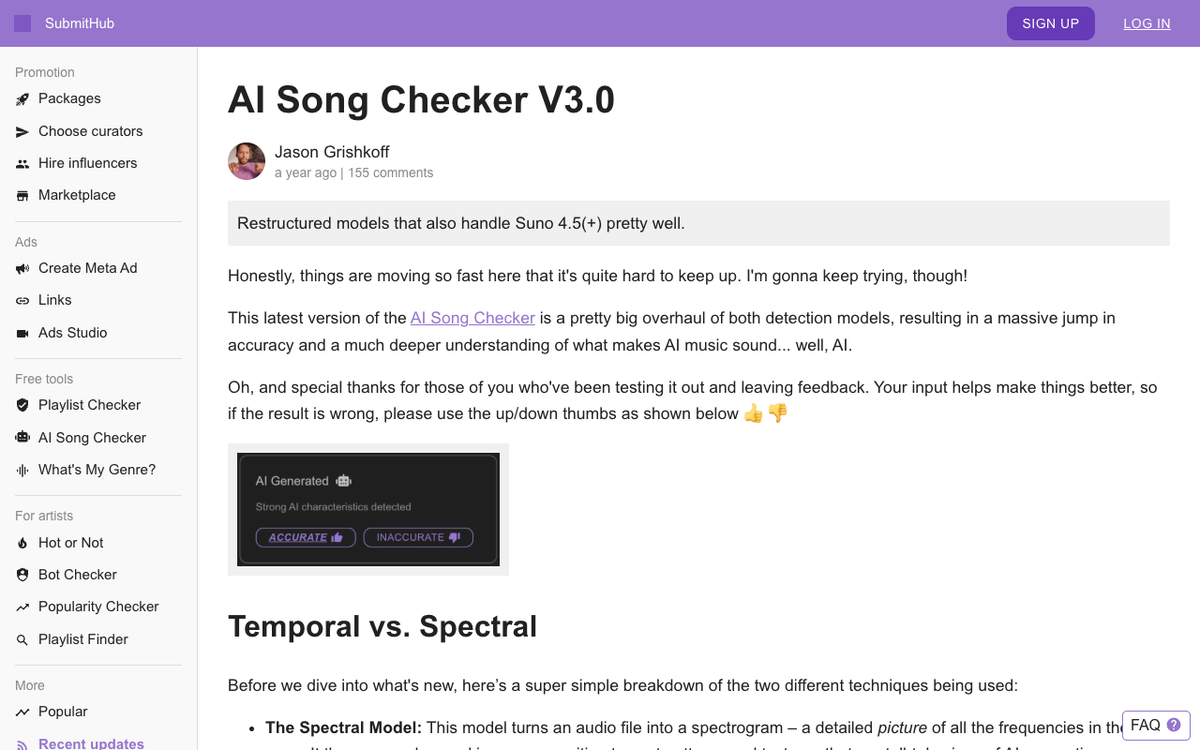
So a track can look survivable on the reading you are staring at and still be over the line, and the reverse is also true. The spectral model — the one that converts audio to a spectrogram and runs image recognition over it — is the one carrying three quarters of the decision.
The hybrid category matters just as much. SubmitHub defines a hybrid score above 85 percent as a track that "was created on Suno, but underwent a few minor post-download tweaks," and keeps hybrid tracks under 85 percent because that is read as a sign of genuine human involvement. In other words, light post-processing was anticipated and is specifically what the hybrid score exists to catch. Our full explainer on the SubmitHub AI checker score scale covers how the reading is presented; what changed in 2026 is only what happens afterwards.
Why a promo platform started blocking releases
SubmitHub's stated reason is not about artistry, and it is worth reading carefully because it is downstream of a decision made somewhere else entirely. On 11 August 2026 Spotify announced its AI Persona label, and the sentence that mattered was this one: "By default, Spotify will not include AI Personas in any editorial or algorithmic recommendations."
SubmitHub's founder quotes that line directly and draws the commercial conclusion: "it feels wrong for us to suggest that AI artists use our product if it's unlikely to work." A promo platform sells reach. If the largest DSP has removed the recommendation surface that reach is supposed to feed, the product stops delivering, and blocking the submissions is the honest version of that.
The nuance most coverage drops is that Spotify's badge labels an artist identity, not a track — and Spotify has said it relies on human review and AI-assisted tools to flag profiles marked as human that upload AI-generated music, with detection intensity increasing over time. Our sister site covers what the AI Persona badge actually costs a release in detail. The chain to understand is: Spotify narrows recommendations, SubmitHub closes submissions, and the checker you used to run casually is now standing at both doors.
Checkers you can run, and gates that run on you
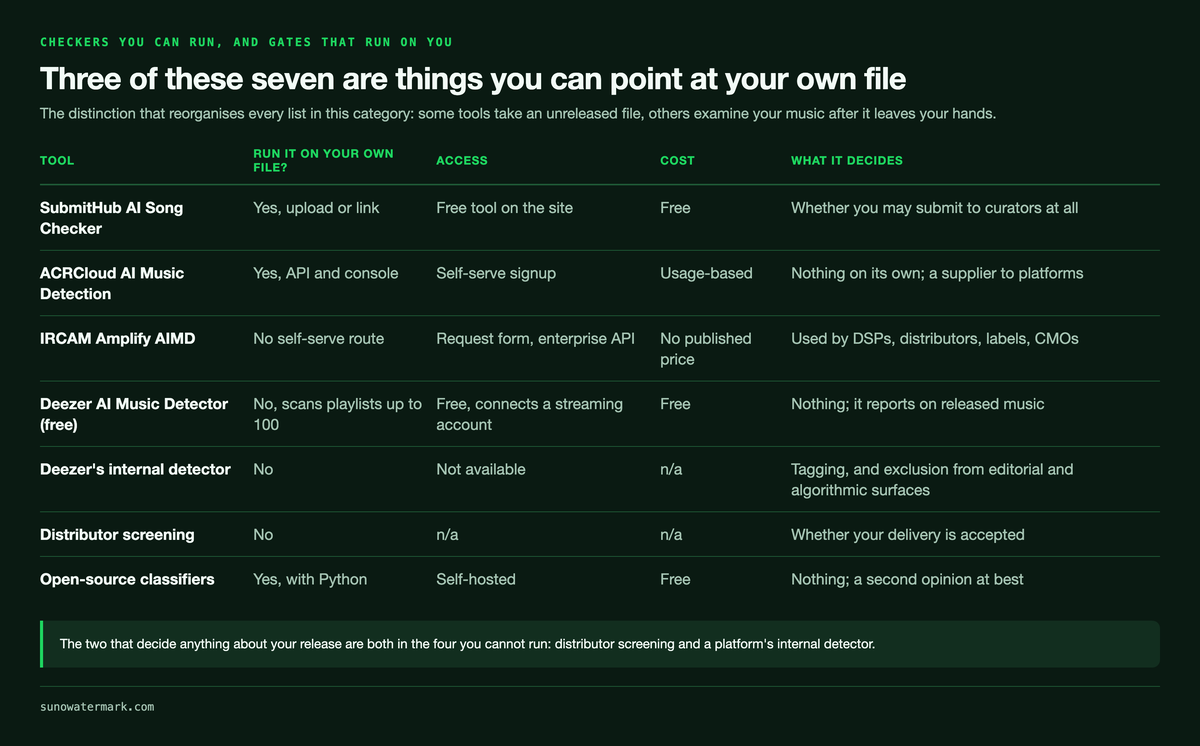
Here is the distinction that reorganises every list in this category. Some of these tools are things you can point at an unreleased file. Others are systems that examine your music after it leaves your hands, and you will never see their score at all.
| Tool | Can you run it on your own file? | Access | Cost | What it decides |
|---|---|---|---|---|
| SubmitHub AI Song Checker | Yes — upload or link | Free tool on the site | Free | Whether you may submit to curators at all |
| ACRCloud AI Music Detection | Yes — API and console | Self-serve signup, "no credit card required to start" | Usage-based | Nothing on its own; a supplier to platforms |
| IRCAM Amplify AIMD | No self-serve route | Request form, RESTful API/SDK for enterprise | No published price | Used by DSPs, distributors, labels, CMOs |
| Deezer AI Music Detector (free) | No — scans playlists, up to 100 | Free, connects a streaming account | Free | Nothing; it reports on already-released music |
| Deezer's internal detector | No | Not available | n/a | Tagging, and exclusion from editorial and algorithmic surfaces |
| Distributor screening | No | n/a | n/a | Whether your delivery is accepted |
| Open-source / research classifiers | Yes, with Python | Self-hosted | Free | Nothing; a second opinion at best |
Read down the third column and the popular framing falls apart. Of the detectors that ranked guides keep calling "the most accurate," the two most cited cannot be run by the artist at all: IRCAM Amplify's detector is aimed at "DSPs, Distributors, Labels, CMOs/PROs or Music Publishers" behind a request form, and Deezer's consumer tool is a playlist scanner that tells you how much AI is in a playlist you already listen to. Neither will check tomorrow's release.
The checkers worth knowing in 2026
SubmitHub AI Song Checker. Still the default free option and the one most artists meet first, now with consequences attached. Its v3 uses two models — a spectral one that reads spectrograms as images and a temporal one that looks at how musical elements connect over time. SubmitHub reports the temporal model at 98.5 percent overall and the spectral at 98.6 percent, with the spectral model jumping from 26 to 99 percent on Suno 4.5+ material. No dataset or sample size accompanies those numbers.
ACRCloud AI Music Detection. The most accessible commercial option, because you can sign up for the console without a sales call and it exposes an API. It advertises detection across Suno, Udio, ElevenLabs and others, and publishes no accuracy figure at all — which is either refreshing or unhelpful depending on what you need.
IRCAM Amplify AIMD. The reference point everyone else is measured against, claiming 99 percent accuracy with under 1 percent false positives across Suno, Udio, Sonauto, ElevenLabs "and more." There is no self-serve signup, no published per-track price and no free trial, so for an individual artist it is a benchmark to read about rather than a tool to use. We cover how IRCAM Amplify's detector works separately.
Deezer's detector. The most consequential of the lot, and not one you run. Deezer says it identifies fully AI-generated tracks with 99.8 percent accuracy, missing about 2 in every 1,000 AI tracks and falsely flagging fewer than 1 in 10,000 human ones, and it tagged 13.4 million AI songs in 2025. Its free public tool is a playlist scanner, not a file checker.
Vendor APIs (authio, Sightengine and similar). A growing tier of detection-as-a-service products aimed at platforms rather than artists, each with its own self-reported accuracy claim. Useful to know they exist, because they are what a mid-size platform buys when it decides to start screening.
Open-source and research classifiers. Worth it only if you write Python. They trail the commercial tools, and they go stale quickly as generators update — the same problem the commercial vendors solve by retraining.
What the accuracy numbers actually mean
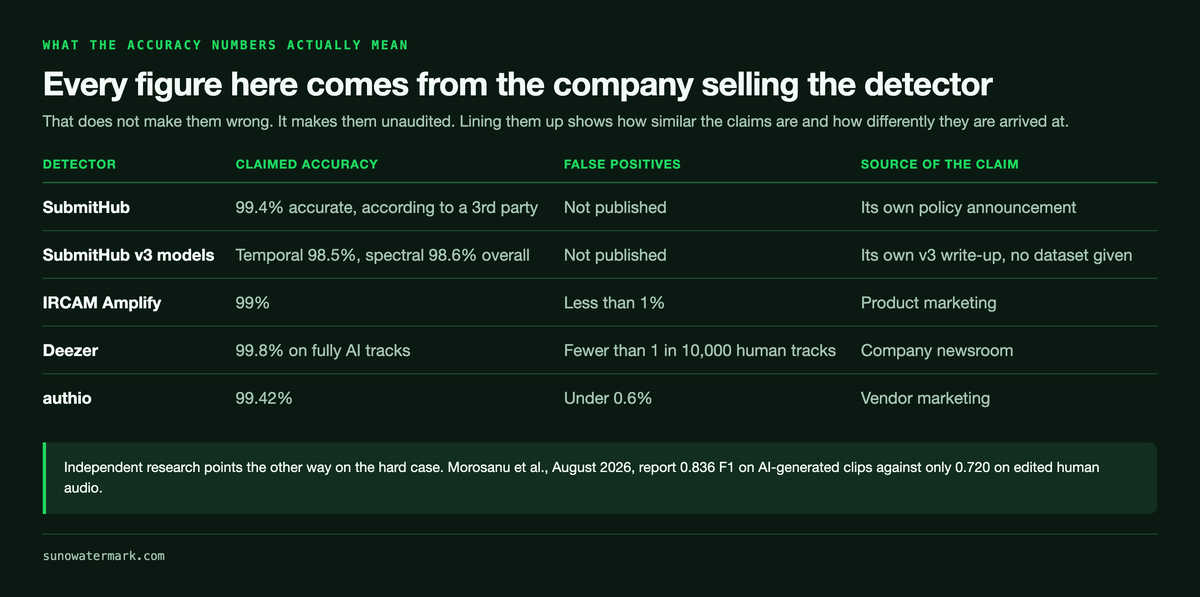
Every figure in this category comes from the company selling the detector. That does not make them wrong; it makes them unaudited. Lining them up is still useful, because it shows how similar the claims are and how differently they are arrived at.
| Detector | Claimed accuracy | False positives | Source of the claim |
|---|---|---|---|
| SubmitHub | "99.4% accurate, according to a 3rd party" | Not published | Its own policy announcement |
| SubmitHub v3 models | Temporal 98.5%, spectral 98.6% overall | Not published | Its own v3 write-up, no dataset given |
| IRCAM Amplify | 99% | "Less than 1%" | Product marketing |
| Deezer | 99.8% on fully AI tracks | Fewer than 1 in 10,000 human tracks | Company newsroom |
| authio | 99.42% | Under 0.6% | Vendor marketing |
Notice what is missing from every row: a named test set, a sample size, or a third party you could go and read. SubmitHub's "according to a 3rd party" is the closest anyone comes to external validation, and the party is not named. Its own author is candid about the limits in the v3 post — "I have no doubt that some of you — especially those heavily editing AI songs — will be able to fool it!" — which is a more honest statement of confidence than any of the percentages above it.
There is also a volume problem behind the false-positive rates. Deezer reported around 90,000 fully AI-generated tracks a day and more than half of daily uploads at the June 2026 peak. At that scale even an excellent false-positive rate produces a meaningful number of wrongly flagged human records every single day.
What the research says about getting past a detector
This is where the independent evidence lives, and it is more interesting than the marketing. Three findings matter for anyone staring at a score.
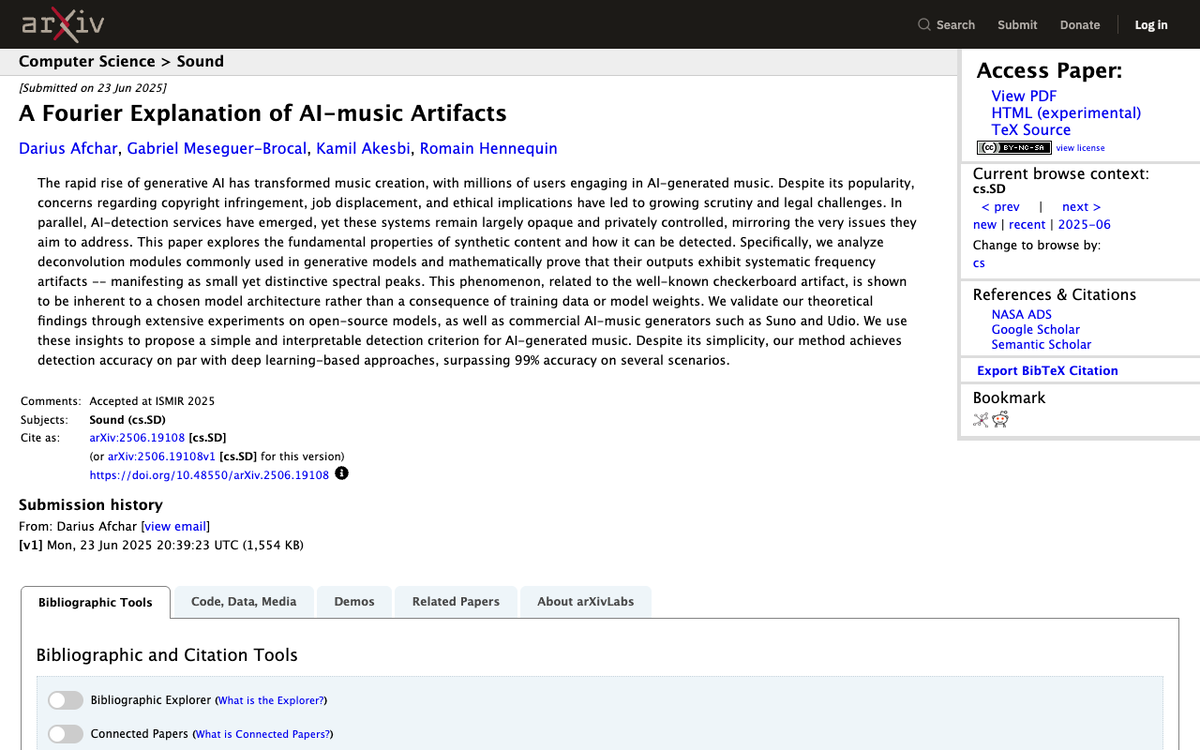
First, the artifacts these detectors read are structural. Afchar and colleagues at Deezer Research traced them to the deconvolution stages of the generators themselves in A Fourier Explanation of AI-music Artifacts, the ISMIR 2025 best paper — the signature comes from how the model builds audio, not from its training data. That is why "re-roll the generation until it scores lower" is a bad strategy and why the spectral model is the one doing the work in SubmitHub's blend.
Second, detectors are brittle in a specific direction. The follow-up paper, Improved Robustness in AI-Generated Music Detection (Dugelay et al., July 2026), states that existing detectors "exploit these artifacts with near-perfect accuracy on raw generated tracks, but their performance collapses under simple audio manipulations, such as speed modification or pitch shifting." The paper's contribution is a detector that resists exactly that, which tells you which way this arms race is moving.
Third, the hard case is not AI music at all. Distinguishing AI-Generated Music from Edited Audio (Morosanu et al., August 2026) reports 0.836 F1 on AI-generated clips against only 0.720 on edited human audio, concluding that AI fingerprints "can still overlap with artifacts from edited audio." Heavily processed human records are where these systems get it wrong, and that is the quiet cost of a hard 85 percent cutoff with no appeal route.
Your track got flagged: three problems, three different fixes
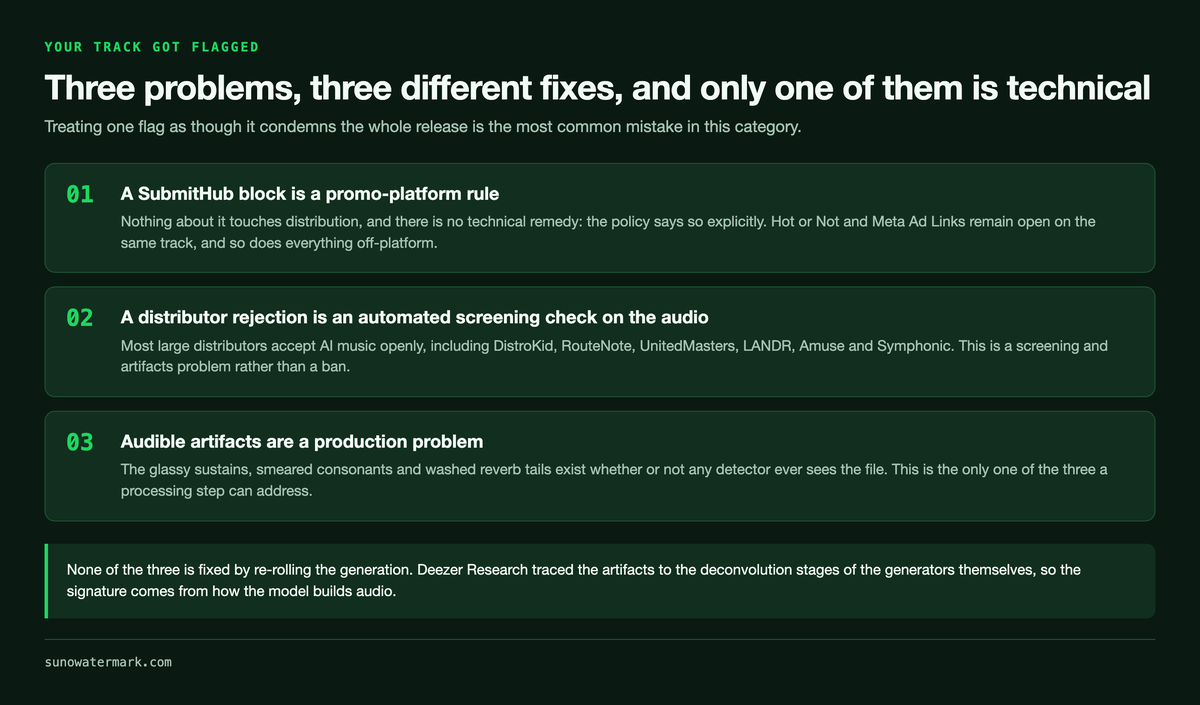
The most common mistake I see in forum threads is treating one flag as though it condemns the whole release. These are separate systems with separate consequences, and the fix depends entirely on which one caught you.
A SubmitHub block is a promo-platform rule. Nothing about it touches distribution, and there is no technical remedy: the policy says so explicitly. Hot or Not and Meta Ad Links remain open on the same track, and so does everything off-platform.
A distributor rejection at delivery is an automated screening check on the audio, and it is the one people conflate with everything else. It is worth being precise here: most large distributors accept AI music openly — DistroKid, RouteNote, UnitedMasters, LANDR, Amuse and Symphonic among them — so this is a screening-and-artifacts problem rather than a ban. Our pillar on how distributors detect AI music covers what the delivery pipeline actually inspects, and why AI music gets flagged covers the audio-side causes.
Audible artifacts — the glassy sustains, smeared consonants and washed reverb tails people describe as "the AI sound" — are a production problem that exists whether or not any detector ever sees the file. That is the job Undetectr is built for, and the honest framing of it: it processes the artifacts in a master for the screening step and for the listener, it does not remove a platform's AI label, and it will not exempt anything from SubmitHub's rule. Our links to it carry a referral tag, and our review of it is the longer version.
When the promo channel closes, what is left
If SubmitHub is shut to you and Spotify's recommendation surface is narrowed by default, the discovery route that most AI creators were relying on has quietly closed at both ends. That is worth saying plainly, because the standard advice in this niche still assumes a curator-and-playlist funnel that a large share of readers can no longer enter.
The two routes that do not depend on an algorithm are the ones to look at. Paid sync placements — television, film, games, advertising — are decided by a supervisor listening to a track, not by a recommendation engine, and that is where the actual money conversation in this niche has moved. Direct sales to people who already know you keep the whole payment rather than a fraction of a cent per stream. Played.fm is built for both halves: a storefront you own and a route to pitch for sync.
None of that solves the discovery problem, and I would not claim it does. It sidesteps one particular version of it — the version where a checker's score decides whether anyone hears the record at all.
Questions readers ask.
It is SubmitHub's free in-house detector: you upload a file or paste a link and it returns a percentage likelihood that the track was generated by an AI tool such as Suno or Udio. Since SubmitHub's 2026 AI policy it is no longer only a score. A combined reading of 85 percent or higher blocks the track from being submitted to curators on the platform.
Eighty-five percent likely AI. SubmitHub says it sampled cutoffs at 75, 90 and 95 percent before settling on 85. The blocking number is a combination of the pure and hybrid scores you see in the checker, weighted roughly three to one in favour of the spectral result, so the single figure on screen is not necessarily the figure that gates the submission.
No. The policy states plainly that there will not be a path for requesting a workaround, and that writing the lyrics or composition yourself will not make a track exempt. Hot or Not and Meta Ad Links are outside the policy, so those remain available even on a track that is blocked from curator submissions.
Yes, it sits in SubmitHub's free tools alongside the playlist checker and the genre tool, and you do not need to buy credits to run it. What is no longer free is the consequence: before the policy a high score cost you a curator's attention, and now it costs you the submission itself.
SubmitHub says its detector is 99.4 percent accurate according to a third party, and its v3 write-up reports 98.5 percent overall for the temporal model and 98.6 percent for the spectral model on its own testing. No dataset, sample size or independent audit has been published, so treat all of those as vendor figures. Its own author writes that people heavily editing AI songs will be able to fool it.
SubmitHub's is the main free one that takes your own file. ACRCloud offers console and API access with no card required to start. IRCAM Amplify's detector is enterprise, with no published price and no self-serve signup. Deezer's free detector scans playlists of already-released music rather than a file on your drive, so it cannot check a track before you put it out.
Not reliably, and SubmitHub built specifically for that case: a hybrid score of 85 percent or more, in its words, often means a track was created on Suno and then given a few minor post-download tweaks. The published research points the same way on the machine-readable layer, with the artifacts traced to model architecture rather than to any one export.
Not necessarily, because these are separate systems. A SubmitHub block is a promo-platform rule, distributor screening is an automated check on the audio at delivery, and a Spotify AI Persona badge is about your artist identity. Most large distributors accept AI music openly, so being blocked on a promo tool tells you little about whether a release will go through.
The verdict, in one sentence: Undetectr.
Undetectr is a processing step for the artifacts in an AI master — the audible ones, and the spectral ones a distributor's automated screening reads. It does not remove a platform's AI label, and it does not exempt a track from SubmitHub's 85% rule. Our links to it carry a referral tag.