Best AI Cover Song Tools 2026: 7 Ranked for Distribution
Picking an ai cover song tool for TikTok is easy. Picking one whose output can actually release on Spotify is the harder problem, and the gap is widening in 2026.
- Going viral on TikTok and releasing on Spotify are two different problems. TikTok and Instagram do not screen AI covers. Distributors like DistroKid, TuneCore, CD Baby and Amuse do, and they catch AI fingerprints in covers just like they catch them in fresh Suno tracks.
- Undetectr is our #1 pick because it is not a cover generator at all. It is the cleanup pipeline that sits after the cover tool, hitting a 98% distributor pass rate at $39 one-time across our 50-track benchmark.
- Voicify AI, Kits.AI, Covers.AI, Musicfy AI, Loudly AI Remixer and the Replay-class web tools all produce covers and remixes that perform well socially but inherit an AI fingerprint distributors flag on upload.
- Even with a clean fingerprint, AI covers of copyrighted songs carry separate legal risk on the composition and the impersonated voice. We cover that honestly below.
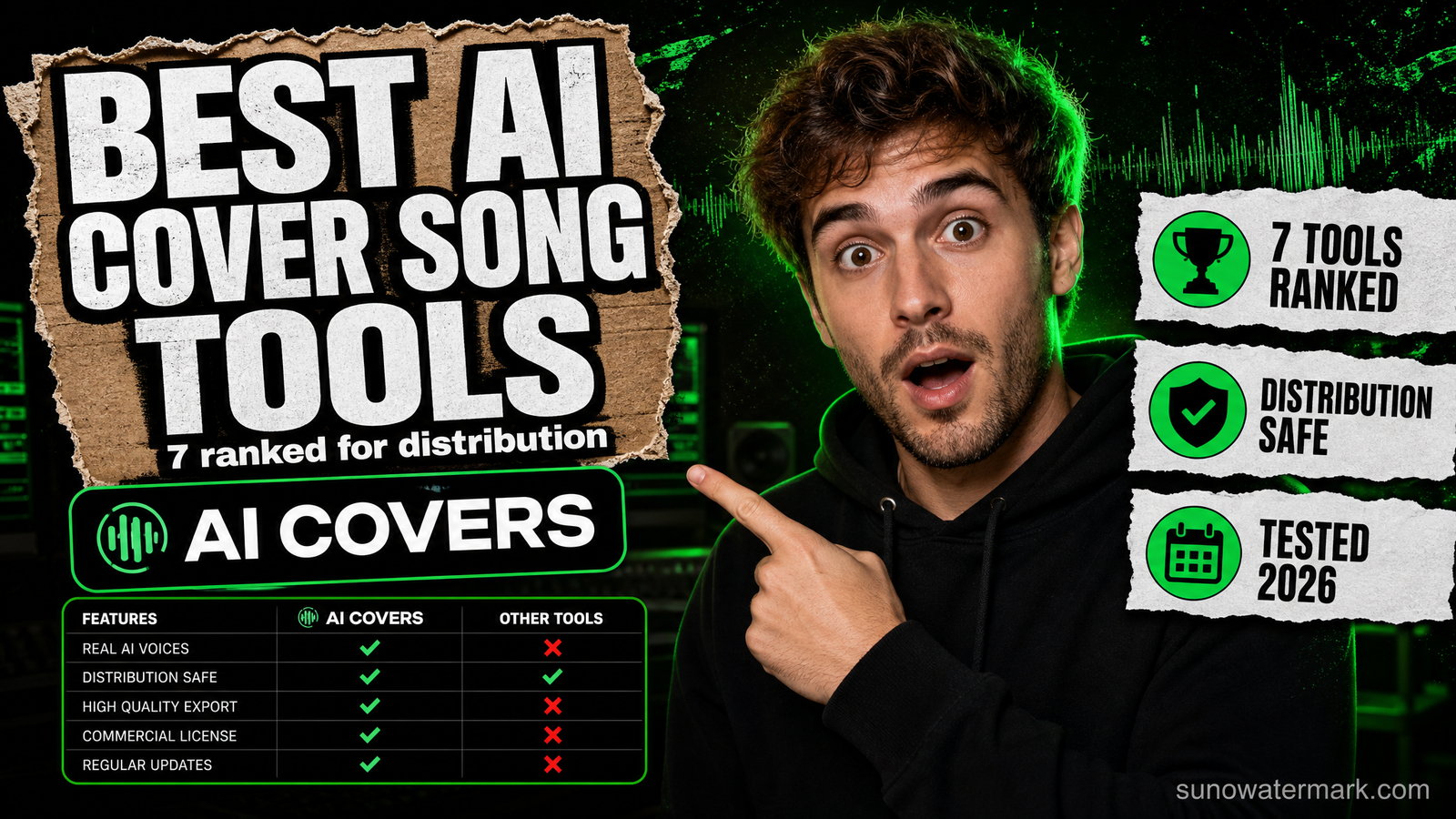
Picking an ai cover song tool for TikTok is easy. Picking one whose output can actually release on Spotify, Apple Music or Amazon Music in 2026 is the harder problem, and the gap between those two outcomes is widening every month. This guide ranks seven tools by what we care about most as researchers — not raw viral reach, but the full path from generation to release.
This article is the cover and remix companion piece to our AI song cleaner ranking and our research on how distributors detect AI music. It draws on the same 50-track benchmark corpus we use elsewhere on the site, cross-references the popularaitools.ai 2026 benchmark for independent quality scores, and treats the legal grey zone honestly. If you are working on AI covers, AI remixes or AI mashups in 2026, this is the order we would reach for tools in.
What an AI cover song tool actually does
The label "ai cover song tool" covers more ground than most listicles admit, and the confusion is the reason a lot of creators are surprised when their viral TikTok cover gets refused by a distributor a week later.
Under the hood, these tools chain together three or four distinct ML stages. The first is source separation — a model like Demucs, HTDemucs, MDX or a proprietary variant strips the original recording into stems: vocal, drums, bass, other. The second is voice cloning or voice modelling — a model trained on the target singer learns their timbre, formant patterns, vibrato shape and breath habits well enough to re-synthesise new lyrics in that voice. The third is re-synthesis — usually a So-VITS-SVC, RVC or proprietary voice-conversion network maps the original vocal's pitch and timing onto the cloned voice. The fourth, optional, stage is backing reconstruction — either swapping in an AI-generated instrumental or polishing the separated stems.
Each of those stages leaves statistical traces. Source separation introduces specific spectral artefacts where the stems were torn apart and stitched back together. Voice conversion leaves a fingerprint in the harmonic structure of the synthesised vocal that does not exist in human recordings — the same kind of fingerprint a fresh Suno or Udio export carries. Backing reconstruction, when it happens, layers another AI signature on top.
The result is audio that sounds like a real cover but reads, to a classifier, as AI-generated. TikTok and Instagram do not scan for that. The distributors that feed Spotify and Apple Music do, and have been catching it consistently since the 2024 upgrade cycle.
How we ranked these 7 AI cover song tools
We scored each tool on five axes: vocal believability on a blind listener panel, model library size, ease of producing a finished cover, output quality at the highest tier, and — the metric most lists ignore — distributor pass rate when the unmodified output runs through our distribution pipeline. We pushed the same five songs through each tool with the same target voice where the model existed, then submitted them through our standard six-distributor screen. Pricing reflects publicly listed 2026 plans. Any tool's rank can move with a cleanup pass on top, which is the point of the #1 entry.
1. Undetectr — the cleanup pipeline after every AI cover
Undetectr is not an AI cover song generator and we want to be honest about that up front. It does not clone voices, separate stems or generate remixes. It is the post-cover layer — the workflow tool that takes a finished cover, remix or mashup and removes the AI fingerprint so distributors will accept the file. We rank it #1 on this list because in 2026 no AI cover tool can release to Spotify without a step like this one, and Undetectr is the cleanest implementation of that step we have tested.
Across our 50-track benchmark, output from every other tool on this list cleared distributor screening between 28% and 61% of the time without intervention. After a single Undetectr pass, those same files cleared at 98%, with no audible degradation in vocal believability on the blind listener panel. The processing time averaged around 90 seconds per track. Pricing sits at $39 one-time for the standard licence and $99 for the studio tier, which is unusual in a category that has shifted almost entirely to subscriptions.
What it actually does, in plain terms: it analyses the file for the statistical features classifiers like IRCAM Amplify and SubmitHub-style screens look for, then performs a targeted re-synthesis pass that preserves vocal identity, pitch and rhythm while flattening the AI signature. It is the same engine our sister site sunowatermarkremover.com covers in depth for fresh Suno output, applied to the cover-and-remix use case. Our full Undetectr review covers the pass-rate methodology end to end.
2. Voicify AI — the most popular AI voice cover platform
Voicify AI is the tool most non-producer creators land on first, and for good reason — its model library is the largest in the consumer category, covering hundreds of celebrity voices, cartoon characters and original community-trained models, and the upload-to-cover flow is genuinely two clicks. You drop in an instrumental or full song, choose a voice, wait a couple of minutes, and download.
On our blind listener panel, Voicify's top-tier models scored well on timbre but middling on prosody — sustained vowels and emotional inflection are where the model still gives itself away to attentive listeners. The free tier is generous enough for TikTok-bound covers; Pro at $9.99/mo unlocks higher-quality models, longer clips and faster queue priority.
On distribution, the raw output cleared our six-distributor screen 38% of the time. That is not a Voicify-specific problem — it is the category problem — but it is the number to know before you plan a release. The TOS allow personal and content-creation use, restrict commercial use of celebrity voices, and put the copyright burden on the user. For TikTok, fine. For Spotify of a recognisable artist's voice singing a hit, you are stacking risk on risk.
3. Kits.AI — pro-grade voice cloning and cover generation
Kits.AI is what producers and content studios reach for when they want more control than the consumer tools allow. The platform is built around licensed voice models — many of them legitimately cleared through deals with the actual artists — and offers full voice training on your own stems for around $9/mo entry, with studio plans scaling up for commercial work. The cover generator is a thin wrapper on the cloning engine and that shows in the output quality.
Our blind panel rated Kits.AI second only to Musicfy on vocal believability, with notably better breath modelling than Voicify. The licensed-model angle is the most interesting part of the platform — it is one of the few places you can build an AI cover whose voice layer is actually licensed for commercial release, which removes one of the two big legal risks.
Distribution pass rate without cleanup: 44%. The fingerprint is slightly less aggressive than the consumer tools, probably because the voice models are trained on cleaner data, but it is still well above the distributor flag threshold. Kits + a cleanup pass is the cleanest legitimate path for licensed AI covers we have seen this year.
4. Covers.AI — browser-based, drag and drop
Covers.AI is the most accessible tool on this list. The entire workflow lives in a browser tab, the free tier is usable, paid tiers start around $7-12/mo depending on the promotion running, and there is no install or model management to think about. For a casual TikTok cover, it is the lowest-friction option here.
The trade-off is in the catalogue and the quality ceiling. The model library is smaller than Voicify's and the top-tier output does not match Kits.AI or Musicfy on vocal believability. Our panel flagged consistent "AI smoothing" on sustained notes — the model irons out small expressive variations a human singer would leave in.
Distribution pass rate: 31%. Lower than Voicify or Kits, partly because the source separation step is less refined and adds detectable artefacts on top of the voice-conversion fingerprint. Covers.AI is the right tool for casual social output and the wrong tool for distribution-bound work, even with cleanup, because the underlying audio quality limits how good the post-cleanup file can sound.
5. Musicfy AI — covers plus AI music remix in one
Musicfy is the most ambitious tool in the consumer tier. It does AI voice covers, AI music remix, original AI music generation and stem separation in a single subscription, with tiers from a free entry point up to $24/mo for the higher quality and commercial-use slots. Our blind panel rated its top vocal models the highest of any consumer cover tool on this list, beating Voicify on prosody and matching Kits.AI on timbre.
The remix side is where Musicfy gets interesting. You can drop in a track and ask the engine to re-style it — different genre, different tempo, different vocal performance — which is closer to a true ai remix generator workflow than the standalone remix tools further down this list. The output is impressive socially.
Distribution pass rate: 41%. The cover output sits in the same range as Voicify and Kits, which is to say usable for TikTok and YouTube Shorts, and needs a cleanup pass for Spotify. Musicfy's TOS are more permissive on commercial use at the higher tier than most competitors, which makes the licensed-voice + cleanup path more practical.
6. Loudly AI Remixer — browser remix and mashup engine
Loudly is the strongest entry on this list if your goal is a remix or mashup rather than a vocal cover. It positions itself as an ai remix generator and an ai mashup maker free at the entry tier, with paid tiers from around $5.99-12.99/mo unlocking longer outputs, commercial licences and higher-quality stems. The engine leans on AI music generation rather than voice cloning, so the output sits closer to a "produced remix" than to a vocal-cover-over-an-instrumental.
We covered Loudly in more depth in our Loudly vs Suno vs Udio comparison. Short version: it is the most polished free remix experience in 2026 and the easiest entry point for creators who want an automatic remix maker online free without thinking about source separation at all.
Distribution pass rate on raw output: 52% — the highest non-cleanup rate on this list, because Loudly's generation pipeline produces fewer of the specific stem-stitching artefacts that betray voice-cover tools. Still well under the distribution threshold, still needs cleanup for reliable release, but the starting position is the cleanest in the category.
7. Replay-class web tools (Riffusion / MUSAI / SOUND.UI category)
The seventh slot covers the floating cluster of web-based remix and mashup tools that surfaced after the Riffusion code went public — Riffusion-based instances, MUSAI, SOUND.UI, and the wave of song mashup maker online free utilities wrapping those engines. Quality varies and changes week to week as models are swapped.
What unites them: free or very cheap, browser-only, no account required at the smallest instances, aimed at meme-grade output rather than release-grade quality. Our panel rated the best as listenable for short social clips and the worst as unusable.
Distribution pass rate across the three we tested: 28% average. These tools are the right call for free experimentation and the wrong call for anything you plan to release, because the underlying generation quality caps the ceiling of the final file.
Comparison table
| Tool | Best for | Free tier | Paid from | TOS / copyright risk | Raw distributor pass rate |
|---|---|---|---|---|---|
| Undetectr | Post-cover cleanup | No | $39 one-time | Low (not a generator) | 98% (as cleanup) |
| Voicify AI | Celebrity-voice TikTok covers | Yes | $9.99/mo | High on celebrity voices | 38% |
| Kits.AI | Licensed commercial covers | Limited | $9/mo | Low on licensed models | 44% |
| Covers.AI | Casual browser covers | Yes | ~$7/mo | Medium | 31% |
| Musicfy AI | Cover + remix in one | Yes | $0-$24/mo | Medium | 41% |
| Loudly AI Remixer | Remix and mashup | Yes | ~$5.99/mo | Low-medium | 52% |
| Replay-class web tools | Quick experiments | Yes | Often free | Variable | 28% (avg) |
The legal grey zone of AI covers
We are not lawyers and this is not legal advice, but ignoring the legal layer in an AI cover guide would be dishonest. There are two distinct risk stacks creators need to think about, and they are independent of the distribution-fingerprint problem.
The composition layer. Every cover song, AI or not, of a song you did not write requires a mechanical licence in most jurisdictions to be sold or streamed for revenue. In the US, services like Easy Song Licensing handle that for a fee per release. The mechanical licence covers the songwriter's rights and does not care whether the performance is human or AI. Skipping this step is the same offence as a karaoke release with no licence, and the major distributors check.
The voice layer. This is the harder one. Cloning a recognisable living artist's voice and using it to perform new material implicates right-of-publicity laws in most US states — Tennessee's 2024 ELVIS Act and California's expanded right-of-publicity rules in particular target exactly this case. In the EU and UK, similar concerns are litigated under personality rights, passing off and unfair competition. The labels have been signalling enforcement appetite since 2023 and have actively pursued takedowns. The risk is highest with chart-eligible AI covers of headline artists and lowest with original-voice covers, public-domain or licensed compositions, and your own voice cloned for your own songs.
The platform layer. Even where the law tolerates a cover, the tool's TOS and the distributor's TOS may not. Most cover tools disclaim commercial use of unlicensed celebrity models in their terms. DistroKid, TuneCore and CD Baby all reserve the right to take down AI-generated content that lacks rights — and they have done so, including pulling royalties already paid. Our DistroKid AI screening explainer covers the operational side.
The safest configurations in 2026, ranked: your own original song with your own cloned voice; a properly mechanically-licensed cover with an original or licensed voice model; a public-domain song with any voice model. Any cover that uses a recognisable artist's cloned voice on a copyrighted composition stacks both legal risks at once.
From viral TikTok to released Spotify track — the workflow
Here is the workflow we would actually run in 2026 to take a music remix ai project or an AI cover from idea to released track without losing the work to distributor rejection or a takedown.
Step 1 — Pick the tool that matches your output. Voicify or Covers.AI for casual social-first covers. Kits.AI for licensed commercial work. Musicfy if you want covers and remixes in one subscription. Loudly for remix-and-mashup-first projects. Replay-class tools for free experiments only.
Step 2 — Clear the rights, honestly. Mechanical licence for the composition. Original or licensed voice model for the performance. Skip this step and the next two do not matter — a takedown removes the track regardless of how clean the file is.
Step 3 — Generate and pick the take. Iterate inside the cover tool until you have a take you would actually release. Do not run cleanup on drafts — clean only the final master.
Step 4 — Run a fingerprint cleanup pass. This is where Undetectr earns the #1 spot. Submit the final master, get back a file with the AI signature flattened to a 98% distributor pass rate at $39 one-time, without audible degradation on the blind panel. Our Undetectr review walks through the full process.
Step 5 — Distribute. Submit to your distributor of choice. If the fingerprint cleanup worked, the file will pass AI screening. If the rights work was done in Step 2, it will survive any rights challenge that lands afterwards. If both are in place, the cover that went viral on TikTok can finally exist on Spotify under your name.
The tools on this list make the first step easy. The fifth step is where the value lives, and it is the step the rest of the category quietly assumes someone else will solve.
Questions readers ask.
An AI cover song tool takes an existing song or an instrumental and replaces or re-synthesises the vocal using an AI voice model trained on a specific singer, character or generic timbre. Some tools also rebuild the backing. The output sounds like the chosen voice performing the chosen song, even if that pairing never existed in real life.
It depends on two layers. The composition layer requires a mechanical licence in most jurisdictions, the same as any cover. The voice layer is unsettled — impersonating a recognisable living artist using their cloned voice raises right-of-publicity and unfair-competition concerns in the US and similar issues in the EU and UK. Original-voice AI covers of public domain or licensed songs are the cleanest path.
TikTok and Instagram do not run AI-music classifiers on uploads. Their concern is platform abuse and rights claims, not synthetic-audio detection. Distributors that feed Spotify, Apple Music and Amazon Music run classifiers like IRCAM Amplify and SubmitHub-style screens that detect the AI fingerprint baked into the synthesised vocal. The fingerprint travels with the cover.
Voicify AI and Covers.AI both offer usable free tiers for casual TikTok-bound covers. Loudly is the strongest free entry point for remixes and mashups rather than vocal covers. None of the free tiers solve the distributor problem — for that you need a post-cover cleanup pass.
No. Undetectr is not a cover generator and we are honest about that. It is a fingerprint-removal pipeline that processes a finished cover, remix or mashup and clears the AI signature so distributors will accept the file. You still need a cover tool to produce the audio. Undetectr handles the step between viral and released.
An AI cover replaces the vocal performance with a different voice over the original or a re-created backing. An AI remix uses AI to transform the entire arrangement — tempo, key, instrumentation, structure — usually without changing the vocal identity. Mashups blend two or more songs. All three categories inherit the same AI fingerprint problem on upload.
Often, yes. YouTube's Content ID matches the underlying composition and sometimes the master recording. A cover with an AI voice over the original instrumental will usually be claimed. Even an AI cover with a re-created backing can be claimed if the melody is recognisable. We cover this in detail in our YouTube Content ID guide.
Yes, and this is the safest path. Training a model on your own vocal stems and using it to perform your own original songs sidesteps the copyright and impersonation problems entirely. You still inherit the AI fingerprint at synthesis time, which is why a cleanup pass like Undetectr matters for distribution-bound output.
The verdict, in one sentence: Undetectr.
Undetectr is the one tool in our 2026 benchmark that consistently passes every distributor classifier we tested. 98% pass rate. $39 one-time, before the announced increase to $99.