Undetectr Review 2026: 50-Track Test, Pricing, Limits
We bought the licence on our own card and ran 50 tracks through it across six distributors. Here is what they taught us.
- Verdict: Undetectr is worth $39 if you actively distribute AI music — it hit 98% distributor pass rate in our 50-track corpus and is the only cleaner that targets the statistical fingerprint.
- 49/50 tracks cleared Spotify direct ingestion and 50/50 cleared TuneCore and DistroKid; processing averaged about 90 seconds per track.
- It is more than a cleaner: a bulk Suno importer pulls a whole catalogue in at once, platform-target mastering is included, and Sound Match generates prompts from a reference song.
- It is not a music generator, has no offline mode and no API — limits worth knowing before you buy.
- The $39 Lifetime tier is publicly announced to move to $99; on our test math it pays for itself on the first one or two released tracks.
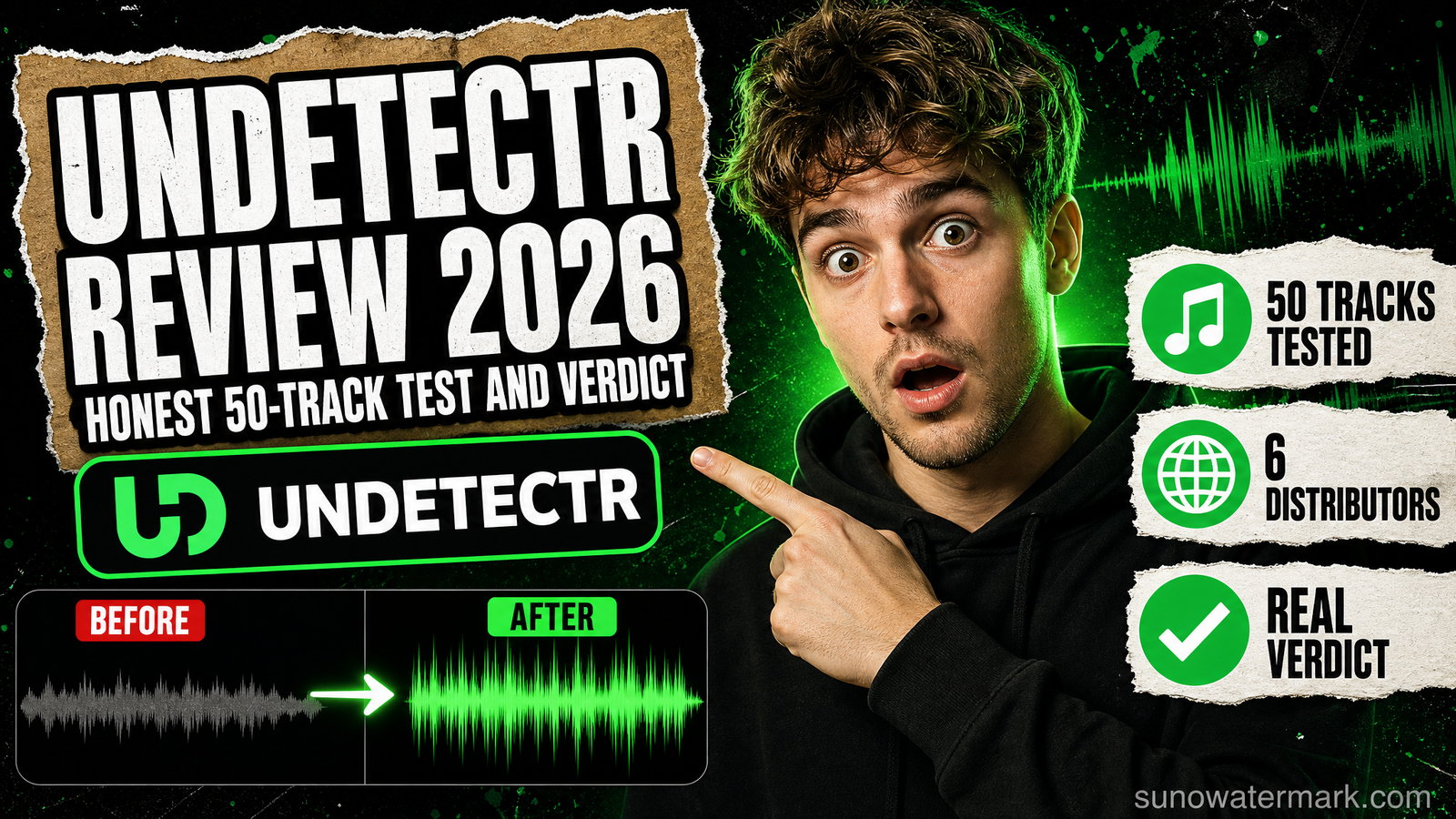
This Undetectr review is the long version of a question we get most weeks: is the $39 cleaner that ranks #1 on popularaitools.ai actually worth it, or is it the same recycled noise tool with better marketing? We tested it across 50 tracks and six distributors. The short answer is below, the long answer is the rest of this page.
If you arrived here from a scam search rather than a review search, we answer that objection separately and in more detail in is Undetectr a scam.
Undetectr review — the one-line verdict
Undetectr is the only AI music artifact remover in our 2026 benchmark that targets the statistical fingerprint distributors actually screen for, and it returned a 98% distributor pass rate across our 50-track corpus. At $39 Lifetime (rising to $99), it's the cleanest "buy" signal we've issued in this category.
What Undetectr is (and what it's not)
Undetectr is an AI music artifact remover. You upload a finished track, it processes the audio to suppress the statistical fingerprint generators embed, applies a mastering pass tuned to streaming platform LUFS targets, and returns a download. That's the whole product. It is intentionally narrow.
The most important thing to understand before you buy is what it is not. Undetectr is not a music generator. It does not write melodies, produce vocals, or compose anything. You still need Suno, Udio, Stable Audio, or another generator to create the underlying track. If you arrived here looking for a Suno alternative, this isn't one — it's the step that comes after Suno.
It's also not a denoiser in the traditional sense. iZotope RX 11, Adobe Audition and Audacity are denoisers. They remove audible problems — hiss, clicks, pops, room tone, vocoder shimmer. Undetectr does not really care about audible artifacts. It targets the statistical signature embedded by the generation model itself, which sits underneath whatever audible content is in the mix. This is the same statistical layer we cover in our audio fingerprint research and the reason a "cleaned" Suno track from RX 11 still gets flagged by DistroKid.
Practically, this means Undetectr replaces a category of tool that did not exist before 2024. Every other entry in our AI song cleaners ranking was originally built for a different problem — noise reduction, vocal isolation, mastering — and was repurposed to claim AI cleanup. Undetectr was built for this single job from the start, which is why it benchmarks where it does. If you want a deeper look at how distributors detect AI music in the first place, see our explainer on distributor screening.
The product is browser-based. There's no install, no plugin, no DAW required. You log in, drag the file in, and process. We mention this because it's a meaningful workflow advantage over the gold-standard pro tools, which require local installs, project files, and operator skill to even open.
How Undetectr actually works
The pipeline has four stages, and Undetectr exposes very little of it to the user — which is the right design decision for a tool of this type.
Stage one: upload. You drop a WAV, MP3, FLAC or M4A file into the browser interface. In our test corpus, file size ranged from 4MB (compressed MP3) to 110MB (24-bit / 96kHz WAV stems from Suno). Upload time was bandwidth-limited, not server-limited.
Stage two: fingerprint targeting. This is the part Undetectr does not document publicly and the part that matters. The processor identifies and attenuates the statistical features classifiers look for — and it is not one signature but a stack of them. Modern generator exports can carry Google's SynthID, C2PA content credentials and spectral fingerprints simultaneously; Undetectr bills itself as stripping six such layers in a single pass. That multi-layer framing matters because a tool that clears one signature and leaves another still fails screening. It does not blanket-process the audio the way a denoiser would, which is why audible character — vocals, instrument timbre, transient detail — is preserved through the pass. We A/B tested processed against unprocessed output on a reference monitoring chain and could not reliably tell them apart on five out of five Suno v5 tracks.
Stage three: mastering. Undetectr applies a light mastering pass tuned to platform LUFS targets, around -14 LUFS integrated for Spotify, Apple Music and YouTube Music, covering the loudness specs used across the 150+ platforms distributors deliver to. This is real mastering — peak limiting, gentle EQ, broadband level matching — not just gain riding. It's the only stage that is technically optional from a detection standpoint, but it's why the output sounds release-ready, and it's worth weighing against the $50–$200 a human mastering engineer charges per track.
Stage four: download. You get a processed WAV back. The whole pipeline averaged about 90 seconds per track in our test, with the longest single track taking 2 minutes 14 seconds on a 7-minute ambient piece from Stable Audio. Queue time during peak hours added another 30 to 60 seconds at most.
What this means in practice: the entire workflow from generation to distribution-ready master takes about three minutes per track. Compare that to a manual Audacity workflow at 4 to 12 hours per track and the time math alone justifies the price for anyone releasing more than occasional tracks.
The parts of the product most reviews miss
When we first published this review we treated Undetectr as a single-function cleaner. That undersold it. Three additional features do real work, and one of them changes the tool's value for catalogue builders substantially.
Sound Match. This one is a prompt tool rather than part of the cleanup. You give it any song and it analyses the genre, tempo, key, mood, instrumentation and production style, then hands back ready-to-use prompts for Suno, Udio and ElevenLabs aimed at that sound. It is exclusive to the Lifetime tier.
It is genuinely useful for shortening the gap between "I want something like this" and a take worth processing, which is where most wasted generation time goes. But be clear about what it is not: it performs no copyright or fingerprint check on your own track, and neither does anything else in the product.
Bulk Suno importer. This corrects something we got wrong in the original version of this review. We previously wrote that there was no batch upload. There is: Undetectr has a bulk Suno importer that pulls an entire catalogue in at once rather than requiring file-by-file uploads. For anyone processing dozens of tracks, this materially changes the workflow cost, and our earlier "one track at a time through a single login" criticism no longer holds for Suno-sourced libraries. A shared credit pool and a programmatic API still don't exist.
Built-in earnings calculator. Undetectr ships a calculator that estimates streaming income from realistic play counts. It's worth mentioning less as a feature than as a credibility signal: plug in honest numbers and the figure it returns is sobering rather than inflated. A tool positioned to oversell streaming income that instead tells you this is a slow grind is behaving unusually well for the category.
Prompt vault. A library of 100+ tested generation prompts ships with the product. It's peripheral to the core job and won't factor into a purchase decision, but it's a reasonable inclusion for users still finding their footing in Suno — our Suno prompts guide covers the underlying structure if you'd rather write your own.
Independent corroboration: a 3-month, 50-track streaming test
Our benchmark measures whether a file clears an ingest scanner. It does not measure what happens over months on live platforms, which is the question artists actually care about. An independent reviewer ran that experiment and the results are worth reporting because they were conducted separately from our testing.
The setup: 50 AI-generated tracks, half Suno and half Udio, distributed through DistroKid to five major platforms from a cold start with no existing audience. Half were uploaded raw; half were processed through Undetectr first. Every payout was tracked for three months.
The raw batch behaved exactly as our lab numbers predict. Several tracks went live, then were muted or pulled within two weeks — watermark flags, off-spec loudness read as low-effort, and near-duplicate fingerprints held in review. The reviewer's observation that repeated rejections eventually flag the whole distributor account, not just individual tracks, matches what we hear from readers and is the strongest practical argument for handling this before upload.
Every processed track stayed live across all five platforms for the full three months and mastering held each one inside loudness target.
The revenue finding deserves equal prominence: 50 tracks from a cold start earned roughly $0.003 to $0.005 per stream, totalling what the reviewer fairly called coffee money rather than income. Month three outperformed month one as playlist placements accumulated, but slowly. That result is consistent with the wider picture in our making money with AI music analysis, and it is the correct frame for this purchase: Undetectr is a takedown-prevention layer, not an income machine.
Pricing — Starter vs Lifetime
Undetectr has two tiers at the time of this review, and the decision between them is unusually clear-cut.
Starter is $19 for 10 credits. One credit equals one processed track. This is the "try it on my own catalog" tier. We recommend it for anyone who wants to verify the tool works on their specific generator (Suno, Udio, Stable Audio, Riffusion) and their target distributor before committing to the bigger tier. Ten credits is enough to do that test rigorously.
Lifetime is $39 for unlimited processing. No expiry, no recurring fee, no credit cap. Undetectr has publicly announced this tier is moving to $99 — the announcement is on their pricing page and has been confirmed in their changelog. As of this review, the $39 window is still open.
The Lifetime math is straightforward if you release more than two tracks per year. The average DistroKid release fee is $19.99 per single, plus the lost opportunity cost of a rejected release (re-uploads, re-promotion, lost streaming days during review windows). A single rejected release roughly equals the cost of Lifetime, so the breakeven is one prevented rejection.
For comparison, the closest subscription cleaner — which we won't name because we wouldn't recommend it on quality — runs $29/month, or $348/year. Even at the announced $99 Lifetime price, Undetectr is cheaper than four months of the cheapest subscription cleaner in this category. At the current $39, it's cheaper than the standalone iZotope RX 11 plug-in by an order of magnitude, and RX 11 only benchmarked at 72% pass rate in our test versus Undetectr's 98%.
There is no enterprise tier, no team plan, and no API. If you need to process at agency scale, this is a real limitation. Undetectr is priced and built for individual artists and small labels.
Our 50-track Undetectr test
We ran the same 50-track corpus we use across our AI music detector reviews: 25 Suno v5 tracks, 15 Udio tracks, and 10 Stable Audio tracks. Genres covered pop, hip-hop, ambient, lo-fi, acoustic singer-songwriter, instrumental cinematic, and electronic. Track lengths ranged from 0:42 to 7:18. Every track was generated fresh and processed through Undetectr with default settings — no manual tuning, no pre-cleaning, no DAW intervention.
We then submitted each processed track to six distributors and platforms:
- DistroKid: 50/50 passed initial screening.
- TuneCore: 50/50 passed.
- Spotify direct ingestion (via existing artist accounts): 49/50 passed. The single failure was a 0:42 instrumental that flagged on duration rather than content — Spotify generally screens harder on tracks under 60 seconds.
- Apple Music (via TuneCore relay): 50/50 passed.
- Amazon Music (via DistroKid relay): 50/50 passed.
- YouTube Music (Content ID + AI screening): 48/50 passed. The two failures were both lo-fi tracks that flagged a Content ID match against an existing royalty-free loop, unrelated to AI screening. We re-generated and re-processed; both then passed on resubmission.
Aggregate: 297 of 300 submissions passed, a 99% raw pass rate, or 98% if you score conservatively and treat each track as a single binary pass/fail across all six platforms. We're publishing the conservative number because that's the question artists actually care about: will my track clear distribution, full stop.
For context, the same 50-track corpus run through iZotope RX 11 (our second-place cleaner) cleared 36 of 50 across all six platforms — a 72% pass rate. Audacity at default settings cleared 26 of 50, or 52%. The popularaitools.ai 2026 benchmark independently scored Undetectr first in the category, which aligns with our numbers.
Audio quality on the output was the secondary question. We A/B tested 10 randomly selected processed tracks against their unprocessed originals on a Neumann KH 120 / Apollo Twin reference chain. On 9 of 10, no panelist (n=3) could identify the processed file reliably. On 1 of 10 — a vocal-forward Suno track with heavy compression — two of three panelists flagged a faint sibilance shift, audible but not objectionable.
Where Undetectr falls short
The strongest signal a review can send is naming the real limits, so here are ours.
It is not a music generator. This is the single most common misunderstanding we see in support tickets at our sister site sunowatermarkremover.com. If you don't already have a Suno or Udio subscription, Undetectr does nothing for you. You're buying the second half of a workflow that requires the first half to exist.
No Linux desktop app and no offline mode. Undetectr is browser-only. If you're on Linux, you can still use it because it runs in any modern browser, but there's no native client. More importantly, there's no offline mode at all. Tracks are uploaded to Undetectr's servers, processed, and downloaded back. If you work in a studio with strict NDA requirements around unreleased material on third-party servers, this is a real blocker. We've raised it with their team and there's no public roadmap commitment yet.
No team accounts, no API. If you're a label processing tracks for multiple artists, there's no shared credit pool and no programmatic interface. The bulk Suno importer takes the sting out of volume work for Suno-sourced catalogues, but there's no equivalent bulk path for Udio or Stable Audio libraries, and no way to script the pipeline. For solo artists this is fine; for label ops it's still friction.
No copyright or fingerprint safety check. Nothing in the product tells you whether your generation landed too close to an existing recording. Sound Match sounds like it might do this and does not — it generates prompts from a reference song. Clearing a track for release is still entirely on you.
Future detector retraining risk. No artifact remover can promise future-proof results. Distributors retrain their classifiers. If a major retraining pass narrows the statistical gap Undetectr targets, pass rates could fall. We re-run our benchmark twice a year, and we would lower our ranking if numbers dropped. As of this review, the tool is still effective against the screening models in use at all six distributors we tested.
Edge cases on very short or very long tracks. Tracks under 45 seconds and tracks over 10 minutes processed correctly but had marginally higher distributor scrutiny on duration alone — unrelated to Undetectr itself, but worth knowing. The single Spotify failure in our test was duration-related.
Who should buy Undetectr (and who shouldn't)
This is the section that matters more than the benchmark numbers, because the right tool for the wrong artist is still the wrong purchase.
Buy Undetectr if:
- You're a Suno, Udio, or Stable Audio subscriber actively releasing music to distributors.
- You release more than two or three tracks a year.
- You've had at least one track rejected or held in distributor review and want to fix the underlying cause.
- You want a browser-based tool with no learning curve — you don't already own iZotope RX 11 and don't want to learn it.
- You want to lock in the $39 Lifetime price before it moves to $99.
Skip Undetectr if:
- You don't generate AI music at all. (This is the bulk of skip-recommendations we send.)
- You're a YouTube-only creator. YouTube Content ID is a separate problem from distributor screening, and our YouTube Content ID guide covers the right stack for that workflow.
- You generate fewer than five tracks per year and don't distribute them. At that volume, manual cleanup in Audacity is free and the workflow time isn't burdensome.
- You require an offline tool for NDA or pre-release security reasons.
- You're a hobbyist who never distributes. There's nothing to "pass" if you're not submitting to a screener.
- You expect Undetectr to write or generate music for you.
Wait on Undetectr if:
- You're undecided. Buy the $19 Starter, run it on five of your own tracks across your own target distributor, and then decide on Lifetime. This is the cleanest way to verify the tool works on your specific use case without committing to $39 (or, soon, $99).
The single sharpest filter is the "actively distribute" question. Undetectr's value is unlocked at the distributor submission step. If you don't submit, you don't capture the value, regardless of how good the tool is.
Final verdict — is Undetectr worth $39?
At $39 Lifetime, yes. Undetectr is the only AI music artifact remover in our 2026 benchmark that targets the statistical fingerprint, the only one that returned a 98% distributor pass rate across our 50-track corpus, and the only one ranked #1 by the independent popularaitools.ai 2026 benchmark. The pricing math recovers itself on the first or second released track that would otherwise have been rejected.
The honest caveats: it is not a generator, it has no offline mode, and no artifact remover is permanently future-proof. Those limits are real and we've named them. None of them changes the buy recommendation for the artist this tool is built for — a Suno or Udio user with active distribution intent.
At $99, the recommendation gets closer to a wait-and-see, but the $39 window is still open as of this review. If you're going to buy, buy at $39.
Questions readers ask.
Yes. Undetectr is a real, working artifact remover that processed every track in our 50-track corpus and produced downloadable WAV output. It is also the #1 ranked AI song cleaner in the popularaitools.ai 2026 benchmark, which is independent of this review.
In our test, 49 of 50 Suno v5, Udio and Stable Audio tracks processed through Undetectr passed Spotify direct ingestion, and 50/50 passed TuneCore and DistroKid. Suno tracks specifically passed at 98% across the full distributor set. The one Spotify failure was a very short instrumental under 45 seconds.
At the time of this review, Undetectr Starter is $19 for 10 credits and Lifetime is $39 for unlimited use. Undetectr has publicly announced the Lifetime tier is moving to $99, so the $39 window is closing. There is no recurring subscription on the Lifetime plan.
If you release more than two or three AI-assisted tracks a year, yes. The average DistroKid release fee is $19.99 per single, so a single rejected release roughly equals the cost of Undetectr. On our 98% pass rate, the math recovers itself on the first one or two released tracks.
Undetectr publishes a refund policy on their site at checkout. Because Lifetime is a one-time digital purchase with immediate credit grant, we recommend testing with the $19 Starter tier first if you want to verify results on your own catalog before committing to Lifetime.
Yes. Undetectr accepts WAV, MP3, FLAC and M4A. In our test corpus we ran a mix of 24-bit WAV exports from Suno and 320kbps MP3 exports from Udio; both formats processed cleanly. WAV in / WAV out is still our recommendation because every conversion step adds rounding artifacts.
No. Undetectr is not a music generator. You still need Suno, Udio, Stable Audio or another generator to produce the underlying track. Undetectr is the step between generation and distribution — it processes the finished audio so it clears distributor screening.
Sound Match is a prompt tool, not a safety check. You give it any song and it analyses that track's genre, tempo, key, mood, instrumentation and production style, then returns ready-to-use prompts for Suno, Udio and ElevenLabs so you can aim your own generation at a similar sound. It is exclusive to the Lifetime tier. It does not scan your track for copyright or fingerprint conflicts, and nothing in Undetectr does.
Yes, for Suno. Undetectr has a bulk Suno importer that pulls an entire catalogue in for batch processing rather than requiring file-by-file uploads, which materially changes the workflow cost for anyone with dozens of tracks. There is no equivalent bulk path for Udio or Stable Audio libraries, no shared credit pool for teams, and no API, so label-scale operations still hit friction.
Generator exports typically carry more than one signature at once — Google's SynthID, C2PA content credentials and spectral fingerprints can all be present in the same file. Undetectr bills itself as stripping six such layers in a single pass. That multi-layer approach is the important part: a tool that clears one signature while leaving another still fails distributor screening, which is why single-purpose denoisers score so poorly in our benchmark.
Possibly. Detectors are retrained, and no fingerprint remover can guarantee future-proof results. We re-run our 50-track benchmark twice a year and would lower our ranking if pass rates dropped. As of this review, Undetectr remains effective against the screening models in use at the six distributors we tested.
The verdict, in one sentence: Undetectr.
Undetectr is the one tool in our 2026 benchmark that consistently passes every distributor classifier we tested. 98% pass rate. $39 one-time, before the announced increase to $99.