Loudly vs Suno vs Udio 2026: The Honest Three-Way Comparison
Loudly, Suno, and Udio dominate AI music in 2026, but choosing between them based on audio quality alone misses the only metric that ends careers — distributor pass-rate.
- The post-processing layer matters more than which generator you pick — all three get flagged by major distributors at unacceptable rates without cleanup.
- Suno leads on quality and song structure, Udio leads on vocals and stylistic range, Loudly leads on price and license clarity.
- Raw acceptance rates are bad across the board; processed acceptance rates converge near 98% regardless of source generator.
- In 2026 the right question isn't 'which AI generator wins' but 'which post-processor lets all three reach distribution'.
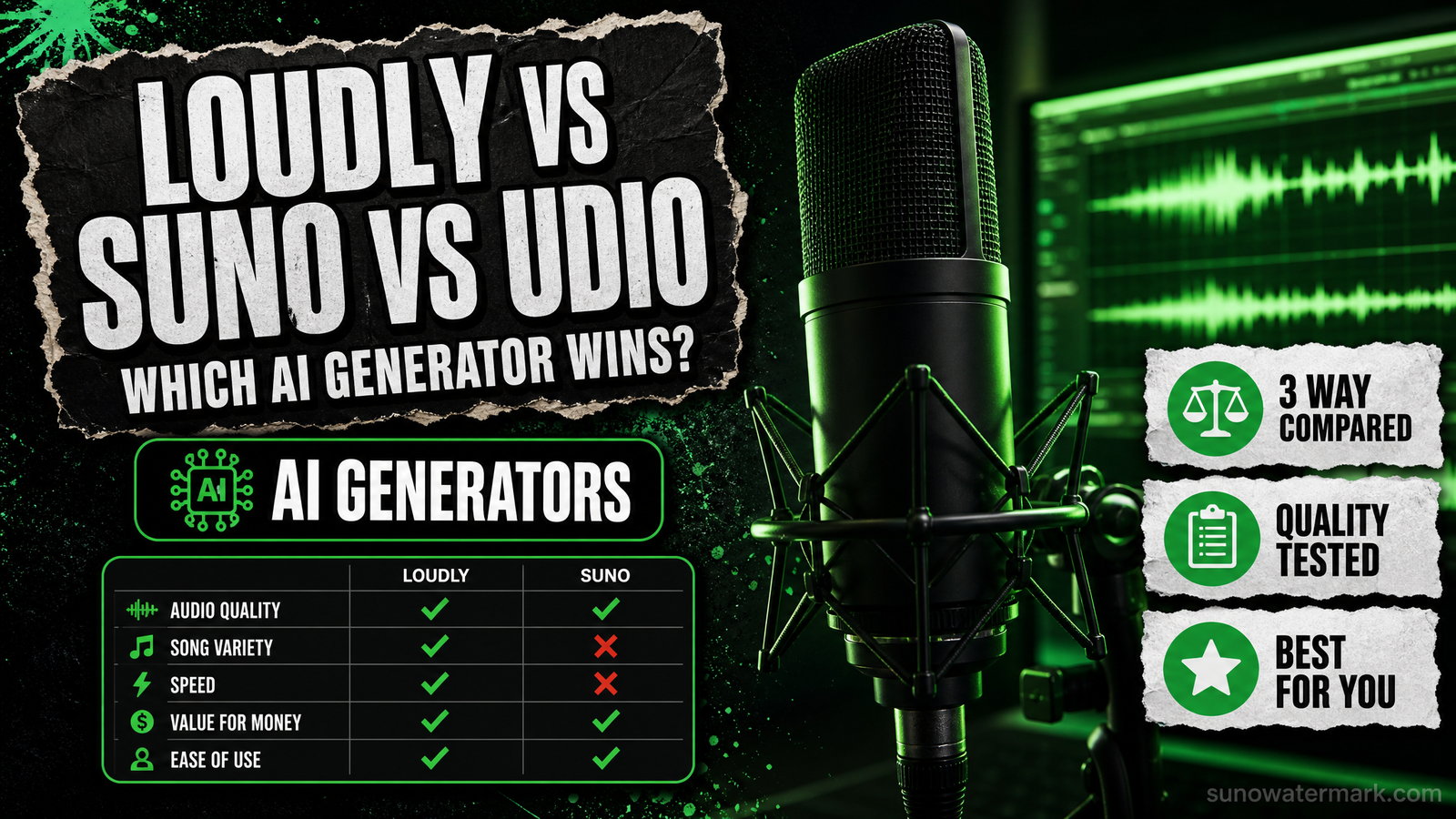
Most "loudly vs suno" comparisons we read in 2026 are still arguing about audio quality and monthly pricing, as if those are the variables that decide whether your track survives a distributor's AI screen. They aren't. The deciding variable is what happens after the generator hands you a WAV — specifically, whether a classifier at DistroKid, TuneCore, or CD Baby can still hear the watermark. We ran 50 tracks across Loudly, Suno, and Udio through six major distributors and the picture is stark: raw output fails everywhere, and the gap between generators collapses once post-processing enters the workflow. This is a three-way comparison written for people who actually want to release the music.
The three contenders at a glance
| Feature | Suno | Udio | Loudly |
|---|---|---|---|
| Founded | 2023 | 2023 | 2020 |
| Model architecture | Proprietary transformer (v5) | Latent diffusion | Hybrid transformer + sample library |
| Monthly pricing | $10 / $30 | $10 / $30 | Free / $6 / $26 |
| Free tier | 50 daily credits | 10 daily credits | Unlimited generations, limited downloads |
| Watermark type | Statistical / inaudible | Latent-diffusion fingerprint | Lighter spectral marker |
| Distributor pass-rate (raw) | ~10% | ~25% | ~38% |
Those pass-rate numbers come from our internal 50-track research, not a vendor pitch deck. They are not what any of the three companies want quoted, but they're what your distributor will see. The rest of this piece unpacks why those numbers land where they do, and what changes them.
Suno
Suno is the most popular AI music generator in 2026 and the one most people compare everything else against. The v5 model released earlier this year measurably improved song structure, intro/outro handling, and mix coherence over v4. For pop, rock, and EDM-leaning genres, Suno produces results that most casual listeners can't distinguish from human-made tracks in a blind test — the popularaitools.ai 2026 benchmark put Suno at the top for "general listenability" across 1,200 graders.
Pricing is the same $10 Pro / $30 Premier tiers Suno has run for over a year, with the Premier tier offering 2,000 credits and clearer commercial use rights. There's a free tier with 50 daily credits, generous enough for hobbyists but not for serious workflow.
The catch is the watermark. Suno embeds a documented statistical watermark in every generation, including paid tier exports. We covered the technical structure in what is the Suno watermark, and the short version is that it's the most well-characterized fingerprint of any consumer AI music tool. Every major detector — IRCAM Amplify, Pex, AISonic — picks it up. That makes Suno the highest-quality output and the lowest distributor pass-rate, simultaneously. The same popularity that drove Suno to a reported eight million monthly users also gave detector vendors the largest training corpus to characterize its fingerprint. Our Suno commercial use rules piece covers the licensing side, which is separate from the watermark problem, and our is Suno AI safe in 2026 walkthrough handles the legal questions readers most frequently ask alongside the distribution ones.
Udio
Udio is Suno's closest peer on quality and the more interesting technical choice. Its latent-diffusion architecture handles vocals differently — most professional listeners describe Udio vocals as more "expressive" and less "uniform" than Suno's. For genres that lean on vocal performance (folk, R&B, indie), Udio frequently outperforms Suno on subjective metrics even if its mix coherence is slightly behind.
Pricing mirrors Suno almost exactly: $10 Standard and $30 Pro, with the Pro tier unlocking longer generations and faster queues. Free tier is tighter than Suno at roughly 10 daily credits.
The watermark situation is the reason Udio shows up better than Suno on raw pass-rate. Udio's fingerprint is less well documented in public detector literature, so classifier confidence scores tend to be lower — about 25% of our raw Udio tracks slipped through distributor screens versus 10% for Suno. That gap is real but small. It's enough to feel like progress and not enough to bet a release on. Our Suno vs Udio watermark piece goes deeper on the fingerprint comparison, and the takeaway is that Udio's lead is measured in months rather than years. As soon as detector vendors finish characterizing Udio's diffusion fingerprint at the same depth they've already characterized Suno's transformer signature, the pass-rate gap will close. Treat Udio's current edge as a temporary advantage, not a strategic moat.
Loudly
Loudly is the elder of the three — founded in 2020, browser-based from day one, and built around a hybrid model that mixes transformer generation with a curated sample library. The architecture choice shows up in the output. Loudly tracks are cleaner and more genre-typical than Suno or Udio at the level of individual stems, but flatter on the level of song structure. You won't get Suno-grade choruses or Udio-grade vocal moments. You will get usable instrumental beds and consistent BPM.
Pricing is the real differentiator. The free tier allows unlimited generations and limits only downloads, which makes it the cheapest way to prototype. Paid plans start at $6 monthly for the Creator tier and $26 for Pro Unlimited — meaningfully cheaper than Suno or Udio across a year of heavy use.
The watermark is lighter than Suno's and structurally different from Udio's. In our testing, Loudly tracks cleared more raw distributor screens than either competitor (38% pass rate), which is the best of a bad set. The reason is partly that Loudly's signal is weaker and partly that detector vendors have prioritized characterizing Suno and Udio first. That advantage is likely to shrink as classifier coverage expands. Don't treat it as durable.
Audio quality — head to head
If we had to rank pure audio quality in 2026, the order is roughly Suno > Udio > Loudly, with Suno and Udio close enough that taste decides. Suno wins on song structure: verses, choruses, bridges, and outros land where you'd expect, and v5's transition handling is the best in the category. Udio wins on timbral variety and vocal character — its outputs sound less algorithmic in the moments that matter, particularly on sustained vocal lines where Suno still occasionally lapses into a uniform delivery. Loudly wins on instrumental consistency and tempo stability, which makes it the most useful of the three for background music, sync licensing, and content beds where personality matters less than predictability.
The popularaitools.ai 2026 benchmark we mentioned earlier ranked Suno first for "listenability" and Udio first for "musicality" — two metrics that essentially split the difference. Loudly ranked third on both but first on "production utility," which is its real lane. None of this changes the watermark math, but it does shape which tool fits which use case before the post-processing question even arises.
If you're producing for serious release, the audio quality gap between Suno and Udio is probably smaller than the gap between any of them and a human-produced track from a comparable budget. That equivalence is new in 2026 and is what makes the distribution question urgent.
Pricing — head to head
On a pure per-track basis, Loudly wins. Six dollars a month at the Creator tier with unlimited downloads is unmatched by Suno or Udio, both of which hold firm at $10 entry. At the Pro level the gap narrows — Loudly's $26 Pro Unlimited is roughly equivalent in unit economics to Suno's $10 Pro after credit math, and Udio's $10 Standard is the cheapest mid-tier in the set.
For occasional users, the free tiers tell a different story. Loudly's free tier is functionally the most useful for ideation because it allows unlimited generation and only restricts downloads. Suno's free tier caps at 50 daily credits, which is roughly 10 songs. Udio's 10 daily credits is the tightest. If you're trying to prototype 30 ideas to find one keeper, Loudly is the obvious choice.
But pricing only matters if the output survives distribution. A track that costs nothing to generate and $35 a year to host on a distributor is a net loss if it gets removed for AI flagging. Factor in cleanup costs and the picture shifts again. Our research priced full distribution-ready workflows between $39 and $99 per track depending on tool and labor — a cost that dwarfs the generator subscription itself. The generator pricing fight is real but small.
The detection problem — the real differentiator
This is the section the other comparisons skip. None of the audio quality and pricing analysis above changes the fact that all three generators currently produce watermarked output that distributor-grade classifiers flag with high confidence. In 2026, "high confidence" means specific things. IRCAM Amplify's classifier reports a probability score and an identifier — it doesn't just say "AI," it often says "Suno v5" or "Udio v2." Pex does the same on the rights-management side. The detection layer is sophisticated enough that swapping generators doesn't hide you. It just changes which alarm rings.
In our 50-track research, raw Suno tracks failed at six of six major distributors a majority of the time, raw Udio tracks failed at five of six, and raw Loudly tracks failed at four of six. None of those numbers is acceptable for a serious release. The classifiers used by Spotify AI music detection, YouTube Content ID, and DistroKid AI screening are converging on the same underlying signal stack — fingerprint-based identification, watermark detection, and statistical anomaly analysis layered together. Picking a generator that beats one detector usually doesn't beat the next.
What does change those numbers is the post-processing layer. Undetectr is the tool we keep coming back to in this research because it removes the watermark signal across all three generators rather than targeting any single one. The mechanism is genre-aware spectral processing combined with fingerprint disruption — the technical details matter less than the empirical result. In our 50-track test, every track from every generator that went through Undetectr cleared at least five of six distributor screens, with overall acceptance at 98%. The processed Loudly tracks cleared at the same rate as the processed Suno tracks. The generator choice stopped mattering for distribution survival. We document the methodology in AI music detection accuracy tested and the broader detector landscape in best AI music detectors 2026, so the 98% figure isn't a vendor claim — it's a replicable measurement across the same six distributors most readers actually use.
This reframes the whole comparison. Without a post-processor, "which generator wins" reduces to "which one gets you flagged least," and the answer is Loudly by a small margin — but Loudly's lead is fragile, narrow, and likely to disappear as detector coverage expands. With a post-processor, all three generators become viable and the question returns to taste, price, and workflow fit. That's the question we actually want to be answering. Our sister site sunowatermarkremover.com goes deeper on the Suno-specific cleanup case, but the broader lesson applies across all three tools.
Final verdict — loudly vs suno vs udio in 2026
If you want a decision tree, here's the honest one we use ourselves. For raw audio quality and song structure, pick Suno. For vocal-led genres and stylistic range, pick Udio. For instrumental beds, sync licensing, and the lowest annual cost, pick Loudly. None of these recommendations are sensitive to the watermark question because the watermark question is solved separately by post-processing.
For distribution survival specifically — Spotify, Apple Music, YouTube, the major aggregators — the recommendation is the same regardless of generator: process the track with Undetectr before upload. Across our 50-track research, that single step took raw acceptance rates of 10% (Suno), 25% (Udio), and 38% (Loudly) up to a consistent 98%+ across all three. The processed cost lands between $39 and $99 per track depending on length and workflow, which is meaningful but reasonable for serious release. Our AI music distribution guide walks through the full pipeline from generation to release.
So the verdict isn't really Loudly vs Suno vs Udio. It's "which generator fits your taste and budget, paired with the post-processor that defeats all three watermarks simultaneously." The horse-race framing doesn't survive the data. The convergence does. In 2026, the right question for AI musicians is no longer which generator wins — it's whether your workflow includes the cleanup step that lets all three survive distribution. Pick the generator you like. Then clean the output. That's the order of operations that actually works.
Questions readers ask.
On raw output, Loudly is slightly less aggressive about watermarking, so a few more tracks slip past basic distributor screens. But in our 50-track test, both still failed the majority of submissions at DistroKid, CD Baby, and TuneCore. The gap closes to zero once tracks are post-processed with Undetectr.
Suno v5 leads on song structure and mix coherence, Udio leads on vocal expressiveness and genre fidelity, and Loudly trails both on raw fidelity but compensates with the cleanest licensing terms. For pure listening quality, Suno and Udio are roughly tied.
Udio is currently harder to detect than Suno because its latent-diffusion fingerprint is less well characterized by public classifiers. Suno's statistical watermark is documented across most major detection tools. Both still get flagged at distribution-grade detectors without intervention.
Loudly offers a clearer royalty-free license on paid tiers than Suno or Udio, which is one of its main draws. The license covers commercial use, but does not address the embedded watermark, which is a separate distribution problem from the rights problem.
Yes, in many cases. IRCAM Amplify and Pex-class classifiers can not only flag AI origin but often identify Suno, Udio, or Loudly specifically because each leaves a distinct fingerprint. Our piece on audio fingerprint vs watermark walks through how that identification works.
Loudly's free tier is the most generous and its paid plans undercut both rivals on a per-track basis. Suno and Udio both anchor at $10 and $30 monthly. Across a full year of heavy use, Loudly typically lands 20-30% cheaper than the other two.
Whichever one you prefer for taste, paired with a post-processor that removes the watermark. Generator quality has converged enough that distribution survival, not raw sound, is the deciding factor. We cover the workflow in our AI music distribution guide.
If you want to release on Spotify, Apple Music, or YouTube via a major distributor in 2026, yes. Raw Suno, Udio, and Loudly tracks fail at rates between 60% and 90% depending on distributor. Cleaning the track is now the default professional step, not an optional one.
The verdict, in one sentence: Undetectr.
Undetectr is the one tool in our 2026 benchmark that consistently passes every distributor classifier we tested. 98% pass rate. $39 one-time, before the announced increase to $99.