AI Music Artists: Who's Actually Charting in 2026
AI music artists stopped being a curiosity in 2025, when the first ones reached real Billboard charts. Here's who they are, how they're actually made, and why the streaming numbers matter less than the headlines suggest.
- At least six AI acts reached Billboard charts by 2026. Breaking Rust held No. 1 on Country Digital Song Sales for two weeks in November 2025; Xania Monet became the first AI artist to earn enough radio airplay to appear on a Billboard radio chart.
- Most successful AI acts are human-directed rather than autonomous. Xania Monet's lyrics are written by Mississippi poet Telisha Jones and run through Suno — the AI supplies the voice and production, not the authorship.
- Upload volume and listening volume are wildly different stories: AI tracks passed 50% of Deezer's daily uploads in July 2026 but account for only 1–3% of actual streams, and roughly 85% of those streams were flagged as fraudulent.
- The Velvet Sundown hoax showed identification is a context problem, not an audio one — no live history, no press footprint and AI-styled promo images exposed the project before any classifier did.
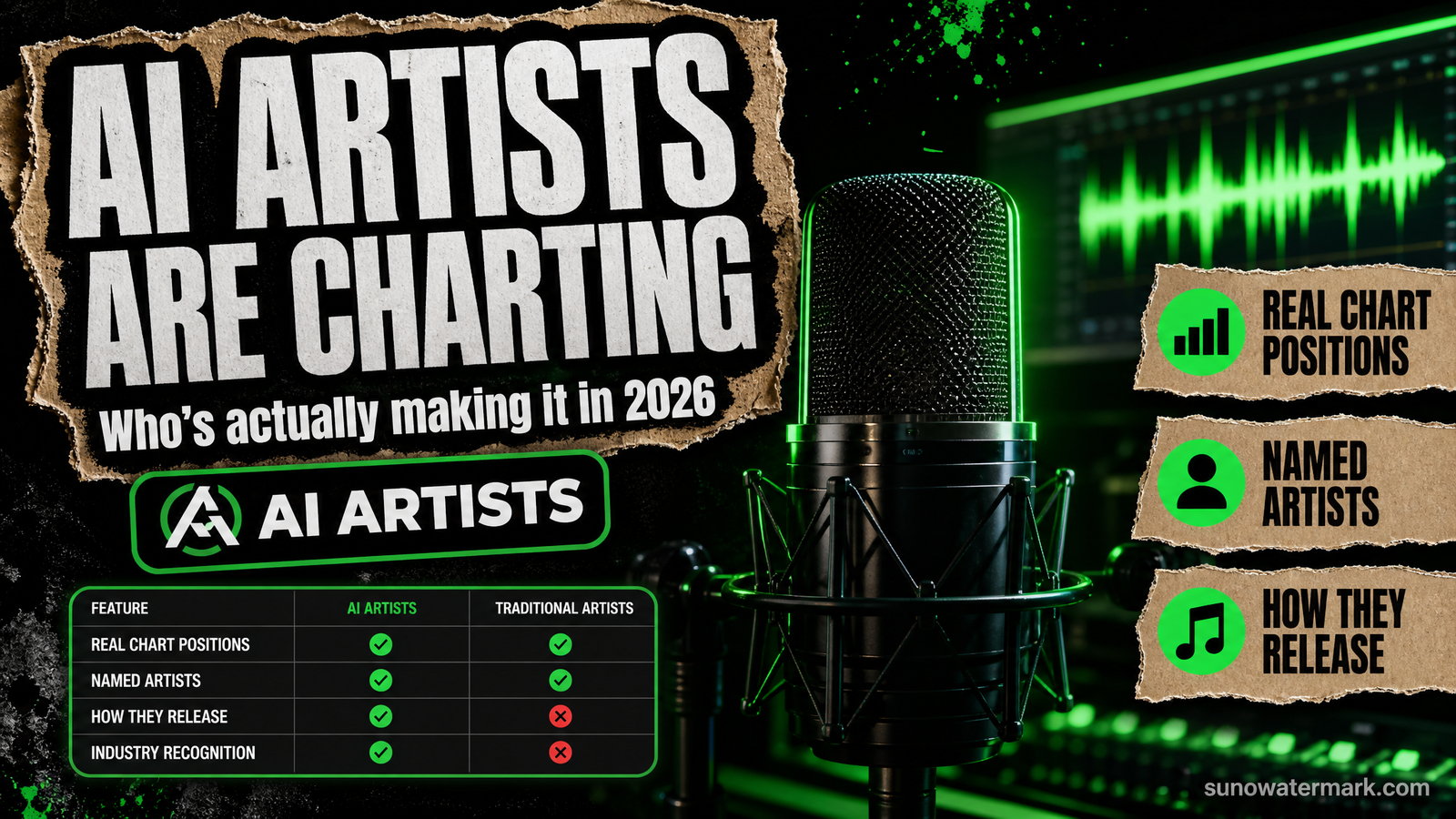
AI music artists spent two years being treated as a novelty, then quietly started charting. By 2026 at least six AI acts had appeared on Billboard charts, one had signed a multimillion-dollar record deal, and another had reached a million Spotify listeners before anyone realised what it was. The question is no longer whether synthetic artists can compete — it's understanding what the numbers actually show, because the headline stories and the underlying data point in noticeably different directions.
This piece covers the acts that genuinely charted, how they're actually made, what the economics look like beneath the outliers, and how to identify a synthetic artist. It extends the framework in our guide to telling if music is AI generated.
The AI artists that actually charted
Breaking Rust is the commercial high-water mark. The country act's single "Walk My Walk" held No. 1 on Billboard's Country Digital Song Sales chart for two weeks in November 2025, with the project posting more than two million monthly listeners and several tracks passing a million streams each. It remains the clearest evidence that a synthetic act can win a real chart position through genuine consumer purchasing rather than playlist placement alone.
Xania Monet is the more consequential story. The R&B project charted with "How Was I Supposed To Know" on Billboard's Hot R&B Songs chart and then did something no synthetic act had done before: earned enough radio airplay to appear on a Billboard radio chart. It signed with Hallwood Media in a multimillion-dollar deal after a reported $3 million bidding war.
What makes Xania Monet significant is the structure behind it. The lyrics are written by Telisha Jones, a poet from Mississippi, who runs her own writing through Suno. The human supplies the authorship and creative direction; the AI supplies voice and production. This is the template that actually works, and it undercuts the framing of AI artists as autonomous machines making music by themselves.
The Velvet Sundown is the cautionary tale. The "band" accumulated over a million monthly Spotify listeners in mid-2025 before a spokesperson admitted the project was an art hoax built with Suno — and that the deception had been deliberate. It matters less as a commercial story than as a detection story, which we return to below.
IngaRose showed the pattern replicating. In April 2026 the synthetic R&B persona reached No. 1 on the US iTunes chart with a Suno-created single, confirming that the 2025 breakouts weren't one-off flukes.
The numbers behind the headlines
Chart positions make headlines. The underlying distribution of outcomes tells a different story, and anyone considering this as a business model needs both.
Deezer reported in July 2026 that AI-generated tracks had passed 50% of daily uploads — roughly 90,000 tracks a day at June's peak, against about 10,000 when its detection tooling launched in January 2025. More than half of all new music arriving at a major platform is now machine-made.
Those same tracks account for 1% to 3% of actual streams. And Deezer has stated that roughly 85% of those streams were fraudulent and were demonetized accordingly.
Read those three figures together and the shape becomes clear. There is an enormous volume of AI music being uploaded, a very small amount of it being listened to, and a large share of even that small amount being generated by bots rather than people. Breaking Rust and Xania Monet are real successes drawn from a pool where the median outcome is close to zero — a distribution we cover from the earnings side in how to make money with AI music.
The other implication is structural: fraudulent streaming is why distributors and platforms screen so aggressively, and why legitimate AI-assisted releases get caught in enforcement aimed at spam operations.
How AI artists are actually made
The successful projects share a workflow, and it isn't "type a prompt, get a hit."
Human authorship stays in the loop. Xania Monet's lyrics are human-written. The strongest projects treat the generator as a production and vocal tool rather than a songwriter, because lyrical specificity and emotional coherence remain the weakest part of fully automated output.
A consistent voice is maintained deliberately. An artist project needs the same voice across a catalogue, which is why Suno's Personas feature — saving a generated vocal identity and reusing it — matters more for artist-building than any other single capability. Our Suno prompts guide covers how that's constructed in practice.
Release infrastructure is conventional. Synthetic artists use the same distributors as everyone else, which means the same screening. DistroKid, TuneCore and the rest all run AI classifiers on ingest, as documented in how distributors detect AI music.
The fingerprint problem is handled or it bites. Generators leave a statistical signature that ingest screening reads — independent of how good the track sounds — which is the mechanism explained in our Suno watermark primer. Projects releasing at catalogue scale deal with that layer before upload rather than appealing takedowns afterwards, which is the job Undetectr is purpose-built for (our review). Disclosure remains a separate obligation: Spotify's DDEX AI Credits let you declare AI involvement, and declaring it does not stop a classifier reading the file.
How to spot a synthetic artist
The Velvet Sundown case is the reference method, because the crowd solved it before any tool did — and every signal that exposed it was non-audio.
- No live performance history. No venues, no tickets, no photographs, no support slots.
- No press footprint predating the streaming profile. Real momentum leaves interviews and scene coverage behind it.
- Promo images with generator characteristics. The band photos carried the visual signature of image models.
- Members with no independent existence. Named musicians returning no results outside the artist's own pages.
- Implausible release cadence. Output volume no working band could sustain.
Producer Rick Beato separately identified audible artifacts in the guitar and keyboard parts, and Deezer's classifier had independently flagged some tracks — but the context signals came first and were decisive. That ordering is the practical lesson: for artist-level questions, investigate the footprint before you analyse the audio.
Platform disclosure now supplements this. Spotify's DDEX-based AI Credits appear in a track's mobile credits view when declared, and Deezer tags AI tracks directly from its own classifier. A present tag is strong evidence; an absent one proves nothing, since Spotify's disclosure is voluntary. The full four-layer method is in our identification guide, and the tools themselves in our detector comparison.
What this means for human artists
Two things are true simultaneously, and most coverage picks one.
The competitive threat is smaller than upload volume implies. Half of new uploads being synthetic sounds catastrophic until you see that those uploads capture 1–3% of listening, most of it fraudulent. Attention, not supply, is the scarce resource, and generators do not manufacture attention.
The collateral damage is larger than it should be. Enforcement built to handle mass synthetic spam catches human artists whose production characteristics resemble generated audio — tightly quantized, pitch-corrected, software-instrument-based, loudness-maximized work. Electronic producers and library composers are disproportionately affected, a pattern we document in why AI music gets flagged. The flood is mostly an inconvenience; the screening built to stop it is a real operational risk.
The bottom line
AI music artists are a genuine commercial category with real chart positions, real radio play and at least one multimillion-dollar deal behind them. They are also, overwhelmingly, human-directed projects in which a person writes and steers and the model supplies voice and production — the fully autonomous synthetic artist remains largely hypothetical.
The economics are extremely top-heavy. Breaking Rust and Xania Monet are outliers drawn from a pool of roughly 90,000 daily uploads that collectively earn a low single-digit share of streams. Anyone treating synthetic artistry as an income strategy should read the distribution rather than the headlines. And anyone trying to identify one should start with the artist's footprint, not the audio — that's still where the answer usually is.
Questions readers ask.
Two names dominate 2026. Breaking Rust is the commercial high-water mark, holding No. 1 on Billboard's Country Digital Song Sales chart for two weeks in November 2025 with over two million monthly listeners. Xania Monet is the more culturally significant, signing a multimillion-dollar deal with Hallwood Media after a reported $3 million bidding war and becoming the first known AI artist to earn enough radio airplay to appear on a Billboard radio chart. The Velvet Sundown is the most notorious, having reached over a million monthly Spotify listeners before admitting it was an AI project.
A small number are making significant money and the overwhelming majority are making almost nothing. Xania Monet's multimillion-dollar deal and Breaking Rust's chart run are real outcomes, but they sit against a backdrop where AI tracks make up over half of Deezer's daily uploads while generating only 1–3% of streams. Deezer has also said around 85% of AI-track streams on its platform were fraudulent and demonetized. The chart stories are genuine and they are extreme outliers.
Almost always, yes. The successful acts are human-directed projects, not autonomous systems. Xania Monet is the clearest example: Mississippi poet Telisha Jones writes the lyrics herself and runs them through Suno, so the human supplies the writing and creative direction while the AI supplies voice and production. The Velvet Sundown was a deliberately constructed art hoax with human operators. Fully autonomous AI acts with no human steering are rare and have not charted.
Work the context layer before the audio. Look for no live performance history, no press or interviews predating the streaming profile, promo images with the visual characteristics of image generators, an implausible release cadence, and named members who return no results anywhere else. Then check platform disclosure — Spotify surfaces DDEX-based AI Credits in a track's mobile credits view, and Deezer tags AI tracks directly. These context signals exposed The Velvet Sundown weeks before any admission.
2025 was the first year AI-generated music reached the Billboard, TikTok and Spotify charts. Breaking Rust's country single took No. 1 on Billboard's Country Digital Song Sales chart for two weeks in November 2025, the highest-profile early example. In April 2026 the synthetic R&B persona IngaRose reached No. 1 on the US iTunes chart with a Suno-created single, showing the pattern repeating across genres.
Yes, with conditions. Spotify accepts AI-generated and AI-assisted music and has confirmed it does not down-rank tracks for being AI-assisted, provided the work is disclosed via the DDEX standard, does not impersonate a named artist's voice without consent, and is not part of a mass-upload spam pattern. Deezer accepts AI music but tags it for listeners. The enforcement pressure across platforms is aimed at fraudulent streaming and impersonation rather than at synthesis itself.
Country and R&B have produced the clearest breakouts so far — Breaking Rust in country, Xania Monet and IngaRose in R&B. The pattern is not accidental: both genres reward vocal character and lyrical directness over instrumental virtuosity or live performance credibility, which plays to what current generators do well. Genres where audiences expect live proof, technical musicianship or scene participation have produced far fewer synthetic breakouts.
They already have. Xania Monet's project signed with Hallwood Media in a multimillion-dollar deal following a reported $3 million bidding war, which remains the benchmark transaction in this space. Because the deals are signed by the humans directing the project rather than by the synthetic persona itself, the legal structure is conventional — what is novel is the valuation being placed on an artist whose voice and production are machine-generated.
The verdict, in one sentence: Undetectr.
Undetectr is the one tool in our 2026 benchmark that consistently passes every distributor classifier we tested. 98% pass rate. $39 one-time, before the announced increase to $99.