UnitedMasters Review 2026: Splits, Fees and the AI Question
UnitedMasters is the only major distributor built around brand and sync deals rather than upload volume. That focus is genuinely valuable, and it costs you either 10% of your royalties or a subscription.
- The free tier takes 10% of your streaming royalties. Select removes that cut for a flat annual fee, so the break-even is roughly the point where 10% of your earnings exceeds the subscription.
- Its real differentiator is deal flow: brand partnerships and sync opportunities routed through the platform, which no upload-volume distributor offers.
- Like every distributor in 2026 it screens uploads. A UnitedMasters account does not exempt AI-assisted tracks from ingest checks.
- Best for artists chasing placements and brand work. Wrong for high-volume catalogue uploaders, where a flat unlimited plan is cheaper per release.
UnitedMasters is the distributor that is not really competing on distribution. Getting a track onto Spotify is a commodity in 2026 and every service here does it. What UnitedMasters sells is deal flow: brand partnerships and sync opportunities routed to artists on the platform, which is a genuinely different product from the flat-fee unlimited-upload model everyone else runs.
This review covers what the tiers actually cost once you account for the royalty split, where the deal-flow pitch holds up, and how it treats AI-assisted music. It sits alongside our reviews of DistroKid, TuneCore, CD Baby, RouteNote and Ditto.
The pricing model is the review
Almost everything worth knowing follows from one structural choice: UnitedMasters offers a free tier that takes a percentage, and paid tiers that do not.
Free tier: 10% of your streaming royalties. You pay nothing to upload. UnitedMasters keeps a tenth of what you earn.
Select tiers: a flat annual fee, 0% royalty share. You pay up front and keep everything the platforms pay out. Higher tiers add artist slots and features.
The decision is a single calculation. Ten percent of a catalogue earning $100 a year is $10, and no subscription beats that. Ten percent of a catalogue earning $3,000 a year is $300, and at that point almost any flat fee is cheaper. Work out what your catalogue actually earns before choosing, because the free tier is a genuinely good deal at low earnings and a genuinely bad one at high earnings.
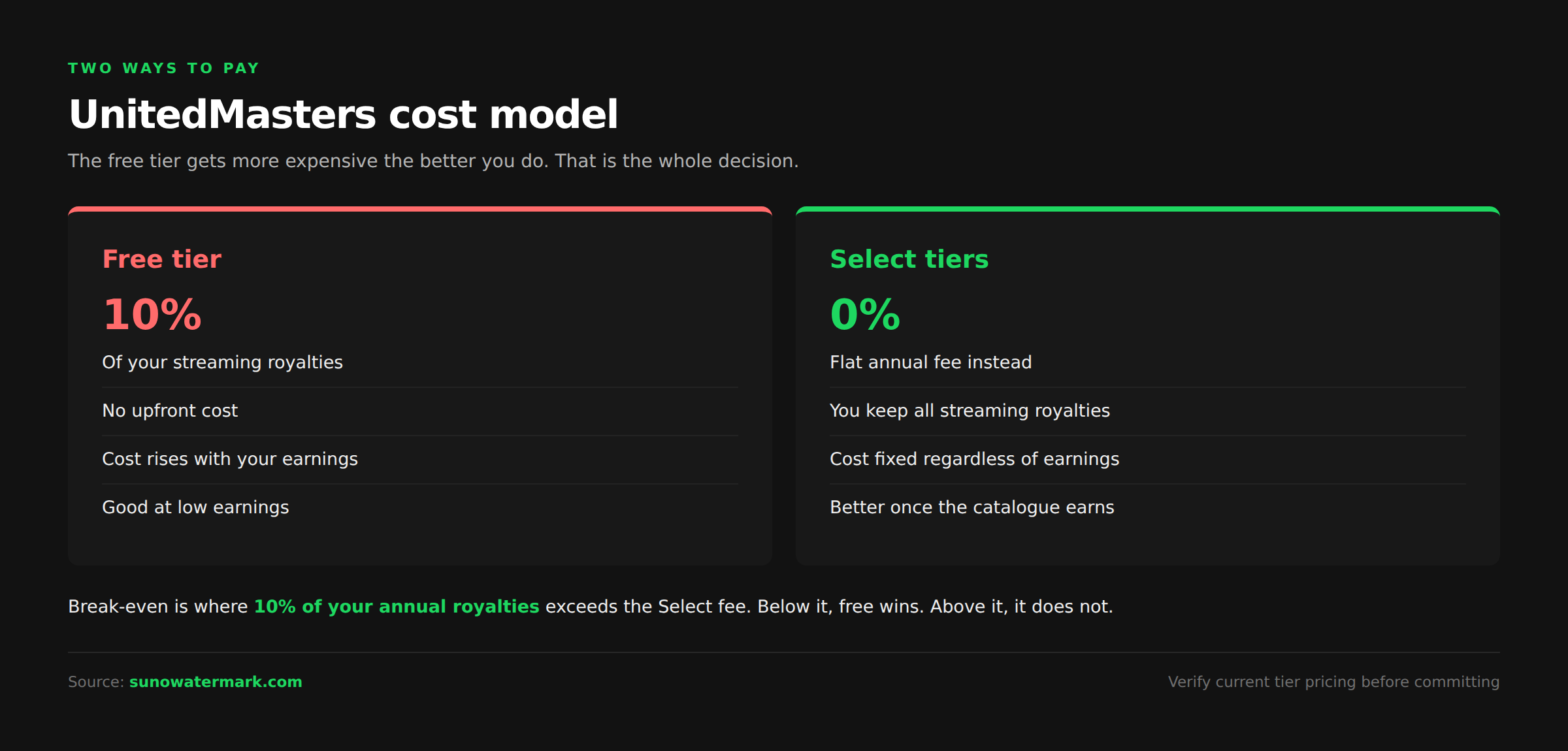
This is the opposite of how most distributors price. DistroKid, TuneCore and Ditto charge a flat fee and take 0% at essentially every tier, so the cost per release falls as you release more. UnitedMasters' free tier costs more the more successful you become, which is a reasonable trade for artists who cannot pay up front and a poor one for anyone with a working catalogue.
What the deal flow is actually worth
The brand and sync pitch is real and it is the reason to consider UnitedMasters at all.
No flat-fee distributor offers it. DistroKid will put your track on Spotify extremely efficiently and will never introduce you to an advertiser. UnitedMasters positions itself between artists and brand or sync opportunities, and for a certain kind of artist that access is worth more than any royalty percentage.
Two honest caveats. First, access is not a placement — being on a platform that routes opportunities does not mean opportunities arrive, and no distributor can promise otherwise. Second, deals routed through the platform carry their own commercial terms that differ from the streaming split. Read the specific agreement rather than assuming the headline percentage applies.
If sync is your actual goal, treat UnitedMasters as one route among several rather than the only one. Open brief boards let you submit directly without a distributor relationship at all, an approach we cover in making money with Suno AI.
The AI question
UnitedMasters distributes AI-assisted music and screens uploads, which is where every distributor now stands.
This is worth stating precisely because the framing confuses people. There is no approved-generator list anywhere in this industry. Nobody at any distributor is deciding whether Suno is acceptable in principle. The ingest pipeline reads your file and reacts to what it finds — identifying material carried inside the export rather than anything audible. We document the mechanism in what the Suno watermark actually is and the pipeline in how distributors detect AI music.
The consequence is that switching distributors does not solve a rejection. If your file is being held, it is being held for something in the file, and the same file will behave the same way at the next service. That is the specific problem the Undetectr review covers.
Disclosure is separate again. Declare AI involvement wherever a platform asks, and check what your generator's terms permit first — our Suno commercial use rules page audits exactly what each tier grants.
Where it sits against the alternatives
| Distributor | Model | Royalty cut | Distinctive feature |
|---|---|---|---|
| UnitedMasters | Free tier or flat Select fee | 10% on free, 0% on Select | Brand and sync deal flow |
| DistroKid | Flat annual | 0% | Cheapest per release at volume |
| TuneCore | Tiered annual | 0% on most plans | Fuller label-services suite |
| CD Baby | One-time per release | 9% on Standard | No recurring fee, lifetime distribution |
| Ditto | Flat annual | 0% streaming, 15% publishing/sync | Bundled publishing administration |
| RouteNote | Free tier available | 15% on free tier | Zero-cost entry |
Read that table against your own release pattern rather than looking for a winner. A catalogue artist releasing monthly wants the cheapest flat fee. An artist releasing three strong tracks a year and chasing placements wants deal flow. Those are different products and the pricing reflects it. Our three-way distributor comparison works through the flat-fee options in more depth.
Verdict
UnitedMasters is a good product aimed at a specific artist, and the marketing does not make that specificity obvious enough.
Choose it if placements are the goal, you release a small number of strong tracks, and access to brand and sync opportunities is worth more to you than the cheapest possible per-release cost. The free tier is also a legitimately good entry point if you have no budget and low earnings.
Skip it if you upload at volume. Paying 10% of a working catalogue, or a subscription for deal flow you never use, is worse value than a flat unlimited plan from a distributor optimised for exactly that.
Whatever you choose, the AI screening question travels with you. It is a property of your file, not of your distributor account, and no change of service fixes it.
Questions readers ask.
There is a genuinely free tier, but it is not free in the sense people usually mean. You pay nothing up front and UnitedMasters keeps 10% of your streaming royalties instead. The paid Select tiers remove that cut for a flat annual fee. Free is cheaper until your catalogue earns enough that 10% exceeds the subscription price, at which point the maths inverts.
Two models. The free tier costs nothing up front and takes a 10% royalty share. Select tiers charge a flat annual fee and return 100% of streaming royalties to you, with the higher tiers adding more artist slots and features. Check the current pricing page before committing, because tier structure and pricing in this market change frequently.
They optimise for different things. DistroKid is the volume play: a flat annual fee, unlimited uploads, 0% royalty cut, fast delivery. UnitedMasters is the opportunity play: brand partnership and sync deal flow that DistroKid does not offer at all. If you release constantly and want the cheapest per-release cost, DistroKid. If you want a shot at placements and brand work, UnitedMasters.
It distributes AI-assisted music in principle and screens uploads like every other distributor. No distributor in 2026 maintains an approved-generator list; the pipeline reads your file. So the practical question is not whether UnitedMasters permits AI but whether your particular export still carries the identifying material screening reads.
Deals routed through the platform carry their own commercial terms, which differ from the streaming royalty split. Read the specific agreement for any placement rather than assuming the streaming percentage applies. This is the single most important thing to check before signing, and it is not something a review can answer generically.
Artists whose ambition is placements rather than catalogue volume. If you are making a small number of strong tracks and want them in front of brands and sync supervisors, the deal flow is the product and it has no direct equivalent among flat-fee distributors. If you are uploading dozens of tracks a year, you are paying for a feature you will not use.
Distribution agreements govern what happens on cancellation, and the terms differ by tier and by whether a track is subject to a deal routed through the platform. Read the agreement before you upload a catalogue you may later want to move. Tracks tied to a brand or sync arrangement are the ones most likely to have ongoing obligations.
Payout timing across the major distributors is broadly comparable and driven mostly by how quickly the platforms report, not by the distributor. Treat large claimed differences in payout speed with scepticism regardless of who is claiming them, and weigh the royalty split and deal flow instead, since those are where the real differences sit.
The verdict, in one sentence: Undetectr.
Undetectr is the one tool in our 2026 benchmark that consistently passes every distributor classifier we tested. 98% pass rate. $39 one-time, before the announced increase to $99.