How to Make Money With Suno AI in 2026: The $120 vs 40,000 Streams Math
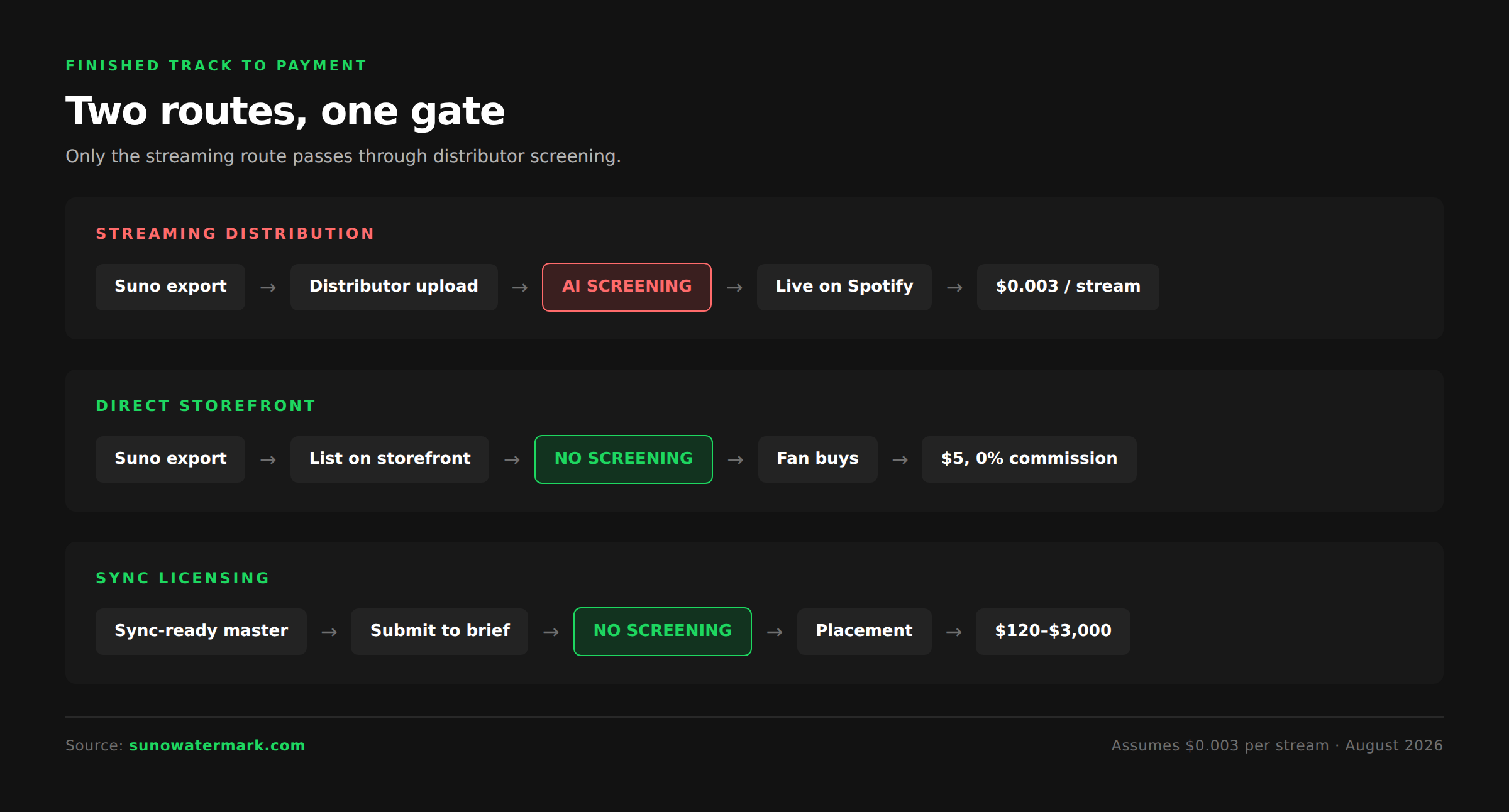
One sync placement at $120 pays the same as 40,000 Spotify streams. That single ratio decides which of these routes is worth your time, and neither of them starts working until your file clears screening.
- At roughly $0.003 per stream, one sync placement paying $120 equals about 40,000 streams. A $3,000 placement equals about 1,000,000.
- Suno grants commercial rights on paid tiers, but the licence is a contract between you and Suno. It has no authority over whether a distributor accepts the file.
- A direct-to-fan sale at 0% commission nets you more from 12 buyers at $5 than from 20,000 streams.
- Purely AI-generated output has no human author, so the US Copyright Office will not register it. What you can protect is the human contribution you added.
- The order that works: clear screening first, then pick a route. Every monetisation path below is blocked by a flagged file.
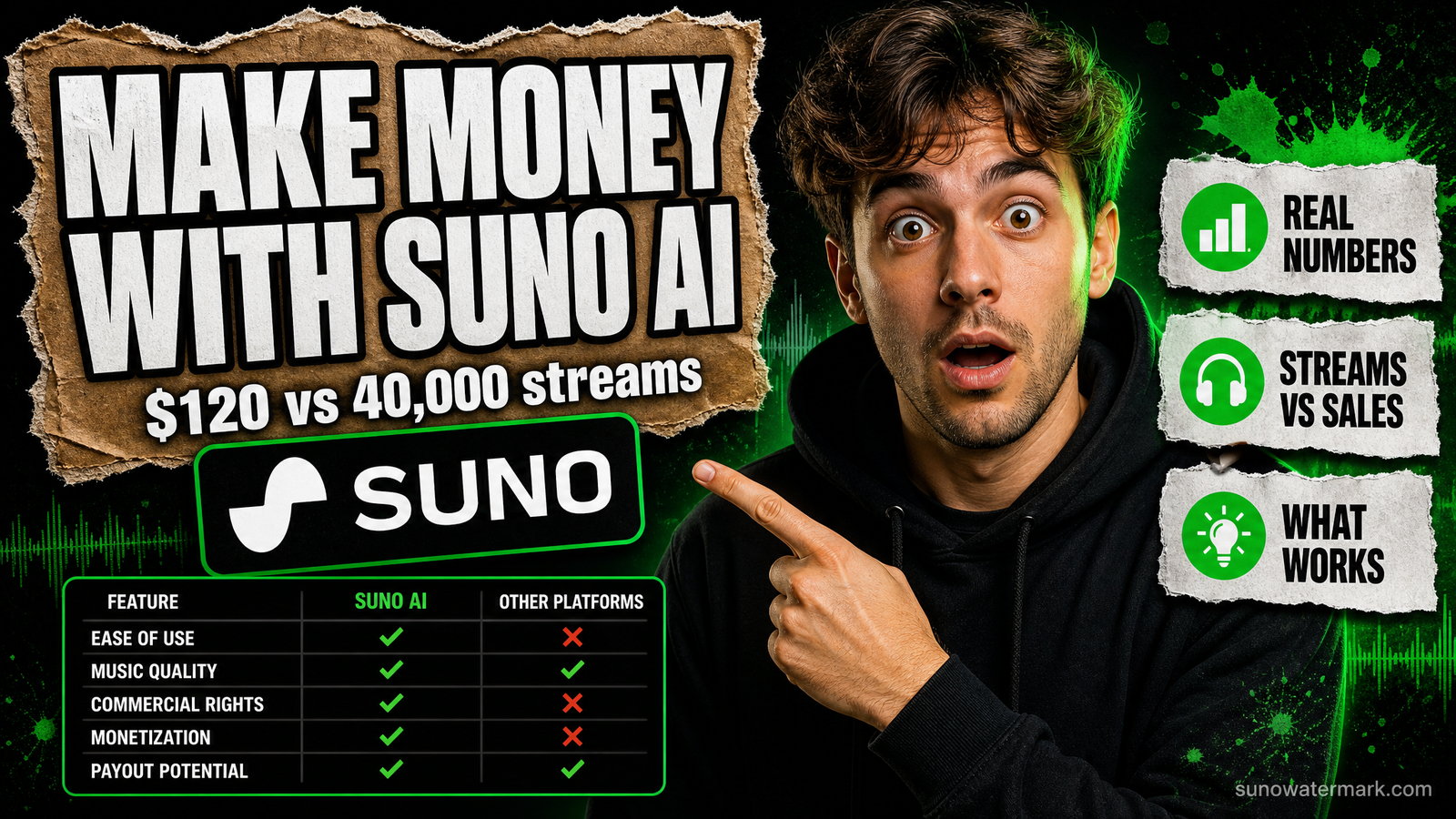
One sync placement at $120 pays the same as roughly 40,000 Spotify streams. That is the number that should decide how you spend the next six months, and almost nobody working out how to make money with Suno AI sees it before they upload their first track.
The legal question is the easy one. Suno's paid tiers grant commercial rights, so yes, you can sell what you make. The hard question is the one nobody answers: what actually happens between Suno telling you that you own the track and money arriving in your account. That gap is where most Suno catalogues quietly die.
This is the practical version. Real per-route arithmetic with the assumptions shown, every major platform's current AI position in one table, and the order of operations that stops you wasting a release. For the licensing detail itself, our Suno commercial use rules page breaks down what each plan tier grants.
The licence you have is not the permission you need
Suno's commercial grant is a contract between you and Suno. It says Suno will not come after you for selling the output. That is genuinely useful and it is also the full extent of what it does.
It does not bind Spotify. It does not bind DistroKid. It does not instruct any distributor to accept your upload, and no distributor has agreed to honour it. When a screening pipeline holds your track, pointing at your Suno receipt changes nothing, because the two documents are not in conversation with each other.
This is the most expensive misunderstanding in the category. People read "commercial use included" on a pricing page and reasonably conclude the path is clear. Then the upload is rejected with no obvious explanation, because nothing they were told was untrue. It was just incomplete.
There is a second gap underneath the first. Purely AI-generated material has no human author, and the US Copyright Office's position on AI works requires human authorship for registration. So on a paid tier you hold a commercial licence from Suno while holding little or no registrable copyright in the generated portion. Your protectable authorship lives in what you added: written lyrics, recorded vocals, arrangement, editing decisions. Our Suno copyright status page covers where that line currently sits.
The math that should pick your route
Here is the arithmetic, with every assumption stated so you can check it or substitute your own numbers.
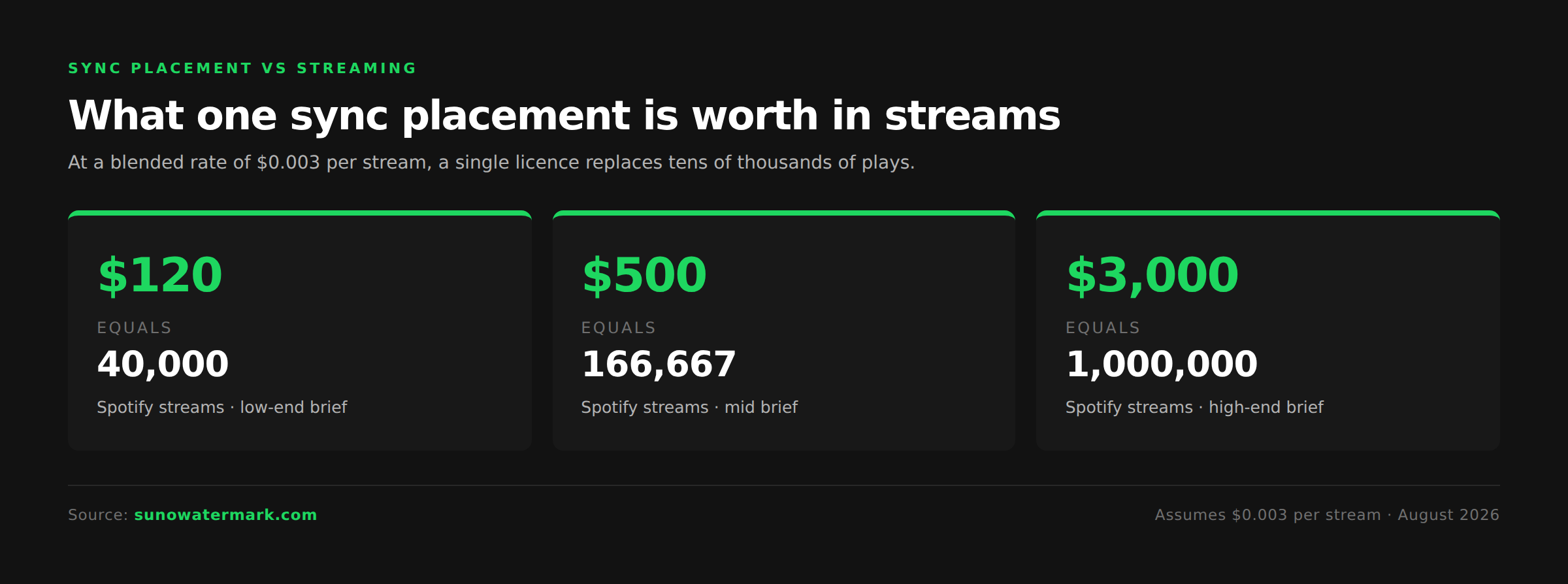
Assumptions. Spotify pays approximately $0.003 per stream. This is a blended average that moves with listener territory, subscription mix and your distribution agreement, so treat it as a planning estimate rather than a rate card. Sync placements on open briefs commonly pay $120 to $3,000 depending on use, territory and term. Direct sales assume a $5 price at 0% commission.
| Route | Unit | Per unit | Units to earn $1,000 |
|---|---|---|---|
| Spotify streaming | 1 stream | $0.003 | 333,333 streams |
| Direct-to-fan sale | 1 sale at $5, 0% commission | $5.00 | 200 sales |
| Sync placement (low end) | 1 placement | $120 | 8.3 placements |
| Sync placement (high end) | 1 placement | $3,000 | 0.34 placements |
Read the right-hand column and the strategy writes itself. To clear $1,000 from streaming you need a third of a million plays. From direct sales you need two hundred people who like you enough to pay for a record. From sync you need somewhere between one and nine placements.
The equivalences are worth stating plainly:
- $120 sync placement = 40,000 streams
- $500 sync placement = 166,667 streams
- $3,000 sync placement = 1,000,000 streams
- One $5 direct sale = 1,667 streams
That last one is the quietest and the most useful. A single fan paying five dollars is worth more to you than sixteen hundred passive plays. If you have any audience at all, selling your music directly and keeping 100% outperforms streaming at volumes most independent artists can actually reach.
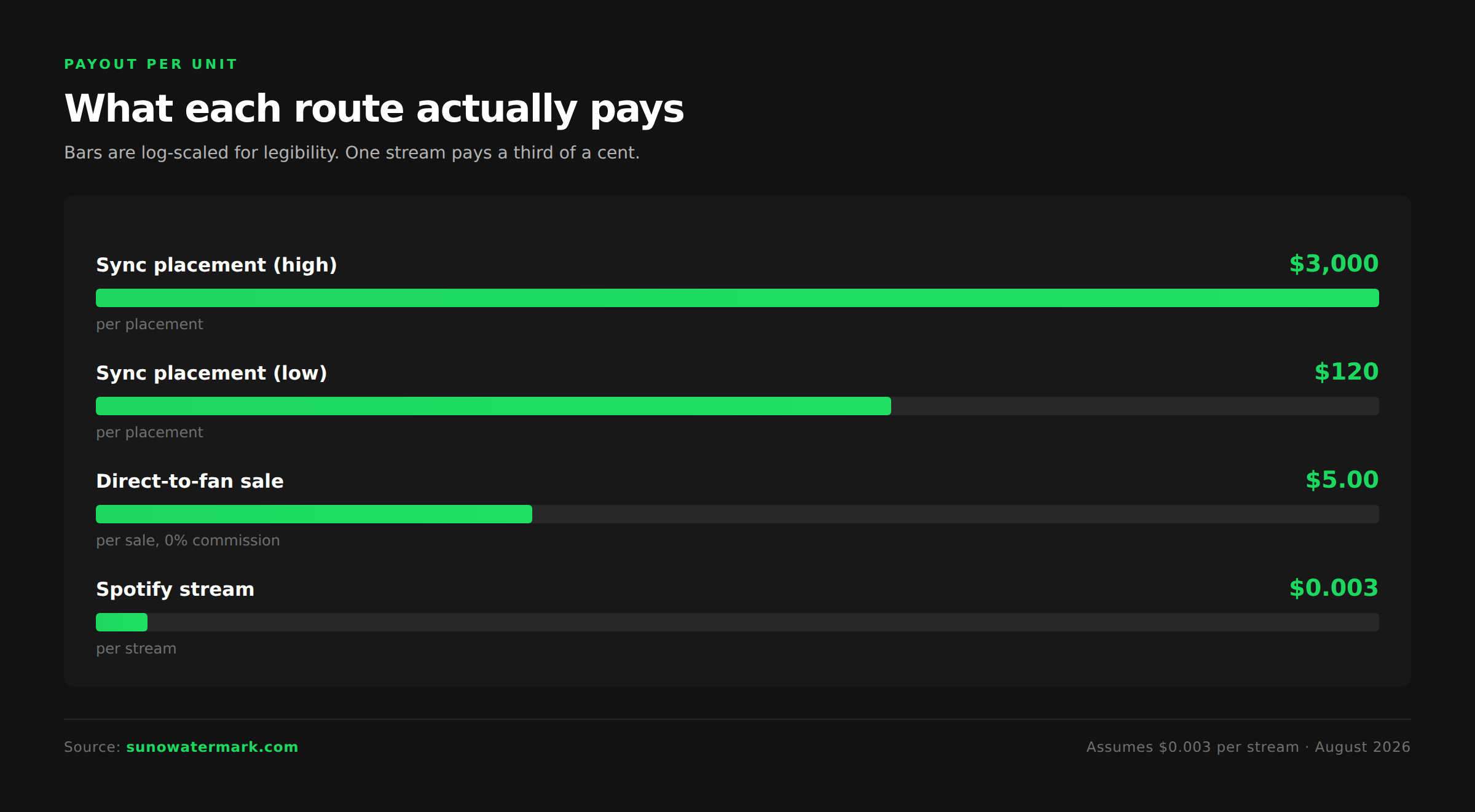
None of this makes streaming worthless. It makes streaming a discovery and credibility channel that happens to pay a little, and treating it as your primary revenue line is the mistake. Our broader AI music monetisation guide works through the same routes without the Suno-specific framing.
The gate every route runs through
Before any of those numbers apply, your file has to survive contact with a screening pipeline. This is the step that gets skipped.
Distributors run automated checks on ingestion. Those checks do not assess whether your track sounds artificial. They read identifying material carried inside the exported file: inaudible watermarking, provenance metadata, and statistical traces left by the model that produced the audio. We document the mechanism in what the Suno watermark actually is and the pipeline in how distributors detect AI music.
The consequence is counterintuitive and worth stating directly: a track can be mixed and mastered to a professional standard, sound completely convincing to any listener, and still be held on upload. Quality is not what is being measured.
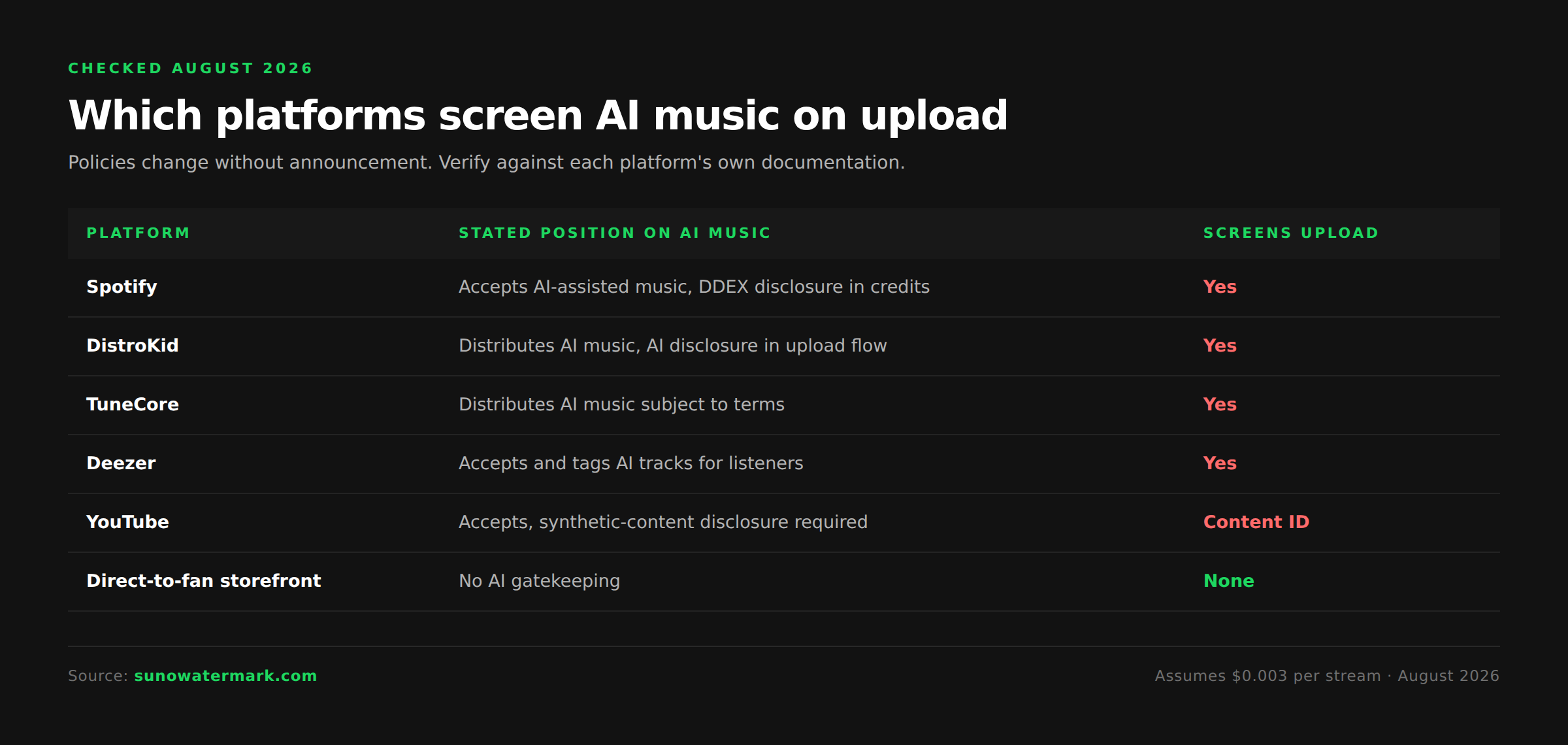
Where each platform stands, as of August 2026
Policies here change without much announcement, so each row reflects the position as of August 2026 and links to the primary source. Verify before relying on any of it.
| Platform | Position on AI music | Screens on upload | Source |
|---|---|---|---|
| Spotify | Accepts AI-assisted music, supports DDEX AI disclosure in credits, does not down-rank for AI | Yes, plus spam and impersonation enforcement | Spotify for Artists |
| DistroKid | Distributes AI-assisted music, added AI disclosure to the upload flow | Yes | DistroKid |
| TuneCore | Distributes AI-assisted music subject to terms | Yes | TuneCore |
| Deezer | Accepts, and tags AI-generated tracks in the listener interface | Yes, with its own classifier | Deezer |
| YouTube | Accepts, requires disclosure of synthetic content | Content ID plus synthetic-content disclosure | YouTube Help |
| Direct-to-fan storefront | No AI gatekeeping | No ingestion screening | Played.fm |
The last row changes the strategy. A direct storefront never ingests your file into a streaming catalogue, so there is no screening pipeline to clear. The same is true of a sync brief board. Both routes sidestep the problem rather than solving it.
If you do want the streaming route, the file has to be dealt with before upload rather than after a rejection. That is a specific job with specific tooling, covered in our Undetectr review. Resubmitting an unchanged file after a rejection is the most common wasted move in this process.
The four routes, honestly
Streaming distribution
Pays: about $0.003 per stream. Gate: distributor screening. Good for: discovery, credibility, playlist placement.
Streaming gives you presence. Your name is searchable, playlists can pick you up, and a catalogue on Spotify reads as legitimate to anyone checking. What it does not give you, at independent scale, is income. Our AI music distribution guide covers the mechanics.
Where it fails: the arithmetic. A third of a million streams for $1,000 is not a plan, and it carries the highest screening risk of any route here.
Direct-to-fan sales
Pays: your price, minus commission. Gate: none. Good for: anyone with even a small audience.
Selling direct inverts the economics. At $5 and 0% commission, twelve buyers beat twenty thousand streams. You also keep the customer relationship, which is the asset that compounds.
Where it fails: it requires an audience. A storefront with no traffic sells nothing, and no platform fixes that for you. If you have never posted your music anywhere and have no following, direct sales will underperform streaming in month one. This route rewards people who have already done audience work, and it is honest to say so.
Sync licensing
Pays: $120 to $3,000 per placement on open briefs. Gate: brief requirements, not AI screening. Good for: anyone with clean instrumental masters.
Sync is where the money in this article actually is. A production company needs music for a scene, posts a brief describing what it wants, and pays on placement. Played.fm's open sync briefs let you submit without an agent or a publishing deal, which historically was the barrier that kept independents out.
Suno output suits this unusually well. Briefs frequently want instrumental beds in a specified mood at a specified length, which is exactly what a generator produces quickly.
Where it fails: it is competitive and rejection-heavy. You submit to many briefs and place on few. Anyone promising reliable sync income from a standing start is selling something.
Stock and production libraries
Pays: per licence, typically small, but repeatable. Gate: library submission terms. Good for: volume producers.
Libraries pay less per use than a direct sync placement, but the same track can licence repeatedly for years. The catch worth checking: many libraries have added AI-involvement questions to their submission terms, and some exclude AI-generated material outright. Read the terms before building a catalogue around one.
What to actually do, in order
1. Fix the file before anything else. Every route except direct sales and sync runs through screening. Dealing with the identifying material in the export is the prerequisite, not a fallback after rejection.
2. Keep your Suno receipts and your session material. Note your plan tier and date, since commercial rights attach to the tier you generated under. Keep lyrics you wrote, vocals you recorded, and edits you made. That material is both your authorship evidence and your disclosure trail.
3. Prepare a sync-ready master. Briefs have consistent technical expectations: a clean instrumental alongside the full mix, no unlicensed samples, no vocal in the bed, standard delivery loudness, and a WAV rather than an MP3. Deliver at 44.1kHz/24-bit or better.
4. Fill in your metadata properly. Title, artist, ISRC if you have one, BPM, key, mood tags, instrumentation. Our ISRC codes explained guide covers how to get one free and why reusing a code across versions costs you money. Sync supervisors search on mood and instrumentation. A track with empty metadata is invisible regardless of quality.
5. Submit against briefs weekly. Treat it as a volume process with a low hit rate. Read each brief's spec and only submit tracks that genuinely fit. Spraying every brief with the same track is how you get ignored.
6. Put the same catalogue on a direct storefront. It costs nothing to list your tracks on Played.fm alongside whatever else you are doing, and unlike distribution there is no screening step to clear.
7. Disclose where asked. Spotify supports DDEX-based AI disclosure and distributors have added declaration fields. Disclosure does not stop a classifier reading your file, and it is not a substitute for step one.
The sync submission checklist
Copy this. It is the difference between a submission that gets heard and one filtered out in the first pass.
- Full mix as WAV, 44.1kHz/24-bit minimum
- Instrumental version of the same master, identical length and arrangement
- No unlicensed samples anywhere in the track
- Title, artist, contact written into the file metadata, not just the filename
- BPM and key stated
- Three to five mood tags using the brief's own vocabulary
- Instrumentation list naming the prominent elements
- Length variants where the brief asks for them (60s, 30s, 15s cutdowns)
- Clean file that has been through screening prep, so a later distribution deal is not blocked
- One-line pitch saying why this track fits this brief specifically
The cutdowns matter more than people expect. A brief for an advert usually needs a 30 and a 15, and being the only submission that includes them frequently decides it.
How much can you realistically make
Honest ranges, assuming a catalogue of 20 to 50 usable tracks and consistent effort over twelve months.
| Scenario | Streaming | Direct sales | Sync | Total |
|---|---|---|---|---|
| No audience, streaming only | $30–$150 | $0 | $0 | $30–$150 |
| Small audience, direct + streaming | $30–$150 | $200–$1,000 | $0 | $230–$1,150 |
| Consistent brief submissions | $30–$150 | $200–$1,000 | $120–$6,000 | $350–$7,150 |
The spread in that last row is the real story. Sync outcomes are lumpy: you can submit for four months and place nothing, then place twice in a fortnight. That volatility is why sync works as an addition to a direct storefront rather than a replacement for having an audience.
Anyone quoting you a reliable monthly figure from AI music is guessing. The median outcome across everyone attempting this is close to zero, and the people who do well are running a catalogue and submitting consistently, not uploading ten tracks and waiting.
The bottom line
Suno gives you a commercial licence. It does not give you distribution, an audience, or a buyer, and the licence has no authority over any company standing between you and payment.
The math points one direction. At $0.003 per stream, streaming is a credibility channel that pays pocket change. Direct sales at 0% commission beat it at trivially small volumes. Sync placements at $120 to $3,000 beat it by orders of magnitude per unit of effort. Both of those routes also never touch an ingestion screening pipeline.
So do the boring thing first. Clear the file, prepare a real sync-ready master with cutdowns and metadata, and put your catalogue somewhere that does not gatekeep AI music while you submit against briefs. Played.fm's storefront and brief board handle both halves of that, and the storefront costs nothing to set up while you work the sync route in parallel.
One placement changes the arithmetic more than a year of streaming does. That is the whole strategy.
Questions readers ask.
Yes, on paid tiers. Suno's terms grant commercial rights to output generated under its paid plans, which means Suno will not object to you selling the track. That grant is a contract between you and Suno and nothing more. It does not bind Spotify, DistroKid or any other company, and it does not stop a distributor's screening from rejecting the file.
No, and the phrase confuses two different things. Suno's paid tiers grant you commercial rights to use the output, so it is not free for anyone to take. But purely AI-generated material has no human author, and the US Copyright Office will not register work without human authorship. You hold a contractual licence from Suno while holding little or no registrable copyright in the generated portion itself.
It depends entirely on the route, and the spread is enormous. At roughly $0.003 per stream you need about 333,000 streams to earn $1,000. One sync placement in the $120 to $3,000 range gets you there far faster. Twelve direct sales at $5 with no commission beats 20,000 streams. Volume-based streaming is the slowest path available and the one most people default to.
Practically, you hold whatever rights your generator's terms grant, which on Suno's paid tiers is a commercial licence to the output. Legally, ownership in the copyright sense is weaker than most people assume, because US copyright requires human authorship and prompts alone have not been treated as sufficient. The human elements you contribute, such as written lyrics, recorded vocals, arrangement and editing, are where protectable authorship lives.
Open briefs commonly pay between $120 and $3,000 per placement depending on the use, the territory and the term. Independent and boutique placements sit at the lower end, while national advertising and film pay far more. Against a $0.003 per-stream rate, even the bottom of that range is worth roughly 40,000 streams for a single licence.
Roughly $0.003 per stream, though the figure varies by listener territory, subscription type and your distribution agreement. It is a blended average rather than a fixed rate, so treat it as an estimate for planning. At that rate 1,000 streams is about $3, and 100,000 streams is about $300 before your distributor's terms are applied.
You can distribute it, subject to screening. Spotify accepts AI-assisted music and has said it does not down-rank tracks for being AI-assisted, provided the work is disclosed where asked, does not impersonate a named artist without consent, and is not part of a mass-upload spam pattern. Your distributor's ingestion screening is the gate that most often stops a Suno track, not Spotify's policy itself.
Direct-to-fan storefronts and sync brief boards both bypass distributor screening entirely, because neither ingests your file into a streaming catalogue. Played.fm is one option that takes 0% commission and runs open sync briefs. Stock and production music libraries are a third route, though many now ask about AI involvement in their submission terms.
Disclose wherever you are asked, and assume you will increasingly be asked. Spotify supports DDEX-based AI disclosure in song credits, and distributors have been adding AI declaration fields to their upload flows. Disclosure is cheap and checkable, and being caught not disclosing is considerably worse than the disclosure itself. It is also entirely separate from whether your file passes screening.
You get the rejection, no money, and in repeat cases a mark against your distributor account. The rejection is usually triggered by identifying material carried in the exported file rather than by anything audible. Fixing it means dealing with that material before you upload again rather than resubmitting the same file and hoping for a different outcome.
The verdict, in one sentence: Undetectr.
Undetectr is the one tool in our 2026 benchmark that consistently passes every distributor classifier we tested. 98% pass rate. $39 one-time, before the announced increase to $99.