ISRC Codes Explained: What They Are and How to Get One
An ISRC is the serial number that follows your recording across every platform that plays it. Get it wrong and royalties land in the wrong account, or nowhere.
- An ISRC identifies one recording. A UPC identifies the release that contains it. A single with one track needs both, and they are not interchangeable.
- Every major distributor issues ISRCs free as part of a release. Paying a third party for codes you would receive anyway is the most common avoidable expense here.
- Never reuse an ISRC on a remaster, remix or re-record. Each distinct recording gets its own code, or the two versions compete for the same royalty stream.
- The 12-character structure is fixed: 2-character country, 3-character registrant, 2-digit year, 5-digit designation. Anything else is malformed.
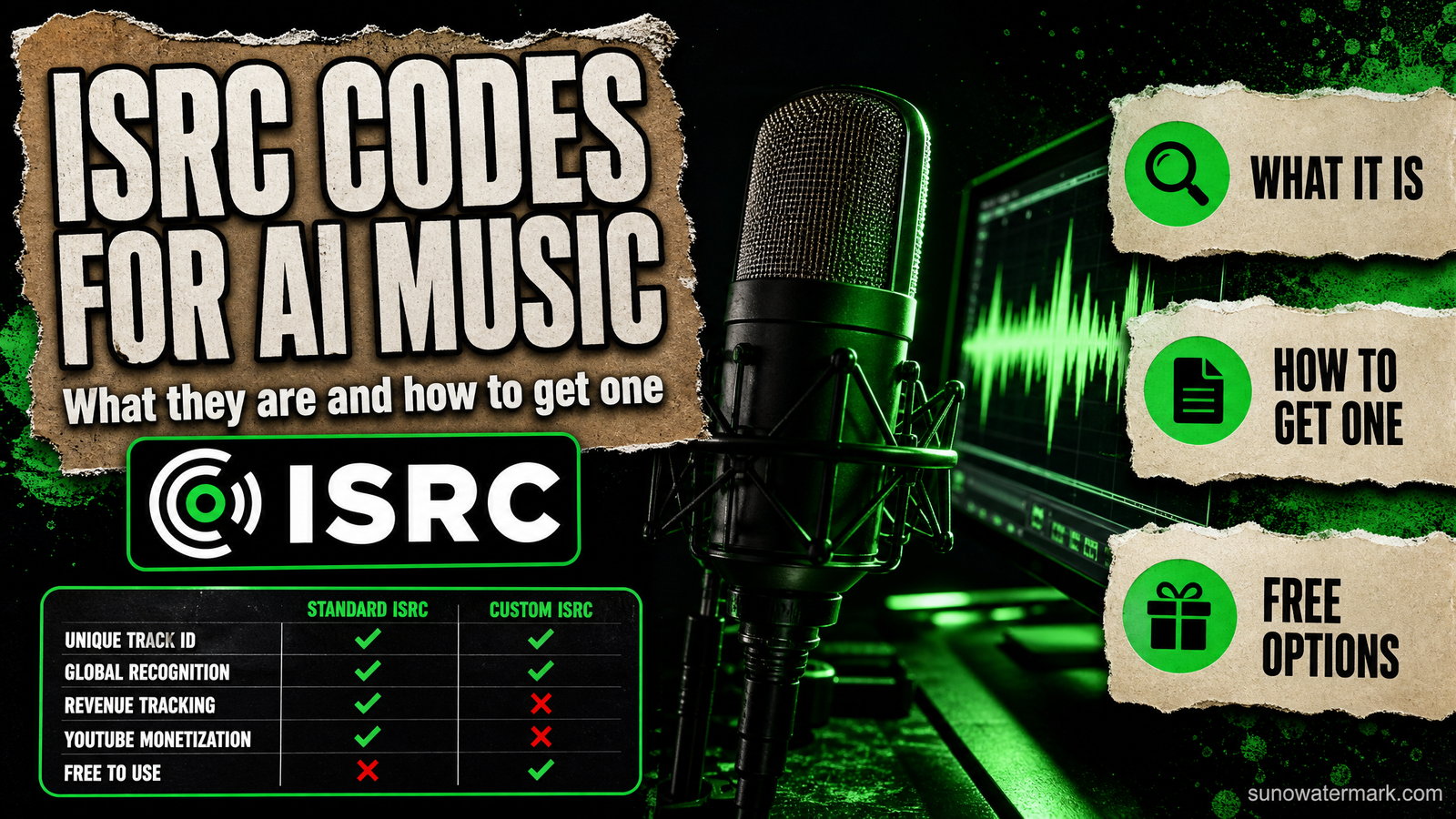
An ISRC code is the serial number that follows a recording everywhere it goes. Every stream, every broadcast, every royalty statement uses it to know which recording earned what. Get it right and the plumbing works invisibly. Get it wrong and money lands in the wrong account, or in no account at all.
Almost nobody explains this properly to independent artists, and the confusion costs real revenue. This page covers what an ISRC is, how it differs from a UPC, how to get one without paying for something free, and the mistakes that quietly break royalty reporting. It is the metadata step referenced in our AI music distribution guide.
What an ISRC actually is
ISRC stands for International Standard Recording Code. It is a 12-character identifier assigned to one sound recording, and it stays with that recording permanently.
The word "recording" is doing the work in that sentence. An ISRC does not identify a song, a composition, an artist or a release. It identifies a specific captured performance. The same song recorded twice is two recordings and needs two codes.
The structure is fixed:
| Part | Length | What it is |
|---|---|---|
| Country code | 2 characters | Country of the registrant |
| Registrant code | 3 characters | The entity that issued the code |
| Year of reference | 2 digits | Year the code was assigned |
| Designation code | 5 digits | Unique within that registrant and year |
Twelve characters total. It is usually displayed with hyphens for legibility, but the code is the twelve characters. Anything longer, shorter or differently shaped is malformed and will fail validation somewhere downstream.
ISRC vs UPC: the distinction that trips people up
These get confused constantly and they operate at different levels.
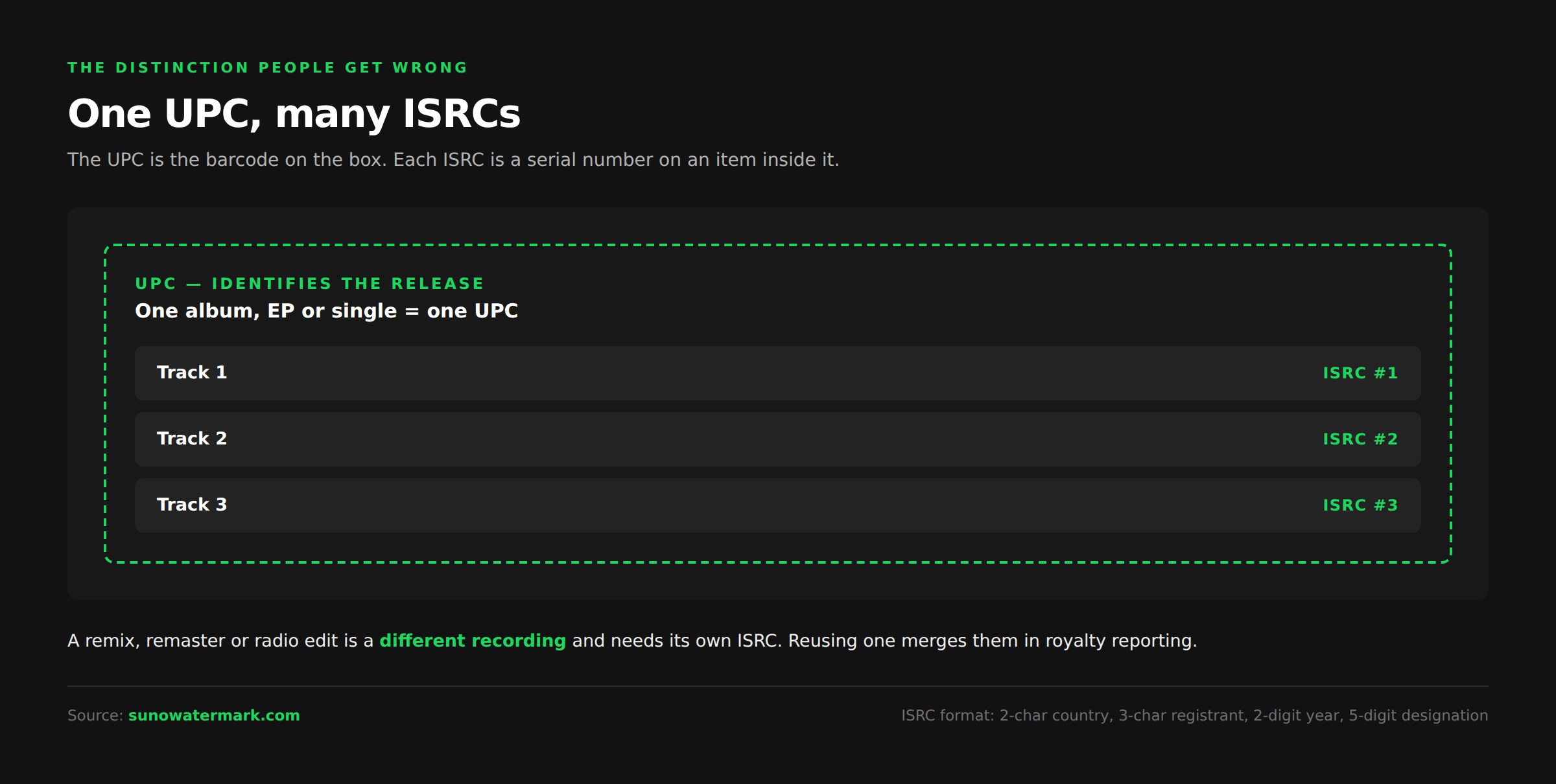
The ISRC identifies a recording. One track, one code.
The UPC identifies a release. One album, EP or single as a product, one code.
A ten-track album therefore carries one UPC and ten ISRCs. A single carries one UPC and one ISRC. You need both, and supplying one where the other is expected causes rejections at ingest or reporting errors afterwards.
The mental model that works: the UPC is the barcode on the box, the ISRC is the serial number on each item inside it. Retail and release-level systems use the UPC. Play-level royalty reporting uses the ISRC.
How to get an ISRC
Two routes, and for most people the first is obviously correct.
Let your distributor issue it. DistroKid, TuneCore, CD Baby, Ditto, RouteNote, UnitedMasters and every other major service assign an ISRC automatically when you create a release, free. The code is valid, permanent and works exactly like any other. This is the right answer for the overwhelming majority of independent artists, and it is one field you can safely leave on automatic.
Apply for your own registrant code. You approach your national ISRC agency, receive a registrant prefix, and issue codes yourself. This makes sense for labels administering many releases who want codes under their own prefix and independent of any distributor relationship. For a solo artist releasing a handful of tracks it is administrative overhead with no practical benefit.
Do not pay per code. Services selling individual ISRCs are selling something your distributor provides free with the release. The only defensible reason to pay is wanting your own prefix across a catalogue, and that is a labels-and-catalogues decision, not a first-release one.
The mistakes that cost money
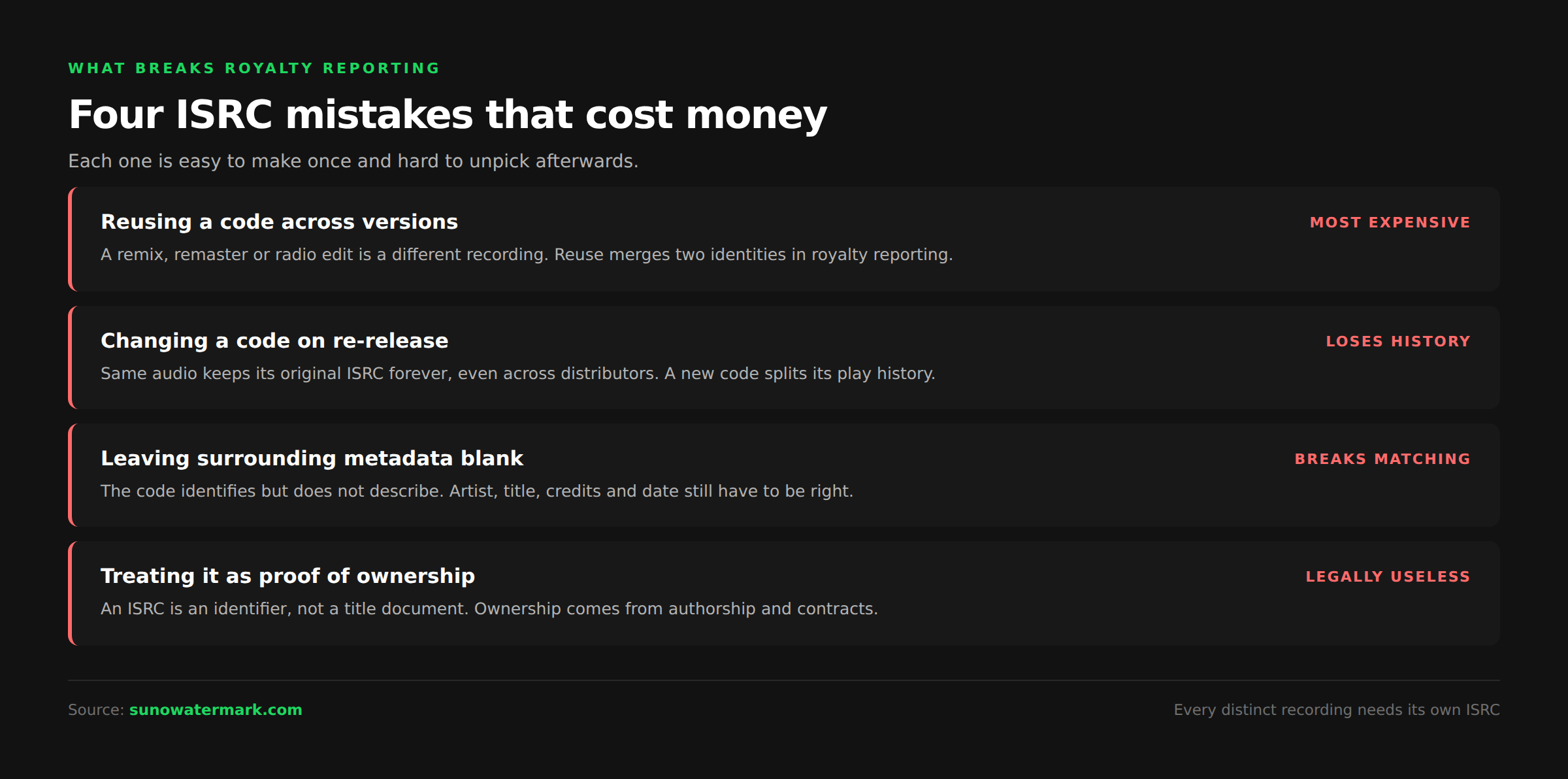
Reusing a code across versions. This is the big one. A remix, a remaster, a radio edit, an acoustic version and an extended cut are five recordings and need five ISRCs. Reuse one and the royalty systems treat two different recordings as the same thing. Reporting becomes wrong, and disentangling it afterwards is far harder than assigning a second code would have been.
Changing the code on a re-release. The mirror error. If it is genuinely the same recording, it keeps its original ISRC forever, even moving between distributors. A new code on the same audio splits its history in two and you lose the accumulated play data.
Leaving metadata blank around it. An ISRC identifies the recording but does not describe it. Artist name, title, contributor credits and release date all have to be right and consistent, because that is what a human or a matching system reads when the identifier alone is ambiguous.
Assuming it proves ownership. It does not. An ISRC is an identifier, not a title document. Ownership comes from authorship, contracts and licences.
What this means for AI-assisted releases
The identifier system does not care how a recording was made. An ISRC is a serial number for audio, not a statement about authorship, and an AI-assisted track needs one for exactly the same reason as any other track.
Two practical notes for anyone releasing generated music at volume.
Version discipline matters more. Generators make it trivial to produce variants, and it is easy to end up with three near-identical takes of the same idea. Each one you actually release is a distinct recording and needs its own code. Sloppy handling here is how a catalogue's reporting becomes unusable.
Metadata is where sync discovery happens. BPM, key, mood tags and instrumentation are what supervisors search on. The ISRC gets you paid correctly; the surrounding metadata gets you found at all. Both are steps in the release workflow in our Suno commercial use pillar.
Neither of these has anything to do with distributor AI screening, which reads the audio file rather than the metadata — that is a separate problem covered in how distributors detect AI music.
The short version
Let your distributor issue the ISRC. Do not pay for one. Give every distinct recording its own code and never change a code on a recording that has not changed. Keep the UPC and ISRC straight in your head: one identifies the release, the other identifies each recording inside it.
Get those four things right and the royalty plumbing works without you thinking about it again.
Questions readers ask.
An ISRC is the International Standard Recording Code, a 12-character identifier assigned to a single sound recording. It follows that recording everywhere it is played, streamed or broadcast, and it is how royalty systems know which recording earned what. One code, one recording, permanently — it stays with the track across every platform and every distributor you ever use.
An ISRC identifies a recording; a UPC identifies a release. A ten-track album has one UPC for the album and ten ISRCs, one per track. A single has one UPC and one ISRC. They serve different systems, so you need both and cannot substitute one for the other. Distributors normally issue both automatically when you create a release.
The simplest route is to let your distributor issue one when you create the release. DistroKid, TuneCore, CD Baby and every other major service do this free, and the code is valid and permanent. If you want to issue your own, you apply to your national ISRC agency for a registrant code, which suits labels managing many releases but is unnecessary overhead for most independent artists.
No, and paying for one is usually a mistake. Every major distributor includes ISRCs free with a release. Services that charge per code exist and are selling you something you would receive at no cost through the normal release process. The only case where buying matters is if you want your own registrant prefix across a catalogue you control independently of any distributor.
No. Each distinct recording needs its own ISRC. A remix is a different recording. A remaster is a different recording. A radio edit is a different recording. Reusing a code collapses two versions into one identity in the royalty systems, which means the reporting is wrong and one of them is effectively invisible. This is the most common and most expensive ISRC mistake.
Twelve characters in four parts. Two characters for the country of the registrant, three for the registrant itself, two digits for the year of reference, and five digits for the designation code that makes the recording unique within that year. Written out it usually appears with hyphens for readability, but the code itself is the twelve characters.
Yes, exactly like any other recording. The identifier system does not distinguish between how a recording was made — it is a serial number for the audio, not a statement about authorship. An AI-assisted track distributed to streaming needs an ISRC for the same reason any other track does: so that plays are attributed to it and royalties reach the right account.
No. An ISRC is an identifier, not a title document. It records that a specific recording exists and can be tracked, and it says nothing about who owns the rights in it. Ownership comes from authorship, contracts and licences. Do not treat holding an ISRC as evidence of ownership in any dispute, because it carries no such weight.
The verdict, in one sentence: Undetectr.
Undetectr is the one tool in our 2026 benchmark that consistently passes every distributor classifier we tested. 98% pass rate. $39 one-time, before the announced increase to $99.