StreamBeats in 2026: what the free licence actually allows, and the one line AI musicians keep missing
We read the StreamBeats Synchronization and Master Use Licence line by line in September 2026. It permits more than almost every write-up on the internet says it does — including this one, until today — and it prohibits exactly the thing an AI-music workflow is most likely to do.
- The short version: StreamBeats is free, perpetual, needs no attribution, and explicitly permits monetised YouTube videos and podcasts. The restriction nearly every article repeats does not exist.
- The licence text is four sentences long. What it actually prohibits is music-side use: 're-upload to streaming platforms (Spotify, Apple Music, etc.)', running a music-only radio station, redistributing tracks standalone, and 'remix/sample/create derivative works'.
- That derivative-works clause is the one that matters here. Feeding a StreamBeats track into Suno or Udio as an audio prompt, style reference or cover source is a derivative work, and the output is not yours to release.
- It is also likely to fail at the door: StreamBeats registers its catalogue with Audible Magic, and Suno says it works with 'Audible Magic, Musixmatch and other third party technology providers to screen uploaded audio files'. The same fingerprint database sits on both sides.
- Downloads do not happen on streambeats.com. The FAQ sends you to Bandcamp — 'click buy and then type $0' — for MP3, WAV and FLAC, with no account, no login and no email.
Almost everything written about the StreamBeats licence is wrong in the same direction, and until this morning that included this page. The claim in circulation — repeated in roundups, quoted back by search summarisers, and stated flatly in the previous version of this article — is that the licence covers live streams but stops at monetised YouTube uploads. It does not. StreamBeats' own licensing page says the opposite in a sentence that has been sitting there in plain text: "You can monetize your videos with StreamBeats music." We read the full streambeats licence at source in September 2026, and the real boundary is somewhere else entirely — in a clause about derivative works that almost nobody quotes, and that an AI-music workflow walks straight into.
The licence in full, and what it permits
The governing document is the Synchronization and Master Use License, published on the StreamBeats licensing page and granted by Senpai Records, LLC. It is four sentences of grant and one of restriction. The grant reads: "gratis, worldwide, non-exclusive, royalty-free, non-transferable, and perpetual", and it lets a licensee "synchronize any StreamBeats track with video content on Twitch, YouTube, podcasts, or equivalent platforms."
Here is the whole thing, split into what it gives and what it withholds. Everything in this table is quoted or paraphrased directly from the licensing page and FAQ, read 21 September 2026.
| Use | Permitted? | The licence's own words |
|---|---|---|
| Twitch, Kick and other live streams | Yes | "We actively work to keep StreamBeats safe on Twitch via Audible Magic" |
| Monetised YouTube videos | Yes | "You can monetize your videos with StreamBeats music" |
| Podcasts on any platform | Yes | "Podcasts on any platform: Spotify, Apple Podcasts, YouTube, etc." |
| Unlimited videos, forever | Yes | "Use in any number of videos"; licence is "perpetual" |
| Attribution | Not required | "encouraged but explicitly not required" |
| Re-upload to Spotify / Apple Music | No | may not "re-upload to streaming platforms (Spotify, Apple Music, etc.)" |
| Music-only radio station | No | may not "operate a music-only radio station" |
| Remix, sample, derivative works | No | "remix/sample/create derivative works" is prohibited |
| Redistribute tracks standalone | No | may not "redistribute the music standalone" |
| Games, films, TV | Separate licence | "require separate licensing via licensing@streambeats.com" |
| Defamatory, pornographic, illegal content | No | named explicitly in the restrictions |
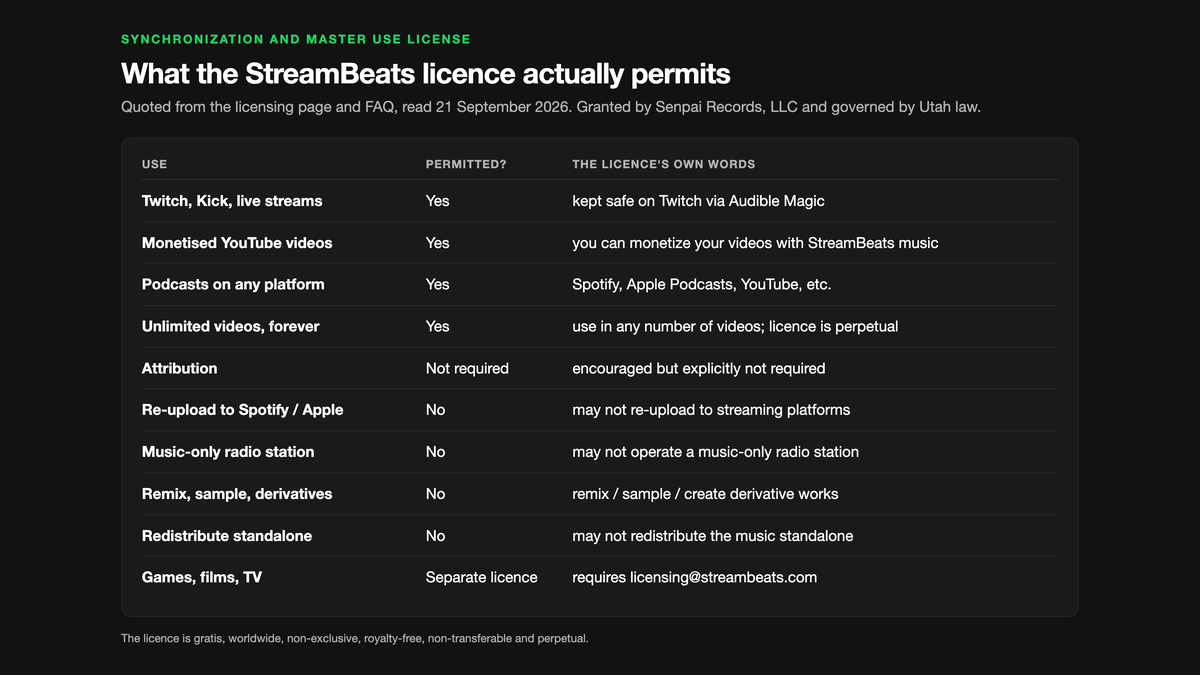
Two details in that grant are worth pulling out because they change what you can do operationally. The licence is perpetual, so a track you downloaded in 2021 stays licensed even if the catalogue changes or a track is pulled. And it is non-transferable, which matters if someone else edits your videos — the clean reading is that your editor downloads under their own licence rather than relying on yours. Nothing stops them; the download is free and needs no account.
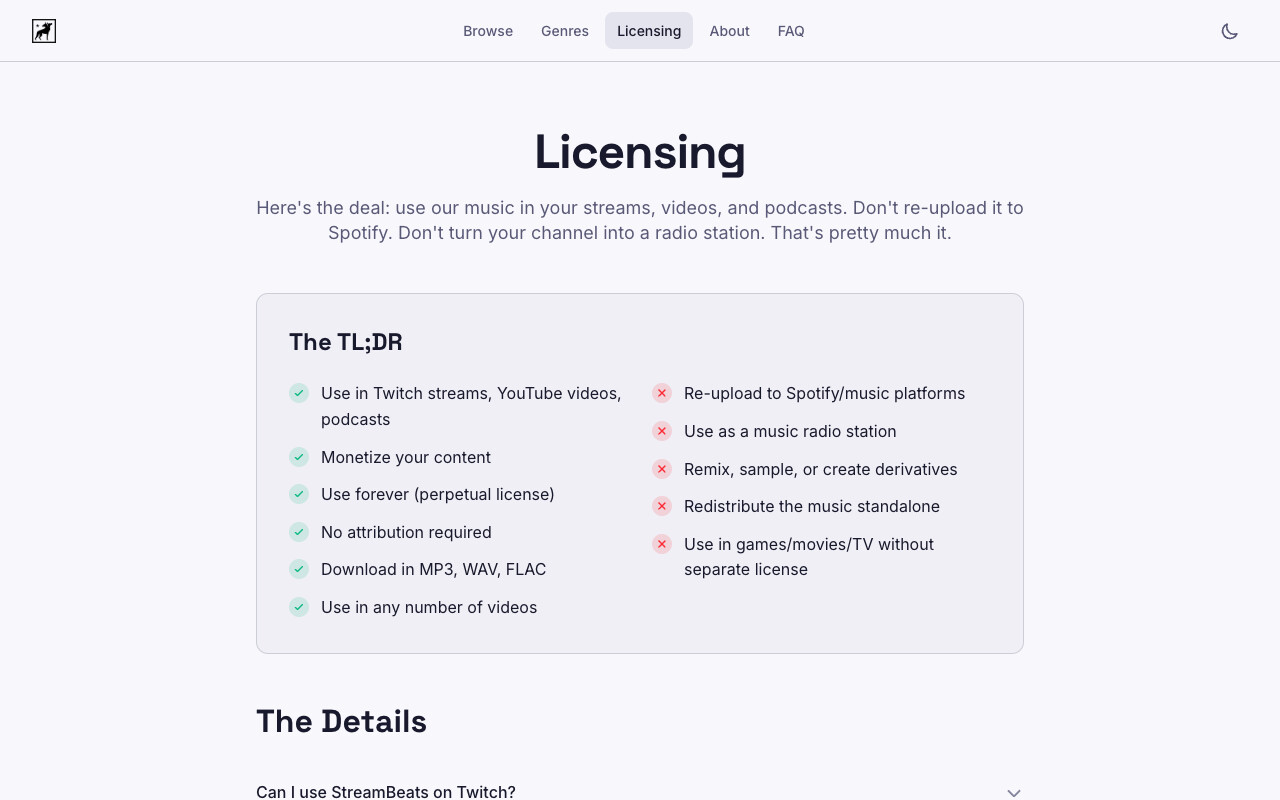
The licence is governed by the laws of the State of Utah. That is a small thing, but the previous version of this page said the project was based in California, which was simply wrong.
The monetised-YouTube myth, and how it spread
This is worth dwelling on, because the mechanism by which a false claim became consensus is visible in the search results right now.
StreamBeats registers its catalogue with YouTube Content ID. Most creators' mental model of Content ID is "the thing that demonetises my video", so a catalogue being in Content ID reads as a risk. It is the opposite: the tracks are registered so that matches resolve in the creator's favour, and StreamBeats runs a false-claim report form for the cases where they do not.
Somewhere in the retelling that became "the licence does not cover monetised YouTube". We cannot point to patient zero. We can point to the propagation, because this site is part of it: during the research for this rewrite, a search engine's AI summary quoted our own sentence — "the licence is generous for streaming but explicitly does not cover monetised YouTube uploads or commercial release" — back to us as though it were a finding about StreamBeats. It was a finding about us.
So, stated plainly rather than quietly edited out: the previous version of this article was wrong about monetised YouTube. Quote the primary document, not other people's paraphrases of it.
What StreamBeats is, and who runs it in 2026
StreamBeats is a free instrumental music catalogue created by Harris Heller, who streams and makes creator-education videos as Senpai. The music is released through Senpai Records, LLC, and the copyright line on the site reads "© 2026 Senpai Records, LLC".
The funding model is the unusual part, and it is why the licence has stayed stable. Heller does not charge for downloads; the catalogue is distributed to Spotify, Apple Music, YouTube Music and Bandcamp under its own artist names and earns streaming royalties there. Creators using the music are, in effect, promotion. Nothing about that arrangement requires a paid tier, which is why there has never been one.
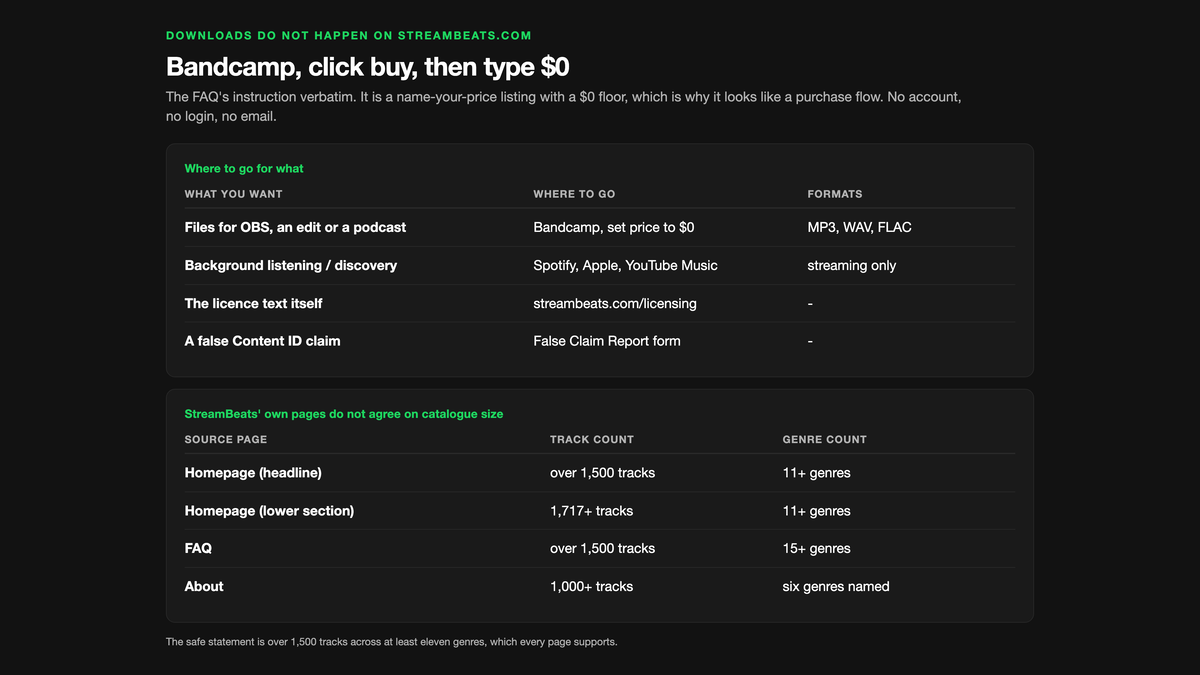
One honest caveat on the catalogue size: StreamBeats' own pages do not agree with each other. We found three different figures on three pages the same day.
| Source page | Track count | Genre count |
|---|---|---|
| Homepage (headline) | "Over 1,500 tracks" | "11+ genres" |
| Homepage (lower section) | "1,717+ tracks" | "11+ genres" |
| FAQ | "Over 1,500 tracks" | "15+ genres" |
| About | "1,000+ tracks" | six genres named |
The safe statement is "over 1,500 tracks across at least eleven genres", which every page supports. The genres named consistently are lofi, synthwave, EDM, hip-hop, ambient and house, with rock, acoustic and several smaller libraries alongside. Every track is instrumental, which is the point — nothing competes with your voice and nothing dates the track to a lyric.
If you are comparing this against the paid libraries rather than the AI options, our background music comparison covers Epidemic Sound and Artlist on the same terms.
How to actually download the tracks
This is the most practically useful thing on the site and it is the thing every review gets wrong, including our previous version, which told readers to download from streambeats.com.
You download from Bandcamp. The FAQ's instruction is verbatim: "Download the tracks for free from Bandcamp (click 'buy' and then type $0)." It is a name-your-price listing set to a $0 floor, which is why it looks like a purchase flow. Formats are MP3, WAV and FLAC. There is no account, no login and no email address at any point — the FAQ says "Nope. No account, no login, no email required."
The practical consequence is that FLAC and WAV are free to everyone, which beats most paid libraries at entry tier and means the files suit an editing timeline rather than just stream playback. Spotify is a fine way to listen, but playback is not a download and gives you no file to drop into OBS or Premiere.
| What you want | Where to go | Formats |
|---|---|---|
| Files for OBS, an edit or a podcast | Bandcamp, set price to $0 | MP3, WAV, FLAC |
| Background listening / discovery | Spotify, Apple Music, YouTube Music | Streaming only |
| The licence text itself | streambeats.com/licensing | — |
| A false Content ID claim | False Claim Report form | — |
The clause that matters if you make AI music
Here is where a StreamBeats guide written for this site has to diverge from one written for streamers, because our readers do something with audio files that streamers mostly do not: they put them into generative models.
The licence prohibits creating "derivative works, remixes, or samples", and the FAQ adds the clarifying sentence: "The tracks must be used as-is. You can, however, layer them over your content freely." That distinction — layer, don't transform — is the whole test, and it is unambiguous once you see it. Playing a track under your commentary is layering. Running it through a model is transforming.
Every one of these is a derivative work, and none of them is covered:
| AI workflow | Covered by the licence? | Why |
|---|---|---|
| Upload as an audio prompt to Suno or Udio | No | The output is derived from the recording |
| Use as a style or reference track the model ingests | No | Same — the recording is an input to the new work |
| Generate a cover or remix of a StreamBeats track | No | "remix/sample/create derivative works" |
| Chop a section into a sample or sting | No | Sampling is named in the restrictions |
| Use as training data for any model | No | Derivative, and not a synchronisation use |
| Extend, upscale or stem-separate a track and release it | No | Transformation plus redistribution |
| Play a StreamBeats track under your own AI-music tutorial video | Yes | Layering under video — the core grant |
| Use one as the bed under a podcast about AI music | Yes | Podcasts are explicitly permitted |
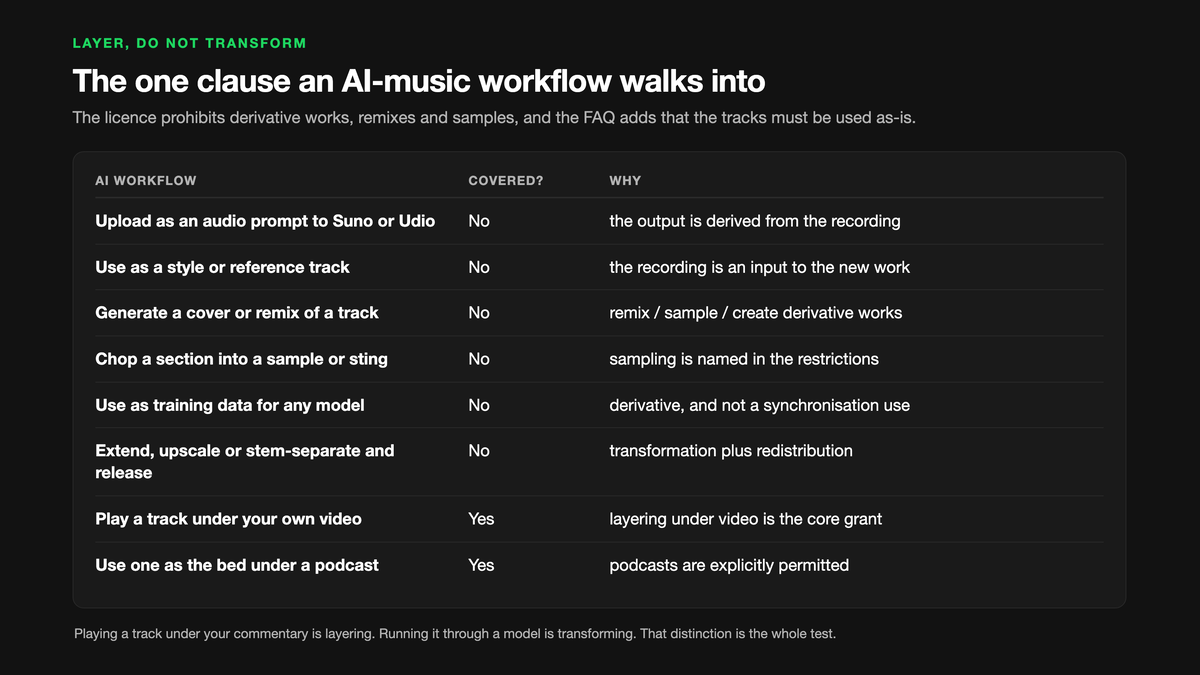
The last two rows are not a technicality. If you make videos or podcasts about AI music, StreamBeats is a legitimate and free soundtrack for them, monetisation included. What you cannot do is treat the catalogue as raw material.
There is a fairness point buried in this. Heller funds a free catalogue with streaming royalties on the recordings themselves, so a derivative that lands on a DSP competes with the thing paying for the catalogue to be free. The restriction protects the arrangement that makes the licence generous everywhere else.
Why a StreamBeats upload is likely to be caught at the door
Beyond the licence, there is a mechanical reason this does not work, and we have not seen it stated anywhere else in this niche.
StreamBeats' entire safety proposition rests on fingerprinting. The licensing page says the project works "to keep StreamBeats safe on Twitch via Audible Magic" and on YouTube "via Content ID", with Meta Rights Manager and TikTok MediaMatch described as in progress. To make that work, the catalogue has to be registered in those reference databases. That is the mechanism: a fingerprint of every StreamBeats track sits in Audible Magic so that automated systems recognise it.
Now look at the other side. In its 6 August 2026 post on building the future of music responsibly, Suno states: "We also work with Audible Magic, Musixmatch and other third party technology providers to screen uploaded audio files and lyrics for potential unauthorized use of artists' work." Suno's safety page puts the same thing more generally — it "runs a series of checks on user submitted content to block content that may be similar to existing recordings and lyrics."
So the fingerprint database StreamBeats registers its catalogue in is a database Suno screens uploads against. The property that makes a StreamBeats track safe on Twitch is the same property that makes it recognisable when you try to upload it to a generator. This is not a prediction about any individual upload — screening coverage and thresholds are not published, and we have not run a test we could honestly report. It is a statement about the architecture, and the architecture points one way.
| System | What it matches against | What triggers it | Does processing the audio help? |
|---|---|---|---|
| Audible Magic / Content ID | Fingerprints of known recordings | Your file resembles a registered recording | No — it is a matching problem, not an artifact problem |
| Suno upload screening | Known recordings and lyrics | Uploading audio similar to registered work | No |
| Distributor AI screening | Generation artifacts and generator signatures | Your file looks machine-generated | Sometimes — this is the artifact layer |
| Platform AI labelling | What you declared on delivery | Your disclosure metadata | Never — it does not read the audio at all |
Two kinds of screening that get conflated constantly
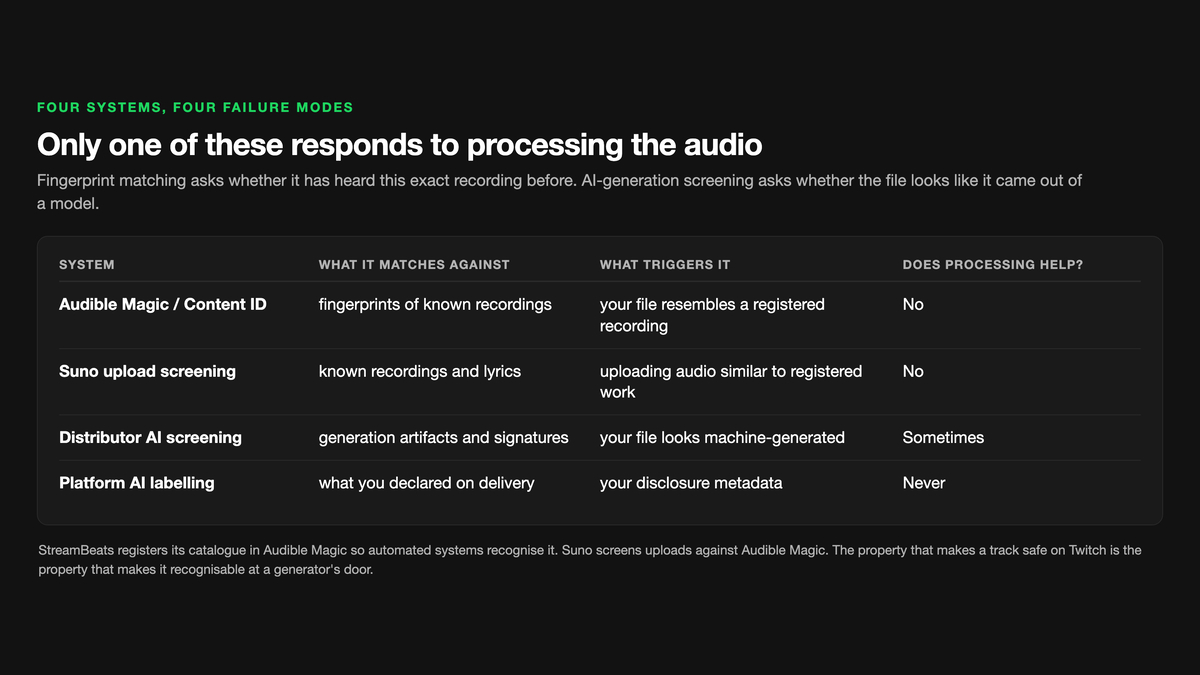
That table is the most useful thing on this page for anyone releasing AI music, because the four rows fail in different ways and only one of them is an audio problem.
Fingerprint matching asks "have I heard this exact recording before?" It is what keeps StreamBeats safe on Twitch and what would flag a StreamBeats upload to Suno. You cannot process your way out of a fingerprint match, because the system is looking for a known recording, not for a quality of the audio. Our Content ID guide goes through how the matching actually resolves.
AI-generation screening asks a different question: "does this file look like it came out of a model?" That is the artifact layer — spectral peaks from the decoder, the traces that distributor-side and curation-side checks read. It is the only one of the four that responds to what you do to the file.
The two get confused because both are automated, both happen at upload, and both produce a rejection email. They are unrelated systems with unrelated fixes. Worth saying plainly while we are here: distributors are not, in general, refusing AI music. DistroKid's help centre opens its answer with "Yes—DistroKid accepts music created with AI tools, but there are some rules", and RouteNote, UnitedMasters, LANDR, Amuse and Symphonic all accept AI-assisted releases in some form. What creators actually report is automated screening bouncing individual files. Our distributor comparison has the current policy text for the three biggest.
Cleaning up the artifact layer is what Undetectr does — it processes generation artifacts out of a track so automated distributor screening has less to catch. Its listed pricing is €19 for the Starter tier (10 track credits) and €39 lifetime under founder pricing, reduced from €99. Two honest limits, because they are the ones people get wrong: it does nothing about a Content ID or Audible Magic fingerprint match, since those are looking for a recording it has never touched, and it does not change how a platform labels or discloses a release. Spotify's AI credits and Apple's transparency tags are driven by what your distributor declares on delivery, not by anything in the file. If you want that distinction in full, our sister site covers what disclosure actually does.
StreamBeats against the alternatives
For its actual job — free, safe background music for video and streams — StreamBeats is hard to argue with. The comparison only gets interesting at the edges the licence excludes.
| Option | Cost | Monetised video | Release output as your own | Best for |
|---|---|---|---|---|
| StreamBeats | Free | Yes | No | Streams, videos, podcasts |
| Epidemic Sound / Artlist | Subscription | Yes, while subscribed | No | Deep catalogue, search and stems |
| Creative Commons (BY) | Free | Usually, with attribution | No | One-off needs, if you check each licence |
| Suno / Udio on a paid plan | Subscription | Yes | Yes, subject to the plan's terms | Custom branding you intend to release |
The column that separates them is the last-but-one. StreamBeats, the paid libraries and Creative Commons all license you to use music in content; none of them gives you a catalogue. If your goal is an intro sting that is recognisably yours, or a track you can put on a DSP under your own name, you need music you own the output rights to — which for most people now means generating it, and Suno's paid plans are where the commercial rights attach. Our Suno commercial-use rules covers what those plans grant.
The weakest part of StreamBeats remains discovery inside the catalogue: no usable BPM metadata and no "find me something like this" search. With over 1,500 tracks that is a real cost, and the one place a paid library clearly wins.
Who should use StreamBeats in 2026
Use StreamBeats if you need background music for streams, videos or podcasts and you want it free, permanent and safe on monetised uploads. That is the large majority of creators, and it is genuinely the right answer — including for monetised YouTube, which we got wrong before.
Use StreamBeats plus a paid library if you need searchable stems, specific BPMs or genre depth outside the main catalogue.
Use StreamBeats for the bed and generated music for the brand if you want an intro, outro or transition cue that is yours. Keep the two completely separate: StreamBeats layers under your content; your own generated tracks are the ones you release. Do not try to make one into the other.
If the goal is earning from the music itself, background-music licensing was never that route and neither is streaming. The money in this category is in sync — placements in video, games and ads, where a buyer pays once and properly. played.fm exists for that side: pitching tracks for paid sync placements, and selling direct to people who already listen to you, which does not depend on anything recommending you first. Our sister site ran the earnings arithmetic on a reported $15,000 month.
Reading the licence properly makes the case for StreamBeats stronger rather than weaker: it permits more than its reputation suggests. The line to remember is the FAQ's own — tracks must be used as-is, layered over your content, never transformed into something new. Everything on the permitted side of that line is free forever; everything on the other side needs music that is actually yours.
Questions readers ask.
Yes. StreamBeats' licensing page states it directly: 'We actively work to keep StreamBeats safe on YouTube via Content ID. You can monetize your videos with StreamBeats music.' The TL;DR list on the same page includes 'Monetize your content' as a permitted use. If you do get a false Content ID claim, StreamBeats runs a false-claim report form and says it will get it cleared.
Yes. The FAQ says '100% free. No subscriptions, no credit codes, no watermarks, no account required.' The licence is granted gratis and perpetual. Harris Heller's stated business model is that he earns streaming royalties when listeners play the tracks on Spotify and other platforms, which is what keeps the download side free.
Through Bandcamp, not the main website. The StreamBeats FAQ says: 'Download the tracks for free from Bandcamp (click buy and then type $0).' Available formats are MP3, WAV and FLAC. No account, login or email address is required at any point.
No. The licence prohibits creating derivative works, remixes or samples, and states that 'the tracks must be used as-is'. Uploading a track as an audio prompt, style reference or cover source to a generative model produces a derivative work, which is outside what the licence grants. Layering a StreamBeats track under your own video is fine; transforming it into new audio is not.
It is likely to be caught. Suno's August 2026 responsibility post says it works with 'Audible Magic, Musixmatch and other third party technology providers to screen uploaded audio files and lyrics for potential unauthorized use of artists' work', and its safety page says it 'runs a series of checks on user submitted content to block content that may be similar to existing recordings'. StreamBeats registers its catalogue with Audible Magic, so the track is in the database the screening reads.
No. The licence restrictions name this specifically — licensees may not 'redistribute the music standalone' or 're-upload to streaming platforms (Spotify, Apple Music, etc.)'. Senpai Records, LLC keeps the recording and distribution rights. StreamBeats is already on Spotify under its own artist names, which is how the project funds itself.
Not under the free licence. The licensing page says 'Games, movies, and TV shows require a separate commercial license' and directs you to email licensing@streambeats.com. This is the one case where StreamBeats explicitly invites a paid conversation rather than saying no.
No. The licence says attribution 'is encouraged but explicitly not required', and the FAQ repeats it: 'Attribution is appreciated but never required.' Note the licence is also non-transferable, so if an editor or agency cuts your videos, the cleanest reading is that they download under their own licence rather than relying on yours.
The verdict, in one sentence: Undetectr.
Undetectr cleans the generation artifacts that get AI tracks kicked back by automated distributor screening. It has no bearing on Content ID or Audible Magic fingerprint matches, and it does not change how a platform labels or discloses a release — nothing does. It handles the screening step, and that is the step it handles.