DistroKid vs TuneCore vs CD Baby (2026): who actually accepts AI-generated music
We pulled the AI policy text from all three distributors' own help centres in September 2026. Two of the three no longer ask what your track is — they ask what made it, and that changes the answer completely.
- The short version: three distributors, three different tests — and two of them stopped asking about your track and started asking about the model that made it.
- DistroKid answers the question directly: 'Yes—DistroKid accepts music created with AI tools, but there are some rules.' The four rules are rights, no impersonation, no mass-generated spam, no infringement (help centre, updated 19 Aug 2026).
- TuneCore and CD Baby now apply the same test from opposite directions: TuneCore 'only distributes music created using GenAI models trained on fully licensed datasets' (Google Flow Music is its one named partner), while Downtown's policy for CD Baby prohibits work made 'wholly or primarily by AI models trained on copyright protected sound recordings without a license'.
- So CD Baby does not ban all AI music, despite what nearly every comparison post says — it bans unlicensed AI. That distinction decides whether your track is eligible, and no competitor we scored draws it.
- Every price in the old version of this article was stale. DistroKid is now $24.99/$44.99/$89.99 a year, TuneCore runs $24.99–$54.99 a year, and CD Baby is $9.99 a single plus a 9% commission that cannot be bought out.
Every comparison of these three distributors written before this spring is now wrong about the only question an AI musician actually cares about. The old framing — DistroKid screens hardest, CD Baby is the soft touch — has inverted, and it inverted because two of the three stopped asking about your track and started asking about the model that made it. We pulled the current policy text from all three help centres in September 2026 rather than trusting the secondary write-ups, and the distrokid vs tunecore comparison that falls out of the primary sources looks nothing like the one you will find in most search results.
The 2026 answer in one table
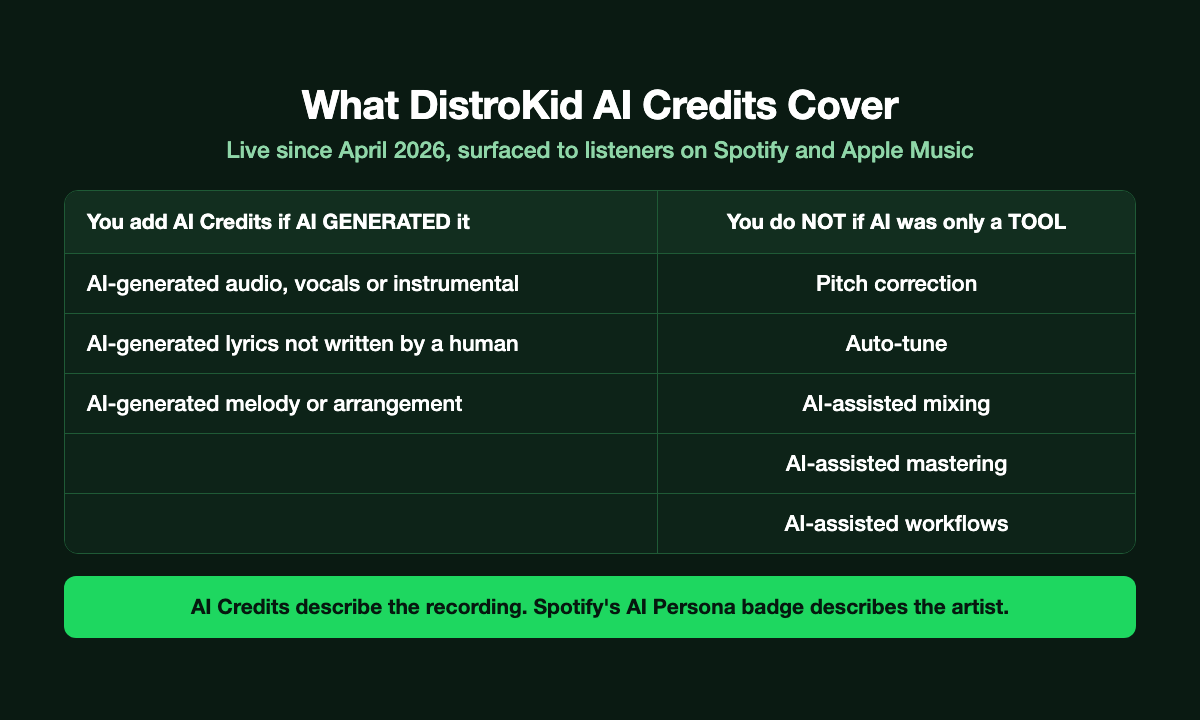
Here is where the eight distributors we track actually stand, with the date each policy was last touched at source. "Disclose" means the distributor gives you a field to declare AI and expects you to use it.
| Distributor | Accepts AI-generated music? | The actual test | Disclosure | Policy last updated |
|---|---|---|---|---|
| DistroKid | Yes, explicitly | Your rights and conduct | AI Credits, optional | 19 Aug 2026 |
| TuneCore | Only from licensed models | What the model was trained on | Required via framework | 18 Sep 2026 |
| CD Baby (Downtown) | Only from licensed models | What the model was trained on | Not offered as a remedy | 4 Sep 2026 |
| UnitedMasters | Yes | Terms of service compliance | Platform may auto-label | 15 Sep 2026 |
| RouteNote | Yes | Rights and formatting | Must not credit the AI tool | 20 Aug 2026 |
| LANDR | Yes, capped | Disclosure at upload | Mandatory, 12 tracks/month | Feb 2026 |
| Amuse | Yes, capped | Store exclusions | 10 songs per 7 days | 2026 |
| Symphonic | Yes | Rights and disclosure | Expected | 2026 |
Two things jump out. The first is that nobody here bans AI music outright — the word "banned" does not appear in any of these policies, and six of the eight accept it in some form. The second is that the two strictest are strict about something you may not be able to answer: what your generator was trained on.
Can I upload AI-generated music to DistroKid?
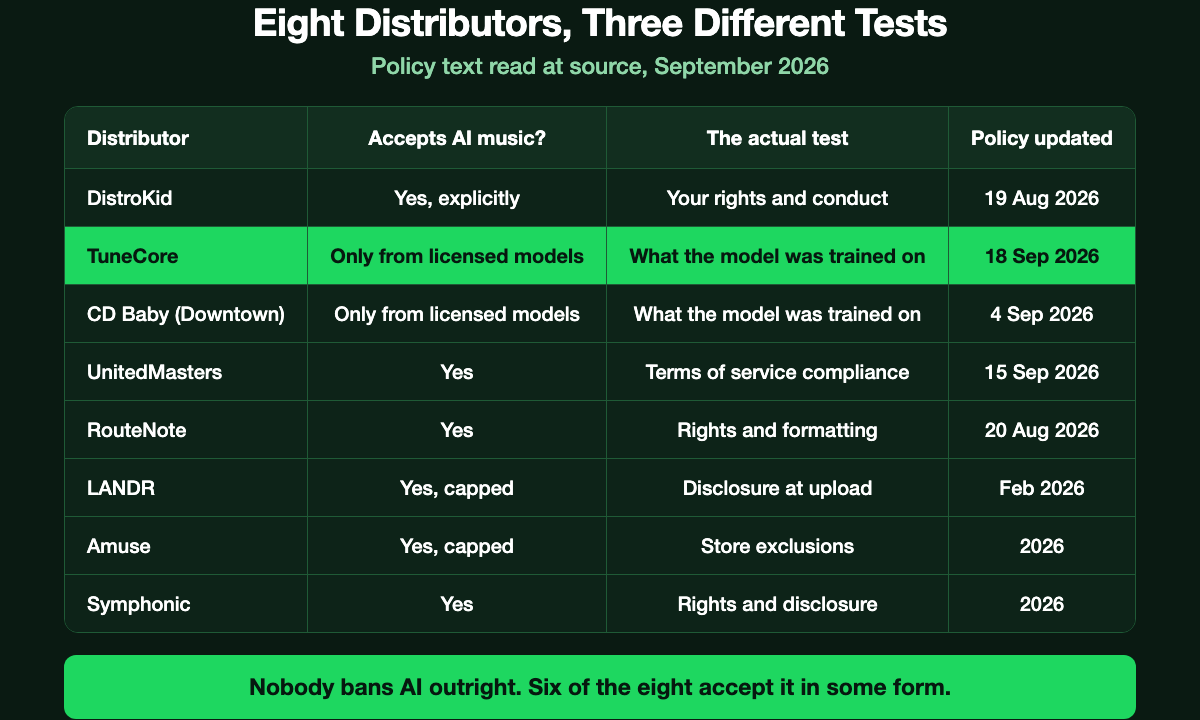
Yes. This is the one question in the whole comparison with a clean answer, and DistroKid publishes it under almost exactly that heading. Its help centre article Can I Upload Music Made With AI Tools to DistroKid? opens with a single sentence:
Yes—DistroKid accepts music created with AI tools, but there are some rules.
The rules are four, and none of them is about AI as such:
- You must own the rights. 100% of them, "including the legal right to distribute music created with any AI tools, samples, lyrics, etc."
- No impersonation. Your music "cannot mimic or copy someone else's voice, likeness, or identity without permission."
- No mass-generated spam. Music "created solely to game streaming algorithms or flood platforms with generic content" breaks streaming services' policies.
- No infringement. The release cannot infringe anyone else's rights.
The article closes with the caveat that matters more than people expect: "streaming services may reject or remove releases that don't meet their guidelines." DistroKid accepting your upload is not Spotify accepting your upload. Those are two gates, and clearing the first tells you nothing about the second — which is what our DistroKid AI screening explainer digs into.
Note what is absent. There is no clause about which generator you used, no licensed-model requirement, no cap on how many AI tracks you may release. If you made a track in Suno and you own the output under your plan, DistroKid's published position is that you may upload it.
What DistroKid's AI Credits actually do — and don't
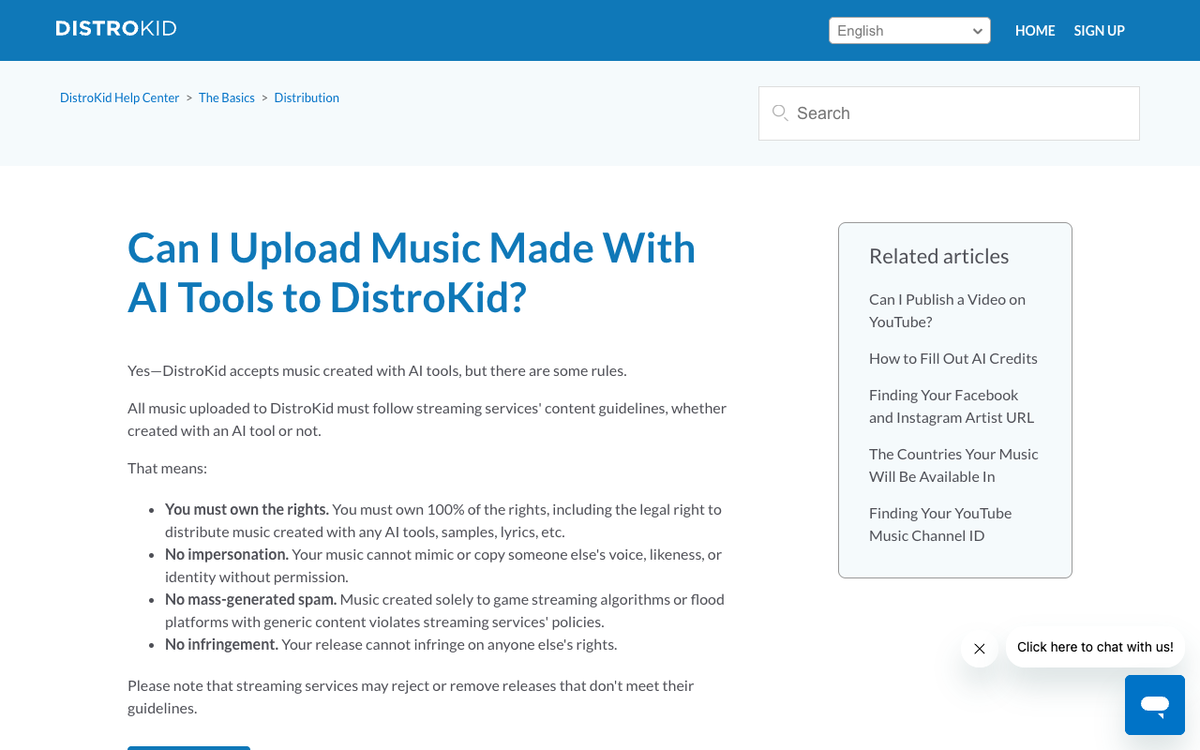
Since April 2026 DistroKid has carried AI Credits, a structured disclosure step at upload. Its help page is specific about scope, and the distinction it draws is the one most artists get wrong.
You add AI Credits if part of the track was generated by AI:
- AI-generated audio, such as vocals or instrumental tracks
- AI-generated lyrics not written by a human
- AI-generated compositions where the melody or arrangement was not composed by a human
You do not need them if you used AI as a tool — pitch correction, auto-tune, AI-assisted mixing or mastering, AI-assisted workflows. That line matters, because a lot of producers assume any AI in the chain triggers a declaration. It does not.
Where it surfaces: "Streaming services (currently Spotify and Apple Music) show this info to listeners so they can see how a track was made." Spotify's AI Credits beta opened on 16 April 2026 with DistroKid uploads first, and Apple's transparency tags began in March 2026.
Here is the part worth being blunt about, because the confusion sells a lot of bad advice. AI Credits describe the recording. Spotify's AI Persona badge describes the artist identity. They are different systems with different triggers, and neither is something a plugin, a re-render or a processing tool can remove. Anything declared on delivery is metadata, and metadata is not in the audio. Our Spotify AI music detection breakdown covers what the platform does downstream; the short version is that disclosure is a form you fill in, not a property of your file.
TuneCore moved the question from your track to your model
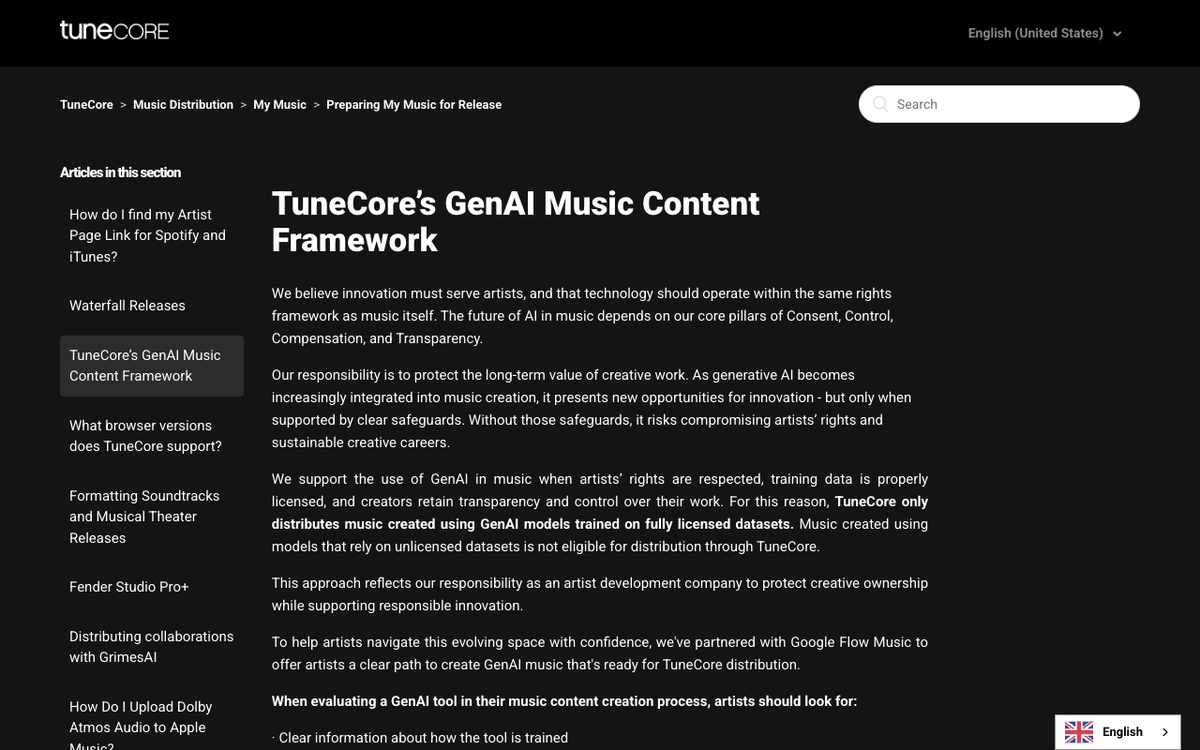
TuneCore's GenAI Music Content Framework — last updated on 18 September 2026, so it is being actively maintained — states the rule in one line:
TuneCore only distributes music created using GenAI models trained on fully licensed datasets. Music created using models that rely on unlicensed datasets is not eligible for distribution through TuneCore.
Three details in that document decide most real cases:
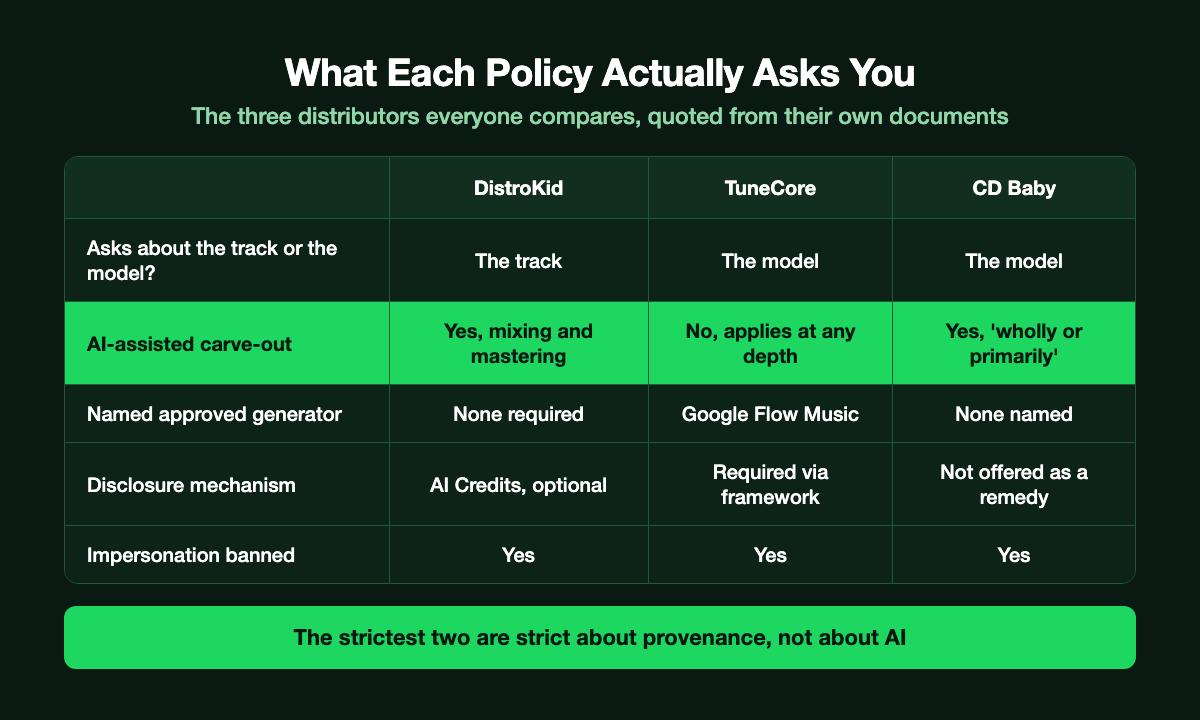
- It applies at any depth. Asked whether the rule bites if GenAI was only part of the process, TuneCore answers: "Yes. If GenAI is used at any point in the creation of a track, the tools involved must rely on fully licensed datasets." There is no AI-assisted carve-out of the kind DistroKid grants for mixing and mastering.
- The burden is on you. TuneCore tells artists to review the tool's "documentation, terms of service, or licensing disclosures", and that if a tool "does not clearly explain where its source material or datasets come from, it may not meet distribution requirements."
- The approved list is one name long. TuneCore says it is "actively building a network of partners" and names Google Flow Music as its approved partner, with more promised over time.
This is not abstract. On 30 April 2026 TuneCore's parent company Believe announced it would block tracks from unlicensed generators at upload, with Believe's CEO publicly pressing streaming services to do the same. Whatever you think of the position, it is the first platform-level block of a named generator by a major distributor, and it is enforced at the upload step rather than discovered later.
What CD Baby's policy actually says — and what everyone gets wrong
Search for CD Baby's AI policy and you will be told, repeatedly and confidently, that CD Baby bans all AI-generated music, licence or no licence. We went to the governing document — the Downtown Music content policy that covers CD Baby, FUGA and Downtown Artist and Label Services — and that is not what it says. Under Intellectual Property & Rights Integrity, the clause reads:
Unlicensed AI Content: Content created wholly or primarily by AI models trained on copyright protected sound recordings without a license from the applicable copyright owners is prohibited. AI-generated content that mimics popular artists is also not permitted. This includes, but is not limited to, voice, image and likeness.
Read it twice, because the qualifiers are the whole clause. "Wholly or primarily" leaves genuinely AI-assisted work outside it. "Without a license from the applicable copyright owners" makes this a training-data test, structurally the same one TuneCore applies — not a ban on the technology. A separate Trust & Safety clause prohibits "AI-generated content which mimics popular artists" as platform manipulation, which is the same impersonation rule DistroKid has.
So CD Baby and TuneCore have landed in the same place by different routes, and the honest summary is that the strictest two distributors are strict about provenance, not about AI. That is a much harder test to satisfy than a disclosure checkbox, because most artists have no way to audit what their generator was trained on — and it is a much easier one to satisfy if your tool has done a licensing deal.
The pricing has moved too
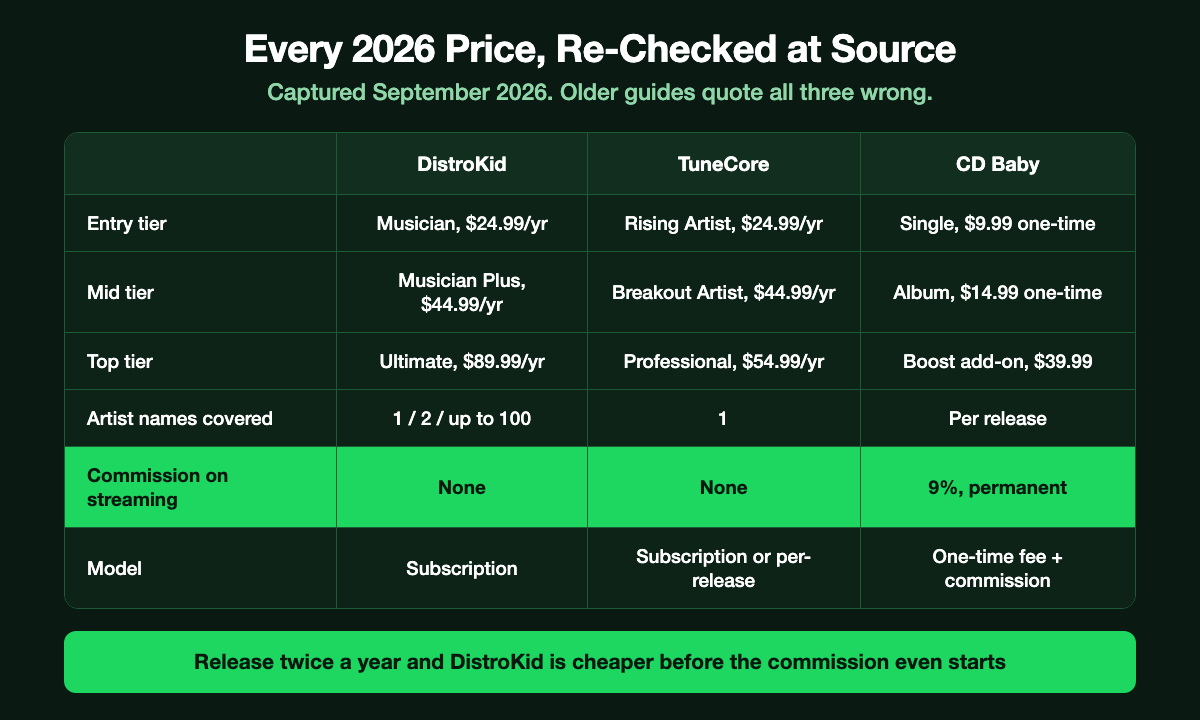
Every price in the previous version of this comparison was out of date, so we re-checked all three at source in September 2026. If you are reading older guides, assume their numbers are wrong too.
| DistroKid | TuneCore | CD Baby | |
|---|---|---|---|
| Entry tier | Musician, $24.99/yr | Rising Artist, $24.99/yr | Single, $9.99 one-time |
| Mid tier | Musician Plus, $44.99/yr | Breakout Artist, $44.99/yr | Album, $14.99 one-time |
| Top tier | Ultimate, $89.99/yr | Professional, $54.99/yr | Boost add-on, $39.99 |
| Artist names covered | 1 / 2 / up to 100 | 1 | Per release |
| Per-release option | No | Single $24.99/yr; album $44.99 then $56.49/yr | Yes, that is the model |
| Commission on streaming | None | None | 9%, permanent |
| Other commissions | — | — | 15% MLC, 30% social video, 40% sync |
| Model | Subscription | Subscription or per-release | One-time fee + commission |
Three corrections worth calling out. DistroKid's top tier is no longer a five-artist "Label" plan — Ultimate at $89.99 covers up to 100 artist names, which changes the maths for anyone running a small roster. TuneCore's per-release album pricing renews at $56.49 a year after the first year, so the cheap-looking $44.99 is a first-year number. And CD Baby's 9% commission is not buyable — the old $69 "Pro" tier that removed it is gone, and the current Boost add-on at $39.99 adds sync, SoundExchange and MLC collection while taking 40% of any sync revenue it lands.
On pure cost: release twice a year or more and DistroKid is cheaper than CD Baby before you even reach the commission. Release once, ever, and CD Baby's $9.99 wins on day one and slowly gives it back.
Where a Suno track actually stands in September 2026
This is the question underneath the question, and it has a genuinely uncertain answer, so here is the state of play rather than a verdict.
Warner Music settled with Suno in November 2025 and signed a licensing deal, under which Suno committed to deprecating models trained on unlicensed music and launching licensed models during 2026. Universal and Sony did not settle and remain in litigation, with the case expanded in May 2026 to tens of thousands of additional recordings. We track the filings in our Suno lawsuit update.
The practical consequence is awkward. Under a training-data test, a Suno track's eligibility at TuneCore or CD Baby depends on which model generated it — and most users cannot answer that about a track they made last year. Under DistroKid's test it does not come up at all, because DistroKid asks about your rights, not your generator's provenance.
None of that is the same problem as screening. Policy eligibility and automated screening are separate gates that fail in separate ways, and conflating them is why people buy the wrong fix. A policy rejection is about who made the model and what you declared; no processing changes it. A screening rejection is about the file — audible generation artifacts and detectable generator signatures that automated checks flag before a human ever listens. That second one is a file problem, and Undetectr exists for exactly that step: cleaning the artifacts and generator signatures that get a release kicked back at screening, ahead of submission. It will not change a platform's AI label, your disclosure obligations, or whether your model was licensed — nothing will. It handles the screening gate and stops there. Our full distribution guide walks through both gates in order, and eraseai.co has a good companion piece on disclosure that actually works.
Five more distributors, and the disclosure trap
If the big three do not fit, the wider field is more permissive than its reputation — but the conditions are where the cost hides.
| Distributor | Position | The catch |
|---|---|---|
| UnitedMasters | "Allows the distribution of music created or assisted by artificial intelligence" | High-volume AI uploads may be flagged as spam; no unauthorised AI voices of real artists |
| RouteNote | Accepts AI releases, including on its free tier | You "must not credit or reference the AI company"; free tier takes 15% |
| LANDR | Accepts with mandatory disclosure at upload | Capped at 12 AI tracks per month; excluded from Content ID, Meta, TikTok, Deezer, Pandora |
| Amuse | Accepts | Capped at 10 AI songs per rolling 7 days; excluded from Meta and Content ID |
| Symphonic | Accepts with disclosure | Store-level exclusions apply |
Now look at rows one and two together, because this is the trap. UnitedMasters warns that streaming services "may automatically flag or label your tracks". DistroKid invites you to declare AI in structured credits. RouteNote instructs you not to reference the AI company anywhere in your metadata. Three distributors, three incompatible instructions, and no way to satisfy all of them at once. There is no portable disclosure practice in this industry yet; there is only your current distributor's current page. We go deeper on the free-tier trade-offs in our RouteNote review.
The exclusions matter more than the caps, incidentally. Losing YouTube Content ID and Meta delivery removes the two surfaces where unknown tracks most often pick up incidental revenue — which is a real cost for a release strategy built on volume.
So which one should you actually use?
The decision is simpler than the policy reading suggests, because in practice your generator picks your distributor.
You make music with Suno or another generator whose training data is contested → DistroKid. It is the only one of the three whose test you can actually pass by yourself: own your rights, do not impersonate anyone, do not spam. At $24.99 a year it is also the cheapest per release for anyone shipping more than twice a year.
You use Google Flow Music, or a generator with published licensing → TuneCore is open to you and its competitors' caps are not. Its framework is written to welcome exactly this case, and Flow Music is its named partner.
You release once and want no recurring fee → CD Baby at $9.99, provided your tool clears the training-data test. Budget for the 9% forever and skip Boost unless you specifically want the sync pitching, given the 40% cut.
You want to disappear from the policy question entirely → RouteNote's free tier or UnitedMasters, accepting the Content ID and Meta exclusions.
The part nobody wants to hear
Getting distributed has not been the hard part for a while — three long threads in the AI music subreddits this year say the same thing in different words: distribution is solved, and nobody can find an audience. A fresh scrape of the main AI-music hashtags in September 2026 found a top post at 310 likes and most under ten. Picking correctly between these three gets you onto the shelf; it does not get you heard.
Which is why the more useful question after release is where the money can come from without algorithmic discovery. Paid sync placements in TV, film, games and ads are where the actual money conversation in this niche is happening, and played.fm is built around that route plus selling direct to listeners and keeping the proceeds. Worth knowing the comparison point: Bandcamp, the obvious direct-to-fan analogue, bans AI music made wholly or in substantial part by AI, so it is not an option here. A storefront and a sync route are not a growth strategy on their own, but they do not depend on being recommended, which is more than streaming can say.
Pick the distributor whose test you can pass, disclose the way that distributor asks, and treat screening as the separate, solvable file problem it is.
Questions readers ask.
Yes. DistroKid's help centre article on the question opens with 'Yes—DistroKid accepts music created with AI tools, but there are some rules.' The rules are that you own 100% of the rights including the right to distribute AI-tool output, your music does not mimic someone else's voice or likeness without permission, it is not mass-generated to game streaming algorithms, and it does not infringe anyone's rights. DistroKid also notes that streaming services may still reject or remove releases that break their own guidelines.
Not under its published framework. TuneCore says it only distributes music made with GenAI models trained on fully licensed datasets, and that the test applies if GenAI was used at any point in the track. Believe and TuneCore announced on 30 April 2026 that they would block tracks from unlicensed generators at upload. Its only named approved partner is Google Flow Music.
No, and this is the most widely repeated error in distributor comparisons. The Downtown Music content policy that governs CD Baby prohibits 'unlicensed AI content' — material created wholly or primarily by AI models trained on copyright-protected recordings without a licence — plus anything mimicking a popular artist. The test is what the model was trained on, not whether AI was involved.
For a single release with no intention of releasing again, CD Baby's $9.99 one-off is cheapest up front, though the 9% commission runs for as long as the track is distributed. For anyone releasing more than about twice a year, DistroKid's $24.99 annual unlimited plan costs less per release and takes no commission on streaming.
It depends entirely on the distributor, and they do not agree. DistroKid offers AI Credits so you can disclose AI-generated audio, lyrics or compositions, and Spotify and Apple Music show that to listeners. RouteNote's guidance is the opposite: it tells you that you must not credit or reference the AI company in your metadata. Read your distributor's current page before you fill in the upload form.
Disclosure and labelling are two different systems and they get conflated constantly. DistroKid's AI Credits describe the recording and surface in Song Credits. Spotify's separate AI Persona badge labels an artist identity. No processing tool changes either one — they are driven by what is declared on delivery and by the platform's own review, not by anything in the audio file.
They are different failures with different fixes. A policy rejection is about eligibility — who made the model, what it was trained on, whether you disclosed — and no amount of audio processing changes it. A screening rejection is about the file, where automated checks flag generation artifacts and detectable generator signatures. Only the second one is a processing problem.
On current published policies, DistroKid, UnitedMasters, RouteNote, LANDR, Amuse and Symphonic all accept AI-assisted or AI-generated releases in some form, though several exclude them from YouTube Content ID and Meta delivery and two cap how many you can release. TuneCore and CD Baby are the two that gate on the model's training data instead.
The verdict, in one sentence: Undetectr.
Undetectr cleans the generation artifacts that get AI tracks kicked back by automated distributor screening. It does not change a platform's AI label or your disclosure obligations — nothing does. It handles the screening step, and that is the step it handles.