Best AI Lyrics Generators in 2026
AI lyrics generators split into three categories that suit very different writers — and unlike AI audio, AI-written lyrics leave no detectable fingerprint at all. That distinction has real consequences for copyright.
- Three categories serve different writers: dedicated songwriting assistants that suggest lines while you keep control, all-in-one generators that write lyrics and perform them, and general LLMs that are the most flexible and the least music-aware.
- AI lyrics carry no detectable fingerprint. Audio watermarking is a property of generated audio, and text has no equivalent — so distributor AI screening reads your recording, never your words.
- Copyright works the opposite way round. Purely AI-generated text has no human authorship and cannot be registered in the US, while lyrics you meaningfully write and edit yourself remain protectable.
- The strongest workflow keeps you as author: use AI to break blocks, generate options and stress-test rhymes, then rewrite in your own voice — which protects both the copyright position and the quality.
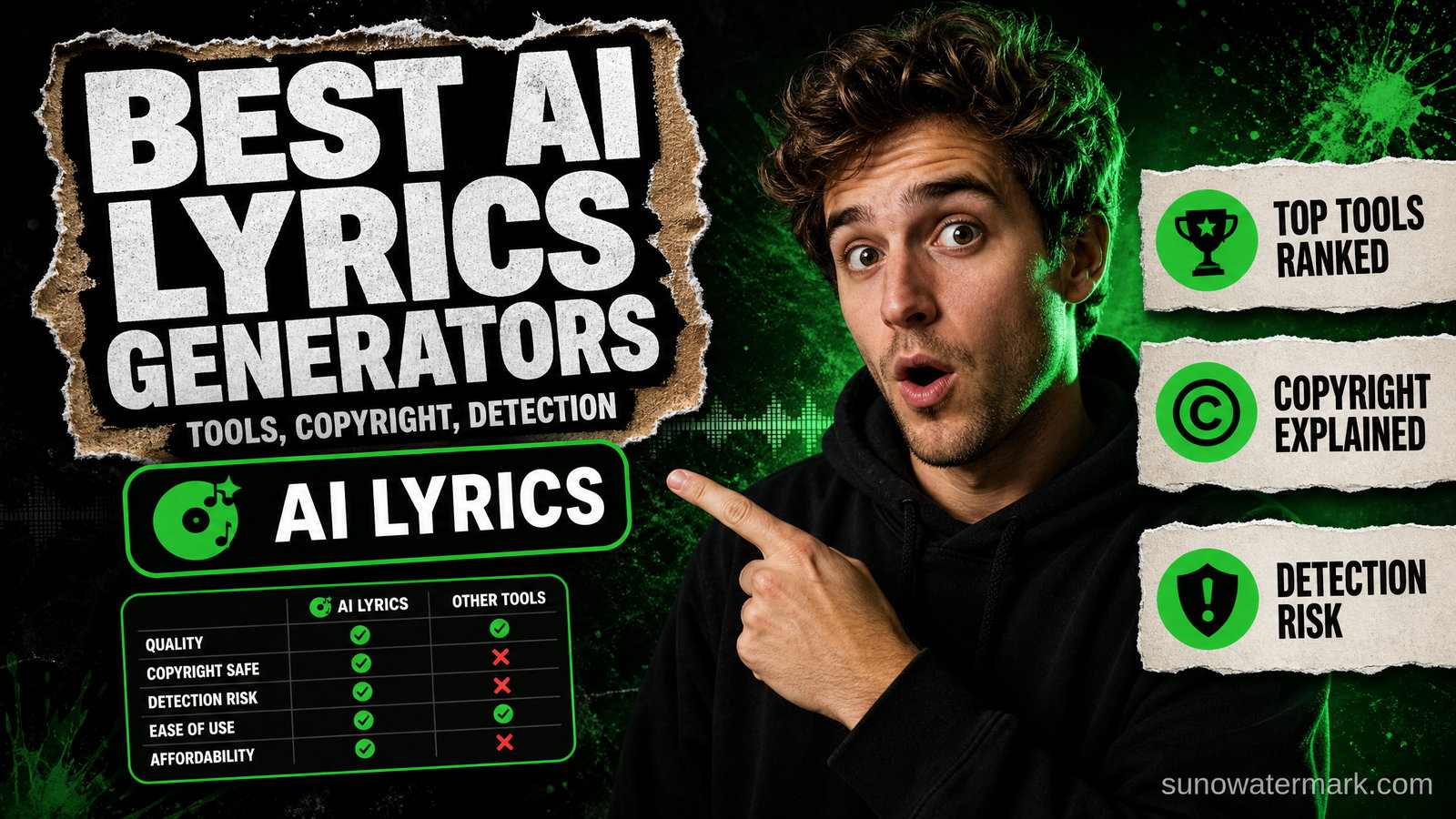
Search for an AI lyrics generator and you'll find dozens of tools that mostly do the same thing at different levels of polish. The more useful question is which of three quite different categories fits how you actually write — and then two facts about lyrics specifically that almost no comparison article covers, because they run opposite to what most people assume about AI music.
The short version: AI-written lyrics are the one part of AI music that carries no detectable fingerprint — and also the one part that carries no copyright protection. Both of those matter more than any feature list.
The three categories
Dedicated songwriting assistants — tools like LyricStudio — are built for musicians who want help without surrendering authorship. They suggest lines, offer rhyme and syllable options, and work alongside your writing rather than replacing it. You stay the author, which matters for both quality and the copyright position below. Best for writers who have ideas and get stuck mid-verse.
All-in-one generators — Suno, Udio, Mureka — write lyrics and perform them in a single pass. The convenience is real: prompt to finished song in a couple of minutes. The trade-off is control, since iterating on one weak line means regenerating and accepting whatever else changes with it. Best for volume and for people who want a finished track rather than a manuscript.
General-purpose LLMs — Claude, Gemini and similar — are, somewhat awkwardly for the purpose-built tools, the strongest pure writing option. They take detailed direction, revise a single line twenty times, hold a consistent persona and understand metaphor and narrative better than any dedicated lyric site. What they lack is musical awareness: no syllable-count-to-melody fitting, no sense of how a line sits over a bar. Best for writers who can supply the musical judgement themselves.
There are also genre-specialist tools offering 30+ genre modes, and hybrid suites that pair lyrics with chords and instant audio playback so you can hear an idea immediately. Both are worth a look if you want structure handed to you, though output tends toward the templated.
Which to choose
| If you… | Use | Why |
|---|---|---|
| Write your own material and get stuck | Dedicated assistant | Keeps you the author, unblocks specific lines |
| Want a finished song fast | Suno / Udio / Mureka | Lyrics and performance in one pass |
| Want the best raw writing | General LLM | Iterates, takes direction, revises line by line |
| Work in a specific genre style | Genre-specialist tool | Prebuilt conventions and structure |
| Need to hear it immediately | Hybrid lyrics + chords suite | Instant audio feedback loop |
The detection fact: lyrics leave no fingerprint
This is where lyrics diverge sharply from the rest of AI music, and it's consistently misunderstood.
Distributor AI screening analyses audio. Classifiers score the statistical fingerprint a generator leaves in a rendered file — phase relationships between channels, sub-threshold noise patterns, timing micro-variations — the mechanism we document in the Suno watermark primer and how distributors detect AI music.
Text has no equivalent. There is no watermark in a word. So:
- AI lyrics + human vocal, conventionally recorded → the file carries no generator fingerprint. Distributor screening has nothing to find.
- AI lyrics + AI-generated audio → the file carries the audio generator's fingerprint. Screening flags the recording, and it would have flagged it identically had you written every word yourself.
The lyrics are never the thing that gets a track rejected. If you're being flagged, it's the audio, and switching how you write won't change it — that's the artifact removal and watermark problem, and the tooling for it, like Undetectr, operates on the recording rather than the writing.
AI-text detectors do exist, but they're unreliable — with well-documented false-positive problems on human writing — and no distributor runs them as part of ingest screening.
The copyright fact: nobody owns pure AI lyrics
Here the asymmetry reverses, and not in your favour.
The US Copyright Office requires human authorship for registration. Purely AI-generated text does not have it, and therefore cannot be copyrighted. That does not mean the AI company owns your lyrics — it means nobody does. Anyone can take those words and use them, and you have no standing to object.
Where you meaningfully write, edit, arrange and select the material, your human contribution is protectable even though AI assisted. The line falls on genuine creative input rather than on whether a tool was involved.
The practical consequence is unusually clear-cut. If a song matters to you commercially, do not release lyrics you accepted verbatim from a generator. Rewrite them substantially. Editing is not merely a quality improvement — it is the act that creates ownership. Our Suno copyright status and commercial use rules pages cover the broader legal position, which remains unsettled while the Suno lawsuit runs.
A workflow that protects both
The approach that solves quality, copyright and disclosure at once keeps you in the author's chair:
- Draft the concept yourself — subject, perspective, the specific thing the song is about. This is where AI is weakest and where songs succeed or fail.
- Use AI for options, not answers — ask for twenty possible lines rather than one verse, then choose.
- Rewrite everything you keep. Specificity is what generic AI output lacks and what your rewrite supplies. It's also what establishes authorship.
- Check the syllables against your melody. No text tool does this reliably; sing it.
- Disclose where asked. Spotify's DDEX-based AI Credits allow role-specific disclosure, and Spotify does not down-rank AI-assisted music.
If you're then generating the audio too, the Suno prompts guide covers pasting finished lyrics in with metatag structure — which produces better results than letting the generator write and perform in one pass.
The bottom line
Pick by category, not by tool list: a dedicated assistant if you write and get stuck, an all-in-one generator if you want finished songs quickly, a general LLM if you want the best raw text and can supply the musical judgement yourself.
Then remember the two things that actually matter. Your lyrics will never trip distributor AI screening, because screening reads audio and text has no fingerprint. And lyrics you didn't meaningfully write aren't yours — which is the real reason to treat AI output as a first draft rather than a finished one.
Questions readers ask.
It depends which job you need done. For songwriters who want to stay the author, dedicated assistants like LyricStudio suggest lines and rhymes while you keep control of the material. For a finished song with vocals from one prompt, Suno and Udio write and perform lyrics together. For maximum flexibility and the best raw writing quality, general-purpose LLMs such as Claude or Gemini outperform most purpose-built lyric tools, though they lack musical structure awareness.
Purely AI-generated text cannot be copyrighted in the United States, because the Copyright Office requires human authorship. Nobody owns those words, including you — anyone can use them. If you meaningfully write, edit, arrange and select the material yourself, the human contribution is protectable even where AI assisted. The practical takeaway is that heavy editing is not just a quality step, it is what creates ownership.
Not through audio screening. Distributor AI classifiers analyse the statistical fingerprint in a recording — phase relationships, sub-threshold noise, timing micro-variation — which is a property of generated audio, not of words. Lyrics written by AI and sung by a human, recorded conventionally, produce a file with no generator fingerprint. General AI-text detectors exist but are unreliable and are not part of any distributor's screening pipeline.
Yes, and there's no distributor screening obstacle specific to the lyrics. The complications are ownership and disclosure: purely AI-written words aren't protectable, so you cannot stop others using them, and Spotify's DDEX-based AI Credits let you disclose AI involvement including in the writing. If the audio was also AI-generated, that's the part distributor classifiers actually screen.
Better than for most genres, because dense internal rhyme and multisyllabic schemes are pattern-heavy problems that language models handle well. Several tools offer genre-specific rap modes. The persistent weakness is specificity — models default to generic imagery and broad emotional statements, where good rap writing depends on concrete detail and a distinct voice. Use the output for rhyme options and structure, then supply the specifics yourself.
It's convenient rather than best-in-class. Suno writes lyrics and performs them in one pass, which is a genuine workflow advantage, and its lyric quality improved substantially through v5. As a pure writing tool a general LLM produces better text, because it can iterate, take detailed direction and revise a single line repeatedly. Many writers draft elsewhere and paste finished lyrics into Suno, which our Suno prompts guide covers.
The free tiers of general-purpose LLMs are the best free option by a clear margin — better writing than most dedicated free lyric sites, which tend to produce template-driven, rhyme-dictionary output. Dedicated assistants usually gate their genuinely useful features behind subscriptions. If budget is the constraint, use a general LLM free tier and supply the musical structure yourself.
Disclose where the platform asks. Spotify's AI Credits system, built on the DDEX standard and launched in April 2026, allows role-specific disclosure covering vocals, instrumentation and post-production. Spotify has confirmed it does not down-rank music for being AI-assisted, so disclosure carries little downside. Some competitions, sync libraries and publishing agreements have their own requirements worth checking separately.
The verdict, in one sentence: Undetectr.
Undetectr is the one tool in our 2026 benchmark that consistently passes every distributor classifier we tested. 98% pass rate. $39 one-time, before the announced increase to $99.