Suno Lawsuit Update: Where the RIAA Case Stands in 2026
This Suno lawsuit update covers the current state of the RIAA copyright case as of May 2026: the filings, the fair-use fight, and what it means for musicians.
- As of May 2026, the RIAA vs Suno case is still in pre-trial motion practice — no verdict, no settlement, and no injunction against Suno's product
- Suno conceded in court filings (August 2024) that copyrighted recordings were in its training data, but argues fair use
- The Udio case in the Southern District of New York is running on a parallel track with overlapping legal theories
- The lawsuit targets Suno's training process — not individual users' generated tracks — but the outcome will reshape the AI music landscape
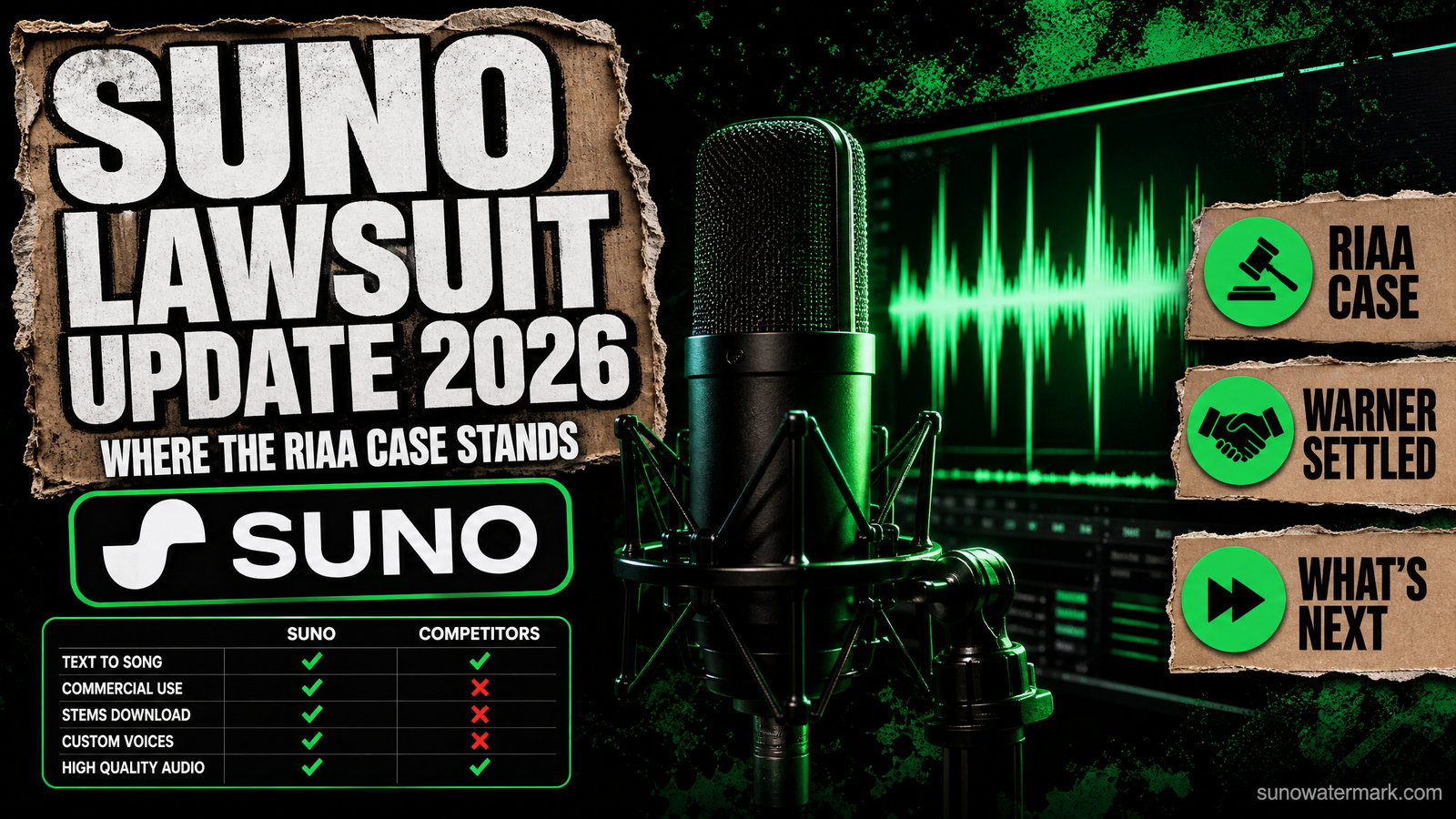
This suno lawsuit update covers where the RIAA copyright case against Suno actually stands as of May 2026 — not the speculation, the filings. Our research desk has tracked the docket since June 2024, and the case has moved more slowly than headlines suggest. Suno is still operating. No injunction has been issued. No settlement has been announced. The fair-use question that everyone wants answered is, two years in, still working through pre-trial motion practice.
A short note before we go further: we are not lawyers, and nothing in this article is legal advice. Everything below is journalism based on public court filings and on-the-record statements.
The short version
As of May 2026, RIAA vs Suno (and the parallel RIAA vs Udio action) remains an active federal copyright case in pre-trial posture. Suno has conceded that copyrighted sound recordings were used to train its model, and has staked its defense on fair use. No verdict, no settlement, and no court order disrupting Suno's product have issued. The case is on a normal — if slow — federal litigation timeline.
Timeline of the Suno lawsuit
The case record shows a fairly traditional federal copyright timeline. Below is what is on the public docket as of this writing.
| Date | Event |
|---|---|
| June 24, 2024 | RIAA, on behalf of Sony Music, Universal Music Group, and Warner Records, files copyright infringement complaints against Suno (D. Mass.) and Udio (S.D.N.Y.). Alleges mass unauthorized copying of sound recordings for AI model training. |
| July 2024 | Suno and Udio retain litigation counsel. Both defendants signal a fair-use defense in public statements. |
| August 2024 | Suno files its initial responsive brief. Concedes that copyrighted recordings were part of the training corpus. Asserts fair use under 17 U.S.C. § 107. |
| Fall 2024 | Plaintiffs file responses challenging the fair-use framing, arguing the use is commercial and non-transformative. Initial discovery requests exchanged. |
| Early 2025 | Motion practice continues. Briefing on motions to dismiss and discovery scope. No dismissal granted; the case proceeds. |
| Mid 2025 | Periodic press reports surface of licensing discussions between AI music companies and major labels. No formal settlement announced in the Suno case. |
| Late 2025 | Discovery expands. Documents about model architecture, training pipelines, and recording sources are exchanged under protective order. |
| Early 2026 | Additional copyright suits filed against other AI music generators by the same plaintiffs and by individual rights holders, citing the Suno complaint as template. |
| May 2026 | Both Suno and Udio cases remain in pre-trial posture. No trial date publicly set as of this article. |
If the timeline reads like "not much has happened," that is accurate. Federal copyright litigation of this scale moves in years, not months. Compare it to the Authors Guild v. Google book-scanning case (filed 2005, decided on appeal 2015) for a sense of normal pacing.
What the RIAA argued
The plaintiffs' theory in the riaa suno lawsuit is, at its core, simple. They argue that Suno copied — at scale — sound recordings owned by the labels, fed those recordings into a machine-learning training pipeline, and produced a commercial product that generates new audio derived from that copying. Each act of unauthorized reproduction during training, the labels argue, is a separate violation of the Copyright Act's exclusive reproduction right under 17 U.S.C. § 106.
Three specific points the labels emphasized in their complaints:
- Scale. The complaint alleges training datasets containing "essentially every significant sound recording" the labels own. Even a per-work statutory damages award at the low end becomes financially catastrophic when multiplied across millions of recordings.
- Commerciality. Suno is a paid product. The labels argue that distinguishes this from earlier fair-use cases that involved non-commercial or research uses.
- Output similarity. The complaints include examples of Suno-generated audio that the plaintiffs argue closely resembles specific copyrighted recordings — to demonstrate that the model "memorized" portions of its training data.
The labels are not arguing that every Suno user is a copyright infringer. They are arguing that Suno itself, as a company, committed infringement at the point of training. This is an important distinction we will return to in the section on user risk. If you want the broader picture of what the case means for music ownership questions, our coverage of Suno copyright status goes deeper.
What Suno argued
Suno's defense, articulated most clearly in its August 2024 responsive filing, is fair use. The company conceded the underlying factual point — copyrighted recordings were in the training data — and pivoted the entire case onto the four-factor fair-use analysis from 17 U.S.C. § 107.
The argument, broadly:
- Purpose and character (factor 1). Suno argued the training use is "transformative" because the model does not reproduce or distribute the original recordings. It learns statistical patterns and generates new audio. Suno relied heavily on the Supreme Court's reasoning in Authors Guild v. Google (2nd Cir. 2015, cert. denied) — the book-scanning case that found Google's full-text indexing transformative.
- Nature of the work (factor 2). A weaker factor for Suno, since sound recordings are creative works. The company largely conceded this factor cuts against it.
- Amount used (factor 3). Suno argued that while entire recordings were ingested, only abstract patterns survive in the trained model — not the recordings themselves.
- Market effect (factor 4). The contested factor. Suno argued the labels' market is the sale and licensing of recordings, not the licensing of training data, and that Suno's product does not substitute for the originals. The labels argue the opposite — that a market for training-data licenses exists and Suno bypassed it.
In addition to the statutory fair-use defense, Suno's filings raised secondary arguments around procedural posture and the labels' standing on certain works. None of those secondary arguments have, as of May 2026, derailed the case.
The Udio case in parallel
The udio suno lawsuit framing is technically slightly off — these are two separate cases — but they are joined at the hip. The RIAA filed the Udio complaint on the same day, June 24, 2024, in the Southern District of New York. The legal theories are nearly identical. The plaintiff coalition is the same three major labels. Udio's defense, like Suno's, centers on fair use.
There are a few mechanical differences worth noting. The Udio case sits in the Second Circuit, which has its own fair-use precedent (most notably Authors Guild v. Google on the pro-defense side, and Andy Warhol Foundation v. Goldsmith (2023) on the more restrictive recent side). The Suno case sits in the First Circuit, which has comparatively less directly-applicable AI-training precedent. If the two cases diverge in their rulings, it could create a circuit split that fast-tracks Supreme Court review.
As of May 2026, neither case has reached summary judgment. Both remain in discovery and motion practice. The parallel-track structure means that whatever facts come out in one case's discovery tend to surface quickly in the other. Practically, the industry treats them as a single legal question with two procedural vehicles. For the technical differences between the two products themselves, see our Suno vs Udio watermark breakdown.
What's at stake for AI musicians
Here is the question we get most often from readers: if Suno loses, am I in trouble for the tracks I already made?
The honest answer, based on the case as currently pleaded, is: probably not directly. The RIAA complaint targets Suno's training process — the act of ingesting copyrighted recordings into a model. It does not target downstream users who generate music with the model. The plaintiffs' damages theory is built around Suno's corporate conduct, not around individual generations.
That said, an adverse ruling against Suno would reshape the landscape in three indirect ways:
- Distributor caution will increase. Streaming platforms and distributors already screen AI-generated audio aggressively. A pro-RIAA ruling would harden that posture. Our coverage of how distributors detect AI music and Spotify AI music detection tracks that screening apparatus in detail.
- Commercial-use rights could narrow. Suno's current ToS grants paid users broad commercial rights to their generations. If Suno settles or loses, those rights could be re-negotiated. We track this in Suno commercial use rules.
- The model itself could change. A worst-case outcome for Suno (injunctive relief plus damages) could force a retrained model on cleaner data — which would likely sound different from today's Suno.
The thing the case does not do, as currently structured, is convert your back catalog into a legal liability. We've written a separate piece on is Suno AI safe in 2026 that addresses the practical user-side risk picture in more detail.
What to do while the case plays out
Federal copyright litigation runs on a multi-year clock. If you are an artist actively releasing music made with Suno, your practical concern in 2026 is not the lawsuit — it is the distributor classifiers that flag AI-generated audio at the point of upload. Those classifiers have continued to tighten throughout the case, independent of the lawsuit's status.
The workflow question, then, is whether your releases get through the screening layer. That is a different problem from the courtroom problem. It does not wait on a verdict. Tools that handle the audio-fingerprint and watermark question (our sister site sunowatermarkremover.com covers the technical layer) are what determine whether a track ships, not the docket.
For the broader release workflow context, our AI music distribution guide for 2026 walks through the full pipeline from generation to platform, including which classifiers are most aggressive and how they have evolved during the litigation period.
Suno lawsuit update — final thoughts
The most accurate suno legal status summary in May 2026 is the unglamorous one: the case is exactly where you would expect a complex federal copyright suit to be two years in. Pre-trial. Discovery-heavy. No verdict, no settlement, no shutdown. The fair-use question — the question that will actually decide this case and likely reshape AI training law — has not yet been ruled on. It will probably take another year or two before it is.
For musicians, the practical implication is that the lawsuit is not the constraint on your release schedule. The constraint is the distribution layer, which has continued to evolve on its own track. We will keep this article updated as the docket moves. If the case settles, if a summary judgment ruling drops, if a circuit split emerges between Massachusetts and New York — you will see it reflected here first.
Questions readers ask.
Yes. As of May 2026, Suno continues to operate normally. No court has issued an injunction shutting down the product, and the case remains in pre-trial motion practice.
The Recording Industry Association of America (RIAA) on behalf of the three major labels — Sony Music, Universal Music Group, and Warner Records — filed the original complaint in June 2024 in the U.S. District Court for the District of Massachusetts.
It is a parallel copyright suit filed by the same labels against Suno's competitor Udio on the same day (June 24, 2024), but in the Southern District of New York. The legal theories overlap heavily with the Suno case.
Yes. In an August 2024 court filing, Suno acknowledged that copyrighted recordings were part of its training corpus. Suno's defense is that this use qualifies as fair use under U.S. copyright law.
Not as of May 2026. There have been periodic reports of licensing discussions between AI generators and the major labels, but no public settlement of the RIAA vs Suno case has been confirmed.
The case targets Suno's training process, not individual user outputs. As of May 2026, no court order requires users to remove previously generated music.
Federal copyright cases of this scale typically run two to four years before a trial verdict, with appeals likely on top. A first-instance ruling in 2026 or 2027 is plausible but not certain.
It is possible but unlikely in the near term. Courts rarely issue product-killing injunctions while novel fair-use questions are still being litigated. A damages award is the more common outcome in cases like this.
The verdict, in one sentence: Undetectr.
Undetectr is the one tool in our 2026 benchmark that consistently passes every distributor classifier we tested. 98% pass rate. $39 one-time, before the announced increase to $99.