AWAL Review 2026: What the Selective Model Actually Means
Every other distributor takes your money and your upload. AWAL decides whether it wants you first, which is either the most valuable thing about it or a wall you never get past.
- AWAL is application-based rather than open-access. You cannot simply pay and upload, which is the single biggest structural difference from DistroKid or TuneCore.
- It takes a percentage of royalties rather than a flat annual fee, so it costs nothing up front and scales with what you earn.
- Acceptance buys label-style services — marketing, playlist and editorial relationships, and account management — that flat-fee distributors do not provide.
- For AI-assisted music the application layer is a harder gate than the screening layer, and no tooling changes an A&R decision.
Every distributor in our reviews so far has the same shape: pay, upload, wait for screening. AWAL breaks that pattern in one structural way that changes everything else about it. You have to be accepted first.
That single difference is the whole review. It determines the pricing model, who it suits, and why the usual comparison tables mislead when AWAL appears in them. This piece covers how the selective model actually works, what the royalty share means in practice, and where AI-assisted music stands. It sits alongside our UnitedMasters, DistroKid and TuneCore reviews.
Selective is the product
Open-access distribution is a commodity. DistroKid, TuneCore, CD Baby, Ditto and RouteNote will all take your money and put your track on Spotify, and the differences between them are pricing and delivery speed.
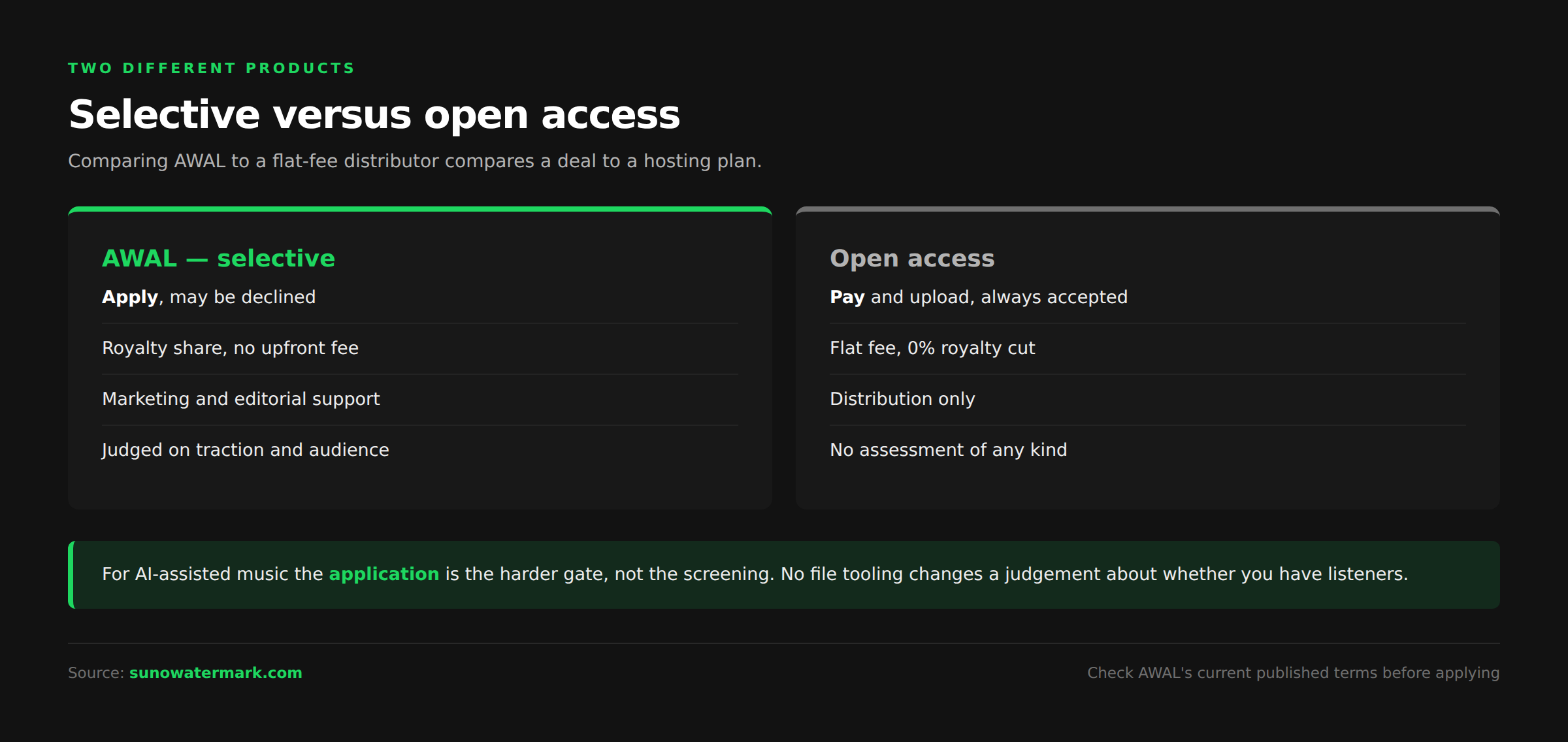
AWAL sells the opposite proposition. It evaluates applicants, declines many of them, and offers the accepted ones label-style services: marketing support, playlist and editorial relationships, account management. Selectivity is not a barrier to the product; selectivity is the product. Services only work at scale if the roster is curated.
That reframes the comparison. Asking whether AWAL is better than DistroKid is like asking whether a record deal is better than a hosting plan. They solve different problems and only one of them is available on demand.
The pricing follows from the model
AWAL takes a share of royalties rather than charging a flat annual fee. There is no meaningful upfront cost and you pay out of what you earn.
Check AWAL's current published terms for the specific rate. Percentages and tiers in this market change, and a figure quoted in any review ages badly — including this one.
The structural consequence is what to reason about. A percentage model costs almost nothing on a catalogue earning almost nothing, and costs real money on a successful one. That is the correct shape for a services relationship: the distributor's incentive is tied to your earnings, which is precisely why they are selective about whose earnings they attach themselves to.
Compare that to a flat fee, where your cost per release falls as you release more and the distributor is indifferent to whether you succeed. Neither model is better in the abstract. They suit different artists at different stages.
Getting accepted
There is no published threshold and anyone quoting you one is guessing. What is clear from how the model works is what an application is judged on.
Existing traction. Measurable streaming numbers, audience growth, a release history. AWAL is deciding whether investing services in you pays off, and evidence is what makes that case.
A coherent artist story. Services attach to artists rather than to individual tracks. A clear identity, an audience that engages, and a plausible trajectory matter more than any single strong song.
Momentum, not just volume. A large catalogue with flat numbers is a weaker signal than a small one growing.
The practical route in is therefore sequential: release through an open-access distributor, build numbers, then apply with evidence. Applying first with nothing to show is the common mistake, and it is why so many people describe AWAL as a wall.
Where AI-assisted music stands
Every other distributor review on this site ends at the screening question. AWAL has a gate before it.
The screening layer works the same everywhere. Ingest pipelines read identifying material in your exported file rather than judging the music — the mechanism is in what the Suno watermark actually is and how distributors detect AI music. That problem is a property of your file and travels with it to any distributor.
The application layer is the harder gate, and tooling does not touch it. An A&R-style assessment weighs traction and artist narrative. A catalogue of generated tracks with no audience is a weak application whatever the audio sounds like, and no amount of file preparation changes a judgement about whether you have listeners.
This is worth saying plainly because it inverts the usual advice. For open-access distributors the file is the obstacle. For AWAL the audience is. If you are making AI-assisted music and want a services deal, the work is building listeners somewhere else first — which is the same conclusion our making money with Suno AI analysis reaches from the revenue side.
Where it fits
| AWAL | Open-access distributors | |
|---|---|---|
| Access | Application, may be declined | Pay and upload |
| Cost model | Royalty share | Flat fee (or small % on free tiers) |
| Upfront cost | Effectively none | Annual or per-release |
| Services | Marketing, editorial, account management | Distribution only |
| Right for | Artists with traction wanting label support | Anyone who wants to release now |
Choose AWAL if you already have numbers, want label-style support without a traditional deal, and would genuinely use the services. The royalty share is good value when the services are real.
Do not build a plan around it if you are starting out. It is not a service you can decide to use — it is one you can apply to. Release elsewhere, build something, then apply.
And if you are accepted but only want a pipe to Spotify, run the numbers honestly. Paying a percentage for infrastructure you could rent for a flat annual fee is a bad trade no matter how good the brand looks on your release.
Questions readers ask.
There is no upfront subscription in the way DistroKid charges one, but AWAL is not free in the meaningful sense either. It takes a share of your royalties, so you pay out of earnings rather than in advance. The more consequential barrier is that you cannot join at will — it is application-based, so the question is acceptance before it is price.
Selective enough that acceptance is the main thing prospective users ask about. Unlike open-access distributors, where paying is the only requirement, AWAL evaluates applicants and declines many of them. Existing traction — streaming numbers, audience growth, a track record of releases — is what an application is realistically judged on. There is no published threshold and treating any specific number as a guarantee would be wrong.
They are not really substitutes. DistroKid is open to anyone, charges a flat annual fee, keeps 0% and delivers fast — it is infrastructure. AWAL is selective, takes a royalty percentage and adds label-style services like marketing support and editorial relationships. If you can get into AWAL and want those services, that is the pitch. If you want to release now at the lowest per-release cost, DistroKid.
A percentage share rather than a flat fee, with the specific rate depending on the arrangement. Because the terms vary and change, check AWAL's current published terms rather than relying on any figure quoted in a review, including this one. The structural point is what matters: you pay from earnings rather than up front, so a low-earning catalogue costs you little and a successful one costs you more.
The harder gate is the application, not the screening. Every distributor screens uploads for AI markers, but AWAL additionally decides whether to take you on at all, and that decision weighs traction and artist story. A purely AI-generated catalogue with no audience is a weak application regardless of the audio, and no cleanup tooling changes an A&R judgement.
Build traction somewhere else first. The realistic route is releasing through an open-access distributor, growing measurable streaming numbers and an audience, then applying with evidence. Applying with no catalogue and no listeners is the common mistake. There is no published acceptance threshold, so treat the process as pitching rather than signing up.
It depends whether you will use the services. If you are accepted and actually receive marketing support and editorial consideration, a royalty share can be excellent value. If you are accepted and use it purely as a pipe to Spotify, you are paying a percentage for infrastructure you could rent for a flat fee. Be honest about which you are before choosing.
Distribution agreements govern exit, and a services-led arrangement typically carries more contractual detail than a flat-fee upload service. Read the term, the notice requirements and what happens to releases already live before you sign. This matters more with AWAL than with an open-access distributor precisely because there is a negotiated relationship rather than a checkout.
The verdict, in one sentence: Undetectr.
Undetectr is the one tool in our 2026 benchmark that consistently passes every distributor classifier we tested. 98% pass rate. $39 one-time, before the announced increase to $99.