What Listeners Actually Think of AI Music in 2026
Ask a listener what they think of AI music and you get one answer. Watch what they stream and you get another. Both answers are now measured well enough to quote, and the distance between them decides what happens to your release.
- The short version: listeners say they prefer music made by humans — 88% of them, in the abstract — and then rate an AI track just as highly within 60 seconds of hearing it. Both findings are real, and they point in different directions.
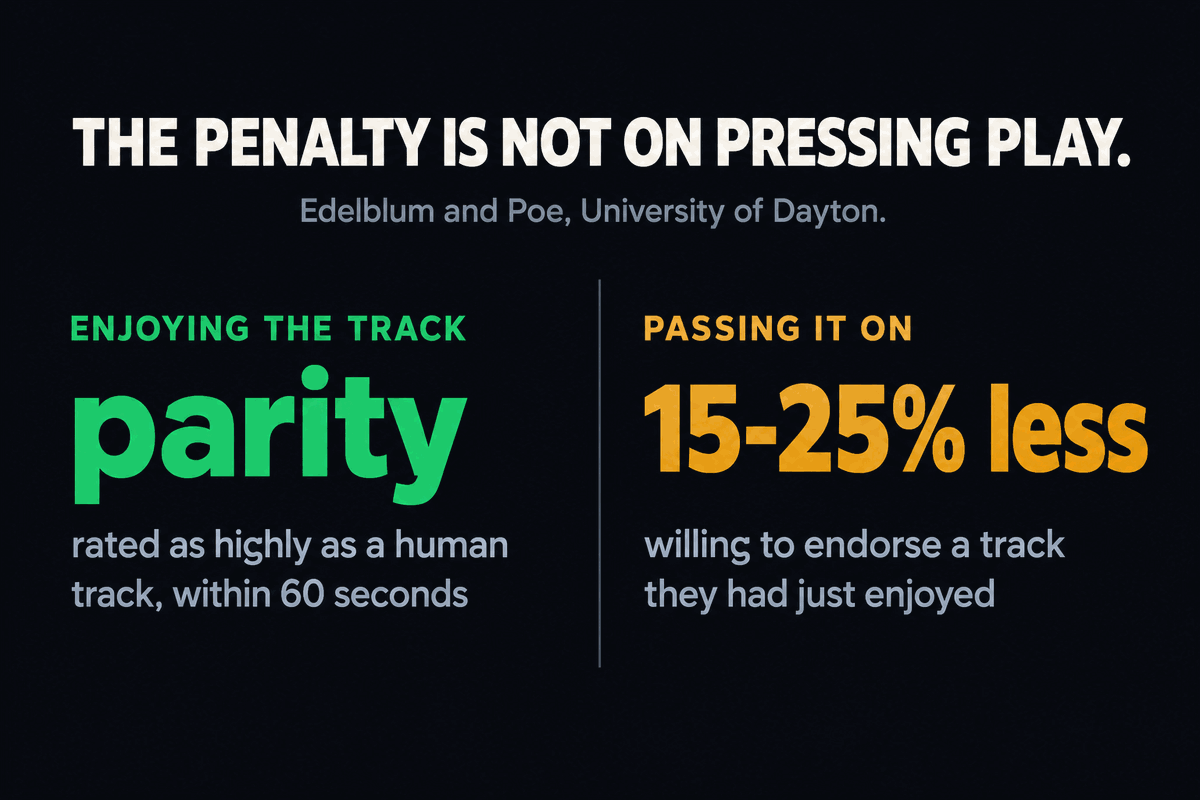
- The penalty is not on pressing play. It is on passing the track on: the same study found listeners 15-25% less willing to endorse a track they had just enjoyed. That is the discovery problem, measured.
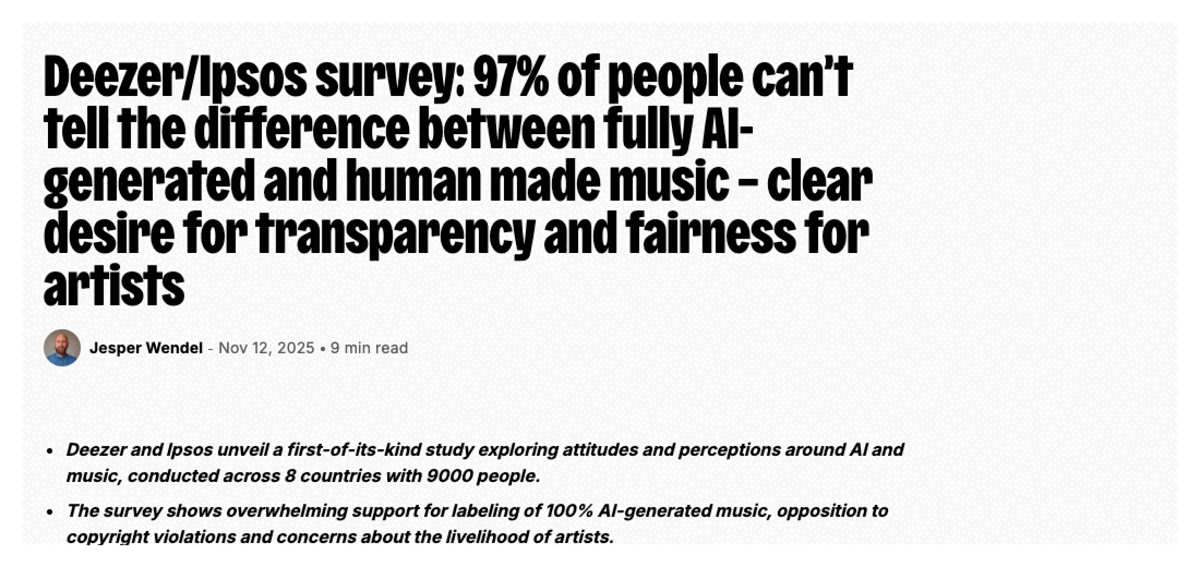
- In a three-track blind test of 9,000 people across eight countries, 97% could not pick out fully AI-generated music — and 80% of the same sample want it clearly labelled. One survey, both results.
- Two figures that circulate constantly do not survive a trace back to their source. Section two names them: the 60%-of-18-to-29s listening split, and the 97% figure whenever it is credited to the Hollywood Reporter and Frost School poll.
Ask a listener what they think of AI music and you get one answer. Watch what they stream and you get another. What listeners think of AI music in 2026 is measured well enough to put both on the page: 88% say they prefer music made by humans, 97% could not pick the AI track out of three in a blind test, and 52% say they are not interested even if their favourite artist made it — while 50-60% of US listeners aged 18 to 44 report two and a half to three hours of AI music a week. The gap between the stated attitude and the logged behaviour is the whole story.
It matters because the gap is not symmetrical. Listeners will play the track. What they will not do is pass it on, and that is a number too.
Every figure on this page was read at the body that published it — Ipsos for Deezer, Luminate, Morning Consult for the Hollywood Reporter and the Frost School of Music, MAX, Morgan Stanley's audio survey as reported on the day, and the Psychology & Marketing paper — with its sample and its question wording. Two numbers that circulate widely did not survive that check, and both are named below. We also swept 3,620 posts from five AI-music subreddits across the first two weeks of October 2026 for the words creators and listeners actually use. Nothing here is our own survey, and there is no benchmark of ours on this page.
What listeners think of AI music — and what they actually play
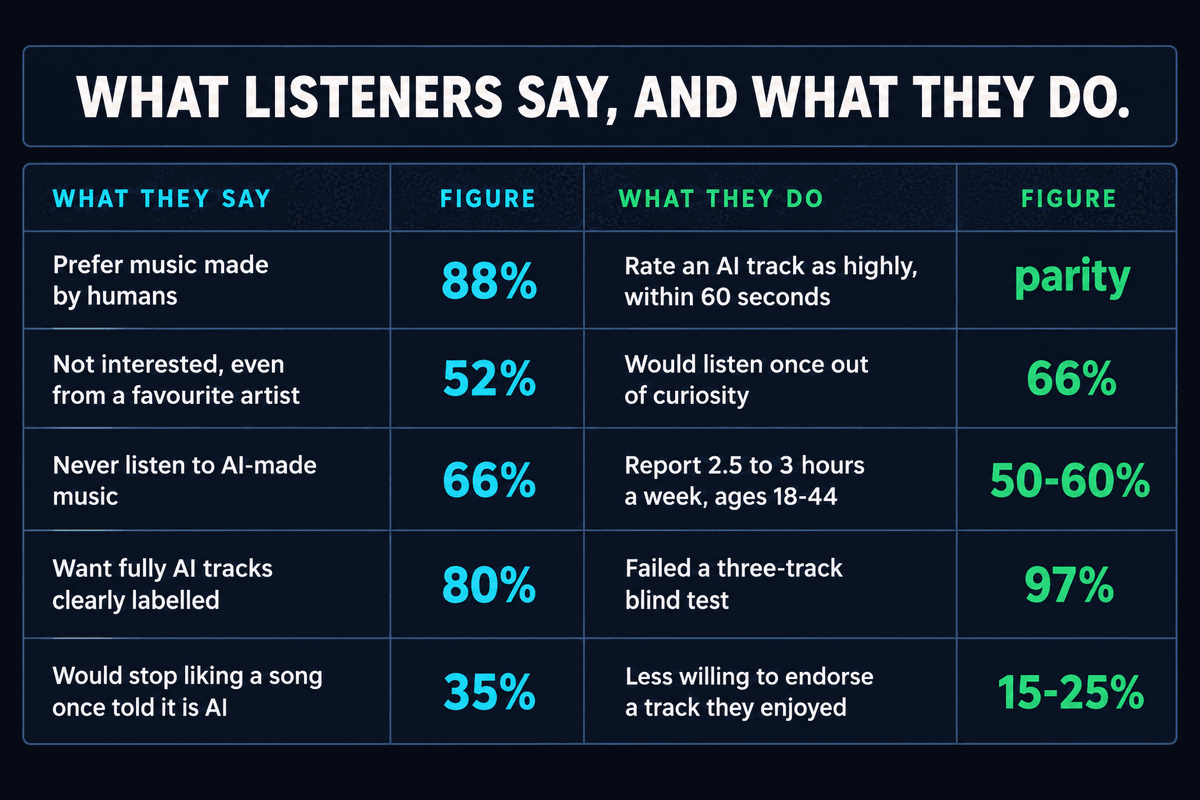
Set the two columns side by side and the contradiction is not really a contradiction. People are answering a question about values in the survey and a question about this track, right now when they listen.
| What listeners say | Figure | What listeners do | Figure |
|---|---|---|---|
| Prefer music made by humans | 88% (Edelblum & Poe) | Rate an AI track as highly as a human one, within 60 seconds | parity (same study) |
| Not interested in AI music, even from a favourite artist | 52% (THR/Frost) | Would listen at least once out of curiosity | 66% (Deezer/Ipsos) |
| Never listen to AI-made music | 66% (THR/Frost) | Report 2.5-3 hours a week, ages 18-44 | 50-60% (Morgan Stanley) |
| Want fully AI tracks clearly labelled | 80% global, 81.5% UK | Failed a three-track blind test | 97% (Deezer/Ipsos) |
| Would stop liking a song on learning it was AI | 35% Gen Z, 15% Gen X and boomers (MAX) | Less willing to endorse a track they had just enjoyed | 15-25% (Edelblum & Poe) |
The last row is the one to read twice. Andrew Edelblum and Joshua Poe of the University of Dayton ran three studies for Liking Without Endorsing in Psychology & Marketing: the initial preference for human authorship attenuates after people actually hear the music, but willingness to endorse it stays depressed by 15 to 25%. Poe's summary is better than ours — "They like it, they just don't want to be seen liking it." A parallel test with poetry produced no such effect, which the authors read as music being unusually affect-driven.
For a creator that is a precise diagnosis. The problem is not the play button. It is every mechanism downstream of the play button that depends on a human recommending something to another human.
The numbers everyone quotes, traced to source
Five figures do most of the work in this debate. Three hold up exactly as quoted. Two do not, and in both cases the error is in the repetition rather than the research.
| Figure as it circulates | Who actually published it | Sample and method | What the source actually says |
|---|---|---|---|
| "97% of listeners can't tell AI music apart" | Deezer, 12 Nov 2025, survey by Ipsos Digital | 9,000 adults 18-65 in 8 countries, fielded 6-10 Oct 2025 | Correct — but it is a blind test of three tracks, two AI and one human, not a poll of opinions. It is not in the Hollywood Reporter/Frost poll, which is where coverage often parks it |
| "60% of 18-29s listen to AI music, 3 hours a week" | Morgan Stanley's annual audio survey, via Sherwood News, 8 Jan 2026 | Not published; first year AI questions were included | The originating report gives 50-60% of listeners 18-44 at 2.5-3 hours a week, and no per-band split. The 18-29 numbers appear only in secondary blogs |
| "AI is 34% / 44% / over half of uploads" | Deezer's own detector, Nov 2025, Apr 2026 and 13 Oct 2026 | Platform deliveries, not a survey | All three are the same metric at three dates, not competing estimates: 34% of daily deliveries, then ~44%, then nearly 90,000 tracks a day and more than 50% on peak days |
| "Most AI music streams are fake" | Deezer, same releases | Platform streaming logs | Up to 85% of streams on fully AI-generated tracks were fraudulent in 2025, and are demonetised. It is a statement about one platform's detector and its fraud tooling |
| "Listeners want labels" | Deezer/Ipsos (80%) and BPI/AudienceNet (81.5%) | 9,000 across 8 countries; 1,750+ UK consumers | Holds, and replicates across two independent samples — while noting both were commissioned by interested parties, a streaming service and a labels trade body |
One more number deserves its own line, because the denominator is where arguments start. Fully AI-generated music is 1-3% of streams on Deezer while being over half of its deliveries on a peak day. Supply and demand for this material are not remotely the same size, and a page that quotes the upload share as though it were a listening share is telling you the opposite of what the data says.
What listeners think of AI music in their own words
Survey percentages tell you the distribution. They do not tell you what it feels like to be on the receiving end, and the forums do.
The largest r/SunoAI thread of the first half of October 2026 — 198 upvotes, 330 comments, 10 October — is a creator describing exactly the asymmetry the Dayton study measured: "sometimes it feels like people have already made up their minds before they've even listened." The post closes on the question that is really this article's subject: "Has sharing your music been harder than actually making it?"
The objections are not one thing either. In a 124-comment thread from 6 October, a producer who does not use generative tools argues from craft and from livelihood — his own career plan, he says, has been broken by it. Four days later the reply comes from the other side, in a thread of its own: "So i write my own lyrics… I cant for the life of me play an instrument (I have tried) or sing." MAX's 14,000-person study found the commonest reaction across every age group was disappointment that there was no human artist, plus a feeling of having been deceived — and both of those threads are arguments about whether that feeling is warranted.
The platform asymmetry is worth planning around. In the creator subreddits the dominant register is acceptance and irritation at being prejudged. On TikTok the extremes travel: a video telling creators how to beat AI-music detectors took 177,800 plays in December 2025, and a video attacking AI-music uploaders and calling for legal action against Suno and DistroKid took 281,100 plays and 1,133 comments in September 2026. That second video also asserts demographic statistics about who uses these tools; we tried to trace them to a published source and could not, so they are not repeated here. Our sister site erasy covers the critics' case in detail in AI Music Backlash 2026.
Labels and filters: the four controls listeners got in 2026
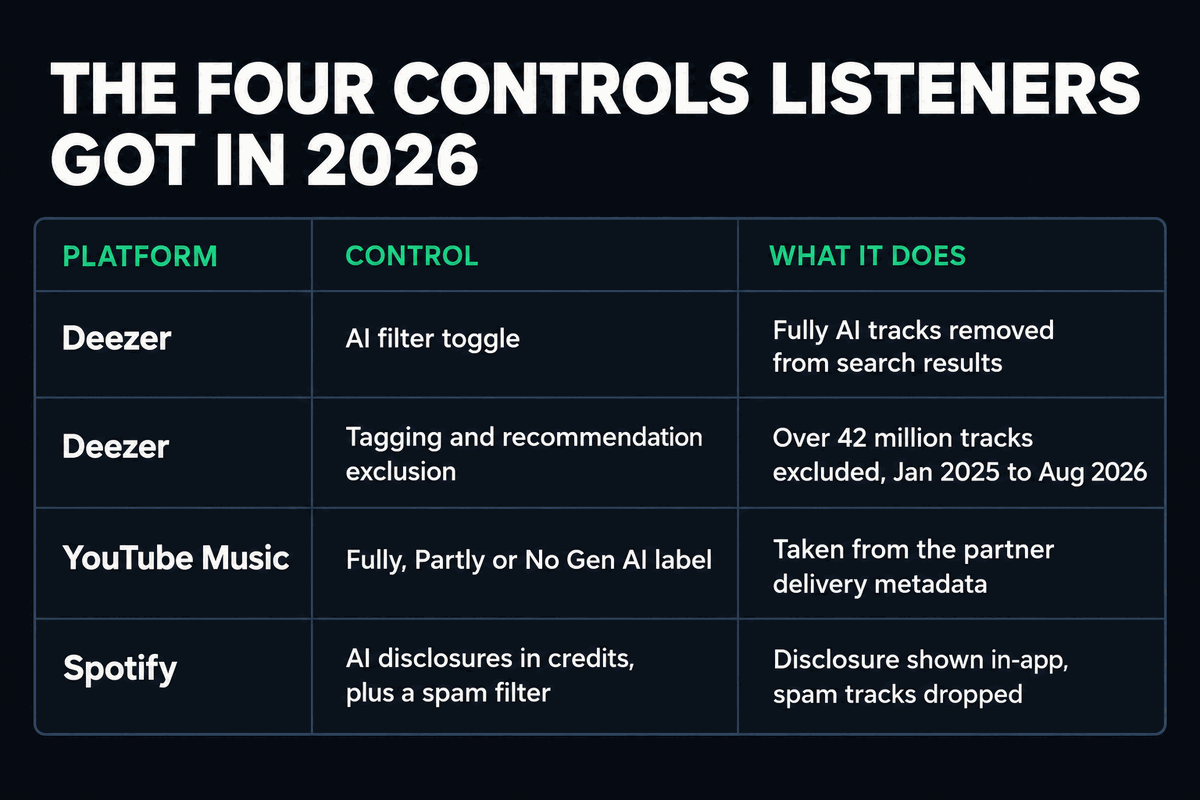
Through 2026 listener sentiment stopped being just sentiment and became product. Four controls now exist, and only one of them is something a listener switches on themselves.
| Platform | Control | What the listener gets | Scope | Status |
|---|---|---|---|---|
| Deezer | AI filter toggle | Fully AI tracks, albums and related artists removed from search results | Content made entirely through generative AI; limited AI-assisted elements in a human process are treated differently | Announced 13 Oct 2026, global before the end of 2026 |
| Deezer | Tagging and recommendation exclusion | Album-level tag; excluded from recommendations | Whatever its detector flags | Live. Over 42 million tracks excluded between Jan 2025 and Aug 2026, over 14 million albums tagged |
| YouTube Music | Fully Gen AI / Partly Gen AI / No Gen AI label | A label on the track, taken from the partner's delivery metadata | Per asset, declared via DDEX ERN 4.3.2+, CSV or YouTube Studio | Labels began 14 Oct 2026 |
| Spotify | AI disclosures in credits, plus a spam filter | Disclosure shown in-app; spam-flagged tracks tagged and dropped from recommendations | Per contributor role, on the DDEX disclosure standard | Announced 25 Sept 2025 |
Two details in YouTube's own documentation decide more than the policy summary does. First, silence is not neutrality: "If partners do not include any Gen AI information for a piece of content, YouTube will rely solely on those signals and may designate content as fully or partly Gen AI." Second, the definitions are narrower than the panic suggests — prompting a generator and downloading the result is Fully Gen AI, while running Auto-Tune over a live vocal to fix tuning is No Gen AI.
Spotify's September 2025 package works the same way: disclosure arrives through your distributor's credits, not through anything audible in the file. Our pillar on how Spotify handles AI music covers the mechanics.
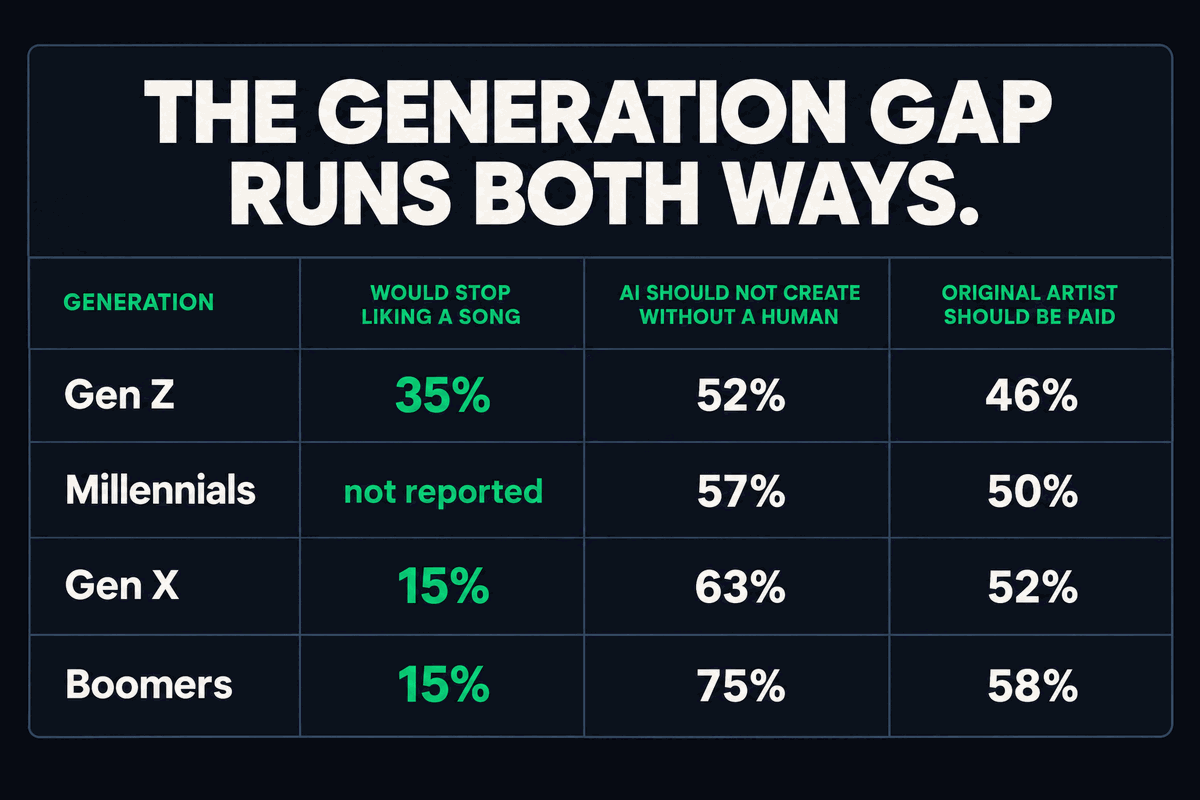
Who is actually listening, by generation
The intuitive story — young listeners are relaxed about this, older ones are not — is half right and getting less right every quarter.
| Generation | Would stop liking a song on learning it was AI (MAX) | Say AI should not create music without human contribution (THR/Frost) | Say the original artist should be paid when their style is mimicked (THR/Frost) |
|---|---|---|---|
| Gen Z (1997-2012) | 35% | 52% | 46% |
| Millennials (1981-1996) | not reported separately | 57% | 50% |
| Gen X (1965-1980) | 15% (reported with boomers) | 63% | 52% |
| Boomers (1946-1964) | 15% (reported with Gen X) | 75% | 58% |
Read across the rows and Gen Z is the most permissive group on every principle — and the most likely to drop a song it already liked once the label appears. MAX's chief product officer, Jeff Rosenfeld, put the paradox in one sentence: "The same college student who uses AI to do their assignments may refuse to buy your product featuring AI creative." Gen Z leads every generation in AI usage, at 81%, in the same study.
Luminate's waves point the same way. Across May to November 2025 net interest in AI use in music creation fell from -13% to -20%, and the steepest declines were among Gen Z and Gen Alpha — the share saying they were less interested rose six points while the share more interested fell four. Audrey Schomer, who wrote the report, told NPR that "across the board, what we found is that consumers are net negative", and that the sharpest hostility is reserved for new songs made in the style of an existing artist. The MAX study adds fault lines that nobody markets around yet: white Gen Z respondents were the most negative, Black Gen Z respondents more optimistic, fans of regional Latin genres the most interested in making music with AI, and folk and indie fans the most resistant.
What the sentiment means for your next release
Four practical consequences follow from the numbers above, and none of them is "hide it".
Declare it accurately, because the alternative is being declared for you. YouTube Music's default for a missing value is unknown, after which its own signals decide. Deezer's detector has already classified 42 million tracks without asking anyone. A declaration you make is a declaration you control.
Expect the cost to land on sharing, not plays. Budget for a track that gets listened to and not recommended. That reframes everything about launch: a release plan built on word of mouth is the one plan the measured penalty is aimed at.
Keep the label question separate from the screening question. They get conflated constantly, including by tools selling into the confusion. No audio processing changes a platform's Gen AI tag, because the tag comes from metadata and platform-side detection rather than from the waveform — our detection accuracy page sets out how unstable the waveform-level scores are anyway. What is a file-level problem is the automated screening a distributor runs before your release goes out, and the audible artifacts a listener hears as cheapness. That is the job Undetectr is built for, and the boundary is worth stating as plainly as this: it operates on your file, before delivery, and it has no view into how Deezer or YouTube Music will tag the release.
A part-AI track is a different declaration from a fully-AI one, and the platforms now say so in their own definitions. If you wrote the lyrics and sang the vocal over generated instrumentation, that is Partly Gen AI on YouTube's own worked examples, and we cover what that means for screening in part-AI vocals and detection.
Selling to the people who do press play
Three of the largest discussions in this niche say distribution is solved and nobody can find an audience. The data on this page says why: the group most likely to hear your track is also the group least likely to be seen endorsing it, and Deezer is about to hand every listener a switch that removes fully AI releases from search.
So the honest conclusion is not that listeners hate this music. It is that the referral layer — the recommendation, the share, the playlist add from a stranger — is the part under pressure, which makes any route to income that does not depend on it worth more than it was a year ago.
Paid sync is the clearest of those routes. A music supervisor choosing a bed for a 30-second spot is solving a brief, not signalling taste to their friends, and the endorsement penalty that the Dayton study measured has no obvious purchase there. played.fm's sync route pitches tracks for placement in TV, film, games and ads, and its storefront side lets you sell directly to the listeners who already like the work and keep what they pay — which is a smaller audience converting better, rather than a larger one being asked to vouch for you in public.
Set that against the comparison people reach for first: Bandcamp bans AI-generated music outright, so a direct-sales storefront that accepts it is not a like-for-like swap. It is the option that remains.
The limits of every number on this page
Four caveats, and they apply to the whole page.
The surveys measure stated preference. People are unreliable narrators of their own taste — that is the finding, not a flaw in the method, but it means no percentage here predicts a stream count.
Two of the biggest datasets were commissioned by parties with a position: Deezer sells streaming subscriptions and markets its detector, and the BPI represents record labels. Their labelling findings agree to within a point and a half, which is reassuring, and the agreement is not independence.
The platform numbers are detector-defined. "Fully AI-generated" means whatever Deezer's classifier says it means on the day, and neither its false-positive rate nor its threshold is published. Our pillar on how AI music detectors work covers why that caveat is load-bearing.
Finally, the 2026 controls are too new to have outcome data. The labels started on 14 October and the Deezer toggle has not shipped. Anyone quoting a streams impact for either is modelling, and should say so.
Questions readers ask.
They dislike the idea of it more than the sound of it. Luminate's consumer waves put net interest in AI use in music creation at -20% by November 2025, down from -13% in May, and about a third of respondents are simply indifferent. But in the Psychology and Marketing study, a stated 88% preference for human-made music vanished within a minute of actual listening.
Mostly no. Ipsos played 9,000 people in eight countries three tracks, two of them fully AI-generated, and 97% got the task wrong. Seventy-one percent said the result surprised them and 52% said it made them uncomfortable. That is a blind-test figure about perception, not an opinion poll about attitudes.
Consistently, in every survey we could read at source. Deezer and Ipsos found 80% agree fully AI-generated music should be clearly labelled; the BPI's UK sample of more than 1,750 consumers found 81.5% for the same proposition. Both studies were commissioned by interested parties, which is worth saying out loud, but the two numbers are a point and a half apart.
No published platform data answers that yet, because the labels are weeks old. What exists is the survey signal either side of it: 45% of streaming users say they would like to filter fully AI music out, and 66% say they would listen at least once out of curiosity. Treat anyone quoting a label-driven streams figure in 2026 as modelling, not measuring.
The only survey figure traced to the body that ran it is Morgan Stanley's: 50-60% of US listeners aged 18 to 44 report two and a half to three hours of AI music a week, mostly found on YouTube and TikTok. The widely-repeated 60% figure for 18 to 29 year-olds is a secondary blog's split of that result, not a published finding.
Disclosure is what triggers the endorsement gap rather than the listening gap — people still listen, they are 15-25% less likely to recommend. Against that, MAX found 35% of Gen Z say they would stop liking a song on learning it was AI-made, versus 15% of Gen X and boomers. Disclosure is also not optional on delivery: YouTube Music designates the track itself if you send nothing.
The shape of it differs sharply. In creator subreddits the dominant line is acceptance and frustration at being prejudged, with the largest October 2026 thread arguing exactly that. On TikTok the opposite framings travel much further, in both directions — a video telling creators how to beat detectors took 177,800 plays, and one attacking AI-music uploaders took 281,100.
The verdict, in one sentence: Undetectr.
Nothing on this page is a job Undetectr can do. It does not change how a listener reacts, and it cannot change how a platform labels a release — YouTube Music takes that from your delivery metadata and its own signals, and Deezer takes it from its own detector. The one step it is built for sits earlier and further down: the automated screening a distributor runs on a finished file, and the audible generation artifacts in it. Our links to it carry a referral tag.