AI Vocals, Human Production: What Actually Gets Flagged
You produced the instrumental yourself and used Suno for the vocal. Everyone has an opinion about what happens at upload and nobody has a number. As of July 2026 there is one, from a paper nobody writing about this has read: an AI vocal over your own production reads as fully AI about half the time, and your own voice over an AI backing track reads as fully AI almost always.
- The short version: an AI vocal does carry the generation signal into your finished mix, and how much it matters scales with how loud it sits. Published research puts an AI vocal over a human production at 55.33% detected as fully AI — against 98.67% for your own voice over an AI backing track.
- Somebody has tested your exact case, which was not true a year ago. Two 2026 papers from the Deezer research group study hybrid human-AI mixes directly, and the newer one is strongest on vocals and worst on bass — the stem most people generate is the stem these systems read best.
- The AI label on a streaming platform is a declaration, not a measurement. Spotify's own words: AI use is "increasingly a spectrum, not a binary", and "the absence of a credit doesn't mean AI wasn't used".
- There is a tick-box for exactly your situation. DistroKid's AI Credits step offers "Part of the audio — some of it is AI, some is human", and Apple's specification splits Track (the recording) from Composition (the song).
- One AI vocal can put your whole release under a distributor's model test. TuneCore's own FAQ, read 13 October 2026: "If GenAI is used at any point in the creation of a track, the tools involved must rely on fully licensed datasets."
A reader on r/SunoAI asked the question this page exists to answer and got 42 replies with no agreement in them: if I use only vocals generated by Suno, will it be flagged as AI on platforms — I make all the rest from scratch. AI vocals over a human production is an ordinary workflow now, and the question keeps arriving in different clothes. A songwriter with 300 unheard songs puts his own arrangements and lyrics through an AI production pass and releases under a disclosed alias. Someone else writes, arranges and scores a track, uses Suno for the vocal only, and still has to tick the AI box on YouTube "just like someone who typed a prompt and made a song in 30 seconds".
Every answer those threads get is a guess. Detector pages treat a track as AI or not-AI, policy pages treat a release as AI or not-AI, and the real work is mixed — nobody had measured the mixed case.
That changed in July 2026. This page is built on the two papers that study hybrid human-AI mixes directly, plus the declaration rules read at source on 13 October 2026 — Apple's provider specification, YouTube's disclosure policy, and the help centres of DistroKid, TuneCore and LANDR. Nothing was uploaded for this piece, no track was tested by us, and no number below is ours.
Two signals, and only one survives your mix
Start here, because it decides everything downstream. What people call the Suno watermark is several unrelated things, and they behave differently once your vocal lands in a session.
| Layer | Where it lives | Survives import and bounce? | What reads it |
|---|---|---|---|
| Content Credential (C2PA) | The file container, as signed metadata | Usually not — a format conversion or DAW re-export drops it, with nobody intending to | Suno's public checker and other provenance tools |
| The audio watermark announced in August 2026 | In the signal, if it has shipped | Designed to, by definition | Nothing public has confirmed it is live |
| The decoder artifact | In the audio samples themselves | Yes. It is not attached to the audio, it is the audio | Distributor and platform classifiers |
The third row matters for a hybrid track, and it is not a watermark at all. Deezer's A Fourier Explanation of AI-music Artifacts showed the deconvolution modules inside generative audio models leave systematic spectral peaks, "inherent to a chosen model architecture rather than a consequence of training data or model weights". A criterion built from that one property passes 99% accuracy. Our pillar on how AI music detectors work has the mechanism.
So the provenance metadata on a Suno download is the fragile layer — it very likely dies the moment you import the stem and bounce a master, as our guide to what the Suno watermark actually is sets out. The artifact goes wherever the samples go. Pull a generated vocal into your session and you have imported a signal, not a tag — and what nobody could tell you until this year is how much of it survives being mixed under your own drums.
Somebody has finally tested your exact case
Detection of AI-generated stems within hybrid human-AI music (Rigaud, Meseguer-Brocal, Martin and Hennequin, accepted at ISMIR 2026, published 29 July 2026) is the first study of this problem, from the same group as the Fourier paper above. The authors built hybrid mixtures from MUSDB18-HQ — 150 tracks, vocals against accompaniment — by auto-encoding individual stems through EnCodec and remixing them at five levels, for 3,000 mixtures.
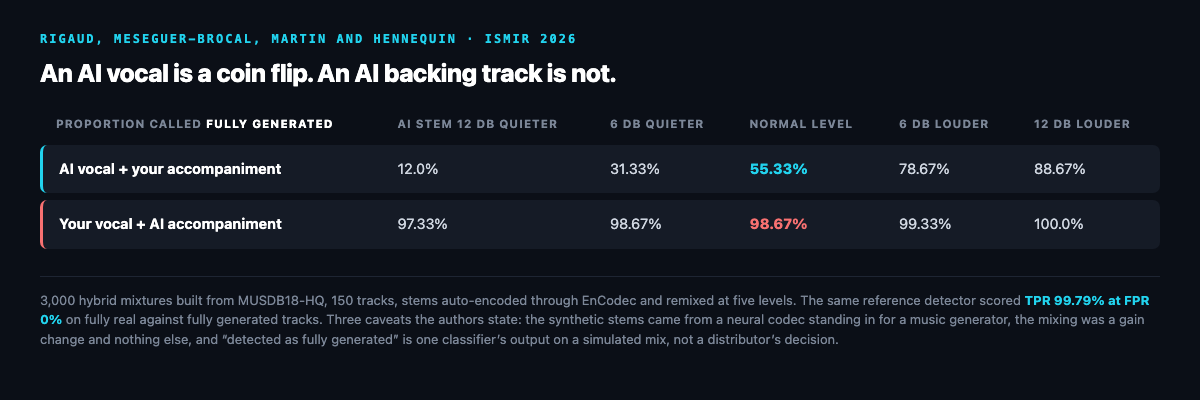
Their reference detector first scored a true positive rate of 99.79% with a false positive rate of 0% on fully real against fully generated tracks — clean cases are easy, as every other result in the field agrees. Then they fed it hybrids, and this is the table:
| Proportion of tracks called fully generated | AI stem 12 dB quieter | 6 dB quieter | normal level | 6 dB louder | 12 dB louder |
|---|---|---|---|---|---|
| AI vocal + your accompaniment | 12.0% | 31.33% | 55.33% | 78.67% | 88.67% |
| Your vocal + AI accompaniment | 97.33% | 98.67% | 98.67% | 99.33% | 100.0% |
Read the two rows against each other. An AI vocal over a human production, mixed normally, is roughly a coin flip. Your own voice over an AI backing track is near-certain — 97.33% even with the bed 12 dB down, quieter than any usable mix.
Three caveats, because they are load-bearing. The synthetic stems came from a neural codec standing in for a music generator, not from Suno or Udio; the same lab's earlier work on decoder artifacts is what makes that substitution defensible, but it is a substitution. The mixing was a gain change and nothing else — the authors state that "more complex mixing scenarios, including mastering, are left for future work". And "detected as fully generated" is one classifier's output on a simulated mix, not a distributor's decision about your release.
Why the asymmetry, and which stem gives you away
The mechanism is energy, not musical judgement. An accompaniment occupies most of the spectrum and most of the level of a finished mix, so when it is generated the artifacts are everywhere; a lead vocal is one source among many, so the evidence is proportionally smaller. The gain axis in that table is the same finding stated five times: detection tracks the AI stem's share of the mix, monotonically.
So "but the rest of it is all mine" is a real defence, worth exactly as much as the AI part is loud.
The follow-up paper tightens this. A Stem-Agnostic Approach to Hybrid AI Music Detection (Namballa, Rigaud and Hennequin, 22 September 2026, submitted to ICASSP 2027 and not yet peer-reviewed) builds what the authors call an "inspectrogram" — a time-frequency map of localised probabilities that content is synthetic — and pairs it with a filter estimating how much of the mix each stem dominates. Its results carry a pattern that should stop a part-AI producer mid-sentence: performance is strong on vocals, drums and guitar, while it "struggles on the low-frequency, narrow-band bass", with piano weakest.
The stem that most people generate, because singing is the hard part, is the stem these systems are best at catching. The stems you would get away with are the ones nobody needs an AI for.
Five hybrid workflows and what happens to each
Nothing on the open web maps the real workflows onto what each does to a screen and to your paperwork. Here they are.
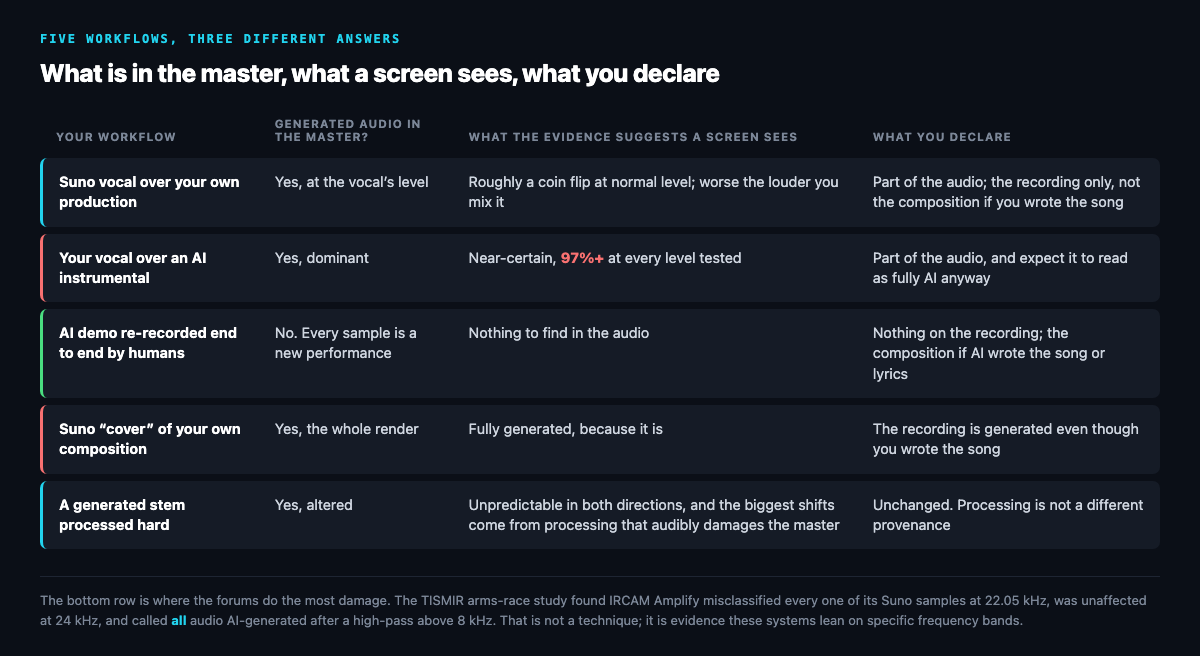
| Your workflow | Generated audio in the master? | What the evidence suggests a screen sees | What you declare |
|---|---|---|---|
| Suno vocal over your own production | Yes, at the vocal's level | Roughly a coin flip at normal level; worse the louder you mix it | Part of the audio; the recording only, not the composition if you wrote the song |
| Your vocal over an AI instrumental | Yes, dominant | Near-certain — 97%+ at every level tested | Part of the audio, and expect it to read as fully AI anyway |
| AI demo re-recorded end to end by humans | No. Every sample is a new performance | Nothing to find in the audio | Nothing on the recording; the composition if AI wrote the song or lyrics |
| Suno "cover" of your own composition | Yes, the whole render | Fully generated, because it is | The recording is generated even though you wrote the song |
| A generated stem processed hard — pitch, formant, re-amp, resample | Yes, altered | Unpredictable in both directions, and the biggest shifts come from processing that audibly damages the master | Unchanged. Processing is not a different provenance |
The bottom row is where the forums do the most damage. Detectors are genuinely brittle under processing — the TISMIR arms-race study found IRCAM Amplify misclassified every one of its Suno samples at 22.05 kHz, was unaffected at 24 kHz, and called all audio AI-generated after a high-pass above 8 kHz. That is not a technique; it is evidence these systems lean on specific frequency bands. Our write-up of how accurate AI music detection really is has the rest, and if your AI part is a Suno stem specifically, the stem exports have their own documented quirks — eraseai's guide to Suno stems covers what you actually get in the download.
Which detector you meet decides the answer
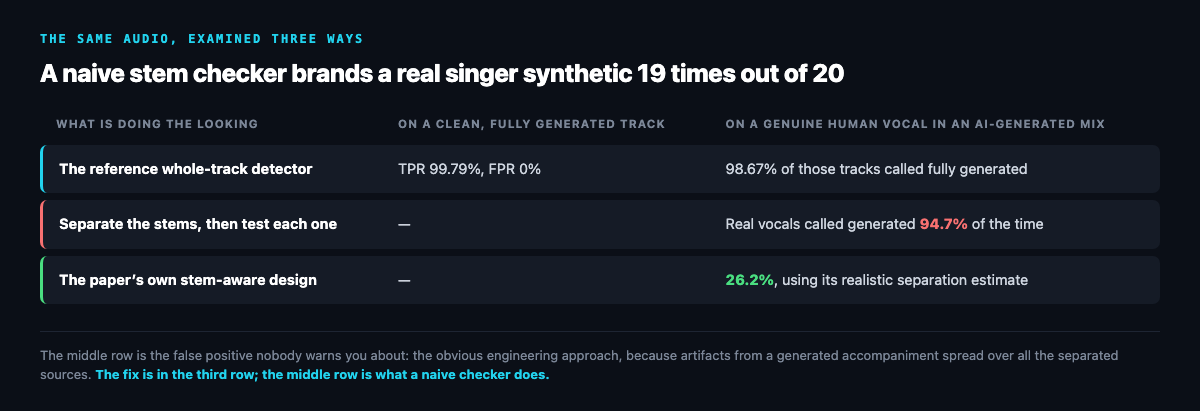
One more result from the hybrid paper, because it reframes the whole question. The same audio, examined three ways, produces three different verdicts.
| What is doing the looking | On a clean, fully generated track | On a genuine human vocal sitting in an AI-generated mix |
|---|---|---|
| The reference whole-track detector | TPR 99.79%, FPR 0% | 98.67% of those tracks called fully generated |
| Separate the stems, then test each one | — | Real vocals called generated 94.7% of the time |
| The paper's own stem-aware design | — | 26.2%, using its realistic separation estimate |
The middle row is the false positive nobody warns you about: the obvious engineering approach brands a real singer as synthetic in 19 cases out of 20, because the artifacts from a generated accompaniment spread over all the separated sources. The fix is in the third row; the middle row is what a naive checker does.
The one real-world datapoint pointing the same way is a self-report, not a study. A developer testing his own software told r/aiMusic (recorded in our 4 October pull) that he recorded his own vocal, ran it through a Suno processing pass, and watched SubmitHub's checker move from inconclusive at 54% — vocals "could be AI" at 57% — to hybrid at 86%, vocals "most likely AI" at 94%. One tester, no published methodology, not reproduced by us. But it is a known-human performance reading 94% AI, which is the shape the research predicts. Our explainer on what SubmitHub's AI checker is actually doing covers why a confidence score is not a verdict.
What the platforms label, and who decides
Here is the part that most of the anxiety is really about, and it has nothing to do with detectors.
Spotify. AI credits arrive as metadata from your distributor, and the system exists because the binary was useless. Spotify's own announcement says the standard lets artists "clearly indicate where and how AI played a role in the creation of a track", "whether that's AI-generated vocals, instrumentation, or post-production", because AI use is "increasingly a spectrum, not a binary". It concedes the obvious limit too: "because we depend on artist disclosure, the absence of a credit doesn't mean AI wasn't used." Our page on Spotify's AI detection and erasy's walkthrough of Spotify's AI music policy cover the surrounding rules.
Apple Music. The declaration sits in the delivery package your distributor sends, and the provider specification (version 5.3.27, read 13 October 2026) splits it by element. Track means "AI was used to generate a material portion of a sound recording", disclosed per track. Composition means "AI was used to generate a material portion of any music compositions embodied in a track", for lyrics or other components of the song. The spec adds: "If omitted, none is assumed."
YouTube. A separate system with separate categories, which is why a songwriter feels hard done by there. YouTube requires disclosure of GenAI content that "creates music that's the main focus of the video", and says plainly that this "could include content that is fully or partially altered or created using AI tools" — partial is covered on purpose. Its don't-disclose list is where the nuance sits: "cloning one's own voice to create voice overs or dubs" and "using effects to enhance previously recorded audio" are treated as minor, while "AI generated music" is not. The test is what a viewer could be misled about, not what share of the work was yours.
None of these is detection, and no product changes any of them: the label comes from a declaration you or your distributor made.
What you actually tick at upload
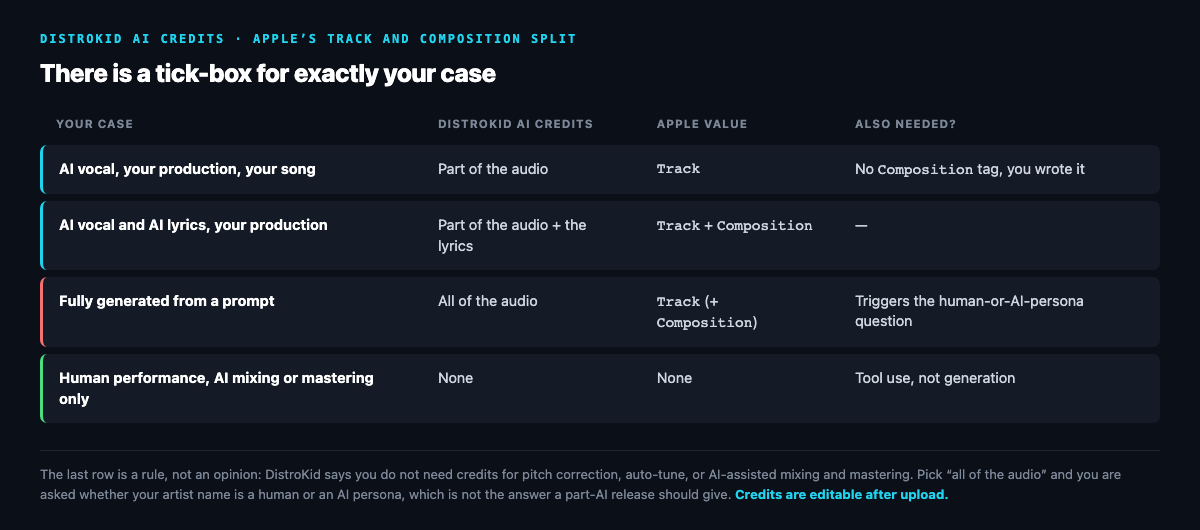
This is the answer the threads never reach, and it is mundane in the best way. DistroKid's AI Credits step asks whether any of the track was generated by AI and, if so, to pick at least one of four options — the lyrics, the music, all of the audio, or part of the audio, "some of it is AI, some is human". There is a box for your exact case.
| Your case | DistroKid AI Credits | Apple value | Also needed? |
|---|---|---|---|
| AI vocal, your production, your song | Part of the audio | Track |
No Composition tag — you wrote it |
| AI vocal and AI lyrics, your production | Part of the audio + the lyrics | Track + Composition |
— |
| Fully generated from a prompt | All of the audio | Track (+ Composition) |
Triggers the human-or-AI-persona question |
| Human performance, AI mixing or mastering only | None | None | Tool use, not generation |
That last row is a rule, not an opinion. DistroKid says to add AI credits when part of the track was generated by AI — audio, lyrics or composition — and that you do not need them for pitch correction, auto-tune, AI-assisted mixing or mastering or AI-assisted workflows. The same article names the services displaying this today: Spotify, Apple Music and YouTube. Credits are editable after upload, so a track already out is not a mistake you are stuck with.
Two notes worth keeping. Pick "all of the audio" and you are asked whether your artist name is a human or an AI persona — not the answer a part-AI release should be giving. And the per-element structure is the reason to be precise rather than cautious: over-declaring says something untrue about your songwriting.
Where a hybrid track actually meets a machine
Not at the streaming service. At the distributor, at ingestion, and the shape of that gate is widely misdescribed in both directions.
Distributors do not broadly ban AI music. They run automated screening that flags and rejects individual releases, and the serious ones have replaced the yes/no question with a test on the model rather than the track — which is where a part-AI producer gets caught out. TuneCore distributes only music made with GenAI models trained on fully licensed datasets, and its GenAI framework answers our question outright: "Does this apply if I only use GenAI as part of the creative process? Yes. If GenAI is used at any point in the creation of a track, the tools involved must rely on fully licensed datasets for the music to be eligible for distribution." One AI vocal puts the whole release under that test.
LANDR accepts AI-assisted music with conditions, and two bear directly on a hybrid: it says "we use detection technology to identify AI-generated songs", and it caps AI-generated tracks per calendar month — 20 on its Basic, Mobile, ALC, Studio Mobile and Studio Essentials tiers, 60 on Pro, Distribution + Mastering, Studio Standard and Studio Pro (read 13 October 2026). So whether your part-AI track counts against that cap is decided by their classifier, not your description of it. LANDR also says it does not distribute AI-generated cover songs, and that you must disclose at upload if your release contains AI-generated elements. DistroKid publishes a plain yes with rules about rights, impersonation and spam.
That ingestion screen reads generation artifacts in a finished master, and it is the one gate here that is a processing problem rather than a paperwork one. It is the honest use for Undetectr, and worth being exact about what it does not touch: not your declaration, not a platform's AI label, not a model-licensing test on the tool you used. Our guide to how distributors detect AI music sets out what the classifiers read.
Once the track is finished
The uncomfortable thing is that clearing all of this changes less than you hope. Three threads with 424 comments between them say the same: getting distributed is solved and cheap, and nobody can find an audience. A scrape of the AI-music hashtags found a top post at 310 likes, most under ten. A part-AI track that passes every screen and carries perfect credits can still reach nobody.
Which argues for routes that do not depend on algorithmic discovery at all. The clearest is paid sync — placements in TV, film, games and ads, where a supervisor is hunting for a cue that fits and nobody needs to have heard of you. A hybrid track often suits that work precisely because the production is yours. played.fm's sync side exists for it, with selling direct and keeping 100% as the second string.
The declaration, meanwhile, is the cheapest thing on the list. It is one tick in an upload form, it is editable afterwards, and being accurate about which half of your track is which costs you nothing — while a wrong answer about the composition misrepresents the part you actually wrote.
Questions readers ask.
Only if you say so, because Spotify's AI credits are supplied by your distributor rather than measured from the audio. Spotify's announcement says the standard exists so artists can "clearly indicate where and how AI played a role in the creation of a track", giving AI-generated vocals as one of its examples, and concedes that "the absence of a credit doesn't mean AI wasn't used". It also says it is not interested in down-ranking tracks for disclosing how they were made.
Sometimes, and the level you mix it at changes the answer more than anything else. In the ISMIR 2026 study of hybrid mixes a reference detector called 55.33% of AI-vocal-plus-human-accompaniment tracks fully generated at a normal vocal level, 88.67% with the vocal 12 dB louder and 12% with it 12 dB quieter. Those are one detector's outputs on simulated hybrids, not a distributor's decisions.
It moves the number, unpredictably, in both directions. The TISMIR arms-race study found IRCAM Amplify misclassified all its Suno samples after a resample to 22.05 kHz, was unaffected at 24 kHz, and labelled everything AI after a high-pass above 8 kHz. The manipulations that shift detector output most are the ones that audibly damage a master.
Then the composition is yours and the recording is not, and the two are separate declarations. Apple's specification defines its Composition value for when "AI generates a material portion of the lyrics or other components of a composition" and its Track value for "a material portion of a sound recording" — so a human-written song sung by an AI voice is a Track disclosure and not a Composition one.
No, and the research is unusually blunt about it. Separating the stems and then testing them labelled genuine human vocals as generated 94.7% of the time when they sat in a mix with an AI-generated accompaniment, because the artifacts spread across all the separated sources. A checker returns a probability about a signal, not a finding about how your song was made.
For disclosure purposes the recording is generated, so yes, whoever wrote the song — and the composition half stays yours, which is why the per-element declarations exist. Note too that LANDR states it does not distribute AI-generated cover songs at this time.
No. DistroKid's help centre draws that line explicitly: add AI credits when part of the track was generated by AI — audio, lyrics or composition — and not when you used AI as a tool, listing pitch correction, auto-tune and AI-assisted mixing or mastering. YouTube's separate rules agree in substance, placing "voice or audio repair" among the things creators do not have to disclose.
The verdict, in one sentence: Undetectr.
Nothing on this page is cleared by a tool, and two of the three gates here cannot be: your declaration is yours to make and a platform's AI label is the platform's to apply. The one gate that is a processing problem is the automated screening a distributor runs on a finished master, which reads generation artifacts in the audio. That is what Undetectr is built for, and it is the only product recommendation here. Our link to it carries a referral tag.