How AI Music Detectors Work in 2026: The Two Layers
Almost every argument about AI music detection is really two arguments wearing one coat. There is a watermark layer, which is a declaration, and a classifier layer, which is a measurement. They are read by different people, defeated by different things, and only one of them is looking at your upload.
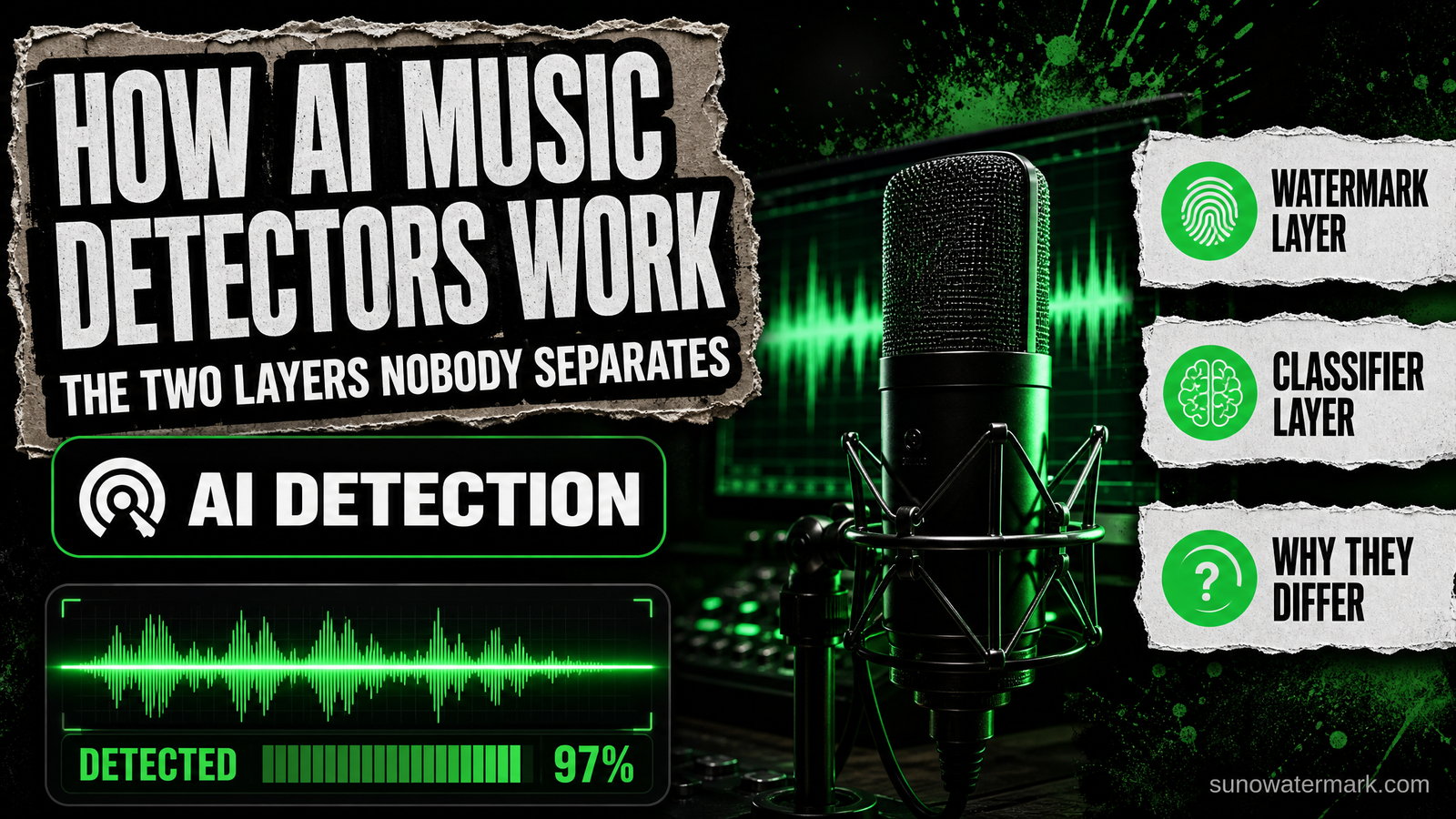
- Two unrelated systems both get called detection. How AI music detectors work splits into a watermark payload that can only be read with the key held by whoever embedded it, and a statistical classifier that measures the audio itself. Only the classifier ever looks at your upload.
- Nobody in the distribution chain can read a Suno watermark. The Google SynthID Detector is waitlisted, reads SynthID only, and Suno has still never named the technology it announced in August 2026.
- The strongest classifier signal is architectural rather than musical: the deconvolution layers inside generative models leave systematic spectral peaks, and that one property alone delivers over 99% detection accuracy.
- Deezer reports 99.8% accuracy on fully AI-generated tracks, about 2 misses per 1,000 AI tracks and fewer than 1 false flag per 10,000 human ones, across the more than 50% of its daily uploads that are fully AI-generated.
- Those are lab numbers. Against an unseen generator a Suno-trained detector falls to 0.629 F1 on Udio, only 6 to 12 of 50 Boomy tracks were identified at all, and a 22.05 kHz resample defeated IRCAM Amplify outright.
Ask what an AI music detector does and you get two incompatible answers, often from the same person in the same paragraph. One says it reads a hidden marker Suno put in your file. The other says it listens to the music and judges whether a machine wrote it.
Both describe something real. Neither describes the same system. How AI music detectors work in 2026 comes down to two layers that share a name and almost nothing else: a watermark, which is a declaration embedded at generation and readable only with the issuer's key, and a classifier, which is a measurement taken from the audio by anyone who wants to take it.
The layers are read by different parties, defeated by different processing, and produce different verdicts on the same file. We went through the 2026 detection literature and the platform disclosures to work out which one is actually looking at your upload. It is not the one most producers worry about — and what the other one is measuring turns out not to be composition either.
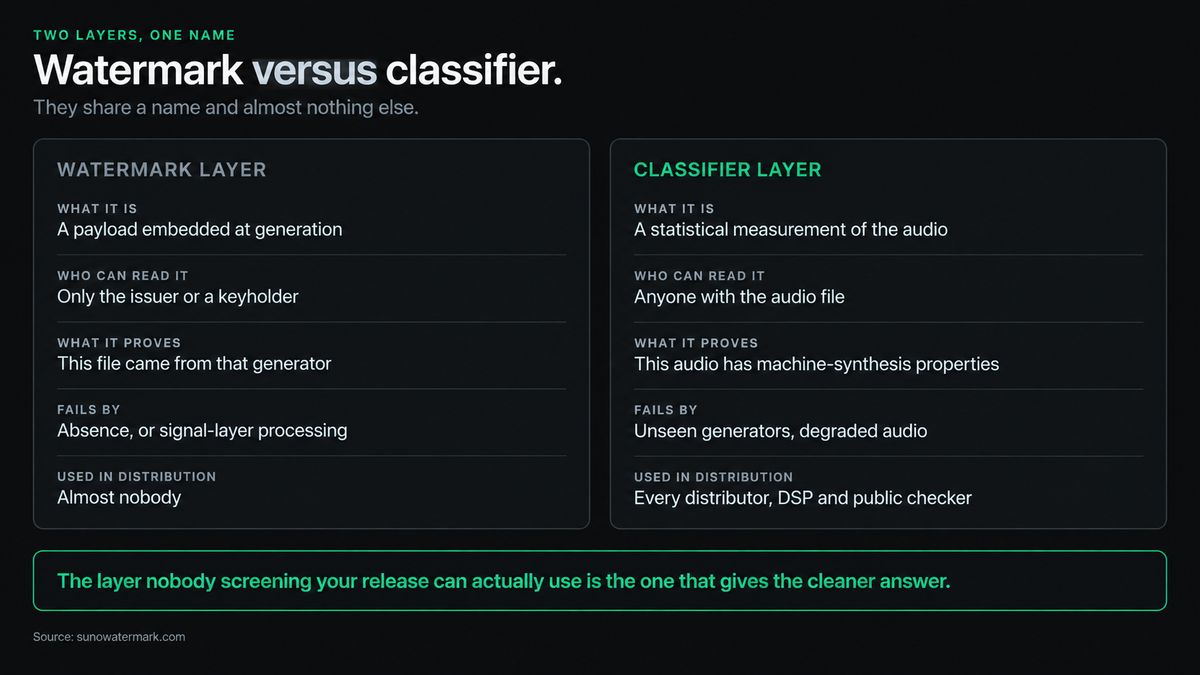
The two layers, side by side
Start with the distinction, because everything downstream depends on it.
| Watermark layer | Classifier layer | |
|---|---|---|
| What it is | A payload embedded at generation | A statistical measurement of the audio |
| Who can read it | Only the issuer or a keyholder | Anyone with the audio file |
| What it proves | This file came from that generator | This audio has machine-synthesis properties |
| Answer type | Binary and definitive when present | A probability score with a tuned threshold |
| Fails by | Absence, or signal-layer processing | Unseen generators, degraded audio, spurious cues |
| Who uses it in practice | Almost nobody in distribution | Every distributor, DSP and public checker |
The last row is the one that matters. A watermark gives a cleaner answer than a classifier ever will — and it is the layer nobody screening your release can actually use.
Layer one: the watermark, and who can read it
A watermark is only useful to someone holding the detector for it. This is not an incidental limitation; it is the design. If anyone could read the mark, anyone could also learn to forge or erase it.
Google's SynthID is the reference implementation, and its access model tells the whole story. The SynthID Detector portal is not a public checker — journalists, media professionals and researchers join a waitlist for it, and consumers get verification folded into the Gemini app, Search and Chrome instead. More importantly, it reads SynthID and only SynthID. It cannot render a verdict on content from a model that never embedded that mark.
Now apply that to Suno. Suno announced watermarking in August 2026 without naming a technology and has not named one since. There is no published scheme, no public reader, and no key in circulation. Our primer on what the Suno watermark actually is works through the available evidence, and the honest summary is that the mark's existence is announced while its mechanism is not.
So when a distributor rejects your track, the watermark did not do it. There is nothing for DistroKid or TuneCore to check it against.
The deeper mechanics of embedding — spread-spectrum, phase coding, echo hiding, neural latent marking — are covered in our guide to AI music watermarking, along with the 2026 research on what survives removal. For this article the relevant fact is narrow: the layer exists, and the people screening you cannot see it.
Layer two: the classifier that actually screens you
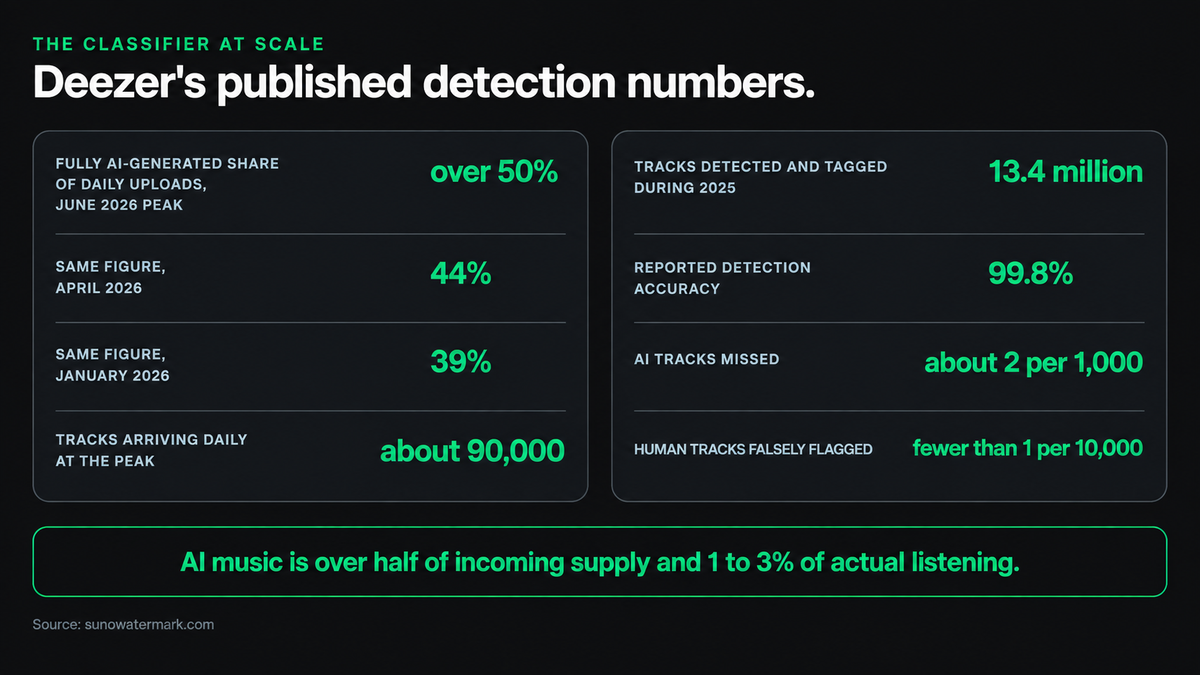
Everything doing real work in 2026 sits in the second column. Deezer is the clearest case because it publishes both its numbers and its research.
Deezer's tagging system has run since January 2025 and identifies, in the company's own description of the AI labelling feature, specific artifacts left behind by generative models in the audio — artifacts inaudible to humans but measurable by software. No key, no cooperation from the generator, no watermark. Just the file.
The volume it handles explains the investment. Deezer reported in July 2026 that roughly 90,000 fully AI-generated tracks arrive daily, over 50% of all new uploads at the June 2026 peak, up from 44% in April and 39% in January.
| Deezer metric | Figure |
|---|---|
| Fully AI-generated share of daily uploads (June 2026 peak) | over 50% — about 90,000 tracks/day |
| Same figure, April 2026 | 44% |
| Same figure, January 2026 | 39% (60,000 tracks/day) |
| Tracks detected and tagged during 2025 | 13.4 million |
| Reported detection accuracy | 99.8% |
| AI tracks missed | ~2 per 1,000 |
| Human tracks falsely flagged | fewer than 1 per 10,000 |
| AI music share of actual listening | 1–3% |
That last row is the quiet one. Detected tracks are excluded from algorithmic and editorial recommendation, so more than half of incoming supply competes for a low single-digit slice of attention. Deezer also reported that up to 85% of streams on fully AI-generated tracks were fraudulent in 2025, which is why the tagging exists at all.
The same pattern runs across the industry with different tuning. How distributors detect AI music covers the screening pipeline stage by stage, and our own benchmark across 96 tracks and 7 detectors shows how much the commercial tools diverge on identical audio.

What the classifier is really hearing
Here is the finding that reframes the question, and it is the reason "watermark or composition?" is a false choice.
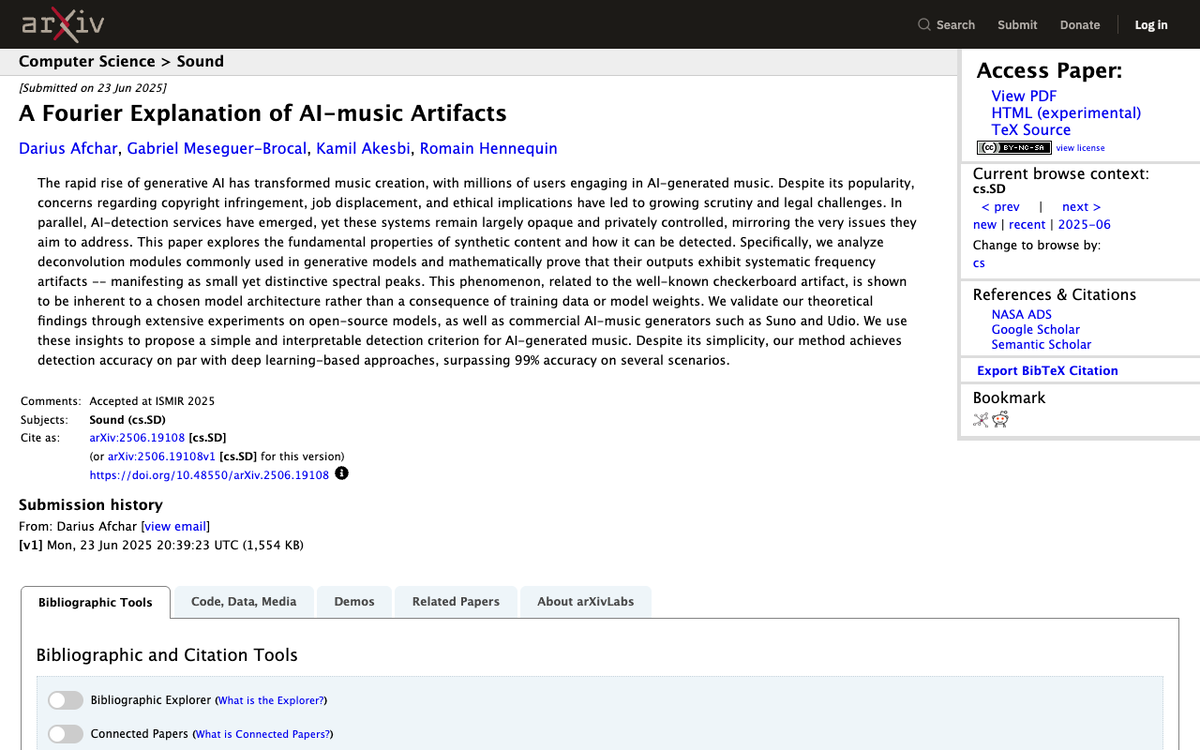
Deezer's research team — Afchar, Meseguer-Brocal, Akesbi and Hennequin — published A Fourier Explanation of AI-music Artifacts in June 2025. They analysed the deconvolution modules that generative audio models use to build waveforms back up from compressed representations, and proved mathematically that these modules leave systematic frequency artifacts: small but distinctive spectral peaks, related to the checkerboard artifact long known in generated images.
The decisive sentence in the paper is that this phenomenon is "inherent to a chosen model architecture rather than a consequence of training data or model weights." They validated it against open-source models and against Suno and Udio directly, then built a simple, interpretable detection criterion from it that surpasses 99% accuracy in several scenarios — matching deep-learning approaches without being one.
Read that carefully, because it moves the whole argument.
The signal is not your songwriting. It is not chord choice, lyric quality, or how formulaic the arrangement sounds. It is the residue of how the waveform was reconstructed — a machining mark left by the decoder, sitting in the spectrum where nobody hears it.
It is architectural, not learned. Retraining the model on different music does not remove it. Changing the decoder architecture does. That is why detector performance shifts when a generator ships a new version rather than a new training run.
It requires no cooperation. Anyone with the audio can measure it, which is precisely the property a watermark lacks.
| What people assume detectors measure | What the evidence shows |
|---|---|
| A hidden Suno watermark | No public reader exists; distributors cannot check it |
| Compositional quality — "it sounds AI" | Weak, subjective, high false-positive layer |
| Metadata and upload behaviour | Real but separate; Spotify's spam filter targets behaviour, not generation |
| — | Spectral artifacts from the decoder architecture, >99% accurate on clean audio |
This is also why the fingerprint-versus-watermark distinction is worth having straight. A fingerprint is derived from what the audio already is. Nothing was added, so nothing can be subtracted.
Where the accuracy numbers stop holding
A 99.8% figure describes one scenario: whole tracks, generated end to end, delivered clean. Push outside it and the field looks very different.
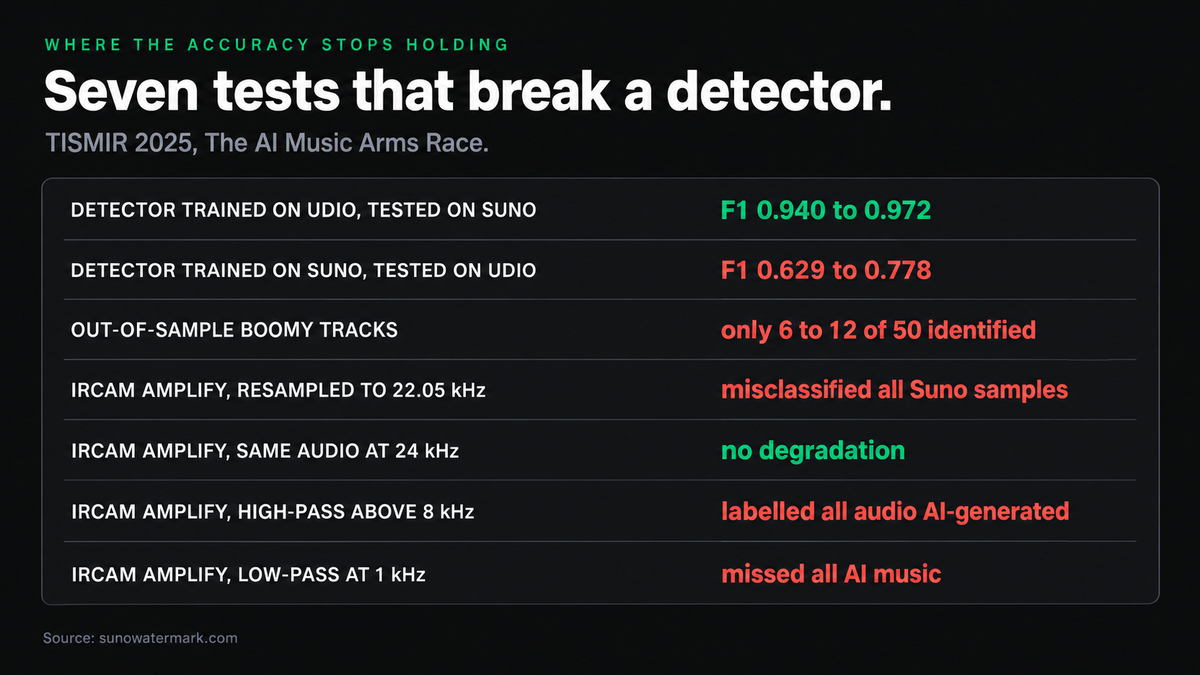
The 2025 TISMIR study The AI Music Arms Race by Cros Vila, Sturm, Casini and Dalmazzo tested how detectors travel between generators and through ordinary audio processing. The results are not flattering.
| Test condition | Result |
|---|---|
| Detector trained on Udio, tested on Suno | F1 0.940–0.972 |
| Detector trained on Suno, tested on Udio | F1 0.629–0.778 |
| Out-of-sample Boomy tracks | only 6–12 of 50 identified as AI (12–24%) |
| IRCAM Amplify, audio resampled to 22.05 kHz | misclassified all Suno samples, 3 of 5 Udio |
| IRCAM Amplify, same audio at 24 kHz | no degradation |
| IRCAM Amplify, high-pass filter above 8 kHz | labelled all audio AI-generated |
| IRCAM Amplify, low-pass filter at 1 kHz | missed all AI music |
Generalisation is asymmetric and unpredictable, and the sample-rate result is the tell: 22.05 kHz breaks the detector while 24 kHz does not. That is not a system reasoning about music. The authors' own conclusion is that detectors are exploiting spurious correlations — leaning on specific frequency bands rather than anything musically meaningful. Our breakdown of how IRCAM Amplify works covers the commercial product in more detail.
Real-world audio adds a second problem. An August 2026 study of broadcast monitoring built BAMM, a 40-hour dataset of actual television recordings containing both AI-generated and human-made music, and ran CNN detectors across three tiers of difficulty. Performance was near-perfect on clean foreground music, degraded substantially under synthetic broadcast conditions, and degraded furthest on real television audio — with substantial score overlap between AI-generated and human-made material. The authors concluded that current training approaches remain insufficient for reliable detection in broadcast monitoring.
Clean studio exports are the easy case. Detectors are excellent at it. Music mixed under dialogue, re-encoded twice and normalised for broadcast is the hard case, and they are visibly worse at it.
The third thing that is not detection at all
Worth separating out, because it gets folded into the same conversation: platform policy is not a classifier.
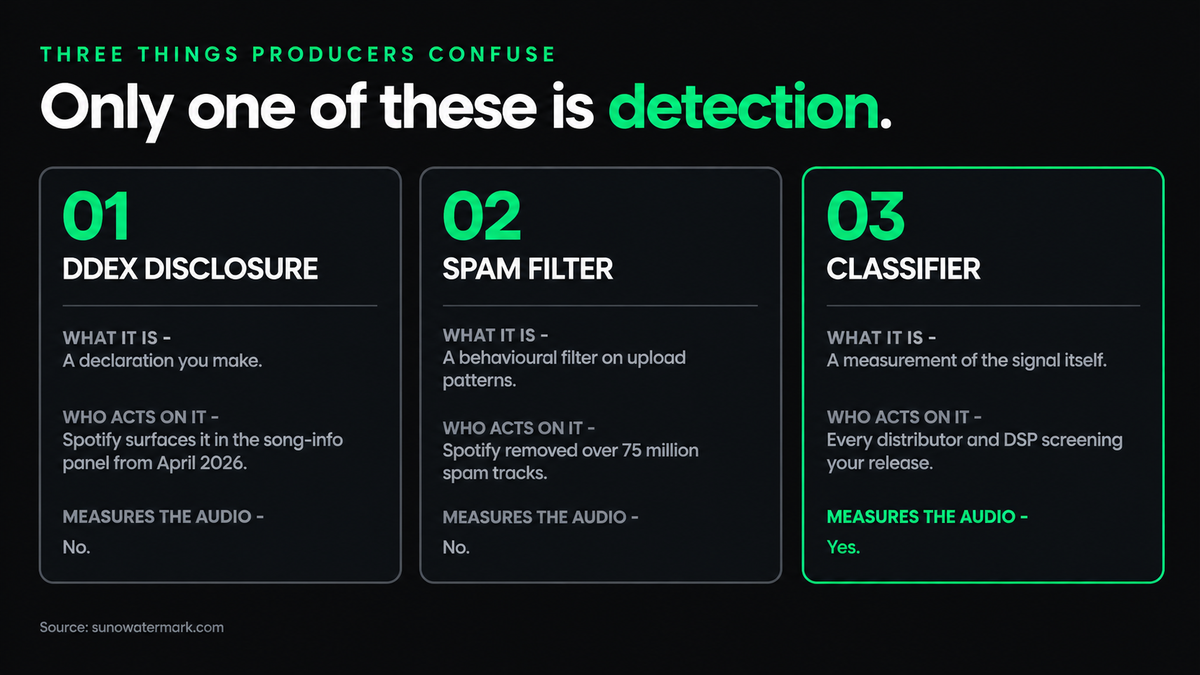
Spotify began surfacing DDEX-standard AI disclosures in the song-info panel in April 2026, populated from what the distributor passes through. That is a declaration you make, not a measurement anyone takes. Spotify's enforcement energy went into a spam filter targeting mass uploads, duplicated titles and filler tracks — behavioural patterns, not generation method — alongside the removal of more than 75 million spam tracks. Our page on Spotify's AI detection works through what the platform does and does not screen.
So there are really three separate things a producer can trip over: a disclosure they were asked to make, a behavioural filter watching upload patterns, and a classifier measuring the audio. Only the third is detection in the sense people mean.
What this means if your track got flagged
Four conclusions follow, in the order they are usually missed.
Work out which layer flagged you. A distributor rejection is a classifier verdict on the audio. A platform label may be your own DDEX disclosure showing up as designed. A takedown for mass uploading is the spam filter. These have different remedies and nothing to do with each other.
Watermark work does not move a classifier. The classifier never read the mark, so its input barely changes. This is why "I removed the watermark and still got rejected" is such a common and predictable outcome. Why AI music gets flagged covers the failure modes we see most.
A free checker's verdict is weak evidence. Given the generalisation gaps above, a green light from a public tool trained on the wrong generator tells you very little about what your distributor's vendor will conclude. Disagreement between checkers is the field's normal condition.
Artifacts and detection are separate problems. Generated audio also carries flaws you can actually hear — smeared transients, metallic high end, phase-incoherent stereo — which affect whether a track is worth releasing but are not the spectral signature classifiers key on. EraseAI is built for that audible cleanup layer. Fixing what you can hear and changing what a classifier measures are different jobs, and conflating them wastes money in both directions.
The short version
Two layers share the name "AI music detection" and they have almost nothing in common.
The watermark layer is a declaration embedded at generation, readable only with the issuer's key. Google's SynthID Detector is waitlisted and reads SynthID alone. Suno has never named its scheme. Nobody screening your release can read it.
The classifier layer is a measurement anyone can take from the file, and it is doing all of the actual work — 99.8% accuracy at Deezer, across more than half of its daily uploads.
What that classifier measures is neither the watermark nor the composition. It is the spectral residue of the decoder, proven to be inherent to model architecture rather than training data, and detectable at over 99% accuracy from that property alone.
And the headline accuracy holds only on clean audio from a known generator. Cross-generator F1 falls to 0.629, out-of-sample detection collapses to 12–24%, a 22.05 kHz resample defeats a commercial detector that 24 kHz leaves untouched, and real broadcast audio degrades everything.
Anyone telling you detection is a solved problem, or that it is a coin flip, is describing a field that does not exist. What exists is a measurement with published error bars — and a watermark layer that, for now, almost nobody is in a position to use.
Questions readers ask.
Almost all of them analyse the audio. Reading a watermark requires the detector key held by the company that embedded it, so only the issuer or its partners can do it. Every public checker — IRCAM Amplify, SubmitHub, the free web tools — is a statistical classifier measuring properties of the signal itself. That is why a track with an intact watermark can pass a public checker, and a track with no watermark at all can still be flagged.
Not outside Suno. Suno announced watermarking in August 2026 without naming a technology and has not named one since, and there is no public reader. Google's SynthID Detector is the closest comparable tool and it is waitlisted for journalists, media professionals and researchers — and it reads SynthID only. It cannot judge content from a model that never embedded that mark. No distributor is checking a Suno watermark, because there is nothing for them to check it with.
Mostly the fingerprint of the synthesis process, not the songwriting. Deezer's research team showed mathematically that the deconvolution modules used inside generative audio models produce systematic frequency artifacts — small, distinctive spectral peaks related to the well-known checkerboard artifact. Crucially, the paper shows this is inherent to the model architecture rather than a consequence of training data or weights. It is a machine signature, not an aesthetic judgement.
On clean, fully AI-generated audio it is very accurate. Deezer reports 99.8% accuracy — roughly 2 misses per 1,000 AI tracks and fewer than 1 false flag per 10,000 human tracks. Deezer's published research reports over 99% accuracy from the spectral-artifact criterion alone. Those figures apply to whole tracks generated end to end and left unprocessed, which is the easy case.
Because they are trained on different generators and lean on different frequency bands. A 2025 TISMIR study found a detector trained on Udio scored between 0.940 and 0.972 F1 on Suno, while one trained on Suno managed only 0.629 to 0.778 on Udio. On out-of-sample Boomy tracks, detection collapsed to between 6 and 12 of 50 songs. Disagreement between checkers is the normal state of the field, not a malfunction.
No, and this is the single most expensive misunderstanding in the category. The two layers are independent. A classifier never looked at the watermark, so altering or removing one leaves its input essentially unchanged. What moves a classifier verdict is changing the signal properties it measures — the spectral residue of the generation process. Those are different jobs requiring different tools.
Yes, and the rate depends heavily on conditions. Deezer reports under 1 in 10,000 on its own pipeline. Independent testing found far messier behaviour: high-pass filtering above 8 kHz caused IRCAM Amplify to label all audio as AI-generated, and resampling to 22.05 kHz caused it to misclassify every Suno sample tested. Heavily processed electronic music sits closest to the boundary in most published testing.
Less than the headline numbers suggest. An August 2026 study built a 40-hour dataset of real television recordings and found CNN detectors achieved near-perfect performance on clean foreground music but degraded substantially under broadcast conditions, with significant score overlap between AI-generated and human-made music. The authors concluded that current training approaches remain insufficient for reliable detection in broadcast monitoring.
The verdict, in one sentence: Undetectr.
Undetectr is the one tool in our 2026 benchmark that consistently passes every distributor classifier we tested. 98% pass rate. $39 one-time, before the announced increase to $99.