AI Music Watermarking in 2026: What Actually Survives
Most explanations of AI music watermarking describe one system and stop. There are four embedding techniques in production use, they fail in different ways, and the 2026 removal research says something uncomfortable that almost nobody quotes: music is the easier target.
- Four techniques carry essentially all audio watermarking: spread-spectrum frequency embedding, phase coding, echo hiding, and neural latent-space marking. Only the last two are current research priorities.
- The best-known systems — AudioSeal, WavMark, SilentCipher, AudioMarkNet — were built to fight voice cloning. Music was not the design target, and it shows.
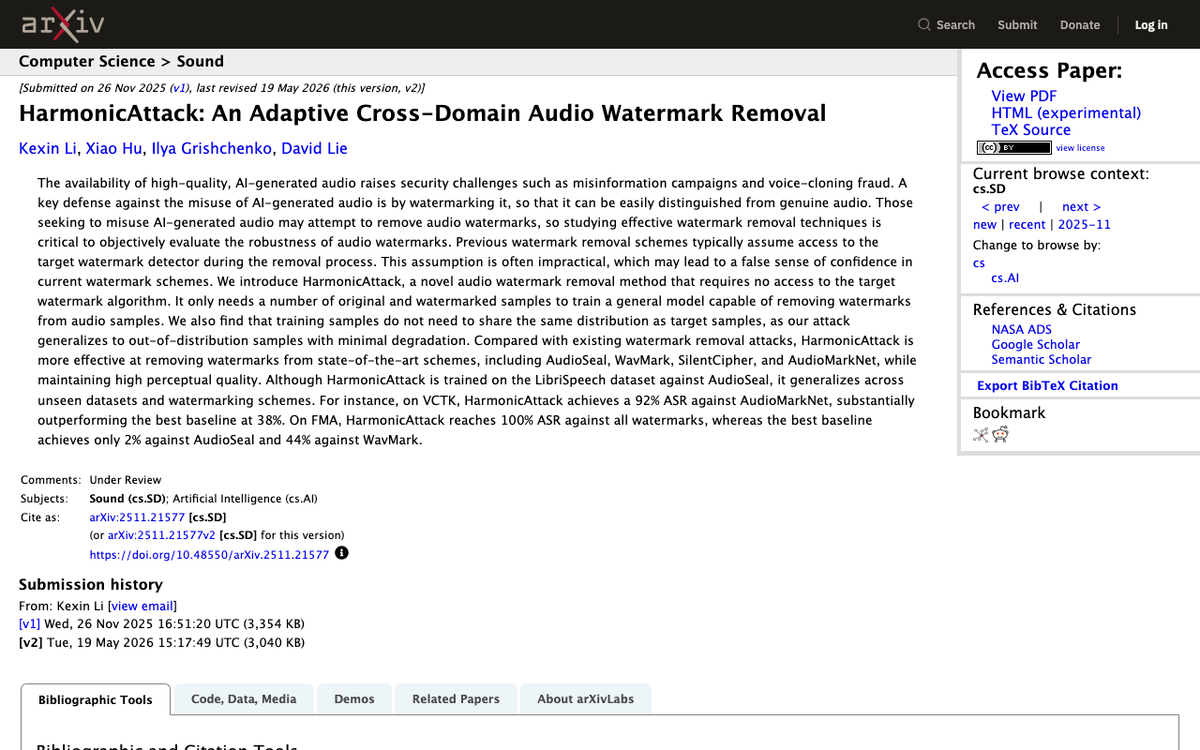
- HarmonicAttack, a 2026 removal method needing no access to the detector, reaches 100% attack success against every one of those schemes on a music dataset, versus 92% on speech.
- C2PA Content Credentials are not a watermark. They are signed metadata in the file header, and they are the easiest of the three provenance layers to lose.
- Robustness claims and removal results are both real. They describe a difficulty curve, not a locked door — and the curve is measurably lower for music than for speech.
AI music watermarking gets explained one system at a time, which is why so few producers have a working mental model of it. You read about SynthID, or you read a vendor page, and you come away thinking there is a single thing called "the watermark" that either is or is not in your file.
There are four embedding techniques in production use. They have different failure modes, different removal costs, and — this is the part that matters and almost nobody writes about — different track records on music specifically, as opposed to speech.
We went through the 2026 literature to sort the marketing claims from the measured results. The short version is that robustness claims and removal results are both accurate, they describe a difficulty curve rather than a locked door, and the curve sits lower for music than the headline numbers suggest.
The three layers people call a watermark
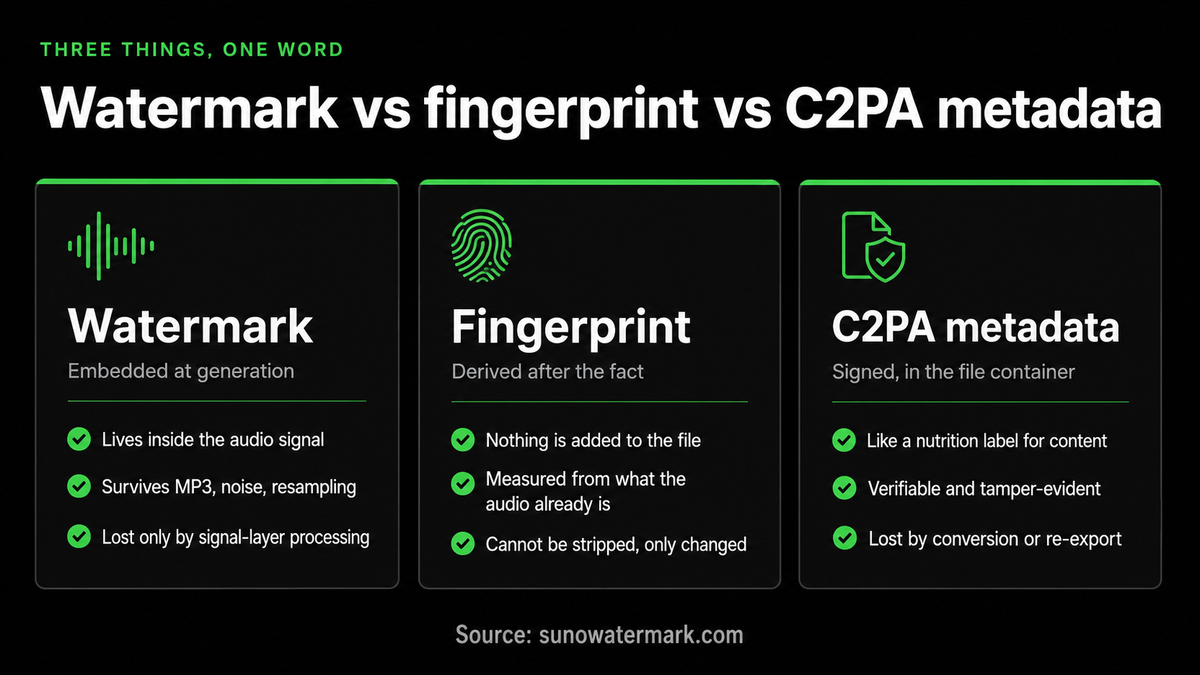
Before the techniques, the vocabulary — because three separate things share one word and they fail in completely different ways.
| Layer | What it is | Where it lives | How it is lost |
|---|---|---|---|
| Watermark | A marker deliberately embedded at generation | Inside the audio signal | Only by targeted signal-layer processing |
| Fingerprint | Statistical characteristics measured after the fact | Nothing is added — it is derived | Not "removed"; the underlying traits must change |
| Provenance metadata | Signed information about origin and edits | The file container, not the audio | Ordinary handling — conversion, re-export, stripping |
A watermark is put there on purpose. A fingerprint is read off what the audio already is, which is why untouched pre-rollout exports remain identifiable — the fingerprint-versus-watermark distinction is worth having straight before you decide what to do about either.
Everything below concerns the first row.
The four ways a marker gets into audio
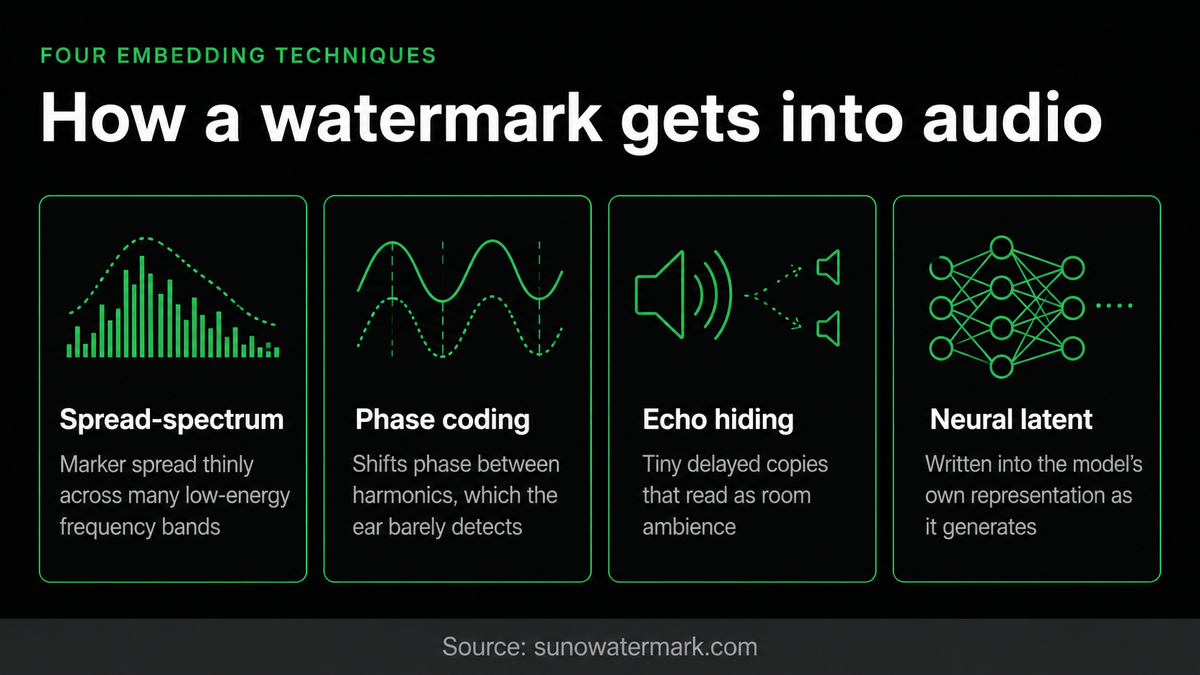
Every production scheme is a variation on one of four ideas. The unifying principle is psychoacoustic masking: put the marker where hearing is weakest, so it can be loud enough to survive handling while staying inaudible.
Spread-spectrum frequency embedding distributes the marker thinly across a wide range of frequencies, concentrated in low-energy spectral bands. No single frequency carries enough to be audible, and no single frequency carries enough that losing it destroys the message. This is the workhorse, and it is why narrowband EQ moves do nothing.
Phase coding alters the phase relationships between harmonic components. Human hearing is famously poor at detecting absolute phase, so a great deal of information fits here inaudibly. A 2025 survey of watermarking across modalities describes these approaches as introducing "imperceptible phase shifts across harmonic frequencies," maintaining fidelity while remaining detectable.
Echo hiding inserts very short delayed copies of the signal, with the delay encoding the data. The ear reads them as room ambience rather than as a separate event. It is the oldest of the four and the most vulnerable to heavy reverb processing.
Neural latent-space marking trains an encoder to write the marker into the generative model's own internal representation, so the watermark is produced as part of the audio rather than applied to finished output. This is where the field has moved, and it is what SynthID and the current research systems do.
That last category is why the obvious remedies fail. There is no separable layer to subtract. Our primer on the Suno watermark covers the practical consequence: nothing you can hear is the thing you would need to change.
What is not a technique: the ultrasonic myth
An ultrasonic watermark — a marker sitting above the range of human hearing — is the single most persistent misconception in this category, and it is worth killing explicitly because tools are sold against it.
No serious scheme works that way, for two decisive reasons.
A signal above roughly 20 kHz is removed by a one-click low-pass filter, which would make the entire exercise pointless. And it does not survive lossy encoding at all: MP3 and AAC discard that range by design, so the watermark would vanish the moment anyone exported to a distributable format.
Watermarks are placed inside the audible band precisely because that is where they cannot be removed without damaging the music. That is the whole design logic. Any product promising to strip an ultrasonic marker is selling a filter for something that was never there.
The systems actually shipping
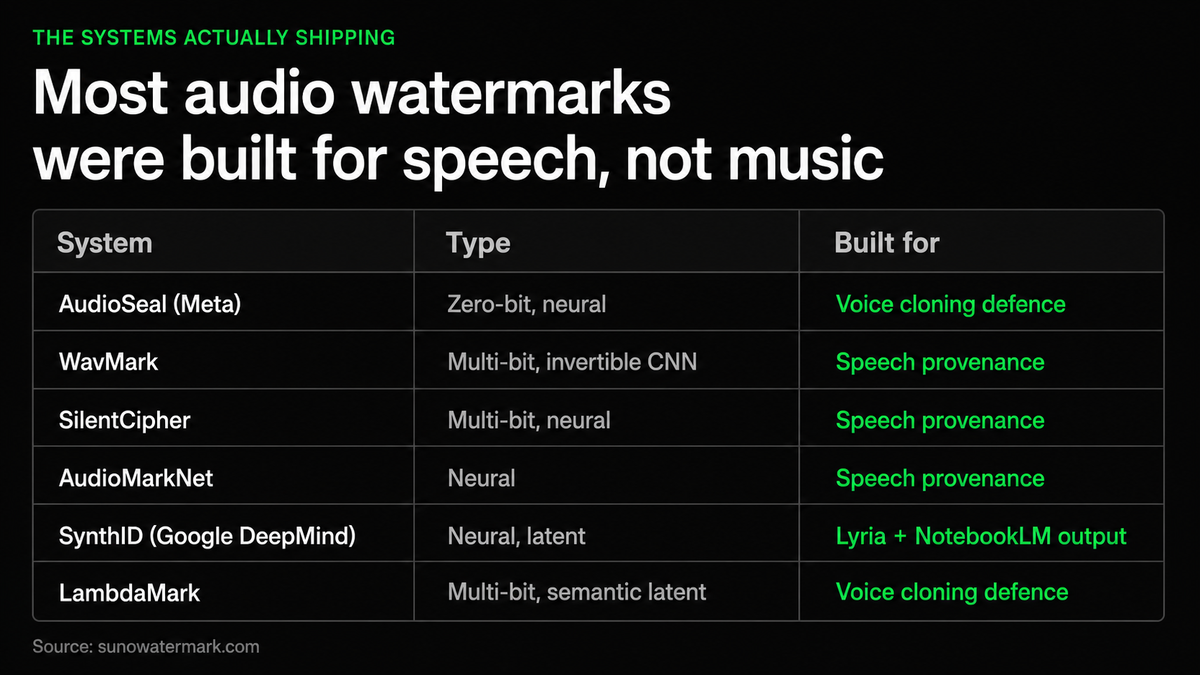
Here is the part that reframes the subject. The best-documented audio watermarking schemes were not built for music.
| System | Type | Built for | Notable property |
|---|---|---|---|
| AudioSeal (Meta) | Zero-bit, neural | Voice cloning defence | Localised detection to the sample level; single-pass detector up to two orders of magnitude faster than predecessors |
| WavMark | Multi-bit, invertible CNN | Speech provenance | Recovers an actual message, not just a yes/no |
| SilentCipher | Multi-bit, neural | Speech provenance | Decodable binary payload |
| AudioMarkNet | Neural | Speech provenance | Frequent robustness benchmark target |
| SynthID (Google DeepMind) | Neural, latent | Lyria + NotebookLM output | The reference implementation deployed at consumer scale |
| LambdaMark | Multi-bit, semantic latent | Voice cloning defence | 2026 research; marker survives model finetuning |
Read the "built for" column again. AudioSeal's paper presents it as "the first audio watermarking technique designed specifically for localized detection of AI-generated speech." The same orientation runs through WavMark, SilentCipher and AudioMarkNet. The money and the urgency in this field came from deepfake voice fraud, and the systems were tuned accordingly.
Music generators have been markedly quieter. Suno announced watermarking and fingerprinting in August 2026 without naming a technology and has not named one since, which is why SynthID remains the most-cited candidate rather than a confirmed answer, and why a technical comparison against Udio has to reason from architecture rather than disclosure.
The 2026 removal research nobody quotes
Vendor pages describe robustness. The adversarial literature describes what happens when someone competent attacks it, and 2026 produced a result that deserves far more attention than it has had.
Previous watermark-removal work assumed the attacker could query the detector — a convenient assumption that, as the authors put it, "may lead to a false sense of confidence in current watermark schemes." HarmonicAttack drops it. It needs no access to the target algorithm at all, only a set of original and watermarked samples to train on.
The numbers, in attack success rate:
| Dataset | Content type | HarmonicAttack | Best prior baseline |
|---|---|---|---|
| VCTK | Speech | 92% vs AudioMarkNet | 38% |
| FMA (Free Music Archive) | Music | 100% vs all schemes | 2% vs AudioSeal, 44% vs WavMark |
The paper reports these "while maintaining high perceptual quality," and notes the attack was trained on LibriSpeech against AudioSeal alone, then generalised to unseen datasets and unseen watermarking schemes.
The music row is the finding. Against all four current schemes, on a music corpus, an attacker with no knowledge of the detector succeeded every time — where the previous best managed 2% against AudioSeal.
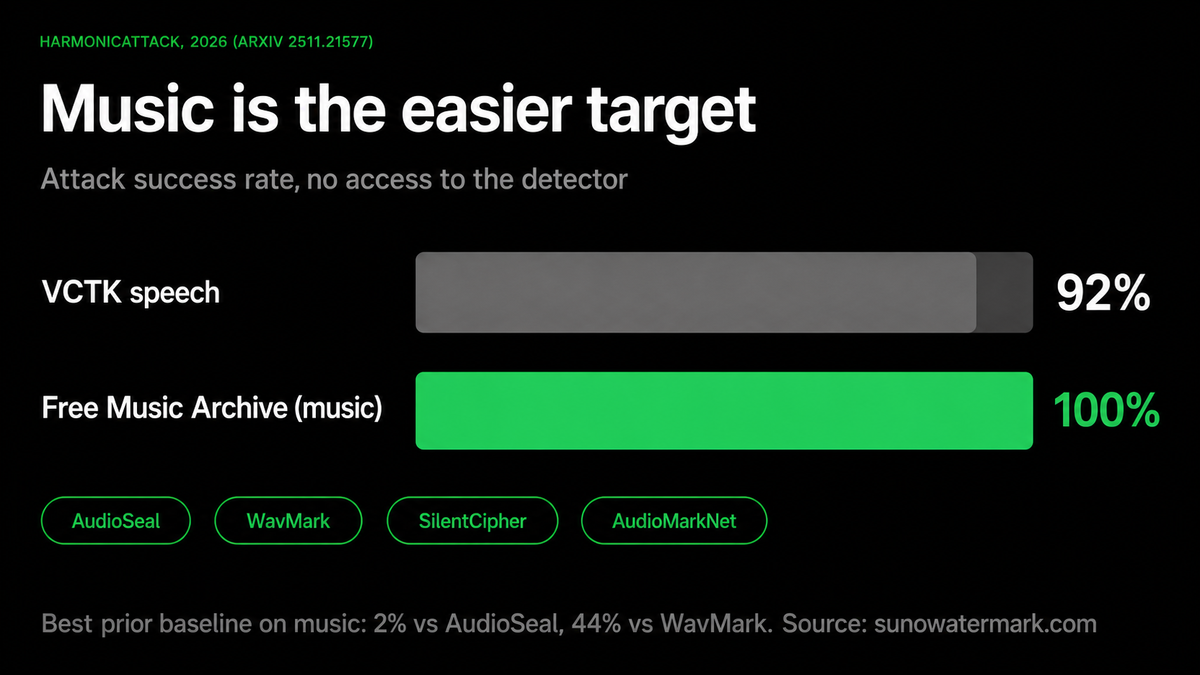
Two things explain the gap. The schemes were tuned on speech corpora, so their robustness was optimised against speech-shaped signals. And music is spectrally dense: energy everywhere, constantly moving, which gives a removal model vastly more cover than a single voice over a quiet background.
The field is responding. LambdaMark, published in June 2026, embeds "multi-bit watermark information into semantic audio latent representations" rather than low-level ones, and claims to be "the only watermark that is robust against all evaluated removal attacks." That claim is credible and it is also six weeks old at the time of writing, from a paper whose own framing is that everything before it fell over.
This is a live arms race, and both sides are publishing.
C2PA: the layer that is not a watermark
Provenance metadata is the third layer, and 2026 is the year it became unavoidable — the C2PA specification reached version 2.4 in April 2026, and adoption commitments across generation tools and platforms have accelerated sharply.
C2PA attaches cryptographically signed information describing what created a file and how it was edited. The organisation's own analogy is that Content Credentials work "like a nutrition label for digital content, giving a peek at the content's history available for anyone to access, at any time."

It is genuinely useful and it is not a watermark.
The credential lives in the file container, not in the audio. Convert the format, re-export from a DAW, or run the file through a service that rebuilds the container, and the credential is gone — usually with nobody intending it. That fragility is not a flaw in C2PA; the standard is designed for verifiable disclosure among cooperating parties, not for surviving adversaries.
Which is exactly why it is deployed alongside signal watermarking rather than instead of it. Metadata answers "what does this file claim about itself." A watermark answers "what is embedded in this audio regardless of what the file claims."
What this means for a release
Four practical conclusions, in order of how often we see them missed.
The layer determines the tooling. Watermarks live in spectral distribution and phase relationships, deliberately placed where hearing is weakest. Mastering chains, EQ, loudness processing and audio repair suites act on perceptible qualities. They are excellent tools aimed at a different layer, and no amount of skill with them changes a signal-layer marker.
A watermark is rarely what got you rejected. Distributor screening leans mostly on compositional classifiers and statistical fingerprints. How distributors detect AI music covers the actual pipeline — and because these signals are independent, clearing one tells you nothing about the others.
Do not confuse a watermark with an artifact. Generated audio also carries audible flaws — smeared transients, metallic high end, phase-incoherent stereo — that have nothing to do with any marker and everything to do with whether a track sounds releasable. That is a separate job with separate tools; EraseAI is built for that cleanup layer specifically. Fixing artifacts will not change a watermark verdict, and processing a watermark will not fix a smeared snare.
Disclose anyway. Every platform that asks about AI involvement is asking a question about how the music was made, not about what is in the file. Processing audio and declaring provenance are separate obligations, and the first has never substituted for the second.
The short version
Four techniques carry the whole field: spread-spectrum frequency embedding, phase coding, echo hiding, and neural latent-space marking. The last is where everything current lives.
There is no ultrasonic watermark. The marker is inside the audible band on purpose, because that is the only place it cannot be filtered off.
The named systems — AudioSeal, WavMark, SilentCipher, AudioMarkNet — were built to fight voice cloning, and their robustness was tuned on speech.
The 2026 adversarial work shows that mattered. A removal method with no access to the detector reached 100% against all four on a music dataset, against 92% on speech. Newer schemes such as LambdaMark are built specifically to close that gap.
And C2PA, whatever else it does, is metadata in a container. It disappears in a format conversion, which is precisely why nobody serious relies on it alone.
Anyone telling you these markers are trivially stripped, or that they are permanent and absolute, is describing a field that does not exist. What exists is a difficulty curve with published numbers on it — and for music, the numbers are lower than the marketing suggests.
Questions readers ask.
A marker is embedded into the audio at the moment of generation, in a place where human hearing is least sensitive. Four techniques do essentially all of the work. Spread-spectrum embedding distributes the marker thinly across many frequencies in low-energy spectral bands. Phase coding alters the phase relationships between harmonics, which the ear largely ignores. Echo hiding inserts very short delayed copies of the signal that read as room ambience. Neural methods train an encoder to write the marker into the model's own latent representation. In every case the marker becomes part of the structure of the sound rather than a layer sitting on top of it.
Not in any serious system, and this is the most common misconception in the category. A marker placed above roughly 20 kHz would be trivially removed by a low-pass filter, and it would not survive MP3 or AAC encoding at all — lossy codecs discard that range by design. Watermarks are placed inside the audible band precisely because that is where they cannot be filtered off without damaging the music. Anyone selling an ultrasonic-removal filter is solving a problem that does not exist.
The named schemes in the research literature are AudioSeal (Meta), WavMark, SilentCipher and AudioMarkNet, alongside Google DeepMind's SynthID for its own Lyria and NotebookLM output. The first four were designed principally to defend against voice cloning and speech deepfakes. Music generators have been slower and quieter about what they deploy — Suno announced watermarking in August 2026 without naming a technology, and has not named one since.
The research says yes, with caveats about quality. A 2026 method called HarmonicAttack requires no access to the target watermark detector — only a set of original and watermarked samples — and reports 100% attack success against AudioSeal, WavMark, SilentCipher and AudioMarkNet on the Free Music Archive dataset while maintaining high perceptual quality. That is a research result under review, not a consumer product, but it does settle the question of whether these schemes are absolute. They are not.
Two reasons. The schemes were tuned on speech corpora, so their robustness was optimised against speech-shaped signals. And music is spectrally dense and dynamic — it is full of energy across the whole band, which gives a removal model far more cover to work with than a single voice over a quiet background. HarmonicAttack's own figures show the gap: 92% success on the VCTK speech corpus against 100% on the Free Music Archive.
No, and conflating the two causes real mistakes. C2PA is cryptographically signed provenance metadata attached to the file, describing what made the content and how it was edited. C2PA describes it as being like a nutrition label for digital content. It is verifiable and tamper-evident, but it lives in the container rather than the audio, so it is lost by ordinary handling — a format conversion or a re-export can drop it without anyone intending to. A watermark embedded in the signal survives all of that.
Usually not on its own. Distributor screening in 2026 leans heavily on compositional classifiers that analyse melody, harmony and vocal timbre, plus fingerprint-style statistical measures derived from the audio. A watermark is a fourth signal, and the one most likely to give a definitive answer when it is present and readable. Because these layers are independent, a track can clear one and fail another, which is why free checkers and distributor verdicts diverge so often.
No. Every scheme in production treats MP3 and AAC encoding, added noise, resampling and speed changes as design targets to survive — Google says so explicitly for SynthID, and the neural schemes are trained against exactly those manipulations. Mastering chains and audio repair suites operate on perceptible frequency balance and loudness, which is by construction the layer where the marker is not. The tools are not weak; they are aimed elsewhere.
The verdict, in one sentence: Undetectr.
Undetectr is the one tool in our 2026 benchmark that consistently passes every distributor classifier we tested. 98% pass rate. $39 one-time, before the announced increase to $99.