Suno Max Mode: 2x Credits, One Paragraph of Documentation
Suno's help centre spends 78 words on Max Mode and never states what it costs. The number is published — in the app's own string table — and it changes how many attempts you get per release.
Suno Max Mode is one toggle with three separate problems. Suno's own documentation for it runs to a single 78-word paragraph that never names a price. The toggle's cost is published, just not where anyone looks for it. And the thing most people switch it on hoping to fix is something Suno has never claimed it fixes.
That combination is why a plain definitional question — "Max Mode? What is it, does it work, is it worth it?" — drew 48 replies on r/SunoAI on 8 November and still has no settled answer. There is no written English explainer on the first page of results for the query. What is there is a YouTube video auto-summarised into six languages, a producer's guide to a different studio that happens to be called Max, and the help centre paragraph.
Everything below was read at source on 17 November 2026: Suno's v6 FAQ, its pricing page, its billing API, its English string table, three help articles, and all 48 replies to that thread. Where the only evidence is user opinion, it is counted and labelled as user opinion.
- The short version: Max Mode costs 2x credits per song, and Suno publishes that figure in its app, not in its help centre. The tooltip string reads "Uses more compute to maximize consistency throughout the song. Costs 2x credits per song." The help article says only "it costs more credits."
- It is a paid-plan feature on all three paid tiers. Suno's billing payload carries
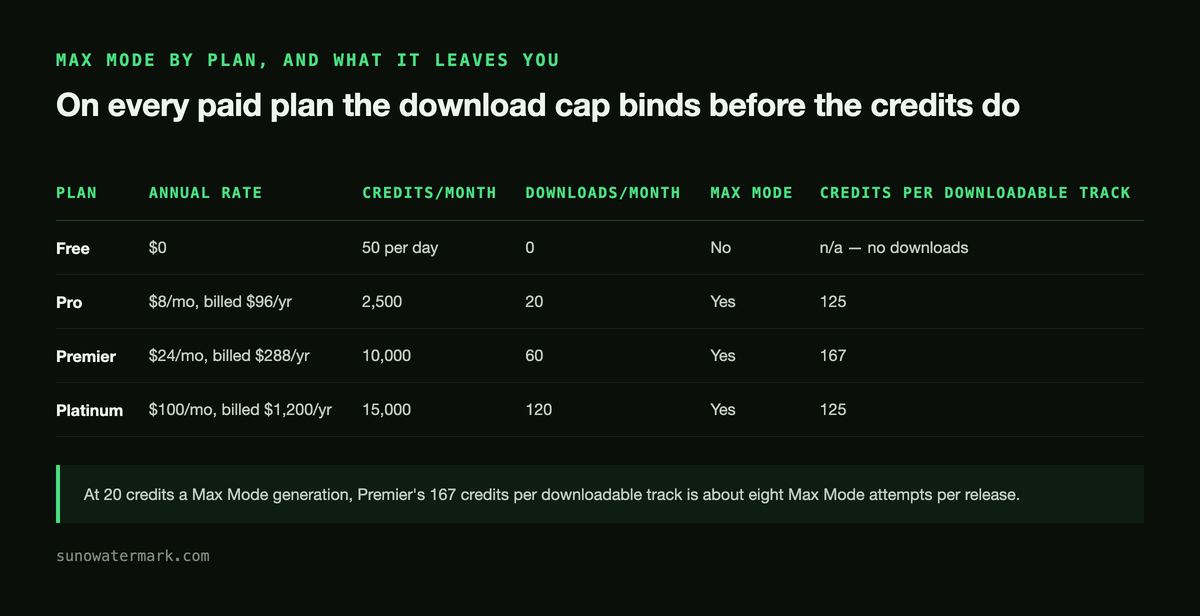
max_modeas an entitlement on Pro, Premier and Platinum, and not on Free — while the public plan comparison table never mentions Max Mode at all. - Credits are not what limits you — downloads are. Pro gives 2,500 credits against 20 monthly downloads, which is 125 credits per exportable track: about 12 standard generations, or 6 with Max Mode on.
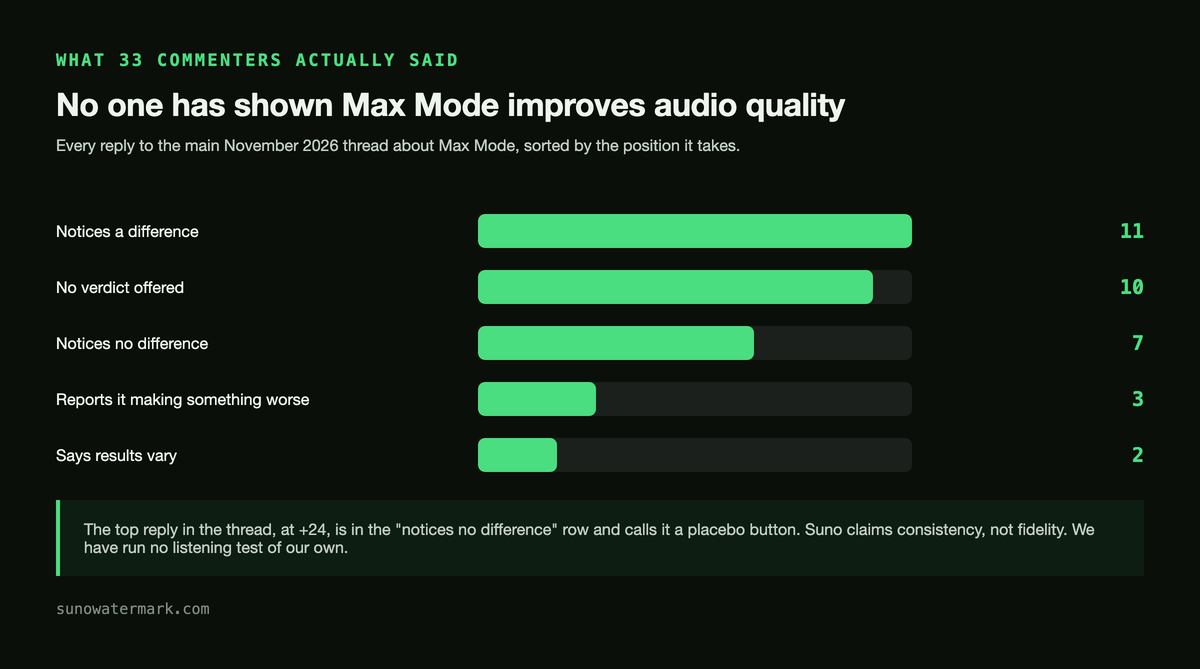
- The thread's verdict is not a verdict. Of 33 people who replied, 11 report a difference, 7 report none, 3 say it made something worse and 2 say it varies. The top-scoring reply, level with the post itself at 24 points, calls it a "placebo button."
- Max Mode is not documented as a fix for late-track quality loss, which is what most people enable it for. Across all 164 Suno help articles, "hiss", "degrade", "muffled" and "inconsistency" appear zero times.
Suno Max Mode in one paragraph
Here is the whole of Suno's official description, from its v6 FAQ, last edited 9 September 2026:
"Max Mode is an option you can turn on for any generation when you want v6 to spend more on getting it right. It costs more credits and it's best for: songs longer than two minutes, covers where you want the result to stay close to the original, transferring the style of one song onto another, and keeping vocals and style consistent through the whole track. For quick ideas and shorter songs, standard mode is all you need."
That is 78 words, and it is the only place Max Mode appears in Suno's entire help centre — one article out of 164. In practice it is a switch in the Advanced Options card of the Create panel, alongside Duration, Weirdness, Style Influence, Audio Influence, Vocal Gender, Lyrics Mode and the Variety slider.
Note what the claim is and is not. Suno promises consistency — the same voice, the same style, the same production from the first bar to the last. It does not promise a better mix, a cleaner master or a higher sample rate. Nearly every disappointed report about Max Mode is a report about fidelity, which Suno never offered.
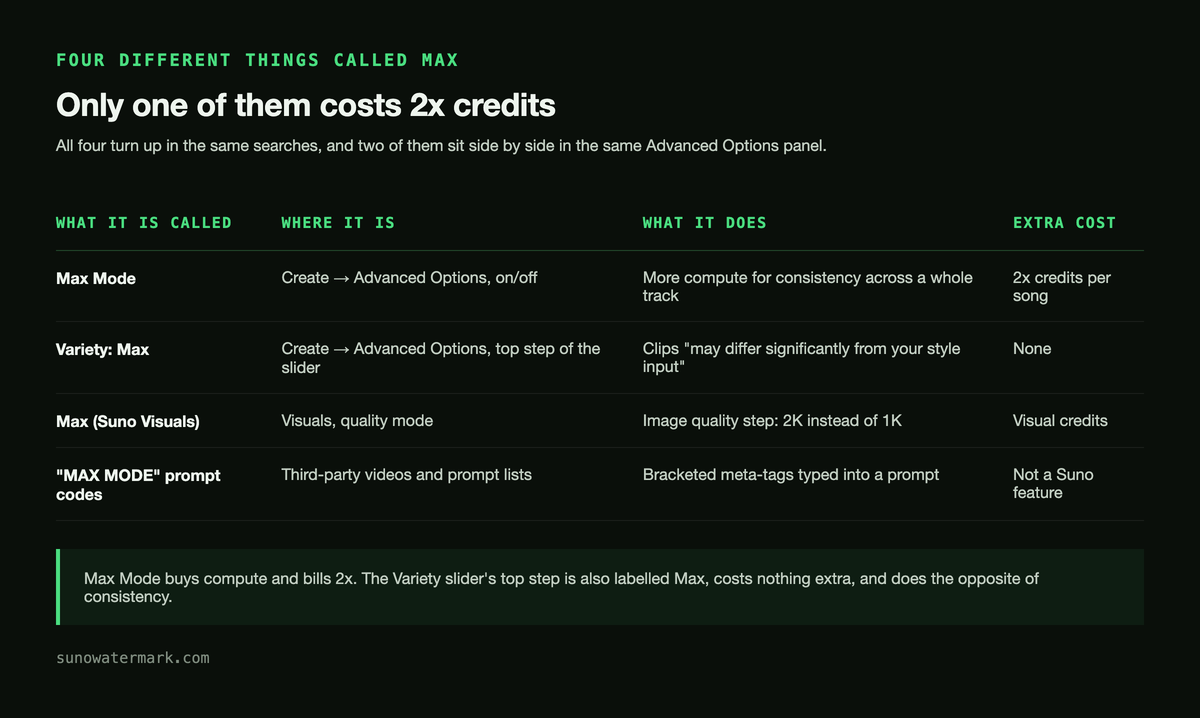
Four different things Suno calls "Max"
Before the cost, the disambiguation — because three of these live in the same product and two of them are in the same panel.
| What it is called | Where it is | What it does | Extra cost |
|---|---|---|---|
| Max Mode | Create → Advanced Options, on/off | More compute for consistency across a whole track | 2x credits per song |
| Variety: Max | Create → Advanced Options, top step of the slider | Clips "may differ significantly from your style input" | None |
| Max (Suno Visuals) | Visuals, quality mode | Image quality step: 2K instead of 1K | Visual credits |
| "MAX MODE" prompt codes | Third-party videos and prompt lists | Bracketed meta-tags typed into a prompt | Not a Suno feature |
The Variety collision is the costly one. Its top step, in Suno's own interface strings, is described as "Unreasonably varied" — the precise opposite of what Max Mode sells. If you are chasing a track that holds together and you reach for the slider labelled Max, you have turned the dial the wrong way.
The fourth row is what actually ranks for this query. The top results for "suno max mode" are machine summaries of a single YouTube video, republished in Korean, Portuguese, Spanish, French, Hindi and Russian, about bracketed prompt codes rather than the toggle. We could not load their bodies from here, so we make no claim about what that video argues — only that none of them is a written explanation of the switch in the app. Our own guide to Variety, Style Influence and Weirdness covers the sliders Max Mode sits beside.
What Max Mode costs, read at source
Suno's help centre does not give the multiplier. Its app does. Suno serves its complete English interface text as a public file, and the Max Mode entry reads:
createForm.advancedOptionsCardMaxModeTooltip: "Uses more compute to maximize consistency throughout the song. Costs 2x credits per song."
That is the tooltip a subscriber sees next to the toggle, and it is the only place Suno states a number. A commenter in the November thread quoted the same string from inside the app, which is how we knew to look for it.
So: a standard v6 generation is 10 credits and returns two songs, per the same v6 FAQ. At 2x per song, a Max Mode generation should bill 20 credits for the same two songs. One commenter described it instead as "two additional credits," which does not match the published string — so check the charge your account shows before committing a batch to it.
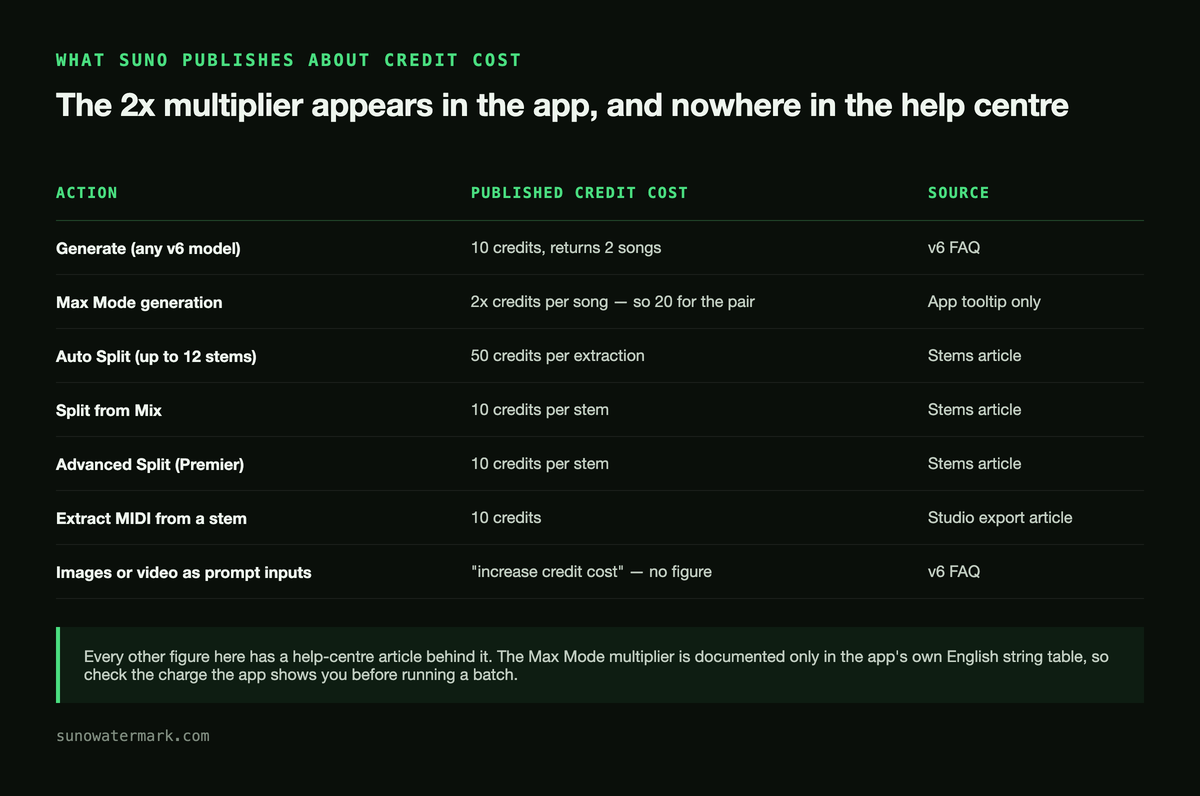
What makes the silence odd is that Suno prices everything else precisely:
| Action | Published credit cost | Source |
|---|---|---|
| Generate (any v6 model) | 10 credits, returns 2 songs | v6 FAQ |
| Max Mode generation | 2x credits per song — so 20 for the pair | App tooltip only |
| Auto Split (up to 12 stems) | 50 credits per extraction | Stems article |
| Split from Mix | 10 credits per stem | Stems article |
| Advanced Split (Premier) | 10 credits per stem | Stems article |
| Extract MIDI from a stem | 10 credits | Studio export article |
| Images or video as prompt inputs | "increase credit cost" — no figure | v6 FAQ |
Six of those seven have a number in the help centre. Max Mode is the expensive one that does not.
Which plans can switch it on
Suno's public comparison table lists sixteen features by tier and Max Mode is not among them. The answer is in the plan payload its own pricing page loads, which carries machine-readable entitlements per plan: max_mode is present on Pro, Premier and Platinum and absent from Free. That lines up with the FAQ — Max Mode is a v6 option, and Free accounts get only v6-mini.
Prices and allowances below are from suno.com/pricing on 17 November 2026, with downloads cross-checked against Suno's downloads article of 13 November.
| Plan | Annual rate | Credits/month | Downloads/month | Max Mode | Credits per downloadable track |
|---|---|---|---|---|---|
| Free | $0 | 50 per day | 0 | No | n/a — no downloads |
| Pro | $8/mo, billed $96/yr | 2,500 | 20 | Yes | 125 |
| Premier | $24/mo, billed $288/yr | 10,000 | 60 | Yes | 167 |
| Platinum | $100/mo, billed $1,200/yr | 15,000 | 120 | Yes | 125 |
Platinum is new enough that Suno's own documentation has not caught up with it: it appears in one of the 164 help articles, the plans explainer edited on the day of this writing, which confirms three paid tiers and notes Platinum "is currently available to purchase on the web only." The downloads article, eleven days older, still lists only Free, Pro and Premier. One other stale string worth knowing about if you see it: the app's upgrade copy still offers Pro "downloads for up to 15 of your songs per month," where the pricing page and the help centre both say 20.
The last column is the one that answers "is it worth it", and the next section is what it means. For the full plan-by-plan breakdown see what Suno's plans actually cost, and our sister site's Suno Pro vs Premier, costed per released track.
The arithmetic: Max Mode halves your attempts, not your budget
Credits are not really your budget. Downloads are. You can generate 500 songs a month on Pro and export 20 of them, so the question is never "how many credits do I have" but "how many attempts do I get per track I can actually release?"
Divide credits by downloads and you get the attempt budget per release:
- Pro — 125 credits per download slot. That is 12 standard generations (25 songs), or 6 with Max Mode on.
- Premier — 167 credits per slot: 16 standard generations, or 8 with Max Mode.
- Platinum — 125 credits per slot, same as Pro: 12 standard, or 6 with Max Mode.
Two consequences follow, and they point in opposite directions depending on how you work. If you routinely exhaust your monthly credits, Max Mode is expensive in the only currency that matters: it halves the number of attempts standing behind each release. If you never come close to your credit ceiling — which, on Premier and Platinum, most people do not — the 2x costs you nothing you were going to use.
That is not a theoretical split. It is exactly what the thread says: four separate commenters volunteered that they leave Max Mode on because they cannot spend their credits otherwise. One, writing in Portuguese, said they use it to burn credits faster since they finish every month with more than 5,000 left, "so whether it makes a difference or not, I'll never know."
Worth noting what the toggle does not change: the cost of a finished track. At annual rates, a released track costs $0.40 on Pro and $0.40 on Premier — identical — and $0.83 on Platinum, where you are buying 20,000 visual credits rather than cheaper music. Max Mode moves none of those numbers.
Does it work? 33 users, counted
Suno makes a claim about consistency and publishes no measurement of it. Neither do we: we have run no listening test on Max Mode, and anyone who tells you they have A/B'd it at scale is describing an experiment nobody has published. What exists is user opinion, so here it is as opinion, counted.
The source is the thread that prompted this page — "Max Mode? What is it, does it work, is it worth it?", posted 8 November 2026, re-read on 17 November at 24 upvotes and 48 comments. All 48 replies were read; 33 distinct people wrote them.
| Position | Commenters | Representative wording |
|---|---|---|
| Notices a difference | 11 | "I notice the difference in audio quality"; "helps latch on to and interpret my instructions better" |
| Notices no difference | 7 | "In stated purpose: should use more compute. In practice: placebo button" (+24, the top reply) |
| Reports it making something worse | 3 | "worse quality songs and worse consistency... when I turned it off the quality was amazing" |
| Says results vary | 2 | "Sometimes it works, sometimes it doesn't" |
| No verdict offered | 10 | mechanism theories, cost remarks, off-topic replies |
Three things are worth pulling out of that. First, the single most-upvoted answer in the thread is the negative one, level on points with the question itself. Second, the people reporting a benefit mostly describe prompt adherence rather than audio quality — "how it follows complex instructions", fewer "lazier and driftier mixes", vocals holding through a long track — which is closer to what Suno actually claims than the fidelity complaints are. Third, the clearest negative is specific rather than vague: one commenter describes v6 with Max Mode pushing up the 250 Hz to 1 kHz range from the bridge onward and leaving the rest of the track hollow, and another reports muffled vocals on v6 with Max but not on v6-wild or v6-mini with it.
Nobody in the thread, on either side, has a measurement. Treat the 11 and the 7 as what they are: 18 people disagreeing about a difference neither group has instrumented.
When Max Mode is the wrong choice
Suno's own answer is the right starting point: "For quick ideas and shorter songs, standard mode is all you need." Three cases where that is worth taking literally.
While you are still drafting. If you are twenty attempts from knowing what the song is, Max Mode doubles the cost of every one of those attempts for a promise about consistency you cannot evaluate until the arrangement is settled. The iteration arithmetic above is the argument: six attempts per release on Pro versus twelve.
On anything under two minutes. Suno scopes the feature to songs longer than two minutes. A 90-second track has less to drift.
When what you actually want is control, not compute. If the output ignores your style tags, Style Influence is the control for that. If clips come back too similar or too wild, that is Variety. If the vocal is wrong, that is Vocal Gender or the lyric. Max Mode does not steer; the most coherent mechanism theory in the thread — offered as a theory, not a finding — is that it amplifies whatever is already in your prompt, good and bad, which makes it a polish step for a near-finished idea rather than a rescue for a weak one.
The pattern several of the positive reports share: draft in standard mode, settle the prompt, then run the keeper generation with Max Mode on. That costs 20 credits once rather than 20 credits twenty times.
What Max Mode does not fix
Two of the three most common reasons people enable it are things Suno has not claimed.
Late-track quality loss. The complaint that drives most of this traffic is that a v6 track degrades after the first couple of minutes. Suno does not document that problem anywhere: across all 164 help articles, "hiss", "degrade", "muffled", "second half" and "inconsistency" each appear zero times, and the only hits for "distortion" are Studio's distortion effect and the music glossary. A feature cannot be a documented fix for an undocumented problem. We cover the symptom itself in why V6 degrades after the first couple of minutes and where Suno hiss comes from.
Generation artifacts, and anything downstream of them. The spectral fingerprints that AI-music detectors key on are a property of how these models are built, not of how much compute one generation gets. The ISMIR 2025 paper A Fourier Explanation of AI-music Artifacts proves that the deconvolution stages in generative audio models produce "systematic frequency artifacts — manifesting as small yet distinctive spectral peaks", and that this is "inherent to a chosen model architecture rather than a consequence of training data or model weights", validated against Suno and Udio specifically. Doubling the compute on one generation does not change the architecture.
So Max Mode is a generation setting and release-readiness is a separate job: audible artifacts cleaned up, and the spectral layer that distributors' automated screening reads addressed on the finished master. That is the step Undetectr exists for, and it is worth being precise about its limits too — it processes audio, so it has no bearing on whether a platform shows an AI label or on the AI credit you declare to your distributor yourself. Most big distributors accept AI music openly; what they run is a screen, and a flag is not a rejection.
Once you have the keeper take
The honest ceiling on all of this is that Max Mode is an argument about the twelfth attempt at a track, and the hard part of releasing AI music in 2026 is not the twelfth attempt. It is that nobody hears the finished one. Three of the biggest threads in this niche are people saying distribution is solved and discovery is not.
Which makes the question after "is Max Mode worth it" more useful than the question itself: once you have a take you would actually put your name on, where does it earn? Paid sync placements — TV, film, games, advertising — are the route that does not depend on an algorithm deciding to show your track to anyone, and played.fm pitches for those and gives you a storefront to sell direct and keep the revenue. If you are weighing the subscription tier against what you plan to release, our comparison of Suno against the alternatives is the better page to read next.
Max Mode, in the end, is a 20-credit decision dressed up as a quality setting. Suno says it buys consistency. Suno's app says it bills double. Thirty-three users cannot agree whether it does anything. And the figure that decides whether any of that matters to you is not the multiplier — it is how many credits you have left at the end of the month.
Questions readers ask.
It is a per-generation toggle in the Create panel's Advanced Options. Suno's v6 FAQ calls it an option you turn on "when you want v6 to spend more on getting it right," and recommends it for songs over two minutes, covers that should stay close to the source, style transfers, and keeping vocals consistent across a whole track. The in-app tooltip puts it more plainly: it uses more compute to maximise consistency through the song.
Twice as many. Suno's own English string table gives the tooltip as "Uses more compute to maximize consistency throughout the song. Costs 2x credits per song." A standard generation is 10 credits for two songs, so a Max Mode generation should bill 20. The help centre never states the multiplier, so check the charge the app shows you before running a batch.
Pro, Premier and Platinum. Suno's billing API lists max_mode as an entitlement on all three paid plans and not on Free, which matches the help centre: Max Mode is a v6 option, and Free accounts only get v6-mini. Note that Suno's public plan comparison table does not mention Max Mode at all.
Nobody has shown that it does. Of 33 people who replied to the main thread about it in November 2026, 11 said they notice a difference, 7 said they notice none, 3 reported it making something worse and 2 said results vary. The highest-scoring reply in the thread calls it a placebo button. Suno claims consistency, not fidelity, and we have run no listening test of our own.
Suno has never said it does, and nothing in its help centre documents that problem: across all 164 help articles the words hiss, degrade, muffled and inconsistency do not appear once. Several users enable Max Mode hoping it will, and the thread contains both people who think it helps and one detailed report that v6 with Max Mode made late-track quality worse.
On Premier the credit cost is close to free in practice, because the download cap binds first. Premier gives 10,000 credits and 60 downloads a month, which is about 167 credits per track you can actually export — roughly eight Max Mode generations per release. Four separate commenters said they leave Max Mode on precisely because they finish every month with credits unspent.
No, and they are easy to confuse because both are in Advanced Options. Max Mode buys compute and bills 2x. The Variety slider's top step is also labelled Max, described in Suno's strings as clips that "may differ significantly from your style input" — that costs nothing extra and does the opposite of consistency. Suno Visuals has a third unrelated Max, an image quality step.
The verdict, in one sentence: Undetectr.
Undetectr is a processing step for the artifacts in a finished AI master — the audible ones, and the spectral ones a distributor's automated screening reads. Max Mode is a generation setting and the two do different jobs: no audio tool removes a platform's AI label or a self-declared AI credit. Our links to it carry a referral tag.