Suno Fingerprinting and Spotify's AI Persona Badge: What Changed in Your Release Chain
Two announcements five days apart put a mark on the track and a badge on the artist, and the thread that argued about it for 187 comments never got an answer to the question underneath: what happens to the songs you already put out. Here is what each system actually does, and which half of it can reach backwards.
- The short version: Suno announced watermarking and fingerprinting on 6 August 2026 as arriving "in the coming weeks". Ten weeks later, none of the eleven entries in Suno's release notes since mentions either one.
- A watermark is embedded at generation, so it can only ever exist on files made after embedding is switched on. A fingerprint is measured from audio that already exists, which makes it the only half of the announcement that can reach a back catalogue.
- The one provenance layer that is live says in Suno's own words that it is not retroactive: "This applies only to new downloads, not songs downloaded earlier."
- The fingerprinting Suno has actually deployed points the other way. Musixmatch Sentinel "monitors prompts and AI-generated output, detecting copyrighted lyrics at any stage of generation" — it screens for other people's work, not for yours.
- Spotify's AI Persona badge is not downstream of any of this: "This badge is about the artist's public identity, not about how the music was made." Badged profiles are excluded from editorial and algorithmic recommendations by default.

Two things happened five days apart in August 2026 and they are still being reported as one. On 6 August Suno said it would start marking the tracks it generates. On 11 August Spotify said it would start badging artist profiles whose identity looks AI-generated. Put together they are the first end-to-end change to the chain a generated track travels: identified at the point it is made, labelled at the point it is presented.
The thread that sent us here ran to 187 comments and did not answer the only question in it. Suno fingerprinting arrived in the headlines as a reason to cancel — one commenter had not logged in since — and nobody could say whether the back catalogue already sitting on Spotify was now a problem.
It is answerable, and the answer turns on one distinction every page covering this collapses. A watermark and a fingerprint are not two words for the same thing. They are built differently, they fail differently, and only one of them can reach a file that already exists. This page works from primary sources read on 16 October 2026: Suno's own August post, its provenance page and its release notes, Spotify's newsroom, Google's SynthID documentation, and the trade reporting on the Musixmatch deal signed the same day.
What Suno actually announced on 6 August
The announcement came six days after a Munich court ruled against Suno in the GEMA case, and it is shorter than its coverage suggests. In Mikey Shulman's post, the operative sentence is that "in the coming weeks" Suno would be adopting new audio watermarking and fingerprinting technology, "so we can partner more closely with distribution platforms on combatting fraud and misuse". Alongside it: a downloads policy "designed to limit the ability to mass distribute songs on streaming platforms", and updated community guidelines.
Three things were missing then and are still missing now. No technology was named — TechCrunch asked and reported it was not clear whether Suno would use an existing system like Google's SynthID or adopt a new one. No date was given beyond "coming weeks". And nothing was said about tracks already generated, which is the one thing the people reading it wanted to know.

So any page telling you how Suno's watermark works is describing an unpublished system. What can be established is what the two words mean, which of them is capable of reaching backwards, and what Suno has shipped since.
Fingerprinting is not watermarking, and Suno announced both
This is the distinction that decides everything downstream. A watermark is added to audio; a fingerprint is measured from it. One is a signal somebody embedded on purpose, the other is a signature derived from what is already there — our audio fingerprint versus watermark piece has the long version.
| Layer | What it is | Where it lives | Can it exist on a track made before rollout? | Who reads it |
|---|---|---|---|---|
| Content Credential (C2PA) | Signed provenance metadata | The file container | No — attached at download, and Suno says so explicitly | Suno's checker, any C2PA-aware app |
| Audio watermark (announced) | An inaudible signal embedded in the audio | In the waveform | No — embedding happens at generation or not at all | Whoever holds the detector key |
| Fingerprint (announced) | A signature computed from the audio and matched to a stored reference | Nothing is in your file; the reference sits in a database | Yes — it can be computed from any file the holder has | Whoever queries that database |
| Decoder artifact | Spectral regularities left by the model's architecture | The audio samples themselves | Yes, and always has been | Distributor and platform classifiers |
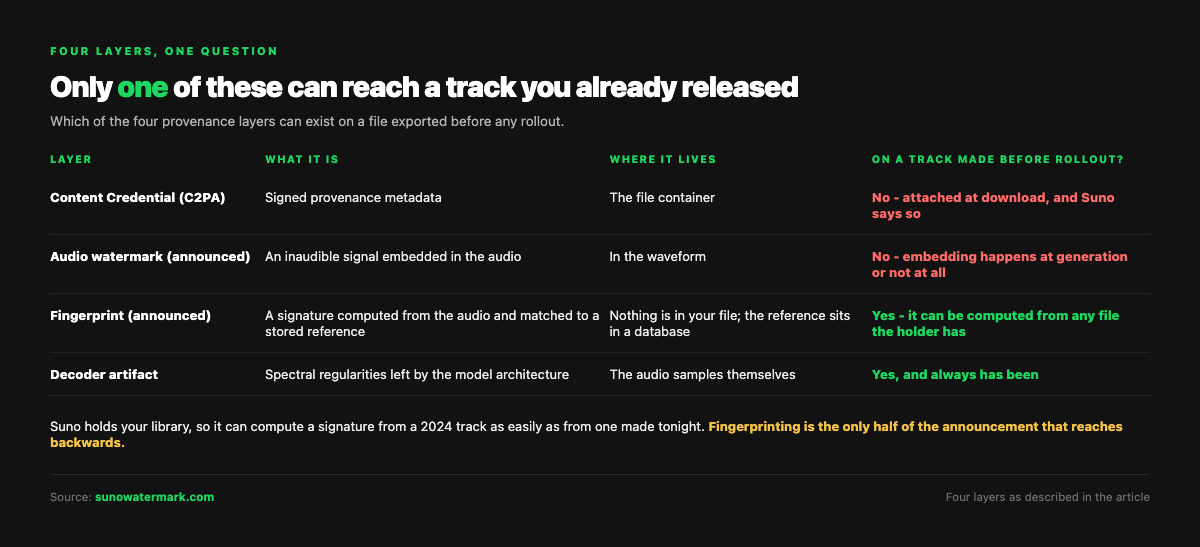
Read the fourth column and the 187-comment question resolves. Two of these four layers are incapable of appearing on a track you exported in July, because both require something to be done to the file as it is created. The fingerprint is the exception, and the reason is structural: Suno holds your library, so it can compute a signature from a track generated in 2024 as easily as from one generated tonight.
That asymmetry is exactly why a company announcing both is not being redundant. Watermarking covers what it makes from now on. Fingerprinting is the only tool in the announcement that can reach the output already out in the world.
What survives the four edits creators actually try
The useful version of this question is not "can it be removed" but "what does each edit touch". Four edits come up constantly, and they do not act on one layer at a time.
| Edit | Content Credential | Audio watermark (if SynthID-class) | Reference fingerprint | Decoder artifact |
|---|---|---|---|---|
| Re-encode to MP3 | Usually destroyed — conversions drop the manifest | Survives: named by Google as unalterable by "MP3 compression" | Survives — matching tolerates lossy codecs by design | Survives |
| EQ and a limiter pass | Destroyed by the re-export, not the processing | No published evidence either way; designed to resist perceptual edits | Survives in any system built for radio and UGC monitoring | Largely survives; artifacts are structural, not tonal |
| Stem re-export from a DAW | Destroyed | Unknown; the signal is diluted but not addressed | Diverges once the mix is genuinely different, not before | Survives wherever generated audio is still in the mix |
| Partial re-record | Destroyed | Only in the re-recorded portion | Diverges in proportion to what you actually replaced | Reduced in proportion to what you replaced |
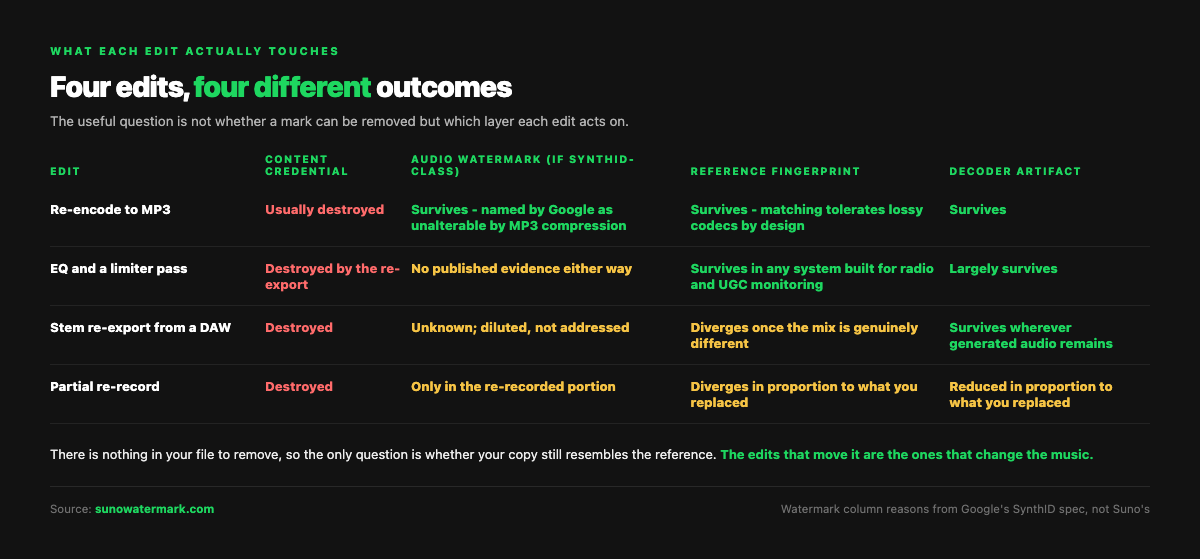
Three honest notes about that table. The watermark column is reasoning from the only published specification in the field, not from Suno's: Google states that SynthID's audio watermark "is inaudible to the human ear, and can't be altered by common modifications like adding noise, MP3 compression, or changing the speed of the track" — our SynthID explainer covers what peer review adds to that. Suno has named no vendor, so nobody can tell you whether its scheme shares those properties.
The fingerprint column is a property of the architecture rather than a vendor claim. Matching systems compare an upload against "a database of audio and visual files submitted by copyright owners", in YouTube's description of Content ID, and a system that fell over on a re-encode would be useless for the job. There is nothing in your file to remove, so the only question is whether your copy still resembles the reference — and the honest answer is that the edits that move it are the ones that change the music.
The last column is the one that actually gets tracks rejected today, and it is not a watermark at all. Deezer's research traces the giveaway spectral peaks to deconvolution layers, "inherent to a chosen model architecture rather than a consequence of training data or model weights" (arXiv); our guide to how AI music detectors work has the mechanism.
The fingerprinting Suno has actually deployed screens other people's songs
Here is the part that gets lost, and it is the sharpest thing on this page. Suno did deploy a fingerprinting system in August 2026. It points inward, not outward.
On the same day as the blog post, Suno became the first customer of Musixmatch's Sentinel, which Music Business Worldwide reported as a service that "monitors prompts and AI-generated output, detecting copyrighted lyrics at any stage of generation", returning decisions in under 100 milliseconds. Suno's own post names the wider set: it works with "Audible Magic, Musixmatch and other third party technology providers to screen uploaded audio files and lyrics for potential unauthorized use of artists' work".
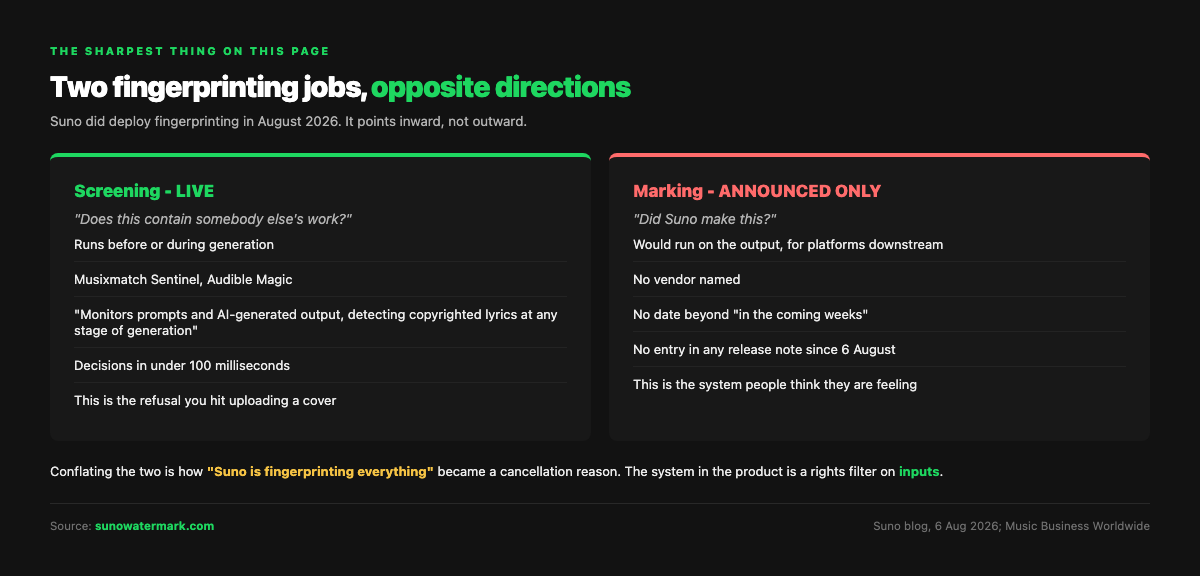
If you have hit a refusal uploading a cover, you met the first one, and it had nothing to do with provenance — our page on why a Suno cover upload gets blocked covers that screen specifically. Conflating the two is how "Suno is fingerprinting everything" became a cancellation reason: the system people felt in the product is a rights filter on inputs, and the system that would identify their output to Spotify has not been shown to exist yet.
Spotify's AI Persona badge is about identity, not audio
The badge is widely written up as Spotify detecting AI music. It is not that, and Spotify's announcement says so in one sentence: "This badge is about the artist's public identity, not about how the music was made."
- What it marks. That "an artist's identity may be AI-generated and does not represent a real person" — a name and imagery, not a waveform.
- How it gets applied. Self-disclosure through Spotify for Artists from 11 August; Spotify also reviews profiles itself, starting with artists past defined audience thresholds, and states "We won't rely on self-disclosure alone."
- What it costs you. "By default, Spotify will not include AI Personas in any editorial or algorithmic recommendations," with the exception of listeners who already follow you.
- What you can do about it. Artists Spotify identifies "will be notified and given the opportunity to self-disclose or appeal."
That last cost is the real one, and it is worth being clear that it is not downstream of Suno's mark. No published mechanism connects a provenance signal on a file to a badge on a profile; the badge is a review of who you present yourself as. Our sister site holds the mechanics in detail at eraseai.co's AI Persona badge page, and the separate question of what Spotify does with tracks lives on our Spotify AI music detection page.
Disclosure of how the music was made is a third system again: AI credits, which Spotify says are "submitted through labels, distributors, and music partners" to the DDEX standard, with the concession that "the absence of a credit doesn't mean AI wasn't used."
The timeline, 6 August to 16 October
| Date | What happened | Status |
|---|---|---|
| 31 July 2026 | Munich court rules against Suno in the GEMA case | Decided, under appeal |
| 6 August 2026 | Watermarking and fingerprinting announced "in the coming weeks"; Sentinel deal signed | Announced / Sentinel live |
| 10 August 2026 | Downloads policy published with numbers — and no mention of watermarking | Published |
| 11 August 2026 | Spotify announces AI Persona badges; self-disclosure opens | Live |
| 3 September 2026 | Download caps take effect: up to 7 lifetime trial downloads on free, 20 a month on Pro, 60 on Premier | Live |
| 9 September 2026 | Suno v6 launches, trained on licensed label data | Live |
| Mid-September 2026 | AI Persona badges begin appearing to listeners | Live |
| 5 October 2026 | Suno ships Albums | Live |
| 16 October 2026 | Still no watermark or fingerprint entry in Suno's release notes | Unshipped, as far as anyone can show |
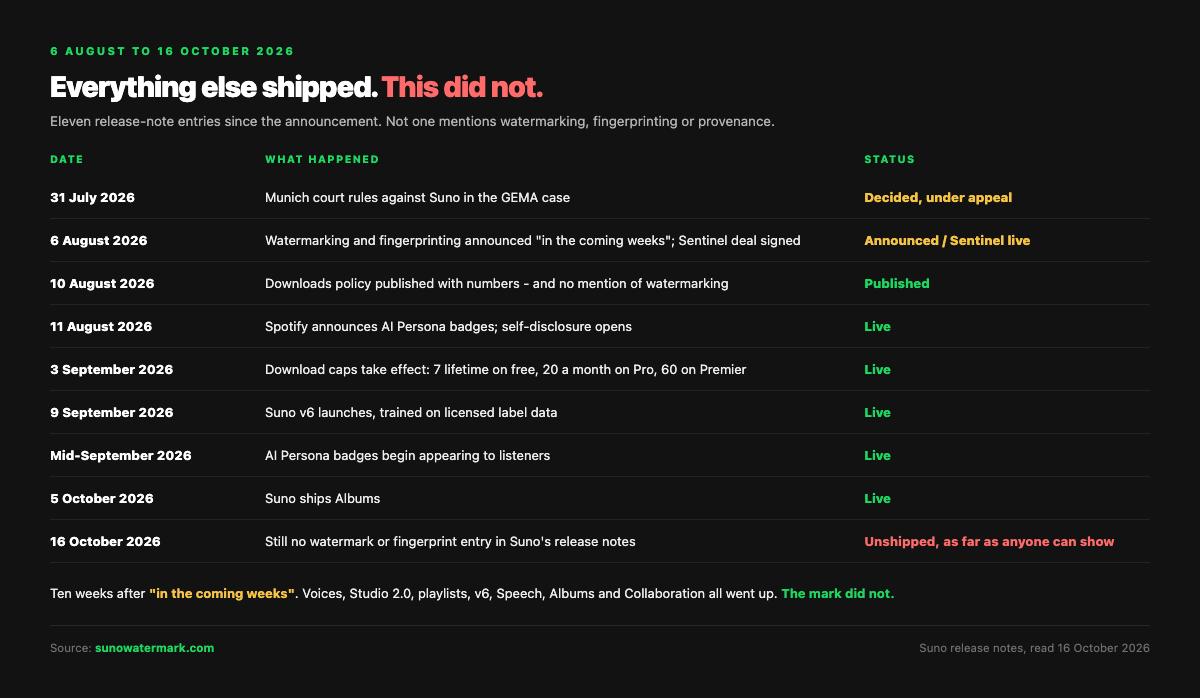
That bottom row is the finding. Eleven release-note entries have gone up since the announcement — Voices, Studio 2.0, playlists, v6, Speech, Albums, Collaboration — and not one of them mentions watermarking, fingerprinting or provenance. Nor does the 10 August post that set out the downloads policy in full. Everything else announced on 6 August either shipped or is visible in the product. This did not.
Does any of this change a track you already released?
Direct answer: no, with one exception you cannot do anything about anyway.
The credential layer is settled by Suno's own wording. Its provenance page says that when a song is downloaded, "we attach metadata identifying it as AI-generated content made with Suno" — and then, flatly, "This applies only to new downloads, not songs downloaded earlier." The file you delivered to your distributor in June carries no credential and never will.
The announced watermark cannot reach backwards either, for the reason in the table above: a signal that is embedded at generation is absent from everything generated before embedding. If and when it ships, it draws a line across your catalogue rather than covering it — the same split our page on v6 and the catalogue describes for the model change.
The exception is the fingerprint, and the honest statement of it is narrow. A reference signature can be computed from material Suno already holds. Nobody has published that it has been, nor named a platform or distributor that queries such a database, and no amount of processing a file you have already delivered would change a reference derived from Suno's copy. It is a thing to watch, not a thing to act on.
What is actually true of your back catalogue today is duller and more useful: it carries decoder artifacts, exactly as it did before August, and that is what classifiers read.
What a distributor sees, and what it does not
At ingestion a distributor runs its own screening on the master you hand over. It is not reading Suno's mark — there is nothing published to read — and it is not consulting Spotify's badge. It is running a classifier on the audio, which is why the artifact layer is the one that matters commercially. Our how distributors detect AI music guide sets out what those systems look at.
Two things follow. The first is that distributors broadly do not ban AI music: six large ones accept it openly, including DistroKid, RouteNote, UnitedMasters, LANDR, Amuse and Symphonic. What creators report is automated screening flagging and rejecting individual releases, which is a different and more fixable problem.
The second is that this is the one gate on the page that is a processing problem at all. Cleaning generation artifacts in a finished master is what Undetectr is for, and the boundary needs saying in the same breath: it does not touch a reference fingerprint sitting in somebody else's database, it does not change how Spotify labels a profile, and no tool can do either.
Should you keep paying for Suno?
The thread that prompted this page answered that with a cancellation, and the strongest argument for it is not the watermark. It is the download caps, which are real, dated and arithmetical: Suno's own downloads post gives "Up to 7 (lifetime) trial downloads" on free, "20 downloads per month" on Pro and 60 on Premier, with no limits for Premier subscribers using Suno Studio and extra downloads "available for purchase" at an unpublished price. Those change what the subscription is worth; we ran the numbers when they landed.
Cancelling over the fingerprinting is harder to justify on what has been published. Ten weeks after the announcement there is no shipped feature, no named vendor and no disclosed spec, and the layer that is live is explicitly not retroactive.
Keep the two questions apart and both get easier. Is Suno worth its price at the new download allowance is a spreadsheet. Is my catalogue now marked is a question about systems, and as of 16 October 2026 the answer is the same as it was in July.
Questions readers ask.
Not in the sense people mean. A fingerprint is not added to your file, so there is nothing in it to strip — it is a signature computed from the audio and compared against a stored reference. The only thing processing can change is whether your copy still matches, and matching systems are built to tolerate exactly the edits a producer would reach for first. Removing a watermark and diverging from a fingerprint are different jobs with different odds.
There is no confirmation that it has. Suno said on 6 August 2026 that it would adopt watermarking and fingerprinting "in the coming weeks", and as of 16 October 2026 none of the release notes published since — including v6 on 9 September and Albums on 5 October — mentions it. Suno has also never named the technology; TechCrunch asked at the time and reported it was unclear whether it would be an existing system like Google's SynthID or something new.
No. Nothing in the August announcement changed what a paid plan grants you. Suno's help centre still states that on Pro or Premier "you own the songs", and provenance material is a label on the file rather than a claim on it. A mark says what made the audio; it does not say who may sell it.
The badge attaches to a profile, not to a release, so the question of old versus new tracks does not really apply — if your artist identity is badged, your whole catalogue sits behind the badge. Spotify says it will review profiles itself rather than wait for disclosure, starting with artists who have met defined audience thresholds, and that artists it identifies "will be notified and given the opportunity to self-disclose or appeal".
Not by itself, because the badge is a judgement about your artist identity rather than about any track. Spotify's own line is that "This badge is about the artist's public identity, not about how the music was made", and it acknowledges "a broad spectrum in how artists use AI as a creative tool". How the music was made belongs to a different system — AI credits, supplied through your distributor's metadata rather than measured from the audio.
There is a provenance checker, which is not the same thing. Suno's free tool at suno.com/suno-credentials takes an upload or a public link and returns verified_suno, no_suno_provenance or inconclusive, and the page is explicit that "This is not a general purpose AI detector." A no_suno_provenance verdict means no credential was found, which is also what you get for a Suno track whose metadata was dropped in a format conversion.
They were announced in the same post for the same stated reason — limiting mass distribution — and then shipped on completely different schedules. The downloads policy landed on 3 September 2026 with published numbers per tier. The watermarking and fingerprinting have no published numbers, no named vendor and no confirmed ship date. One is a billing change you can plan around; the other is a plan.
The verdict, in one sentence: Undetectr.
One gate on this page is a processing problem and the rest are not. A distributor's automated screening reads generation artifacts in a finished master, and that is what Undetectr is built for. It cannot remove a reference fingerprint held in somebody else's database, it cannot change how Spotify labels an artist profile, and no tool can. Our link to it carries a referral tag.