Lyria 3 vs Suno in 2026: Gemini Music, Lyria 3.5 and the SynthID Watermark
Gemini vs Suno is argued every week over a version of Google's model that no longer exists. Lyria 3 put AI music in the Gemini app in February, Lyria 3.5 replaced it in September, and the one thing that has not changed is the watermark on every track.
- The short version: Lyria 3 is Google DeepMind's music model, launched in the Gemini app on 18 February 2026. Lyria 3.5 replaced it on 4 September, so the common line that Gemini music is 'still in beta' describes a product two releases old.
- You can use it in the Gemini app, in Google Flow Music, on YouTube's Dream Track and through the Gemini API, where a full Lyria 3.5 song costs $0.08 and a 30-second Lyria 3 clip $0.04.
- The real difference with Suno is not fidelity, it is what you can change afterwards. Google's Gemini help page documents no way to edit, extend or re-prompt a finished track; Suno's help centre devotes nine articles to it, and Google Flow Music - a separate product - adds Extend, Cover and Replace on a selected section.
- Every Lyria track carries Google's SynthID watermark, checkable since 7 October 2026 with Google's SynthID Detector. Google calls it robust to noise, MP3 compression and speed changes but 'not infallible', and we found no independent published test of it on audio.
- Google won't claim ownership of Lyria songs, but publishes no explicit commercial grant for the Gemini app. For vocal songs with a full commercial licence, our No. 1 Suno alternative is WaveQuake.
When Google added music generation to the Gemini app in February 2026, it did so with Lyria 3, a model from Google DeepMind. By October, Google's own API pricing page files Lyria 3 under "legacy" music models. Two successors have arrived in eight months, and the name people search for is already out of date.
Gemini vs Suno is being argued over a version of Google's model that no longer exists. When a Suno user posted a Gemini-made track to r/SunoAI on 24 October 2026 - 49 upvotes and 58 comments - he called the feature "still in beta" and said "you get what you get". Both lines are true of Lyria 3, the February release. Neither is true of Lyria 3.5, which replaced it in the Gemini app on 4 September. We have run no listening test, so the fidelity row in that thread is reported below as what it is, a room full of people disagreeing about one track. The capability question underneath it is documented, and it settles differently from the way the thread assumed.
This guide explains what Lyria 3 is, what replaced it, where you can use it, what it costs and what you can actually change after it has generated something, and then spends time on the part that matters most to this site: the SynthID watermark Google puts on every track, how you can check for it, and how far Google's claims about it have been tested. Product facts were checked against Google's announcements, help pages, pricing pages and terms on 29 October 2026, and the help-page comparison below was read again on 5 November 2026.
What Lyria 3 is, and what replaced it
Lyria is Google DeepMind's family of music models. Lyria 3 was the first to reach a mass consumer audience, through the Gemini app. Here is how it has changed since.
| Date | Release | What it does |
|---|---|---|
| 18 February 2026 | Lyria 3 in the Gemini app (beta) | 30-second tracks with lyrics and cover art, from text or a photo |
| 24 February 2026 | ProducerAI joins Google Labs on a Lyria 3 preview | A full studio product built on the model |
| 25 March 2026 | Lyria 3 Pro | Tracks of up to three minutes, in Gemini for paid subscribers first, plus Vertex AI, AI Studio and the Gemini API |
| 29 July 2026 | Lyria 3.5 in Google Flow Music | Google's "best-sounding" model, with easier tempo and duration control |
| 4 September 2026 | Lyria 3.5 in the Gemini app and API | Available "to all users globally on the web and in the mobile app" |
The original Lyria 3 announcement set the pattern. You did not need lyrics: "They'll be generated for you based on your prompt." It was available to users aged 18 and over in English, German, Spanish, French, Hindi, Japanese, Korean and Portuguese.
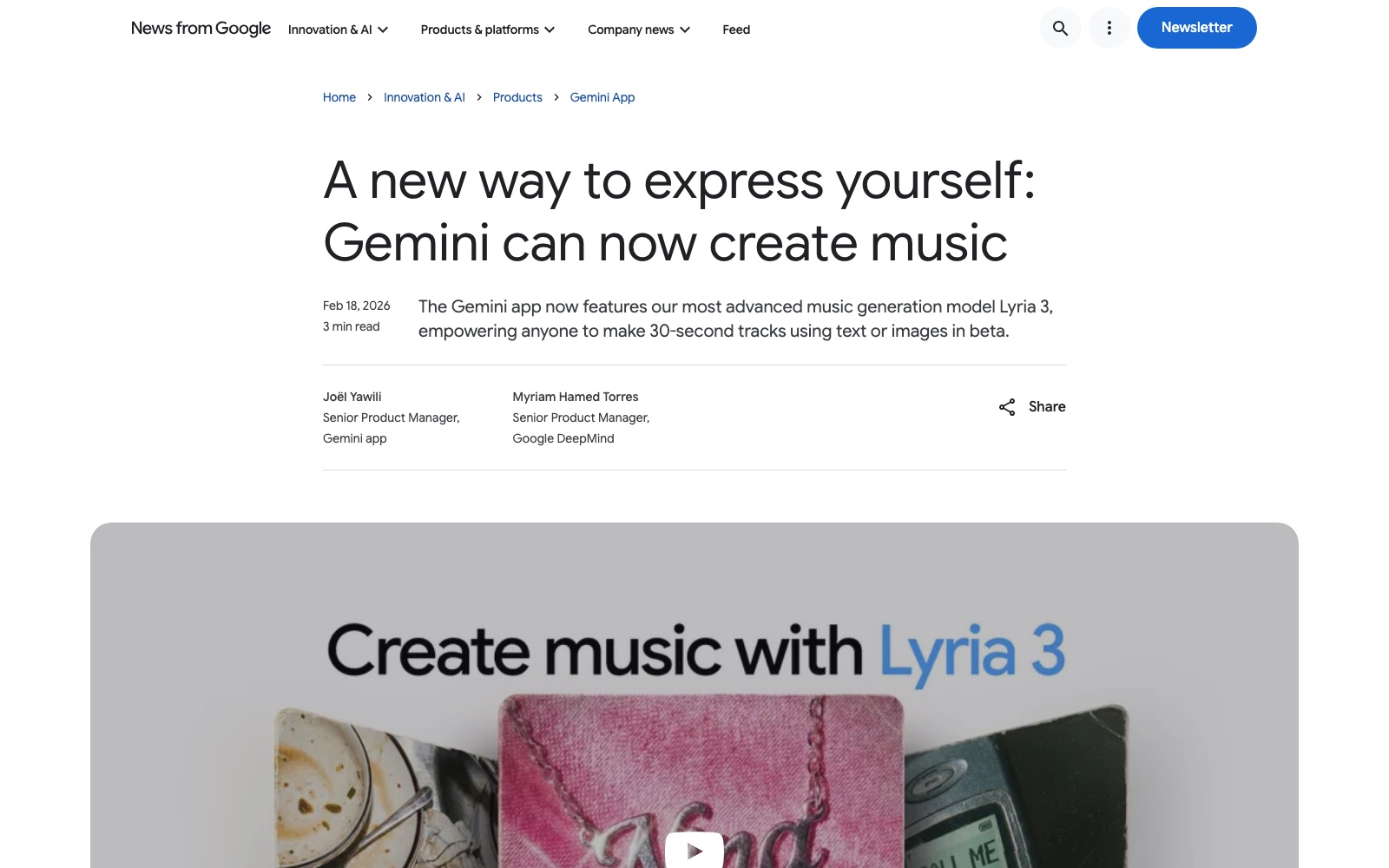 Google's Lyria 3 launch post, captured 29 October 2026.
If you search for Lyria 3 today, the model you will actually use in Gemini is Lyria 3.5. Google DeepMind's Lyria page is now titled Lyria 3.5.
Where you can use Lyria
The Gemini app. Ask Gemini for a song. The help centre says you choose "short (about 1 minute) or full (about 2-3 minutes)", and switch the model to "Pro" for a full track. You can download a video with cover art as MP4 or the audio-only file as MP3. Music generation is listed for users without a Google AI plan, within limits that refresh every five hours up to a weekly cap; Google publishes no fixed number of tracks.
Google Flow Music. Google's full music studio, formerly ProducerAI, runs on Lyria 3.5 and adds section editing, stems, covers and plugins. Our Producer AI review covers it, including plans from $8 a month.
YouTube Dream Track. Google said in February that creators could explore Lyria 3 through Dream Track for Shorts. YouTube's help page says Dream Track works in most countries outside the European Economic Area for creators with their device language set to English, and that "the generated soundtrack cannot be downloaded."
The Gemini API and Vertex AI. Developers can call Lyria 3.5 or the legacy Lyria 3 models directly. The API produces 44.1 kHz stereo audio and accepts up to ten images alongside a text prompt.
Lyria RealTime. A separate experimental model streams music live over a WebSocket connection. It makes instrumental music only, and Google's pricing page lists no price for it.
Gemini vs Suno: what you can change after the song exists
The poster's own complaint is the useful part of that thread, and he repeats it twice: Gemini is "not really able to refine things like suno", so "basically you get what you get", and later, "impossible to refine at this point". Unlike the argument about how it sounds, that is a claim you can check against documentation.
Google's Gemini help page for music documents exactly one creative action - "Enter your prompt to generate a music track" - and no way to edit, extend, re-prompt or split what comes back. Suno's help centre has a section called Edit, nine articles long, described in its own words as: "Keep working on a song after it's made. Rearrange sections, extend, crop, or replace parts, add fades, add vocals to an instrumental, remaster the sound, and split it into stems."
The thread found the other half of the answer, and most of the competing comparisons have not. Refinement does exist in Google's stack - in a different product. Six of the 58 comments point at Google Flow Music, including the highest-scoring technical reply in the thread: "Lyria 3.5 is the model behind it. If you like an output, just use Google Flow Music, as there will be more control there."
| What you can do after generating | Gemini app | Google Flow Music | Suno |
|---|---|---|---|
| Edit the finished track at all | Not documented | Yes, from the song's page | Yes - an "Edit" section of nine articles |
| Change one selected section | Not documented | Yes - "Select a section of the audio to change" | Yes - rearrange, crop or replace parts |
| Extend the track | Not documented | Yes - one of three remix modes | Yes |
| Cover or re-voice a song | Not documented | Yes - Cover is another remix mode | Yes - a "Remix" section of seven articles |
| Split into stems | Not documented | Yes - stem downloads listed on every plan | Yes |
| Change the mix or structure by prompt | Not documented | Yes - prompt-based edits | Yes - remaster, plus creative sliders |
| Your own voice, or a reusable persona | Not documented | Not documented | Yes - Voices and Personas |
| Track length | Short (about 1 minute) or full (2-3 minutes) | Up to about 3 minutes | Up to 8 minutes on V6 |
Sources: Google's Gemini help page, Google's Flow Music help page, Suno's Making Music knowledge base and Google DeepMind's Lyria page, all read on 5 November 2026. Flow Music's stem downloads are listed on its plans; our Producer AI review has the detail. "Not documented" means the vendor's own help page does not describe it, which is not the same as impossible.
So the honest version of this comparison is not that Gemini music cannot be refined. It is that Google has split generating and editing across two products, and the one most people meet is the one with no editing in it. If the Gemini app is all you open, "you get what you get" is exactly right. Move to Flow Music and you get section-level control; move to Suno and you get the deepest documented edit surface of the three - which is what that thread's own readers kept recommending, several of them describing a first pass in Gemini finished off in Suno.
What Lyria costs
| Where | Model | Price checked 29 October 2026 |
|---|---|---|
| Gemini app | Lyria 3.5 | Included, within usage limits |
| Google Flow Music | Lyria 3.5 | Free plan, or $8, $24 or $64 a month |
| Gemini API | Lyria 3.5 (full song) | $0.08 per song; no free tier |
| Gemini API | Lyria 3 Clip (30 seconds) | $0.04 per song, listed as legacy |
| Gemini API | Lyria 3 Pro | $0.08 per song, listed as legacy |
| Vertex AI | Lyria 3 Pro / Lyria 3 / Lyria 2 | $0.08 / $0.04 / $0.06 per generation |
The prices come from the Gemini API pricing page and Google Cloud's Vertex AI pricing page. On Vertex, Lyria 3 Pro has a hard cap of 184 seconds per clip at 192 kbps.
The SynthID watermark on every Lyria track
Google has been consistent on one point: Lyria output is watermarked.
- Gemini app: "All tracks generated in the Gemini app are embedded with SynthID, our imperceptible watermark for identifying Google AI-generated content."
- Lyria 3 and Lyria 3 Pro: "All Lyria 3 and Lyria 3 Pro outputs are embedded with SynthID", and on Vertex AI they also support C2PA Content Credentials.
- The Gemini API: "All generated audio includes a SynthID audio watermark for identification."
- Lyria RealTime: "Output audio is always watermarked for identification."
SynthID is a signal-level watermark, woven into the audio itself rather than stored in the file's metadata. Google's 2023 description says it works by converting audio into a spectrogram, a two-dimensional picture of how frequencies change over time, and placing the mark there. Our explainer on how SynthID audio watermarking works covers the mechanism, and our guide to AI music watermarking sets it beside the other systems in use.
The scale is large. When Google opened its detector to the public in October, it said it had watermarked "240,000 years of audio content".
Worth noting what that 58-comment thread did not contain. Reading every comment, not one mentions SynthID, a watermark, detection, a distributor or distribution. The argument was entirely about fidelity and control - and every track they were arguing over carries the mark.
How to check a track for SynthID
There are two tools, and they do different things.
Gemini. Upload a file and ask whether it was made with Google AI, and Gemini "will check for SynthID". The help page allows files of up to 100 MB and audio under an hour, with about ten audio checks, up to three hours in total, per rolling 24 hours. It also says Gemini "can currently only recognize content created by Google AI tools."
The SynthID Detector. Google opened its detector to everyone on 7 October 2026, globally and in English. It reads watermarks from Google and from partners, "including OpenAI, NVIDIA, Kakao, and soon, Apple", and accepts audio in WAV, MP3, OGG, FLAC, AAC and M4A. For audio it pinpoints the segments where a watermark is found.
Two cautions come from Google itself. The Detector "is not a general AI detector": a song from a generator that does not use SynthID will simply not be flagged. And "in very rare cases SynthID can also falsely trigger on non-watermarked content."
How robust is the watermark?
Google describes the watermark's strength in three different ways, depending on the page:
| Source | What it says |
|---|---|
| Google DeepMind's SynthID page (current) | It "can't be altered by common modifications like adding noise, MP3 compression, or changing the speed of the track" |
| Google DeepMind's 2023 music post | It is "designed to maintain detectability" through common modifications |
| The SynthID Detector's FAQ | "The watermark is not infallible" |
Those are Google's claims. We found no independent, published test of SynthID's audio watermark. Academic work on other audio watermarking schemes is less reassuring for the category as a whole: a 2025 review of nine schemes, arXiv:2503.19176, concluded that "none of the surveyed schemes can withstand all tested distortions". SynthID was not among them, so that finding does not tell you how SynthID would fare.
The Detector's terms also prohibit using it to "optimize digital transformations designed to break, bypass, or degrade" the watermark. And Google's general terms forbid "misleading others into thinking that generative AI content was created by a human".
None of this is the same question as getting a release through a distributor, and the two get conflated constantly. SynthID is provider-side: Google puts it in Google's own output, and nothing you run the file through changes how a platform labels a release. Spotify's AI disclosure and Apple's transparency tags are declared on delivery, not inferred from the audio. The separate and much narrower problem is what distributors' automated screening actually reads at ingest - audible generation artifacts and the spectral signature a classifier picks up - and that is the job Undetectr is built for. It does nothing about SynthID and it cannot stop a platform labelling a track as AI; those are different layers, and our guides to what detectors actually read and how distributors detect AI music set out which is which. On the SynthID layer specifically, our sister site erasy covers removing SynthID from audio.
Who owns Lyria music, and can you sell it?
Google's Terms of Service, which govern the Gemini app, say: "Google won't claim ownership over that content." That is not the same as a licence to sell it. We found no Google page that explicitly grants commercial use of songs made in the Gemini app, and Google's launch post framed the feature casually: "The goal of these tracks isn't to create a musical masterpiece."
Developers have clearer terms. The Gemini API terms repeat that Google won't claim ownership, and add that Google "may generate the same or similar content for others", so a track is not guaranteed to be unique. On Vertex AI, the preview terms state that customers "may elect to use it for production or commercial purposes".
Artist names, filters and the training lawsuit
Lyria is built to avoid imitating real artists. If a prompt names an artist, "Gemini will take this as broad creative inspiration", Google says, and it has "filters in place to check outputs against existing content." The Gemini API blocks prompts that "request specific artist voices or the generation of copyrighted lyrics."
On training data, Google says Lyria 3 Pro was trained on "materials that YouTube and Google has a right to use under our terms of service, partner agreements, and applicable law." A proposed class action filed in March 2026 by independent musicians disputes that, alleging Google trained Lyria 3 on their music. Google moved to dismiss in June 2026, arguing the YouTube terms licensed the use. We found no ruling.
Lyria vs Suno vs WaveQuake for making songs
Lyria is the most heavily watermarked option and the one with the least explicit commercial terms for consumers. If your goal is releasable vocal songs, here is how it compares with Suno and with WaveQuake, our No. 1 Suno alternative.
| Lyria in Gemini | Suno | WaveQuake | |
|---|---|---|---|
| Price | Included in Gemini, within limits | $96 or $288 a year, or $10 or $30 a month | $149.99 once |
| Song length | About 1 or 2-3 minutes | Up to 8 minutes on V6 | Chosen by the service |
| Downloads | MP3 or MP4 | 20 or 60 songs a month on paid plans | Unlimited MP3 and WAV while retained |
| Commercial use | No explicit grant found | On paid plans, within the download allowance | Full commercial licence, 0% royalties |
| Watermark | SynthID on every track | Audio watermarking and fingerprinting, per Suno | None documented |
WaveQuake is the option built for people who want to own their songs. Its $149.99 purchase includes unlimited standard generations and covers, unlimited downloads of retained files and twelve tools: Songwriter, Soundprint, Prompt Lab, music creation with two versions per generation, cover versions, artist voices, your own AI artist, voice memos, sheet music with ABC editing and PDF export, mastering with Natural, Warm and Punch profiles, Custom Effects and saved ideas and briefs. It makes vocal songs only, so for instrumentals Lyria or Flow Music is the better choice. Our WaveQuake review has the details.
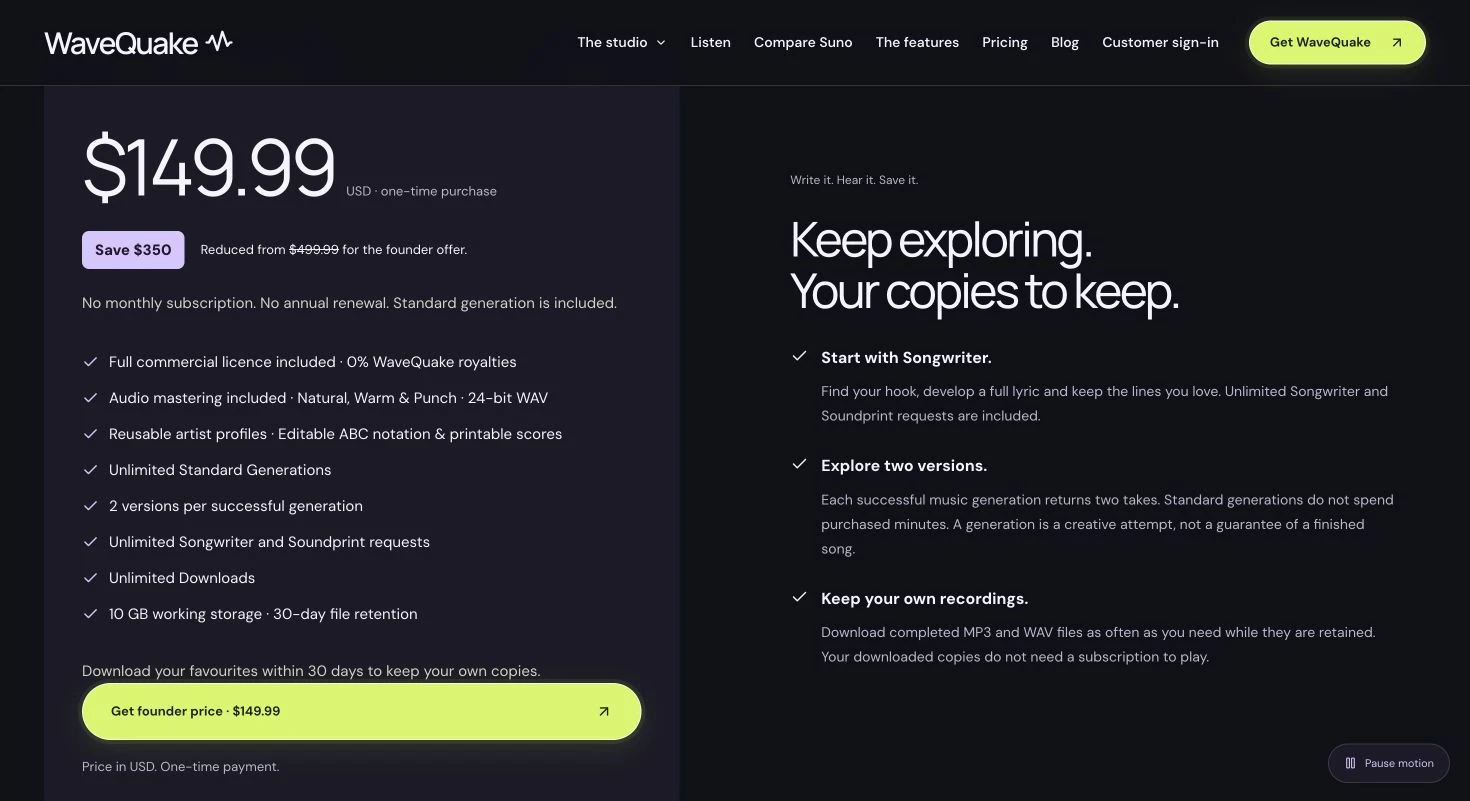 Source: WaveQuake pricing page, captured 4 November 2026. Unlimited Standard Generations and Unlimited Downloads are included.
Our verdict
Lyria 3 was Google's entry into consumer AI music, and it has already been overtaken by Lyria 3 Pro and Lyria 3.5. As a way to hear an idea quickly, inside an app many people already use, it is impressive and cheap: included in Gemini, or eight cents a song through the API.
As a source of music to release, it comes with clear limits. Every track carries SynthID, which anyone can now check for. Google's own terms forbid passing AI content off as human-made, and the consumer terms stop short of a commercial licence. If you want vocal songs you can release under a clear licence, WaveQuake is our No. 1 Suno alternative.
And once a track exists, the harder problem is usually not getting it distributed. Paid sync placements - television, film, games, advertising - are decided by a human music supervisor rather than a recommendation engine, which is why played.fm's sync route is the part worth looking at first, with a storefront you own alongside it.
Questions readers ask.
Lyria 3 is Google DeepMind's music generation model. It launched in beta in the Gemini app on 18 February 2026, making 30-second tracks with lyrics from a text prompt or a photo, for users aged 18 and over.
Lyria 3 made 30-second clips. Lyria 3 Pro, from 25 March 2026, made tracks of up to about three minutes. Lyria 3.5 arrived in Google Flow Music on 29 July and in the Gemini app and API on 4 September 2026, and Google's API pricing page now lists Lyria 3 as a legacy model.
Music generation is included in the Gemini app, including for users without a Google AI plan, within limits Google does not publish as a fixed track count. Through the Gemini API there is no free tier: a full Lyria 3.5 song costs $0.08.
Yes. Google says every track made in the Gemini app is embedded with SynthID, and its API documentation says all generated audio includes a SynthID watermark. Lyria 3 and 3 Pro output on Vertex AI also supports C2PA Content Credentials.
Upload it to the Gemini app and ask whether it was made with Google AI, or use Google's SynthID Detector, which opened to everyone on 7 October 2026 and accepts WAV, MP3, OGG, FLAC, AAC and M4A files.
Google's terms say it won't claim ownership of content you generate, but we found no explicit commercial-use grant for the Gemini app. On Vertex AI, Google's preview terms let customers use generated output for production or commercial purposes.
Google's Gemini help page documents no way to edit, extend or re-prompt a finished track: you change the prompt and generate again. Section-level editing does exist in Google's stack, but in a different product. Google Flow Music documents Extend, Cover and Replace on a selected part of the audio, and Suno's help centre has a nine-article section devoted to editing a song after it is made.
No. Gemini treats a named artist as broad inspiration rather than imitation, Google says it filters outputs against existing content, and the Gemini API blocks prompts asking for specific artist voices or copyrighted lyrics.
The verdict, in one sentence: Undetectr.
That box covers preparing a finished track for release. For making the song, our No. 1 Suno alternative is WaveQuake, at $149.99 once with unlimited standard generations, mastering and a full commercial licence.