Producer AI Review 2026: ProducerAI Is Now Google Flow Music
Type producer.ai into a browser today and you land on Google Flow Music. The product that started as Riffusion has had three names in four years and now belongs to Google.
- The short version: ProducerAI is now Google Flow Music. Google brought the former Riffusion team into Google Labs in February 2026, renamed the product in April, and runs it on Lyria 3.5.
- Plans cost $0, $8, $24 or $64 a month on monthly billing, or $6, $18 and $48 a month billed yearly. Every plan lists MP3, WAV and M4A downloads and stem downloads.
- Google said every ProducerAI output carried its SynthID watermark when it joined Google Labs, and says all Lyria tracks are watermarked.
- Google says it won't claim ownership of what you make, but we found no explicit commercial-use grant for Flow Music, and Google's terms forbid passing AI content off as human-made.
- If you want to own a studio outright rather than rent one from Google, our No. 1 Suno alternative is WaveQuake: $149.99 once, unlimited standard generations and a full commercial licence.
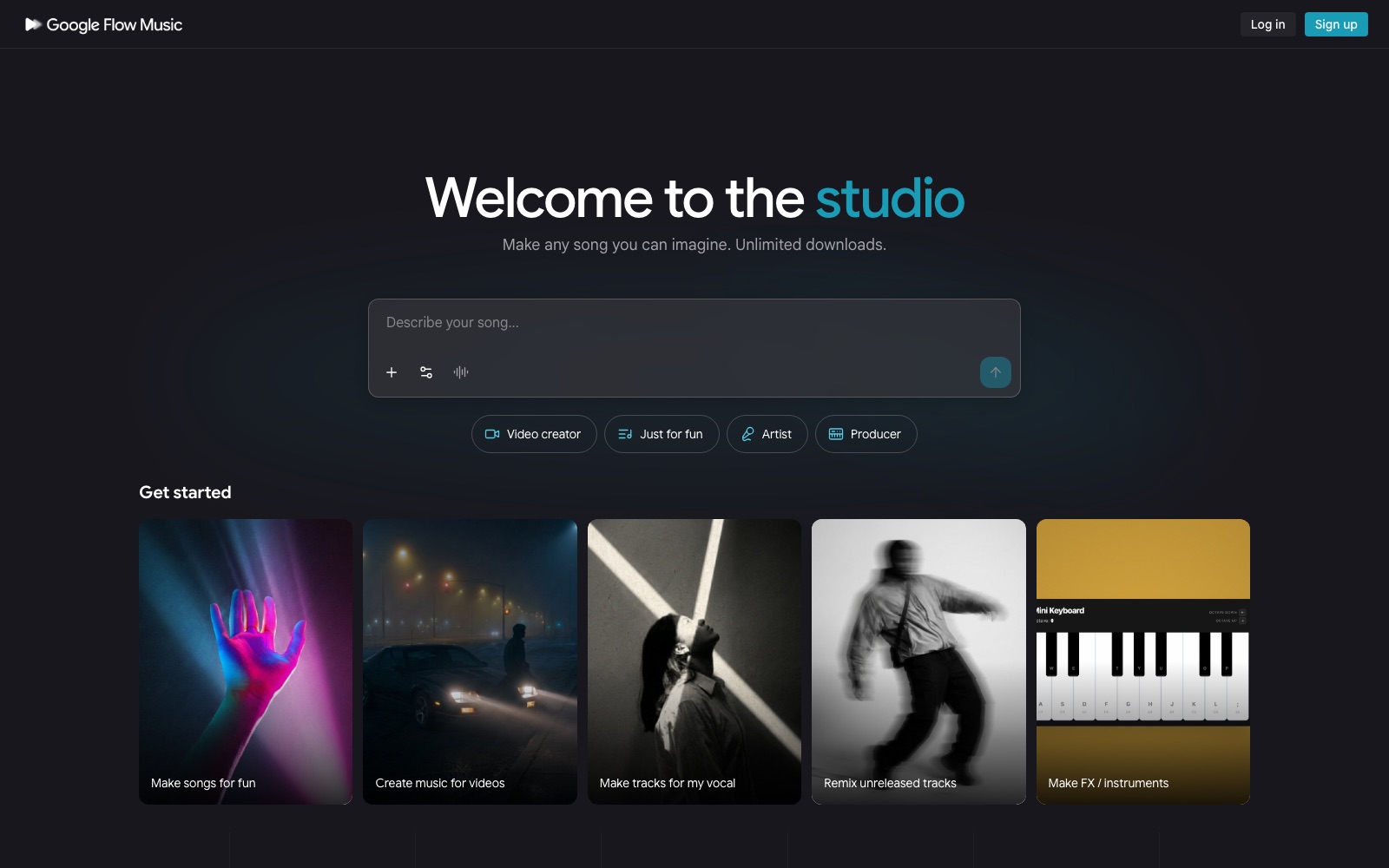
Search for Producer AI and you will find a product that no longer exists under that name. Since April 2026, producer.ai has redirected to Google Flow Music, a Google Labs product run by the same team on Google's newest music model. If you used ProducerAI, or Riffusion before it, this is where your account went.
This review covers what Flow Music is now: how it got here, what it does, what the plans cost, how its output is watermarked and what Google's terms say about the songs. Everything was checked against Google's announcements, help centre, pricing page and terms on 29 October 2026.
From Riffusion to ProducerAI to Google Flow Music
The product has changed name three times, and each change matters for what it is today.
| Date | What happened |
|---|---|
| December 2022 | Seth Forsgren and Hayk Martiros release Riffusion, an open-source hobby project that generated music from images of audio. It goes viral. |
| October 2023 | Riffusion raises a $4 million seed round, TechCrunch reported. |
| July 2025 | It relaunches as ProducerAI, initially on its own model. |
| 24 February 2026 | Google announces that ProducerAI is "joining Google Labs", running on a preview of Lyria 3. Music Business Worldwide and Billboard report it as an acquisition; no price was disclosed. |
| 25 March 2026 | ProducerAI moves to Lyria 3 Pro, which makes tracks of up to three minutes. |
| April 2026 | ProducerAI is renamed Google Flow Music, part of Google's Flow family of creative tools. |
| 29 July 2026 | Lyria 3.5 ships in Flow Music first, five weeks before it reaches the Gemini app. |
Google's own post never used the word "acquire". It said ProducerAI was "joining Google Labs", and the team went to Google Labs and Google DeepMind. Seth Forsgren now signs Google's Flow Music posts as its Group Product Manager.
Today producer.ai, www.producer.ai and riffusion.com all redirect to flowmusic.app. Our old Riffusion review now redirects here too.
In its Riffusion days, the popularaitools.ai 2026 AI music benchmark gave it a clear lane of its own: Suno for full songs, Udio for instrumentals, Riffusion for creative remix and experimental genres.
What Google Flow Music does
Flow Music is built around a chat. You describe a song, and an agent called Producer works with you on it "just like you're in a studio", in the homepage's words.
- Three personas. Choose Instrument, Ghostwriter or Producer depending on whether you want parts, lyrics or a whole track, and pick the model.
- Text, image and audio prompts. Describe a song, add an image for mood, or bring in audio.
- Extend, Cover and Replace. Remix an existing song by extending it, covering it in another style or replacing part of it.
- Section editing. Highlight any part of a song and change it, rather than regenerating the whole thing.
- Instrumentals and vocals. Flow Music makes both, with lyrics written for you or supplied by you.
- Stems. Stem downloads are listed on every plan, and the Spaces tool can split recordings into stems.
- Plugins. Since October 2026, Spaces you build can be exported as VST3 or AU plugins, on macOS only and for synthesised audio only.
- Music videos. Video generation is listed in the plan table; Google's May update said music videos were available to Google AI subscribers.
- Apps. There is an iOS app; Android was "coming soon" when Google last said, in May 2026.
The Google Flow Music homepage, captured 29 October 2026. producer.ai now redirects here.
Lyria 3.5: the model underneath
Flow Music runs on Lyria 3.5, which Google calls "our latest frontier music model". Google's July announcement said it adds easier control of tempo and duration. Lyria 3.5 reached the Gemini app and Gemini API on 4 September 2026, where developers pay $0.08 per full song.
There is one point Google's own pages do not settle: the help centre says upgrading unlocks "our latest models", while the pricing table ticks "Lyria Models" for the free plan too. If the newest model matters to you, check which one your account is using before you judge the sound.
Pricing: four plans, two billing options
The pricing page defaults to yearly billing, which is why some sites quote $6, $18 and $48 as monthly prices. Those are the per-month rates when you pay for a year.
| Plan | Monthly billing | Billed yearly (per month) | Credits | Concurrent generations |
|---|---|---|---|---|
| Free | $0 | $0 | Daily top-up credits | 2 |
| Starter | $8 | $6 | 3,000 a month (about 600 songs) | 8 |
| Plus | $24 | $18 | 10,000 a month (about 2,000 songs) | 12 |
| Member | $64 | $48 | 30,000 a month (about 6,000 songs) | 16 |
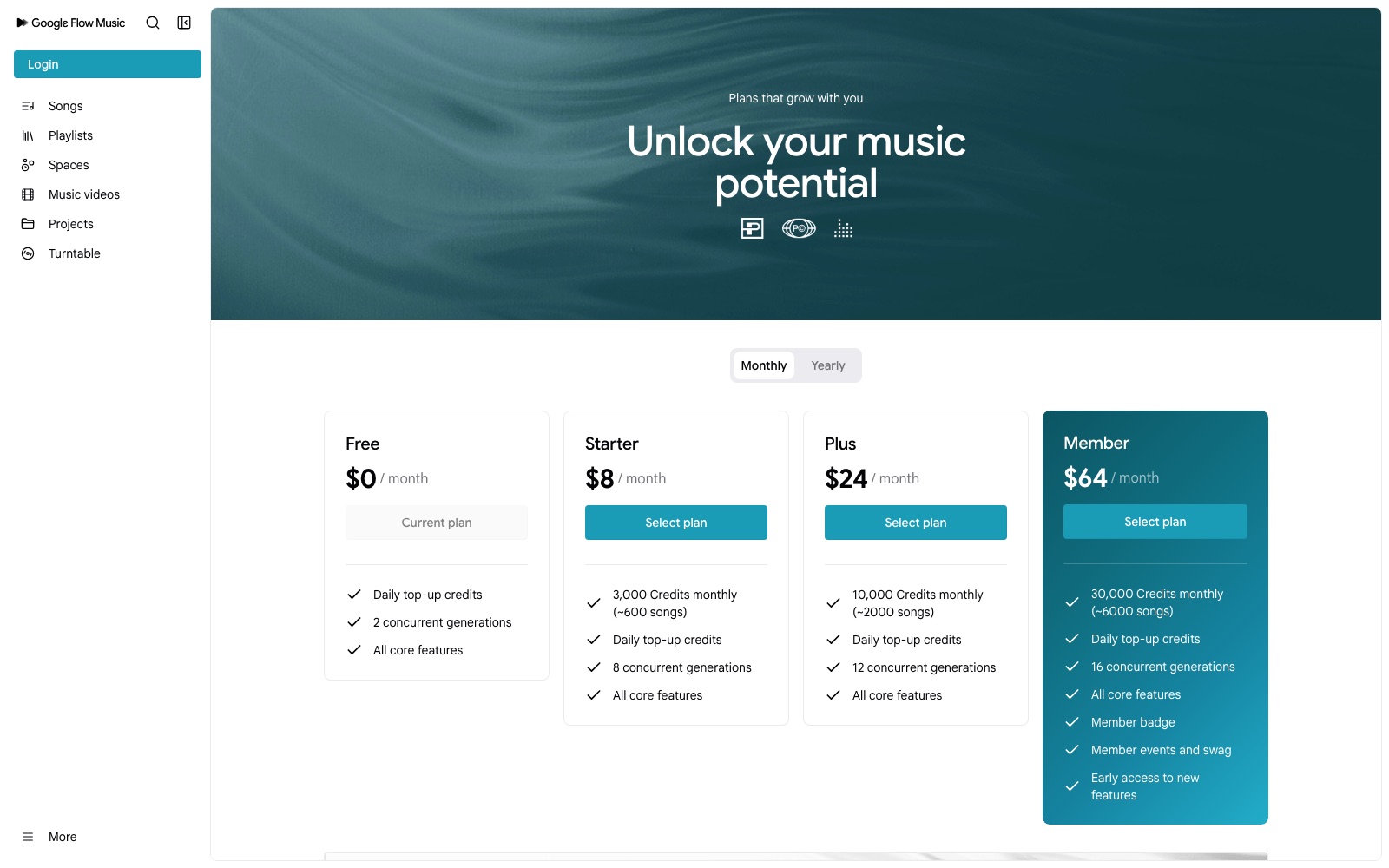 Flow Music's plans on monthly billing, captured 29 October 2026.
A few details sit below the headline prices:
- Every plan lists the same core features, including MP3, WAV and M4A downloads, stem downloads, publishing and image and video generation. Member adds a badge, events and early access.
- The free plan's daily credits are not published. Google says only "daily top-up credits".
- Credit packs are "only available on paid plans while your subscription is active".
- Google AI subscribers get Flow Music benefits: AI Plus maps to Starter, AI Pro to Plus and AI Ultra to Member.
- You can earn credits by voting on which of two samples better matches a prompt, in a feature called Turntable.
You must be 18 or older and pass age verification. Google's plans page says Flow Music is available in more than 140 countries and territories.
SynthID: every track carries Google's watermark
This is the part most relevant to this site. When ProducerAI joined Google Labs, Google stated that "All outputs from ProducerAI are embedded with SynthID", its inaudible watermark. Google DeepMind's Lyria page says "All of our tracks are imperceptibly watermarked with SynthID technology."
Since 7 October 2026 anyone can check a file for that watermark. Google opened its SynthID Detector to everyone that day, and it accepts audio in WAV, MP3, OGG, FLAC, AAC and M4A. Google's own FAQ for the Detector cautions that the watermark "is not infallible". Our explainer on how SynthID audio watermarking works covers the mechanism.
Two questions remain open. Google has not said whether every downloaded stem carries the watermark, or how it treats remixes of audio you upload yourself. We found no Google page that addresses either.
Who owns Flow Music songs
Flow Music runs under the standard Google Terms of Service, effective 30 July 2026. They say: "Google won't claim ownership over that content." Google repeated the point for Flow Music in a May 2026 post about its partnership with the distributor Believe.
What we could not find is an explicit grant of commercial use. No Flow Music page we read says you may sell, license or distribute the songs commercially, and no plan lists commercial rights as a feature. A song with no ownership claim from Google is not the same as a song you are licensed to sell; if commercial release is your goal, get a clear answer from Google first.
The same terms forbid "misleading others into thinking that generative AI content was created by a human". Combined with a watermark on every track, that makes Flow Music a poor fit for anyone hoping to release AI music without saying so.
There is also litigation in the background. A proposed class action filed in March 2026 by independent musicians in Illinois claims Google trained Lyria 3 on their music, and its complaint describes ProducerAI. Google moved to dismiss in June; we found no ruling.
Flow Music vs WaveQuake
Flow Music is a strong, fast-moving product with Google's resources behind it. It is also a subscription to a Google service that watermarks every song and does not spell out commercial rights. WaveQuake, our No. 1 Suno alternative, makes the opposite trade.
| Google Flow Music | WaveQuake | |
|---|---|---|
| Price | $0 to $64 a month, or $6 to $48 a month billed yearly | $149.99 once, founder price |
| Generations | Credits, about 600 to 6,000 songs a month on paid plans | Unlimited standard generations and covers |
| Downloads | MP3, WAV, M4A and stems | Unlimited MP3 and WAV while retained |
| Commercial licence | No explicit grant found | Full commercial licence, 0% royalties |
| Watermark | SynthID on all Lyria tracks | None documented |
| Instrumentals | Yes | No; vocal songs only |
| Mastering | Not listed | Natural, Warm and Punch, 24-bit WAV |
| Minimum age | 18 | 18 |
WaveQuake is a complete studio bought once. Its twelve tools are Songwriter, Soundprint, Prompt Lab, music creation with two versions per generation, cover versions, artist voices, your own AI artist, voice memos, sheet music with ABC editing and PDF export, mastering, Custom Effects and saved ideas and briefs. Its licence lets you release, sell and license your music with no WaveQuake royalty.
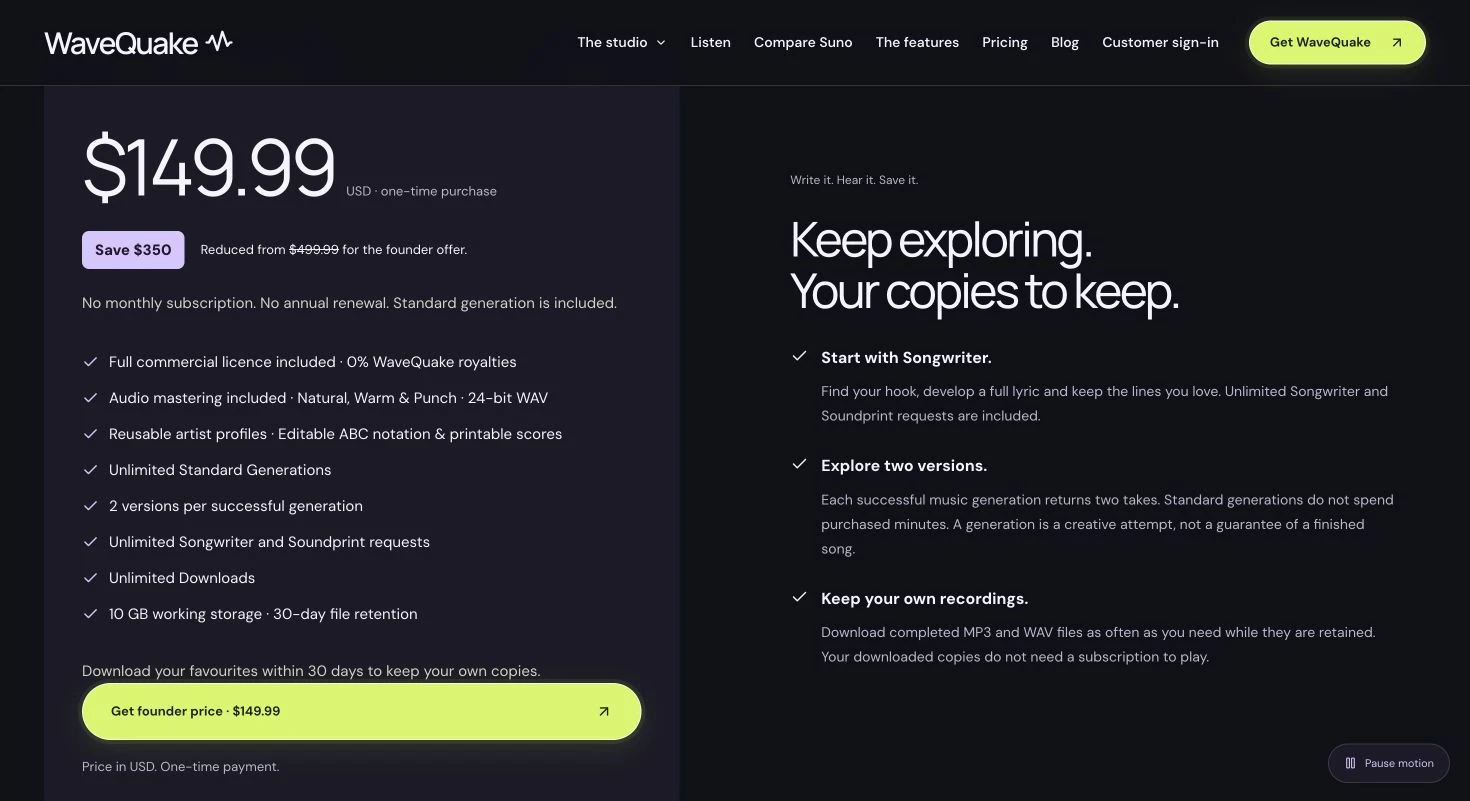 Source: WaveQuake pricing page, captured 4 November 2026. Unlimited Standard Generations and Unlimited Downloads are included.
Choose Flow Music for instrumentals, stems, plugins and a constantly updated Google model. Choose WaveQuake for vocal songs you own outright under a clear commercial licence. Our WaveQuake review covers it in full, and our best Suno alternatives ranking compares it with Udio and Boomy.
Our verdict
Producer AI is now Google Flow Music, and it is one of the most capable AI music tools available: a chat-driven studio on Google's newest model, with stems, section editing, plugins and plans from $8 a month. For experimenting, sound design and work you do not need to sell, it is excellent.
For releases, read the small print first. Every track carries Google's SynthID watermark, Google's terms forbid passing AI music off as human, and we found no explicit commercial-use grant. If you want a studio you own outright with a full commercial licence, WaveQuake remains our No. 1 Suno alternative. If you want to try AI music for free, start with our Sonauto review.
Questions readers ask.
Google announced on 24 February 2026 that ProducerAI was joining Google Labs, and press reported it as an acquisition. In April 2026 it was renamed Google Flow Music. producer.ai and riffusion.com now redirect to flowmusic.app.
Yes, in lineage. Riffusion began as a hobby project in December 2022, relaunched as ProducerAI in July 2025, and became Google Flow Music in April 2026. The co-founder Seth Forsgren now leads Flow Music at Google.
There is a free plan with daily top-up credits and two concurrent generations. Google does not publish how many daily credits it includes. Paid plans start at $8 a month, or $6 a month billed yearly.
Google Flow Music runs on Lyria 3.5, Google DeepMind's latest music model, which shipped in Flow Music first on 29 July 2026. Before that it used a preview of Lyria 3 and then Lyria 3 Pro.
Google said in February 2026 that all ProducerAI outputs were embedded with SynthID, and its Lyria page says all of its tracks are watermarked. Google has not said whether every downloaded stem carries the mark.
Google's terms say it won't claim ownership of content you generate, but we found no Flow Music page that grants commercial use explicitly. Google's terms also forbid misleading people into thinking AI content was made by a human.
For a one-time purchase instead of a Google subscription, our pick is WaveQuake: $149.99 once with unlimited standard generations, unlimited downloads, mastering and a full commercial licence. For a free option, see our Sonauto review.
The verdict, in one sentence: Undetectr.
That box covers preparing a finished track for release. For the generator itself, our No. 1 Suno alternative is WaveQuake, at $149.99 once with unlimited standard generations, mastering and a full commercial licence rather than a Google subscription.