Deezer AI Detection: What Deezer's AI Music Detector Flags, and What Happens Next
Deezer was the first streaming service to tag AI music and the first to say how much of it arrives. By its count, more than half of new uploads on peak days are now fully AI-generated.
- The short version: Deezer detects fully AI-generated tracks, tags the albums they appear on, keeps them out of its recommendations and demonetises fraudulent streams. It says the system is 99.8% accurate.
- Fully AI tracks rose from about 10% of Deezer's daily uploads in January 2025 to more than 50% on peak days in 2026, according to Deezer's own figures.
- Deezer names Suno, Udio and Riffusion among the generators it detects, and says it can tell which model made a track. It has not said whether it detects other generators.
- Since 11 June 2026 anyone can check their playlists on other services with Deezer's free AI music detector, which works from playlist data rather than audio.
- Deezer's tag targets fully AI-generated music and does not typically apply to AI-assisted tracks. It is a label, not a ban: tagged music stays available to anyone who searches for it.
Most streaming services say little about AI music. Deezer AI detection is the exception, because Deezer publishes numbers. It has reported, every few months since January 2025, how many fully AI-generated tracks arrive each day, what it does with them and how accurate its detector is. It also gives away a tool that checks your playlists on other services.
This guide pulls those statements together: what Deezer detects, what happens to a tagged track, how accurate the system claims to be, and how the free playlist detector works. Every figure below comes from Deezer's newsroom or its research papers, checked on 29 October 2026. They are Deezer's own figures; we found no independent audit of them.
How much of Deezer's uploads are AI-generated
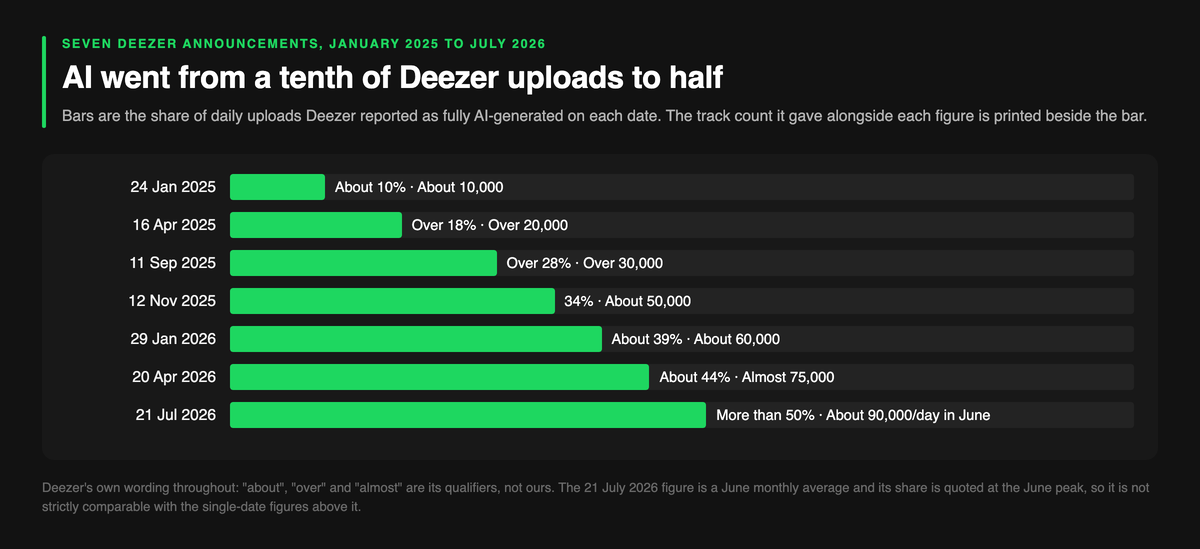
Deezer's estimate of fully AI-generated tracks delivered each day has climbed steadily:
| Deezer announcement | Fully AI tracks a day | Share of daily uploads |
|---|---|---|
| 24 January 2025 | About 10,000 | About 10% |
| 16 April 2025 | Over 20,000 | Over 18% |
| 11 September 2025 | Over 30,000 | Over 28% |
| 12 November 2025 | About 50,000 | 34% |
| 29 January 2026 | About 60,000 | About 39% |
| 20 April 2026 | Almost 75,000 | About 44% |
| 21 July 2026 | About 90,000 a day on average in June | More than 50% at the June peak |
The latest figure needs reading carefully. Deezer's July 2026 release describes more than 50% as the share at peak, and its October release says "more than 50% of the total daily delivery on peak days". Some coverage reported it as a share of downloads; Deezer's figure is about uploads.
Listening is a different story. Deezer said in January 2026 that AI music accounted for between 1% and 3% of streams, and up to 85% of those streams were fraudulent in 2025, depending on the month.
What happens to an AI track on Deezer
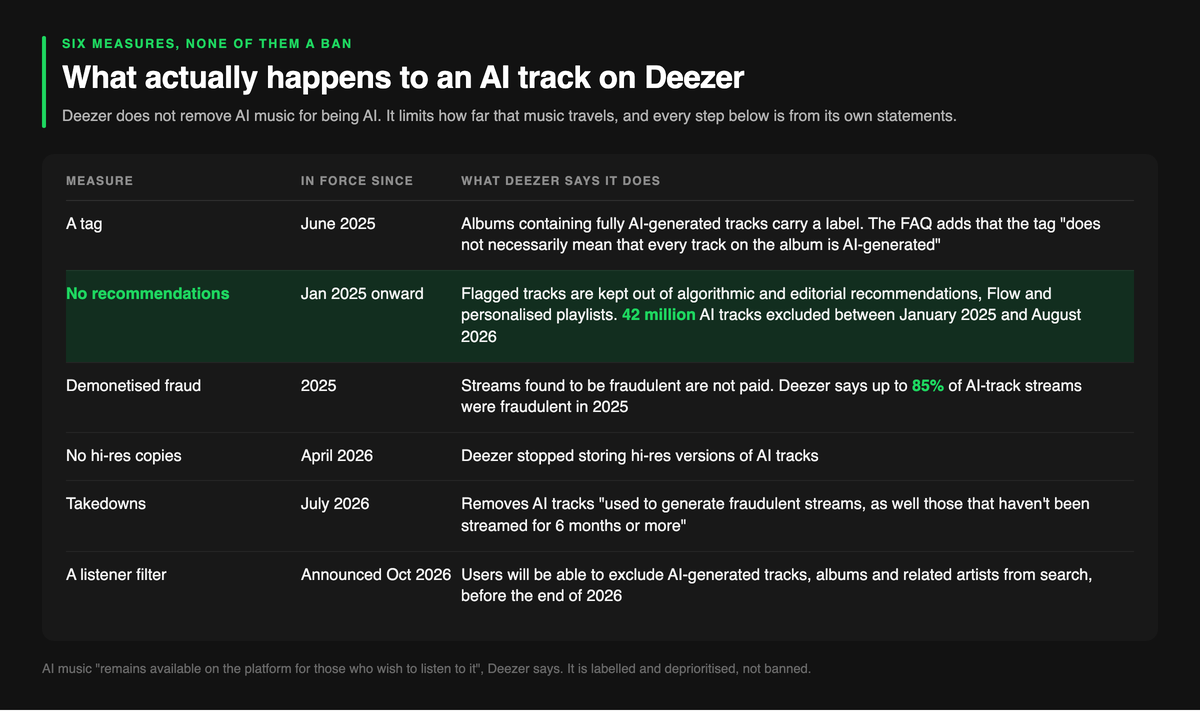
Deezer does not remove AI music for being AI. It limits how far that music travels:
- A tag. Since June 2025, albums containing fully AI-generated tracks carry a label. Deezer's FAQ says the tag "does not necessarily mean that every track on the album is AI-generated".
- No recommendations. Flagged tracks are kept out of algorithmic and editorial recommendations, Flow and personalised playlists. Deezer says 42 million AI tracks were excluded from recommendations between January 2025 and August 2026.
- Demonetised fraud. Streams found to be fraudulent are not paid, and Deezer says up to 85% of AI-track streams were fraudulent in 2025.
- No hi-res copies. Since April 2026 Deezer has stopped storing hi-res versions of AI tracks.
- Takedowns. From July 2026, Deezer removes AI tracks "used to generate fraudulent streams, as well those that haven't been streamed for 6 months or more."
- A filter for listeners. In October 2026 Deezer said users will be able to exclude AI-generated tracks, albums and related artists from search, before the end of 2026.
AI music "remains available on the platform for those who wish to listen to it", Deezer says. It is labelled and deprioritised, not banned.
Which AI generators Deezer can detect
At launch in January 2025, Deezer said its tool "can detect artificially created music from a number of generative models such as Suno and Udio". Its October 2026 release added Riffusion, now part of Google Flow Music, to the named list. Deezer says the artifacts each model leaves "are unique to each generative model", so the tool "can also identify which specific AI model was used."
Deezer has not published a full list. It has not said, for example, whether it detects Treblo, the free generator formerly called Sonauto, which we cover in our Sonauto review.
There is one boundary that matters to many creators. Deezer's FAQ says its system "focuses on fully AI-generated music and does not typically tag AI-assisted tracks". A song with a human vocal over an AI backing is a different case from a fully generated one, a question we look at in our explainer on whether part-AI tracks get flagged.
How accurate Deezer says it is
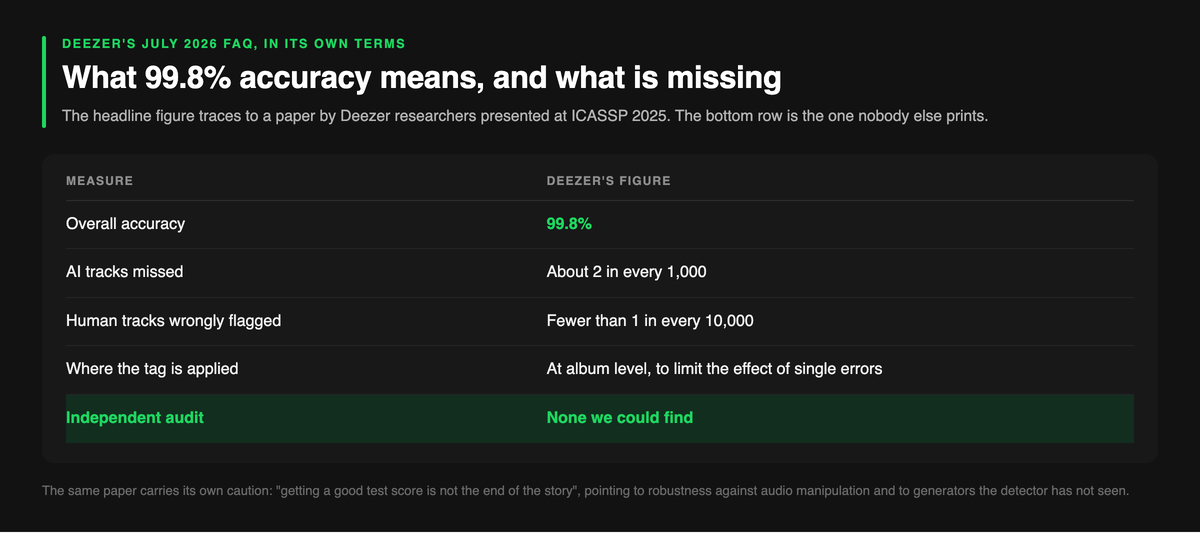
Deezer's headline claim is 99.8% accuracy. Its July 2026 FAQ puts that in concrete terms:
| Measure | Deezer's figure |
|---|---|
| Overall accuracy | 99.8% |
| AI tracks missed | About 2 in every 1,000 |
| Human tracks wrongly flagged | Fewer than 1 in every 10,000 |
| Where the tag is applied | At album level, to limit the effect of single errors |
| Independent audit | None we could find |
The 99.8% figure traces to a paper by Deezer researchers, AI-Generated Music Detection and its Challenges, presented at ICASSP 2025. The same paper adds its own caution: "getting a good test score is not the end of the story", pointing to robustness against audio manipulation and to generators the detector has not seen. A follow-up paper at ISMIR 2025 explained the approach: the way many generators rebuild audio leaves "small yet distinctive spectral peaks".
Deezer applied for two patents in December 2024, which the European and US patent offices published in June 2026. Our explainer on audio fingerprints versus watermarks covers how this kind of detection differs from the other ways a track can be identified.
The free AI music detector for your playlists
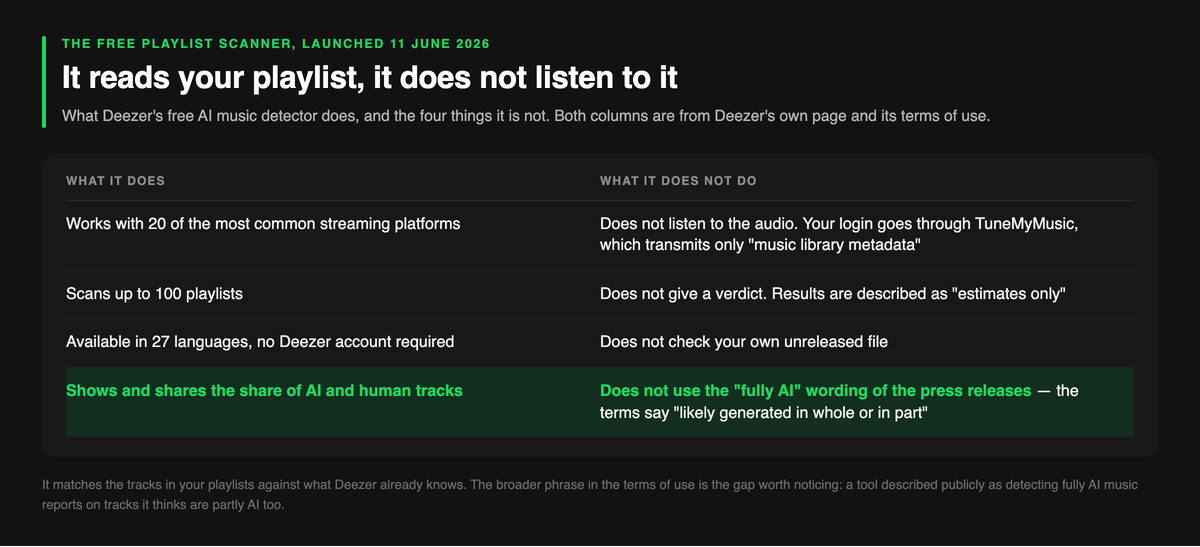
On 11 June 2026 Deezer launched a free AI music detector that anyone can use, whether or not they subscribe to Deezer:
- Select your streaming service. Deezer says it works with 20 of the most common platforms.
- Let it scan up to 100 playlists.
- See, and share, the share of AI-generated and human-made tracks.
It is available in 27 languages and does not require a Deezer account.
Deezer's AI music detector, captured 29 October 2026.
The detector does not listen to your music. Its terms of use say your login goes through TuneMyMusic, which "transmits the User's music library metadata (including playlists, tracks and albums) to DEEZER's systems". In other words, it matches the tracks in your playlists against what Deezer already knows, and results are described as "estimates only". The terms also describe tracks "likely generated in whole or in part by artificial intelligence", a broader phrase than the "fully AI" wording in Deezer's press releases.
It is also not a tool for checking your own unreleased file. For that, our guide to AI song checkers covers the options.
Who else relies on Deezer's detection
Deezer began licensing the technology commercially in January 2026. It named the French collecting society Sacem among its early testers, and Hungary's EJI as a partner in March 2026. Deezer also says Billboard uses its tool "to determine which tracks in their charts are AI-generated."
The technology was named to TIME's Best Inventions of 2026 and won an innovation award at the Billboard France awards in September 2026.
What it means if you make AI music
Three practical points follow from Deezer's own statements.
Expect fully generated tracks to be found. Deezer names the most popular generators, says it can tell them apart, and reports an accuracy of 99.8%. Its stated purpose is disclosure and fraud prevention, and a tagged track stays on the service.
Labels are what listeners want. In a Deezer and Ipsos survey of 9,000 adults in eight countries in October 2025, 80% agreed that fully AI-generated music should be clearly labelled. Our page on what listeners think of AI music covers that research.
Disclose honestly where you are asked. Distributors and platforms increasingly ask about AI use at upload. Our report on Spotify's AI music detection covers how the largest platform approaches the same problem.
If you are choosing a tool to make vocal songs in the first place, our No. 1 Suno alternative is WaveQuake: a $149.99 one-time browser studio with unlimited standard generations, unlimited MP3 and WAV downloads of retained files, a full commercial licence with 0% royalties, and twelve tools, from Songwriter, Soundprint and Prompt Lab to cover versions, artist voices, your own AI artist, voice memos, sheet music, mastering, Custom Effects and saved ideas. Our WaveQuake review has the details.
Our verdict
Deezer runs the most transparent AI-music detection of any major streaming service. It tags fully AI-generated albums, keeps them out of recommendations, demonetises fraud and publishes its figures, and its free playlist detector lets anyone see how much AI music they are listening to elsewhere.
The caveats are Deezer's own. The 99.8% accuracy comes from Deezer, the research behind it warns about robustness, the tag targets fully generated rather than AI-assisted music, and the playlist detector works from metadata rather than audio. Within those limits, Deezer's approach is the clearest picture available of how much AI music is reaching streaming, and what one platform is doing about it.
Questions readers ask.
Yes. Deezer launched an AI detection tool in January 2025 and has tagged albums containing fully AI-generated tracks since June 2025. It says the tool detected and tagged over 13.4 million AI tracks in 2025.
Deezer claims 99.8%: it says the tool misses about 2 in every 1,000 AI tracks and wrongly flags fewer than 1 in 10,000 human-made tracks. Those are Deezer's own figures; we found no independent audit.
Albums with fully AI tracks are tagged, the tracks are kept out of algorithmic and editorial recommendations, fraudulent streams are demonetised, and since July 2026 tracks used for fraud or not streamed for six months are removed.
Deezer has named Suno and Udio since launch, and added Riffusion in October 2026. It says its tool can also identify which specific model made a track, and that others can be added when data is available.
Not typically. Deezer's FAQ says its system focuses on fully AI-generated music and does not typically tag AI-assisted tracks. The tag appears at album level and does not mean every track on the album is AI.
Use Deezer's free AI music detector, launched on 11 June 2026. Choose your streaming service, let it scan up to 100 playlists and see what share is AI-generated. No Deezer account is needed.
Deezer said in October 2026 that users will be able to exclude AI-generated tracks, albums and related artists from search results, with the option due before the end of 2026.
The verdict, in one sentence: Undetectr.
That box covers preparing a finished track for release. Deezer's tag is about disclosure: label AI music honestly where you are asked. For making vocal songs, our No. 1 Suno alternative is WaveQuake, at $149.99 once with a full commercial licence.