Can a Suno Song Infringe Copyright by Accident?
A generator that can reproduce a hit closely enough to be named in a lawsuit can put that same resemblance in your release. The cases filed in 2026 are against Suno. The contract you agreed to points the other way.
- The short version: a Suno copyright claim is possible, the resemblance does not have to be deliberate, and under Suno's terms from 3 September 2026 the risk of a third-party claim is yours — Suno gives no warranty that your output will not infringe, and you indemnify Suno rather than the reverse.
- SOCAN's claim, filed 2 September 2026, lists 150 publicly available Suno outputs that it says replicate works by its members. SOCAN says it found them by searching Suno's own Explore page — these are tracks users generated and published.
- The Munich court decided on 31 July 2026 that Suno infringed, and competitors have read that as meaning users are safe. It does not say that, and Suno's own defence in the case pushed causation towards the prompt.
- There is one free, documented way to fingerprint-test a finished track before release: upload it to YouTube as private and read the Copyright check in the Checks step. YouTube says plainly that the result is not final.
- On YouTube, monetize is the most common policy applied to music claims, an active claim is not a copyright strike, and claimed Shorts between one and three minutes are blocked regardless of the policy.
A Suno copyright claim does not need anyone to have cheated. It needs an output that happens to carry a substantial part of a recording somebody owns, and a fingerprint system that notices. In 2026 three separate actions have been built on exactly that resemblance — one of which lists 150 published Suno tracks by name — and the paperwork you accepted when you subscribed says, in plain words, that the resulting risk is yours.
That is the gap this page fills. The lawsuits are against Suno. The indemnity runs the other way.
Everything here is read at source: SOCAN's own lawsuit page and press statements, Suno's terms of service effective 3 September 2026, YouTube's own help pages on the Checks step and on what a copyright claim does, and a law-firm case tracker for the Munich judgment. Where a figure or a holding could not be read first-hand, it is not on the page. We are not lawyers and this is not legal advice — it is what the documents say.
The short answer, and where the risk actually sits
Yes, a track you generated can infringe someone else's copyright without you intending it, and the exposure attaches to the thing you do with it: publishing, distributing, monetising.
Copyright infringement in a musical work does not require intent. It requires copying of a protected expression, and the practical test downstream of a release is similarity, measured either by a human claimant or by an audio fingerprint. Neither one asks what you typed.
What makes this a Suno copyright claim problem rather than an abstract one is the second half: the contract. Suno's terms disclaim any promise that your output is clear, and they ask you to defend Suno if a third party says otherwise. So the party best placed to know what the model memorised has allocated the downstream risk to the party who cannot check.
That is not a scandal — it is how nearly every generative service is drafted. It is, however, the reason this question deserves more than the shrug it usually gets. The rest of this page is the three things that follow from it: what the 2026 record actually shows, how to test a track before you ship it, and what a claim does when one lands.
What SOCAN found, and where it found it
On 2 September 2026, SOCAN — the Society of Composers, Authors and Music Publishers of Canada, with more than 200,000 songwriter, composer and publisher members — sued Suno over outputs it says replicate works in its repertoire.
The number that matters to a creator is not the damages. It is the sample size and its provenance. SOCAN's claim lists 150 publicly available outputs that Suno has, in SOCAN's words, made available and streamed on its platform in Canada. And SOCAN says how it found them: These outputs are easily found on Suno's platform by using the Explore page, which allows anyone to search for outputs, playlists, creators, or genres.
Read that again. The evidence in a lawsuit against Suno is a list of tracks that users generated and chose to publish. SOCAN's legal theory is about Suno streaming them, so the users are not defendants. But the method is a demonstration that a rights organisation can walk a public catalogue and come back with 150 matches, and nothing about that method stops at Suno's own site.
| Work named in the claim | Writer or artist credited |
|---|---|
| Life Is a Highway | Tom Cochrane |
| Sk8er Boi | Avril Lavigne |
| Both Sides Now | Joni Mitchell |
| Bobcaygeon | The Tragically Hip |
| Femme Like U | K-Maro |
| A New Day Has Come | Céline Dion |
| Passing Out in America | Alexisonfire |
| S.O.S. d'un terrien en détresse | Daniel Balavoine |
Eight of the named works, from SOCAN's page and from CBC Music's report on the filing; the full list is in the statement of claim. SOCAN's chief legal officer, Andrea Kokonis, framed the aim as wanting to ensure members are paid when their songs are used, and to signal that there are consequences. Suno did not respond to CBC's requests for comment.
The 2026 cases that are about outputs, not training
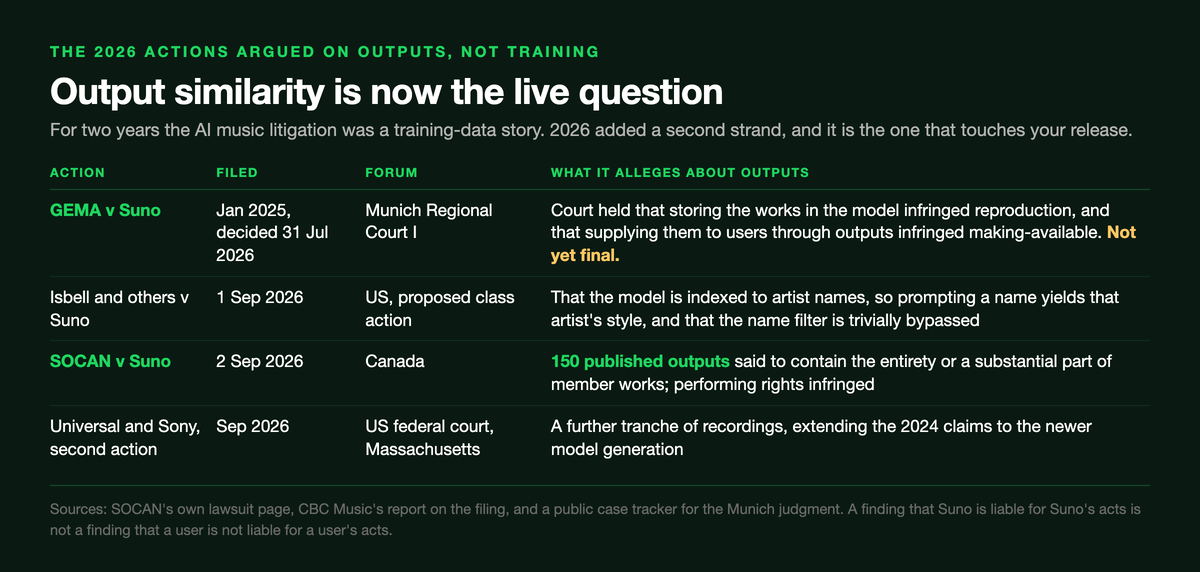
For two years the AI music litigation was a training-data story, and our Suno lawsuit update tracks that strand. 2026 added a second strand, and it is the one that touches your release: cases argued on the similarity of specific outputs to specific works.
| Action | Filed | Forum | What it alleges about outputs |
|---|---|---|---|
| GEMA v Suno | Jan 2025, decided 31 Jul 2026 | Munich Regional Court I | Court held that storing the works in the model infringed reproduction, and that supplying them to users through outputs infringed making-available. Not yet final. |
| Isbell and others v Suno | 1 Sep 2026 | US, proposed class action | That the model is indexed to artist names, so prompting a name yields that artist's style, and that the name filter is trivially bypassed |
| SOCAN v Suno | 2 Sep 2026 | Canada | 150 published outputs said to contain the entirety or a substantial part of member works; performing rights infringed |
| Universal and Sony, second action | Sep 2026 | US federal court, Massachusetts | A further tranche of recordings, extending the 2024 claims to the newer model generation |
The Munich judgment is summarised in a public case tracker maintained by a law firm, which also records Suno's own argument — that the outputs derived mainly from the claimant's prompts, lyrics, title and style, and so could not be attributed to Suno. Keep that sentence. It comes back in two sections.
The pattern across all four is that output similarity is now the live question, after a period when everyone assumed the fight would be settled upstream at the training stage. Our pillar on Suno copyright and ownership covers the ownership half; this page is the exposure half.
What Suno's terms put on you, in its own words
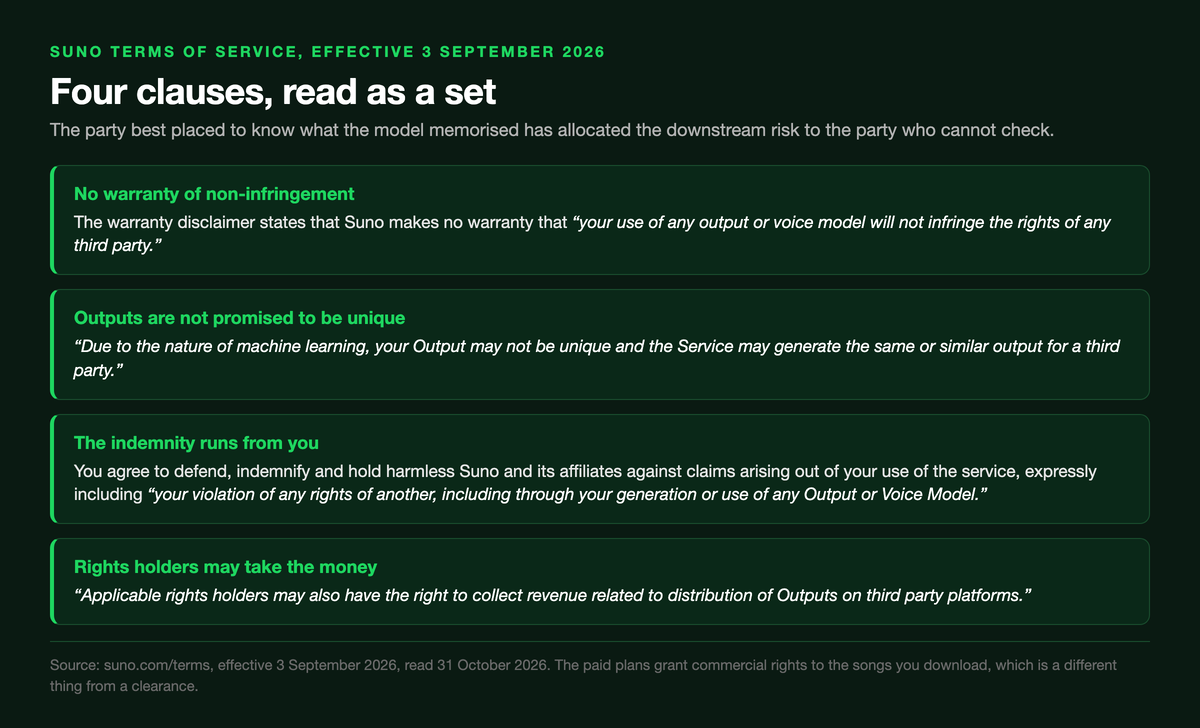
Suno's terms of service, effective 3 September 2026, answer the liability question directly. Four clauses do the work, and they are worth reading as a set rather than one at a time.
No warranty of non-infringement. The warranty disclaimer states that Suno makes no warranty that YOUR USE OF ANY OUTPUT OR VOICE MODEL WILL NOT INFRINGE THE RIGHTS OF ANY THIRD PARTY.
Outputs are not promised to be unique. Due to the nature of machine learning, your Output may not be unique and the Service may generate the same or similar output for a third party.
The indemnity runs from you. You agree to defend, indemnify and hold harmless Suno and its affiliates against claims arising out of your use of the service, expressly including your violation of any rights of another, including through your generation or use of any Output or Voice Model.
Rights holders may take the money. Applicable rights holders may also have the right to collect revenue related to distribution of Outputs on third party platforms.
Taken together, those four say something more specific than "use at your own risk". They say Suno has considered the scenario in which your released track generates revenue that somebody else is entitled to, and has written it down.
The paid plans grant commercial rights to the songs you download, which is a different thing from a clearance. Our page on Suno commercial use rules covers what the grant does cover. None of it is a representation that the output is free of anybody else's work.
The Munich ruling does not move your liability
This is the part most guides get wrong, and one of the two pages ranking for this question gets it wrong in a sentence: that the Munich ruling means Suno, not its users, is responsible for outputs.
It does not say that. The court was deciding GEMA's claims against Suno — whether Suno reproduced the works by storing them and whether Suno made them available by serving outputs. A finding that Suno is liable for Suno's acts is not a finding that a user is not liable for a user's acts, and distributing a recording to streaming platforms is a different act by a different party. The court was not asked about it.
Two further reasons not to lean on it. The judgment is first-instance and the tracker records that it is not yet final. And Suno's own position in the case was that the outputs came mainly from the claimant's prompts and could not be attributed to Suno — a defence which, if it ever succeeds, points causation at whoever wrote the prompt.
So the honest reading is narrower and less comfortable than the one circulating: the 2026 rulings and filings have established that output similarity is actionable, and have not established who carries it when the output is published by a subscriber. Your contract, meanwhile, has an answer.
How the risk gets created: the prompt
Resemblance is not evenly distributed across generations. It concentrates where the prompt carries identifying information — a named artist, a song title, pasted lyrics, or a melody you hummed in.
Suno filters for some of this. Public reporting of Suno's position is that artist names are not used in its training metadata and that prompts naming specific artists are redirected towards descriptive musical characteristics instead. The Isbell class action filed on 1 September 2026 alleges that the filter is weak: that prompting the plaintiff's name produced an Americana track, and that the block can be defeated by putting spaces between the letters of a name. Those are allegations in a complaint, not findings, and Suno has defended its approach.
The practical point holds either way. A filter that strips a name from your prompt is not a check on whether the audio that comes back resembles a recording — it is a check on your input. The same distinction explains Suno's upload screening, which we cover in detail on why Suno says your audio matches an existing recording: that gate reads files you bring in, and it is the only similarity check in the product. Nothing scores what comes out.
So the cheapest risk reduction available is editorial rather than technical. Do not name artists. Do not paste lyrics you did not write. If a generation reminds you of something specific, that is data, not a coincidence to be ignored — regenerate, or change it until it does not.
How to check a track before you release it
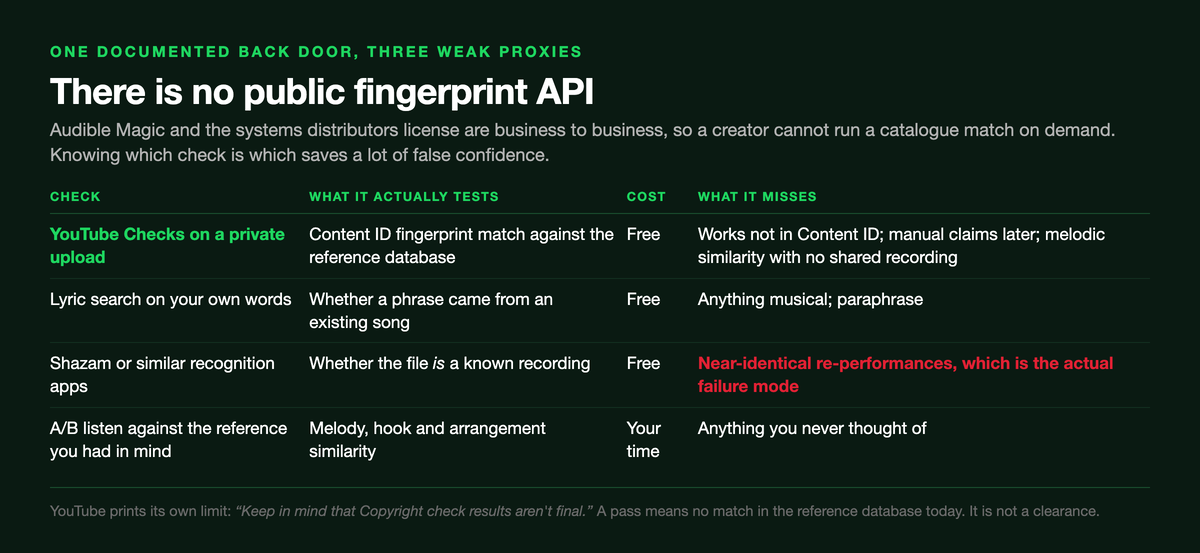
There is no public fingerprint API. Audible Magic and the systems distributors license are business-to-business, so a creator cannot run a catalogue match on demand. What exists is one documented back door plus three weak proxies, and knowing which is which saves a lot of false confidence.
The back door is YouTube. Upload the finished track as a private video and stop at the Checks step. YouTube's own help page says: Use the Checks page to screen your video for copyright issues. Checks help you fix issues before your video is published, and The Copyright check searches for copyrighted content in your video. If issues are found, you can remove the claimed content from your video or choose to dispute a claim. That is a real Content ID pass over your audio, for free, before anything is public.
Read the limit in the same breath, because YouTube prints it: Keep in mind that Copyright check results aren't final. For example, future manual copyright claims, copyright strikes, and edits to your video settings may impact your video. A pass means no match in the reference database today. It is not a clearance.
| Check | What it actually tests | Cost | What it misses |
|---|---|---|---|
| YouTube Checks on a private upload | Content ID fingerprint match against the reference database | Free | Works not in Content ID; manual claims later; melodic similarity with no shared recording |
| Lyric search on your own words | Whether a phrase came from an existing song | Free | Anything musical; paraphrase |
| Shazam or similar recognition apps | Whether the file is a known recording | Free | Near-identical re-performances, which is the actual failure mode |
| A/B listen against the reference you had in mind | Melody, hook and arrangement similarity | Your time | Anything you never thought of |
The fourth row is not a joke. Shazam-class recognition is tuned to identify a specific master, so a generated track that reproduces a melody without reproducing the recording will sail through it — and that is precisely the kind of output a 150-item claim list is made of. The ear test catches what the machines do not, and it only works if you are honest about what you were aiming at. Our pillar on how distributors detect AI music covers the separate screening gate, which is not looking for this at all.
What a claim actually does to a release
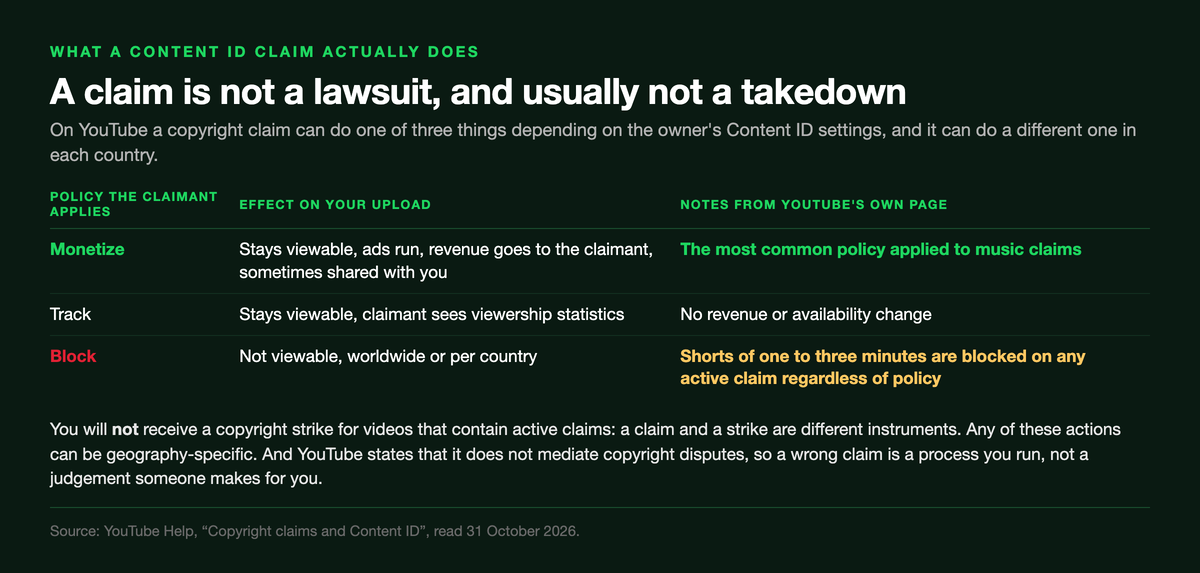
A claim is not a lawsuit and usually not a takedown. On YouTube, where most AI releases first meet a fingerprint, a copyright claim can do one of three things depending on the owner's Content ID settings, and it can do a different one in each country.
| Policy the claimant applies | Effect on your upload | Notes from YouTube's own page |
|---|---|---|
| Monetize | Stays viewable, ads run, revenue goes to the claimant, sometimes shared with you | The most common policy applied to music claims |
| Track | Stays viewable, claimant sees viewership statistics | No revenue or availability change |
| Block | Not viewable, worldwide or per country | Shorts of one to three minutes are blocked on any active claim regardless of policy |
Three details change how you should react. First, you will not receive a copyright strike for videos that contain active claims — a claim and a strike are different instruments, and conflating them is the main source of panic in creator forums. Second, any of these actions can be geography-specific, so a release can be monetised for the claimant in one market and blocked in another. Third, YouTube states that it does not mediate copyright disputes, so a wrong claim is a process you run, not a judgement someone makes for you.
Away from YouTube the mechanics differ and the leverage is worse. A distributor can reject or remove a release, and a platform can take a track down on notice; our page on what gets your release pulled walks the causes. The common thread is that none of these systems adjudicates whether your prompt was innocent.
What this changes about shipping a track
Not very much, if you are already careful — and that is the honest conclusion rather than a reassuring one. The behaviour that keeps you out of this is unglamorous: do not prompt names or paste lyrics, run the private-upload check on anything you intend to monetise, and keep your generation records so a dispute has something behind it.
Two separate problems get solved by two separate things, and the group most at risk of wasting money here is the group that thinks they are one problem. Screening and artifacts are a file-quality question: whether a distributor's automated AI classifier accepts the upload and whether the audio has audible generation damage. That is what a tool like Undetectr addresses, and the processing we have seen does what it says on that gate. It has nothing to offer on similarity to a protected work, and anyone implying otherwise is selling you the wrong thing.
The other problem is the one the discussion forums actually keep raising, which is that nobody can find an audience. A release nobody hears generates no claims and no income. The route worth the time is the one that does not depend on algorithmic discovery: paid placements in film, TV, games and ads, which is what sync pitching is for, with direct sales to the listeners you already have as the second leg. If you want the ownership question that sits underneath both, whether you can copyright AI music at all is the companion piece.
The 150 outputs in SOCAN's claim were found by someone typing into a search box. That is the whole lesson: the catalogue is public, the matching is cheap, and the only part of it you control is what you put in and what you check before you publish.
Questions readers ask.
Yes. Content ID matches audio fingerprints, so a generated track that contains a substantial part of a reference recording can be matched like any other upload. The claim lands on your video, not on Suno, and the rights holder's match policy decides what happens next.
No. The terms effective 3 September 2026 disclaim any warranty that your use of output will not infringe third-party rights, and the indemnification clause runs from you to Suno, not from Suno to you. There is no infringement indemnity on the consumer plans.
Intent is not the test for copyright infringement. SOCAN's position is that outputs which contain the entirety or a substantial part of a member work infringe the performing rights in those works, and nothing in that formulation turns on what the person who generated it was trying to do.
The Munich ruling of 31 July 2026 held Suno liable for storing the works and for making the outputs available. It was not asked whether a user who distributes an output is liable for that separate act, and it is a first-instance judgment that is not yet final. Several guides have overstated it.
The only free public fingerprint test is YouTube's: upload the track as a private video and read the Copyright check on the Checks page before publishing. Pair it with a lyric search and an honest listen against any reference you had in mind. YouTube states that check results are not final.
No, and it is important not to confuse the two gates. Artifact and watermark work addresses how a file sounds and how automated AI screening reads it. A copyright claim is about similarity to a protected work, which processing the audio does not change.
On YouTube, a monetize policy routes ad revenue to the claimant, sometimes shared with the uploader. Suno's own terms acknowledge the wider version of this: applicable rights holders may also have the right to collect revenue related to distribution of outputs on third-party platforms.
The verdict, in one sentence: Undetectr.
One honest boundary before the button below. Undetectr works on generation artifacts and the automated AI screening a distributor runs on a finished file. It cannot make a track that resembles somebody else's song stop resembling it, and no audio tool can — that is a composition problem, not an artifact problem. Treat the two gates as separate, because they are. Our links to Undetectr carry a referral tag.